- Transitioning from keyword-centric models to entity-based SEO allows brands to align with how modern algorithms like RankBrain interpret searcher intent and semantic context.
- Building high-density topic clusters using a hub-and-spoke model establishes the topical authority necessary to outrank competitors and capture high-volume search terms.
- Technical integration of schema markup and semantic triples enhances machine-readability, ensuring content is accurately categorized within search engine knowledge structures.
- Providing unique information gain and comprehensive coverage of sub-topics is essential for maintaining visibility in AI-driven environments like Search Generative Experience.
Search engine optimization has moved from matching keywords to mapping relationships between concepts. Brands that want sustained organic visibility now need to build content that functions as a structured knowledge base, covering a topic's full breadth rather than targeting isolated phrases. Algorithms have evolved to prioritize the intent behind a query over the specific words used in a search box.
Success in this environment relies on creating a logical network of information that search algorithms can easily parse and verify. Building a semantic web of content is the first step toward safeguarding your site's topical relevance against future algorithm shifts. This approach ensures your content remains visible as search engines increasingly rely on AI-driven retrieval.
Understanding the Evolution of Search: From Keywords to Semantic Context
Search engine technology has undergone a fundamental transition since the early days of simple text matching. In the past, rankings often reflected how many times a specific phrase appeared on a page. Today, algorithms like Hummingbird and RankBrain allow systems to understand the meaning and context behind user queries. These updates shifted the focus away from single keywords and toward the searcher's underlying intent.
Hummingbird, which launched in 2013, enabled Google to interpret the relationship between words in a query rather than treating them as isolated terms. The introduction of RankBrain in 2015 further accelerated this progress by incorporating machine learning into the retrieval process. It helps search engines interpret ambiguous queries and provide results that better match what a user is actually looking for.
Establishing topical authority has become a primary requirement for ranking in the current search landscape. Google's Helpful Content system and the site-wide quality signals introduced across its 2022 to 2024 core updates have made comprehensive topical coverage a practical ranking requirement. Sites that cover a niche shallowly, even with strong backlink profiles, increasingly lose ground to domains that answer the full range of questions a searcher in that niche might ask.
The Role of Topical Authority in Modern SEO
Topical authority refers to a website's perceived expertise and trustworthiness in a specific subject area. It represents how much Google trusts a site to cover a subject and its related subtopics fully. When a site achieves this status, it often sees a significant boost in performance across all related search terms. This authority acts as a primary signal that can even outweigh traditional factors like backlink counts.
Search engines evaluate specific topical authority signals, such as the breadth of subtopics covered and the consistency of factual citations across a domain. Focusing on this strategy has led to measurable performance gains for many digital brands. For instance, some sites have increased their organic traffic by 1100% in just 145 days by focusing on semantic depth. In one specific case, a website saw its clicks increase from 10,000 to 200,000 in less than five months.
Similarly, the platform GetWordly.com reportedly achieved 11,000 organic clicks per day within six months of launch, according to a case study published by semantic SEO researcher Koray Tugberk Gubur. This rapid scaling occurred because the site established a clear topical footprint that search engines immediately recognized as authoritative. There's a direct relationship between being an expert on a niche topic and the ability to rank for broad, high-volume terms.
As a site proves its expertise in specific long-tail queries, search engines begin to trust it with more competitive head terms. This happens because the algorithm recognizes the site as a definitive source that delivers high value. Establishing this level of trust is a long-term goal that requires consistent, high-velocity content production. Over time, this consistency positions your site as a go-to reference for the niche, which is the foundation search engines use to assign topical authority.
The Impact of Search Generative Experience on Topical Authority
The rise of Search Generative Experience, or SGE, has changed how users interact with search results by providing AI-generated summaries. These systems prioritize websites with clear entity relationships and deep semantic coverage of a topic. AI-driven retrieval models look for sources that provide comprehensive answers beyond surface-level facts. If your content is poorly structured, it may be excluded from these prominent summaries.
To rank within SGE and AI overviews, you must provide unique data and perspectives that extend beyond what is available via a simple lexical search. Lexical search relies on matching words, while semantic search uses vector embeddings to understand the numerical relationships between concepts. This technical shift means that your content must be optimized for machine-readability as much as for human engagement. Brands that master this balance will dominate the next generation of search visibility.
The Foundation of Entity-Based SEO
The shift from keywords to entities marks a change in how search professionals must think about their content. Instead of focusing on strings of characters, the industry now prioritizes 'things'—specific concepts and objects that search engines can definitively categorize. This technical foundation enables algorithms to distinguish among people, objects, and ideas within a text.
Identifying and mapping these entities allows you to move beyond outdated, keyword-centric strategies. It involves identifying the primary subjects your brand should be associated with and how those subjects relate to the wider world. By understanding these connections, you can create content that fits perfectly into the existing knowledge structures used by major search engines. Using an entity-based SEO approach ensures that every new page strengthens your overall domain authority.
Defining Entities and Their Relationship to Keywords
An entity is a well-defined concept or object that a search engine can uniquely identify, such as a person, place, or thing. While a keyword is simply the search query a person types into a box, the entity is the actual idea behind that query. For example, the keyword "Paris" refers to the entity of the capital city of France. Search engines use these distinctions to provide more accurate results based on the context of the search.
Keywords still play a role in SEO, but they're now viewed as the language used to access entities. A single entity can be associated with hundreds of different keywords and phrases. Understanding this relationship helps writers avoid repetitive keyword stuffing while still addressing the core topic. It allows for more natural language that focuses on describing the concept's attributes and relationships.
When you write with entities in mind, you're helping the search engine build a clearer picture of your content's purpose. You aren't just trying to match a user's word choice, but rather trying to explain a concept thoroughly. This approach ensures that your content remains relevant even as search trends and popular phrasing change over time. It provides a more stable foundation for long-term organic visibility.
How Google's Knowledge Graph Influences Rankings
Launched in 2012, the Knowledge Graph was designed to help Google understand facts about the world. It helps crawlers recognize relationships among specific entities by mapping their connections. Google maintains the Knowledge Graph to provide instant answers and detailed panels in search results. When your content aligns with these facts, it gains greater credibility.
Appearing within these semantic maps is necessary for maintaining visibility in modern search. When the Knowledge Graph recognizes your brand as an authority on a specific entity, your content is significantly more likely to trigger featured snippets. This happens because the algorithm can verify your information against its existing database of known facts. It looks for consistency and depth when determining which sites to promote.
The Knowledge Graph also helps Google understand the nuance of human language. It can distinguish between two entities that share the same name but have different meanings based on the surrounding text. By providing clear context and using related entities in your writing, you make it easier for the algorithm to categorize your pages. This reduces the risk of your content being buried due to architectural decay.
Leveraging Semantic Triples: Subject, Predicate, and Object
Semantic search interprets information through a structure known as a triple, which consists of a subject, a predicate, and an object. The subject is the entity you're talking about, the predicate is the relationship, and the object is another entity or piece of data. For instance, in the sentence "Google acquired YouTube," Google is the subject, acquired is the predicate, and YouTube is the object. This simple structure helps search engines extract hard facts from your prose.
Structuring your sentences clearly can help search engines identify the relationships you're describing. When you use direct and active language, you make it easier for natural language processing models to map your content. This technical approach to writing improves machine-readability without sacrificing user experience.
Using these triples helps define clear relationships that build your topical authority. When you consistently state facts in a way that search engines can easily parse, you reinforce your expertise. You're effectively feeding the algorithm the data it needs to understand your niche. This clarity is a major factor in how modern search systems determine which pages are most helpful to users.
Constructing Product Descriptions as Semantic Triples
Mapping product details using semantic triples helps search engines definitively categorize your products within their internal knowledge bases. This technical nuance helps machines verify the specific features and benefits of what you offer. For example, the statement "BrandVoice offers content marketing services" functions as a triple: BrandVoice is the subject, offers is the predicate, and content marketing services is the object. Structuring product and service descriptions as explicit subject-predicate-object statements makes it straightforward for crawlers to extract and classify what your brand does. Using these structures in your copy makes it easier for algorithms to index your pages correctly.
Direct statements about what a product is or does reduce the ambiguity that often leads to signal dilution in rankings. You can include these triples in your headings or within the first paragraph of a product page. This ensures that the page's primary purpose is communicated immediately to search crawlers. It also provides a better experience for users who are scanning for specific information.
Mapping Your Topical Universe: The Discovery Phase
Before writing any content, you must identify the core topics and subtopics that define your specific niche. This discovery phase involves auditing the entire landscape of information your brand must address to achieve topical exhaustiveness. Leaving gaps in your topic cluster can weaken the authority of your entire domain, as it suggests your knowledge is incomplete. Comprehensive coverage ensures that you're meeting all the possible needs of your audience.
If a competitor covers a subtopic that you ignore, search engines may view them as the more reliable source for the broader category. Using a strategic competitor gap analysis can help you quickly identify these missing pieces.
Identifying Your Core Pillar and Sub-Topic Clusters
A successful semantic strategy begins with choosing a broad pillar topic that serves as your foundation. This pillar page should provide a high-level overview of the entire subject while linking out to more specific details. Once the pillar is established, you break it down into logical sub-topics that address individual aspects of the main theme. This creates a hierarchy that search engines can easily follow.
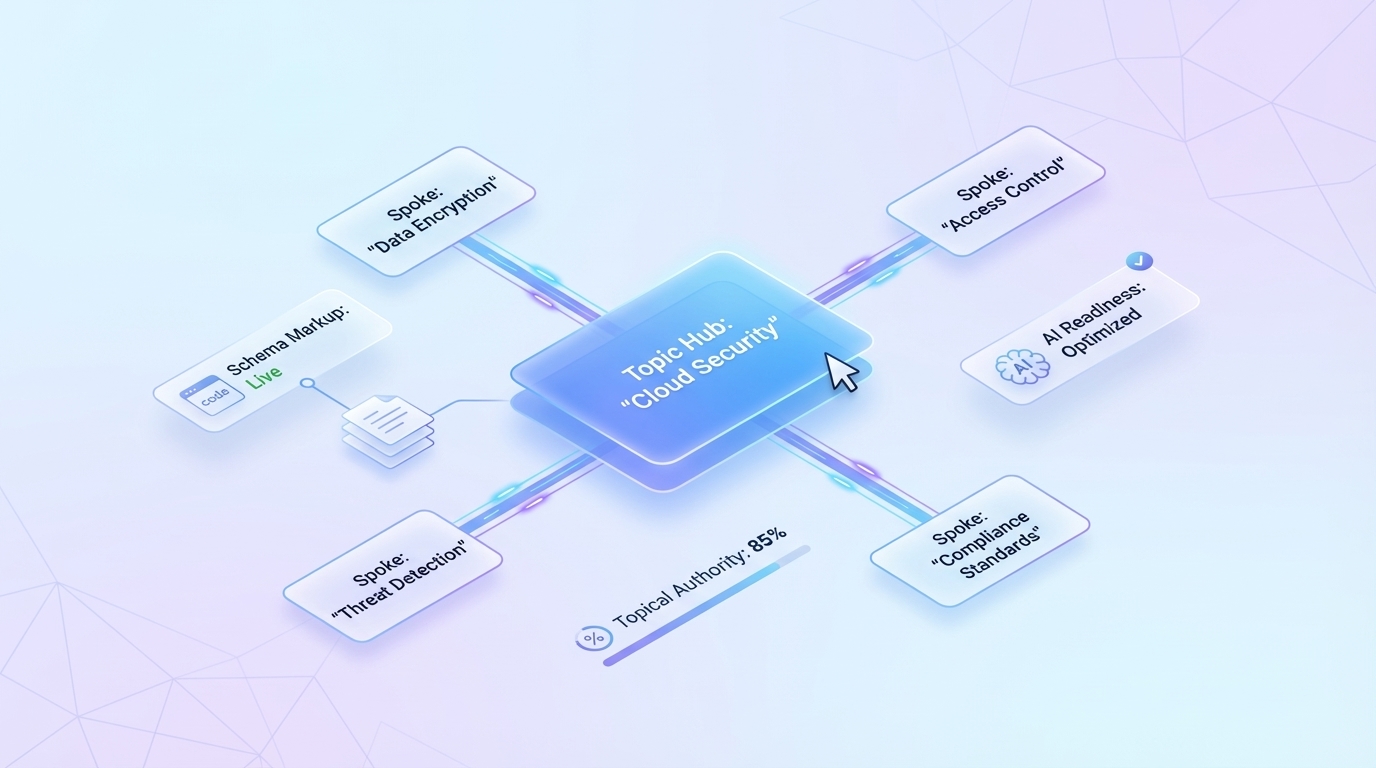
The hub-and-spoke model is an effective architectural blueprint for building this semantic web. In this model, the hub is your broad, foundational content, while the spokes are the detailed articles that cover nested subtopics. This framework allows you to distribute authority from your main pages down to the more specific ones. You should use pillar content services to ensure these foundational pages are optimized correctly.
Using this model ensures that every piece of content has a clear place within your site's structure. You aren't just publishing articles, but rather building an organized library of knowledge. This organizational clarity helps search crawlers understand how each page supports the site's overall theme. It also makes it easier for you to identify where you need to add more content in the future.
Using NLP Tools to Discover Latent Semantic Terms
Natural Language Processing tools such as Clearscope, Surfer SEO, and MarketMuse help find the related terms that top-ranking pages for a topic consistently share. These tools analyze SERP competitors and surface the concepts and phrases whose presence correlates with strong rankings, going beyond synonyms to identify the supporting vocabulary that signals comprehensive coverage. If every top result for "baking" mentions "yeast" and "fermentation," your content should likely include those terms too.
Strategic LSI integration involves placing contextually relevant terms specifically where they clarify the relationships between your primary entities. These latent semantic terms provide the necessary context that search engines use to verify the quality of your work. Including these phrases naturally within your content signals that you have a comprehensive understanding of the subject. It shows that you're discussing the topic in its entirety.
Developing a Semantic Content Calendar
A semantic content calendar organizes your publishing schedule around topical themes rather than random keywords. This framework ensures that you build out an entire cluster of information before moving on to a new subject area. You should plan your pillar pages first and then schedule the supporting spoke content in a logical sequence. This systematic approach signals to search engines that you are deeply invested in thoroughly covering a niche.
Your calendar should also include specific dates for deploying internal links between new and existing content. Timing these deployments correctly helps search engines crawl and index your new clusters more efficiently. By focusing on one topical theme at a time, you build momentum and authority much faster than with a fragmented approach. This discipline is necessary for maintaining a high-velocity publishing schedule.
Building Topical Density Through Strategic Content Clusters
Once you've mapped out your topics, the focus shifts to the actual execution and volume of information within each node. Every article must contribute to the overall density of the topic on your site to signal your level of expertise. This phase involves integrating related terminology and proprietary data into your writing to create a comprehensive knowledge resource. Success depends on maintaining a high standard of quality for every URL you publish.
Topical density isn't about repeating words, but about the quality of related information you provide. You need to ensure that every paragraph adds something meaningful to the reader's understanding. Consistent production of high-quality assets is the only way to outrank high authority competitors in competitive search results.
The Importance of Topic Cluster Density
A dense, well-structured internal linking network, where supporting articles consistently point back to pillar pages using descriptive anchor text, helps search engines map the relationships between your pages and reinforces which pages carry the most topical weight. In today's competitive landscape, one or two articles are no longer enough to win the best keywords. You need a significant body of work to prove your authority to modern algorithms.
As you increase the density of your clusters, you create more opportunities for search engines to find and index your content. Each new article serves as an additional entry point for users while generating fresh link equity across your domain. This growth creates a virtuous cycle where each piece of content makes the others more valuable. It's the cumulative effect of these articles that builds lasting domain authority.
Maintaining this density requires a commitment to a high-velocity publishing schedule. You can't just fill your site with thin content and expect to see a boost in rankings. Every piece in the cluster must meet a high standard of accuracy and usefulness for the reader. If the quality drops, the authority of the entire cluster can be compromised by ranking signal dilution.
Integrating LSI and Contextually Related Keywords
Latent Semantic Indexing is a principle of using linguistically related words to provide context for search engines. These terms help a crawler understand the primary keyword by surrounding it with relevant vocabulary. For example, using words like "processor" and "RAM" helps clarify that an article about "Apple" is about computers. This depth is rewarded by search engines that prioritize the most helpful content.
Integrating these contextually related keywords helps your writing sound more natural and professional. It prevents the awkward repetition of a single target phrase, which can lead to a poor user experience. By using a broad vocabulary, you demonstrate a more sophisticated understanding of the subject matter. This approach ensures that your content is optimized for both robots and human readers alike.
Writing for Information Gain and Unique Value
Google explicitly rewards content that provides information gain, which means offering something new to the searcher. You should aim to include original research, unique case studies, or a perspective not found elsewhere. This uniqueness makes your content stand out in a crowded marketplace. It also helps search engines distinguish your site from competitors who only recycle existing information.
To achieve genuine information gain, focus on original angles: primary research, data from your own clients or campaigns, or analysis that reaches a conclusion the top-ranking pages do not. Content that adds a new perspective or an underrepresented nuance gives search engines a reason to surface your page alongside established competitors rather than behind them.
The Technical Architecture of a Semantic Web
Strong editorial content produces limited results without a technical foundation that lets search engines discover, parse, and connect your pages. Three elements matter most: internal linking architecture, structured data markup, and clean URL structures that reflect your topic hierarchy.
This section covers how you can use internal linking, schema markup, and URL structures to reinforce your topical authority. These elements act as the connective tissue that holds your semantic web together. By optimizing these technical aspects, you make it much easier for search engines to crawl and categorize your site. Proper technical execution is required to maintain a professional search presence.
Masterful Internal Linking: Creating the Web
Internal linking serves as the connective tissue of your semantic web by defining the relationships between your pages. When you link from a supporting article back to a pillar page, you're signaling that the pillar is the most important resource. This passes topical relevance throughout your site and helps search engines understand your content hierarchy. You should use a consistent linking strategy to ensure no page is left in isolation.
Using descriptive anchor text is a major part of this process. Instead of using generic phrases, you should use words that describe the entity or topic of the linked page. This provides the search engine with additional context about the target page. It also helps users understand what they'll find when they follow the link, improving their experience on your site.
A well-planned internal linking structure also helps distribute link equity across your entire domain. When one page on your site gains backlinks, that authority can flow to other related pages through these internal connections. This helps your new content rank faster as it benefits from the established authority of your existing website. It's a powerful tool for scaling your search presence without needing a massive number of external links.
Using Schema Markup to Define Entities
Structured data, or Schema markup, is a way to explicitly tell search engines what a page is about using standardized language. By using the "About" and "Mentions" schema, you can clarify exactly which entities are being discussed in your content. This removes any ambiguity and helps search engines map your pages to the Knowledge Graph more accurately. This provides a machine-readable layer that reinforces the topical relevance of your content.
Implementing Schema markup is particularly effective for identifying people, organizations, and specific products. It allows you to provide additional data points, like dates and locations, in a format that computers can process easily. This can lead to enhanced search results, such as rich snippets, which often have higher click-through rates. It's a direct way to communicate your expertise to search algorithms.
Advanced Strategies for Deep Topical Authority
Once a content cluster is established, maintaining authority requires three ongoing practices. First, monitor your top cluster pages in Google Search Console quarterly and update any that show declining impressions before they lose ranking positions entirely. Second, track new questions appearing in "People Also Ask" boxes for your pillar topics; these signal emerging subtopics your cluster should address. Third, consolidate or redirect supporting pages that receive minimal clicks and no inbound links, since a smaller number of strong pages outperforms a large number of thin ones for topical authority signals.
Semantic Search Optimization (SSO) Techniques
Semantic Search Optimization involves tailoring your content to the way people actually speak and ask questions. This means answering complex, multi-layered questions directly within your articles. You should aim to provide clear answers that satisfy both human curiosity and machine retrieval models. This approach allows you to capture a wider range of search intents from a single piece of content.
For brands in specialized niches, this means developing a specific strategy for your audience. Learning how to build topical authority for B2B SaaS requires a focus on technical problem-solving and industry-specific terminology. Similarly, a semantic SEO strategy for e-commerce brands should focus on product entities and user research intent. Measuring topical authority ROI means tracking organic impressions and clicks for the entire topic cluster (not individual pages), the number of featured snippets and AI overview citations earned across cluster URLs, the share of branded versus non-branded clicks, and the velocity at which new cluster pages reach the first page of results. Monitoring these across a rolling 90-day window gives a reliable picture of whether the cluster is gaining or losing authority.
The Lifecycle of a Content Cluster: Refreshes and Pruning
Content clusters aren't static; they require regular updates to maintain their relevance and authority. As new information becomes available, you must refresh your articles to ensure they remain accurate. A lack of semantic structure can lead to a significant loss of rankings during core algorithm updates. Sites that are constantly updated are seen as more reliable by search engines like Google.
Google verifies entity relationships against its own Knowledge Graph and cross-references factual claims against the broader corpus of authoritative sources it has indexed. Sites whose content conflicts with well-established facts across that corpus, or that fail to cite verifiable sources, are more likely to be scored as low-quality during core algorithm evaluations. Pruning or consolidating underperforming content is a necessary part of managing your semantic web. This prevents content decay and ensures every URL on your site actively supports your topical authority.
Entity-Based Audit for Existing Content
An entity-based audit helps you identify where your existing content library is missing critical semantic signals. You should start by listing the primary entities associated with your brand and checking if they are clearly defined on your site. This process reveals gaps where you might be ranking for keywords but failing to establish deep topical authority. Refreshing these pages can recover lost traffic and strengthen your overall domain.
A practical entity-based audit covers five checkpoints:
- List the five to ten primary entities your brand should be associated with and confirm each has at least one page that explicitly defines and contextualizes it.
- Review each page for subject-predicate-object statements in the opening two paragraphs so crawlers can immediately extract your core claims.
- Check that every supporting article links to its parent pillar page using descriptive anchor text rather than generic phrases like "click here."
- Run your top pages through a tool such as Clearscope or Surfer to identify high-frequency related terms that your content is missing compared to top-ranking competitors.
- Flag any page receiving fewer than ten organic clicks per month over the past 90 days for consolidation, a redirect to a stronger page, or a full rewrite.
Scale Your Topical Authority with Brand Voice Today
Building a semantic web of content is a long-term strategy that moves beyond simple keyword matching to focus on deep expertise. By transitioning from strings to things, you align your website with the way modern search engines interpret meaning and intent. This approach requires consistent effort to map out your topical universe, build dense clusters of information, and maintain a sound technical architecture. Sites that successfully establish this level of authority see lasting growth in organic traffic and user trust.
Achieving deep topical authority demands a high volume of semantically rich content that most internal teams struggle to produce at scale. You cannot simply publish a few articles and expect to dominate a niche; you need a comprehensive network of interconnected pages. This level of production requires a strategic approach to research, writing, and optimization. We specialize in helping businesses build this essential authority through ready-to-publish, SEO-optimized content that fits into your brand's unique semantic web.
At Brand Voice, our expertise in entity-based SEO and semantic search ensures that every article we create for you contributes to your brand's overall expertise. We take the guesswork out of content creation so you can focus on growing your business while we build your digital authority. Our team handles the research, entity mapping, and editorial execution so your content program scales without sacrificing the depth that modern search algorithms reward. Schedule a demo today to see how we can help you publish semantically rich content at scale.