- Sustainable organic growth provides a growth model that is five to seven times more capital efficient than inorganic strategies for most modern businesses.
- Developing detailed buyer personas with psychographic data and professional challenges is essential for tailoring messaging that resonates with a target audience.
- High-authority content marketing must prioritize E-E-A-T standards and original insights to build domain expertise and secure a dominant market position.
- Technical SEO and the optimization of Core Web Vitals are critical for maintaining a healthy digital infrastructure that search engines can crawl and index effectively.
- A structured content repurposing workflow allows marketing teams to maximize reach and engagement by transforming single pillar assets into multiple social formats.
- Continuous optimization and regular content audits provide a higher ROI than creating new assets by refreshing existing content to maintain relevance and rankings.
Sustainable organic growth is a brand's ability to expand its reach and revenue through unpaid channels such as search engines and community referrals. The organic growth model is five to seven times more capital efficient than inorganic strategies for most modern businesses. While paid media offers immediate visibility, organic efforts build a compounding asset that continues to deliver value long after a campaign ends.
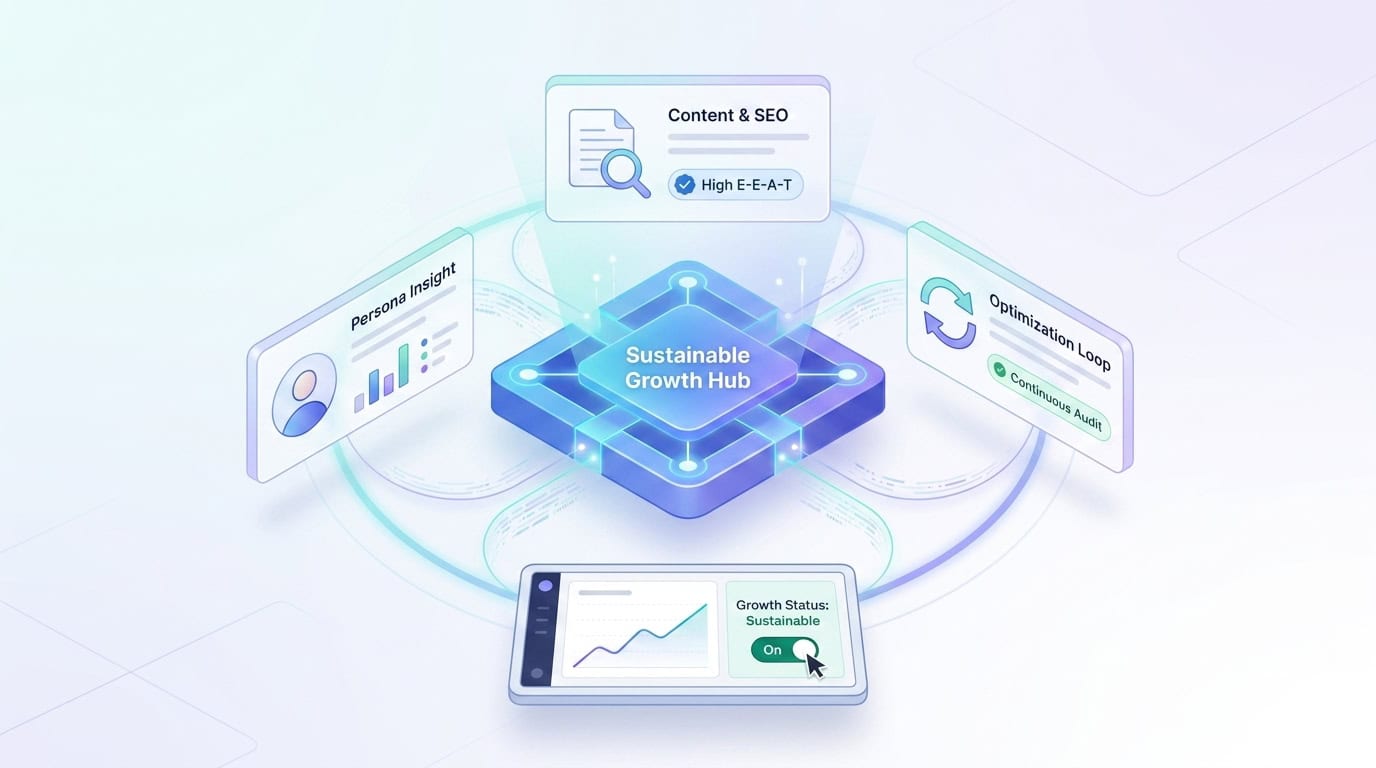
Moving away from isolated marketing tactics is necessary to achieve strategic momentum. A holistic, pillar-based approach ensures that every effort in content, technical health, and distribution works together. Mastering these mechanics builds a resilient digital presence capable of thriving in any market condition.
The Foundation of Organic Success: Defining Your Strategic North Star
Before implementing any of the 7 pillars of marketing, brands must establish a clear strategy to guide their efforts. Jumping directly into tactical execution often leads to disjointed messaging and a significant waste of marketing resources. Companies that prioritize a strong organic strategy deliver shareholder returns that are 3.8 times their industry averages.
Strategy must align broader business objectives with the specific needs of a target audience. Consistent alignment ensures every piece of content or technical update serves a distinct purpose in the growth trajectory. Without this content marketing foundation, teams will likely struggle to maintain consistency across different platforms and stages of the funnel.
Identifying Your Target Audience and Buyer Personas
Creating detailed buyer personas is a requirement for any brand that wants to connect deeply with its market. These personas should go beyond basic demographics such as age and location to include psychographic data and specific professional challenges. When marketing teams understand the daily pressures an audience faces, they can tailor messaging to provide immediate relief or solutions.
Marketing departments should use both qualitative and quantitative data to inform these profiles. Analyzing existing customer behavior, conducting interviews, and reviewing search intent data provides a clear picture of what an audience actually cares about. Using data-driven methodologies removes guesswork and ensures teams are not creating content for an irrelevant audience.
Once these personas are established, they should serve as the filter for every marketing decision. If a proposed campaign or article does not speak to the needs of a specific persona, it likely is not worth the investment. An audience-centric focus helps maintain a high standard of relevance, the cornerstone of sustainable organic growth in a crowded digital space.
Crafting a Unique Value Proposition (UVP) That Cuts Through Noise
A unique value proposition is a concise statement that explains how a product solves a problem, delivers specific benefits, and tells the customer why they should buy. It is the primary reason a prospect should pay attention to a brand in a competitive digital marketplace. A clear UVP differentiates a brand in search engine results pages and across social media feeds.
The UVP should lie at the intersection of a brand's identity and the market's actual demands. It is not just a catchy slogan, but a promise of value that a brand can consistently deliver through its products and content. When value is clearly communicated, organic conversion rates improve because users immediately understand the benefit of choosing that specific brand.
Establishing a building topical authority strategy starts with a commitment to long-term value rather than short-term spikes. Success must be defined beyond just traffic numbers, focusing instead on how organic search supports the bottom line. A well-defined UVP allows a team to say no to distractions and stay focused on activities that drive the most impact.
Pillar 1: High-Authority Content Marketing as Your Growth Engine
High-authority content marketing is the process of creating deep, expert-level assets that satisfy user intent and demonstrate industry leadership. High-authority content builds domain expertise by providing deep answers to complex industry questions. This approach allows brands to secure a dominant market position without relying on expensive paid advertising. For instance, HR Datahub achieved an 80% increase in free-trial bookings by focusing on high-authority content that met its audience's specific needs. Similarly, Trellis, a SaaS company in the oil and gas sector, saw a 100% increase in organic traffic by prioritizing helpful and authoritative assets.
The Shift Toward Helpful Content and E-E-A-T
Google's search algorithms now place a heavy emphasis on Experience, Expertise, Authoritativeness, and Trustworthiness, commonly known as E-E-A-T. Modern quality requirements mean that generic, thin content or low-quality AI-generated text is no longer sufficient for ranking. To achieve results, a content pillar must prioritize original research, unique insights, and a clear demonstration of subject-matter expertise.
The impact of focusing on helpful content is evident in the growth of companies like KubeSphere. They managed to grow their traffic from just 10 visitors to 2,000 website visitors in only six months by adhering to these quality standards. By providing genuine value and answering complex user questions, they established a level of authority that search engines felt confident recommending.
To achieve this level of quality, teams should actively source insights from internal subject matter experts. Engineers, product managers, and sales leads possess deep industry knowledge that external writers cannot easily replicate. Incorporating author bylines and links to professional portfolios for these experts helps anchor the content to real-world entities.
Integrating Expert Insights for Better Semantic Depth
To improve topical relevance, teams must integrate LSI keywords and related entities that search engines use to categorize expert content. This involves moving beyond keyword density to focus on entity relationship mapping. By linking core concepts to recognized industry standards, a brand confirms its expertise to both users and crawlers.
Mapping Content to the Customer Journey: From Awareness to Advocacy
A successful content strategy must cover the entire customer journey, from the initial awareness stage to long-term advocacy. Top-of-funnel content focuses on broad educational topics that introduce a brand to new users who are searching for general information. As users move into the middle of the funnel, they need more specific comparison guides and case studies to evaluate their options.
Bottom-of-funnel content facilitates the final purchase decision through transactional landing pages and detailed product documentation. A multi-channel team must maintain a careful balance between these informational guides and sales-focused pages. If a brand only focuses on one stage of the funnel, it will either have traffic with no sales or a site that no one can find.
After the purchase, content should transition into supporting customer success and fostering advocacy. User manuals, advanced tips, and community-focused stories help keep existing customers engaged and satisfied. This comprehensive approach ensures that the content supports the business at every touchpoint, turning one-time visitors into lifelong fans.
Pillar 2: Technical SEO and Digital Infrastructure
Technical SEO is the practice of optimizing a website's infrastructure to help search engines crawl and index content more effectively. Technical SEO improves crawl efficiency by ensuring search bots can navigate a site without encountering dead ends. A healthy site infrastructure is the prerequisite for all other organic growth efforts.
Marketing teams must prioritize site speed, mobile responsiveness, and overall crawlability to maintain a competitive edge. Poor technical health leads to a frustrating user experience, which ultimately signals to search engines that a site should not rank highly. Focusing on foundational elements allows a team to maximize the impact of every SEO article asset produced.
Core Web Vitals and the User Experience (UX) Connection
Core Web Vitals are a set of specific metrics that Google uses to quantify a user's experience on a webpage. These metrics measure loading performance, visual stability, and the speed at which a page responds to user input. If a site is slow to load or elements jump around while a user is reading, rankings will likely suffer regardless of content quality.
Page speed and responsiveness have become significant ranking factors because they directly impact how users perceive a brand. A technical SEO specialist is an essential part of a modern digital team, monitoring these metrics and implementing fixes. They work behind the scenes to ensure that the site code is clean and images are optimized for fast delivery.
The impact of a technical focus is clear when looking at brands like Resource Guru. By optimizing their digital infrastructure and focusing on targeted keywords, they achieved a 441% increase in share of voice. When teams remove technical barriers, brand visibility can expand rapidly across a target market.
Technical Health Checklist for Site Infrastructure
- Implement SSL certificates for secure data transmission.
- Create a dynamic XML sitemap to assist search engine discovery.
- Optimize the robots.txt file to guide crawler behavior.
- Eliminate broken links and 404 errors to preserve link equity.
Information Architecture and Internal Linking Strategies
Information architecture refers to how teams organize and label content on a website to help users and search engines navigate. A well-organized site structure uses a logical hierarchy that makes it easy to find information in just a few clicks. This clarity helps search engines understand the relationship between different pages and the relative importance of each topic.
Topic clusters are a popular way to organize content by grouping related articles around a central pillar page. This structure allows teams to use internal linking to distribute link equity throughout a site, boosting the authority of all pages within the cluster. When a team links from a high-authority page to a newer article, it signals that the new content is valuable as well.
Strategists should create a clear roadmap for organizing content logically based on how an audience searches for information. Important pages should never be buried deep in a site's architecture, making them difficult for users and crawlers to reach. A clean, intuitive structure improves SEO and keeps users on a site longer by making it easy to explore related topics.
Implementing Schema Markup for Entity Recognition
Structured data helps search engines interpret the specific context of your pages and can lead to rich snippets in search results. This technical layer serves as a direct communication channel with crawlers, clarifying the relationships among products, reviews, and authors. Adding Schema.org markup is a critical step in increasing click-through rates without requiring additional content production.
Pillar 3: Multi-Channel Distribution and Social Amplification
Multi-channel distribution is the strategic process of sharing and promoting content across various platforms to reach a wider audience. Once the digital foundation is sound, the focus must shift to proactively moving that content in front of the target audience. A strong distribution strategy ensures that content reaches people where they already spend their time.
There is a natural synergy between SEO and social media that teams can leverage for better results. While social signals are not a direct ranking factor, the traffic and brand awareness generated can lead to more backlinks and searches. Coordinating these efforts extends the lifecycle of every asset and drives more consistent traffic.
Leveraging Social Media for Brand Awareness and Traffic
Different social platforms serve distinct roles in an organic growth strategy, and teams should tailor their approach accordingly. LinkedIn is often the best choice for B2B brands looking to establish thought leadership. Instagram or TikTok might be better for B2C brands focusing on visual storytelling.
Teams should prioritize creating native content for each platform rather than just sharing links back to a website. Native content is designed specifically for the platform it is on, which encourages more engagement. For example, a long-form article can be broken down into a series of punchy LinkedIn posts or an informative thread on X.
The goal of a social strategy should be to build a community rather than just broadcasting marketing messages. An active community-driven approach creates a feedback loop that continually brings new organic visitors.
Content Repurposing Workflows for Maximum Reach
Repurposing allows a team to extract more value from a single content investment by transforming it into different formats. One long-form pillar article can be transformed into five LinkedIn posts, one newsletter deep-dive, and three short-form video scripts. Systematic repurposing ensures that a brand's message reaches users who prefer different media.
A structured workflow for repurposing reduces the burden on creative teams and maintains a consistent content pacing. By planning these variations during the initial production phase, teams can launch a multi-channel campaign simultaneously. This approach maximizes the initial impact of a new asset and supports the leveraging of the topic clusters strategy.
The Role of Email Marketing in Organic Retention
Email marketing is one of the most stable organic channels because a brand owns the relationship with its audience. Unlike social media or search engines, email is not subject to sudden algorithm changes that can wipe out visibility overnight. Building an email list allows brands to stay in direct contact with their most interested users.
Strategists can use high-value content, such as exclusive reports or helpful guides, to encourage users to subscribe to a newsletter. Once someone is on a list, teams can nurture them with personalized content that addresses specific interests and needs. Consistent engagement keeps a brand top of mind and helps move prospects further down the sales funnel.
Pillar 4: B2B SaaS Organic Growth Strategy and Performance Monitoring
Data analytics is the systematic computational analysis of data to uncover patterns and measure the performance of marketing initiatives. Data-driven decision-making is necessary for any brand that wants to achieve sustainable organic growth. A robust analytics setup allows teams to identify what is working so they can double down on those efforts.
A data analyst plays a pivotal role in a multi-channel digital team by translating raw numbers into actionable insights. They help the team understand the relationship between different channels and how they contribute to growth goals. By constantly monitoring performance, a team can stay agile and make informed adjustments as the market evolves.
Setting Key Performance Indicators (KPIs) for Organic Growth
Setting the right KPIs is the only way to track progress toward long-term goals accurately. Teams should focus on metrics that reflect real growth, such as organic sessions, keyword rankings for high-intent terms, and conversion rates. Research shows that 78% of SaaS investors identify organic growth rate as the most important metric when evaluating potential investments.
Marketing teams should set realistic benchmarks based on historical data and industry standards. This allows them to track progress over time and identify any sudden drops or spikes in performance. By focusing on growth metrics rather than vanity numbers, teams remain focused on activities that drive actual revenue and brand equity.
Decentriq: A Case Study in Data-Driven Organic Success
Decentriq provides a clear example of how a data-driven approach leads to results, achieving 106% organic growth in less than a year. By identifying the specific topics their audience searched for, they were able to align their content production with market demand. This precision ensured that every new asset contributed to their overall search authority and user acquisition goals.
Their success highlights the importance of iterating based on performance data. When a team sees that a specific cluster of keywords is driving high-quality leads, they should expand their coverage of that topic. Decentriq used these insights to pivot its strategy, resulting in a significant lift in conversions in a competitive market.
Calculating Organic ROI for Stakeholders and SEO Budget Justification
Calculating the ROI of organic efforts is essential for securing long-term budget and stakeholder buy-in. Modern SaaS content marketing strategies must demonstrate how organic traffic converts into paying customers. Teams should use multi-touch attribution models to show the value of educational content in the messy middle of the buyer's journey.
Organic growth is 5-7x more capital efficient than inorganic growth for most SaaS companies. High-intent keywords, such as B2B SaaS organic growth strategy, help capture the attention of decision-makers seeking actionable frameworks. Presenting these financial efficiencies to leadership justifies the continued investment in a sustainable content engine.
Pillar 5: Community Engagement and Brand Advocacy
Community engagement is the process of building active relationships with an audience to foster brand loyalty and advocacy. Building a community around a brand is a statistically significant method to move beyond simple user acquisition. Humanizing a brand through active engagement builds trust that is hard to achieve through advertising alone.
A customer is someone who buys a product, whereas a community member feels invested in a brand's success. By fostering these relationships, teams create a network of advocates who will promote the brand on their behalf. This word-of-mouth growth is incredibly valuable because it comes with built-in credibility that no paid campaign can match.
Cultivating User-Generated Content (UGC) and Reviews
User-generated content and customer reviews act as powerful social proof that can significantly boost organic conversion rates. When potential customers see others sharing their positive experiences, it reduces the perceived risk of making a purchase. Teams should actively encourage users to share their stories and feedback across social media and review platforms.
A digital team can facilitate this by creating campaigns that reward users for sharing experiences or by making it easy to leave reviews. This type of content is often seen as more authentic than traditional marketing, which makes it highly effective at building trust. Additionally, a steady stream of new reviews can serve as a positive off-page SEO signal.
Reviews and UGC provide valuable feedback that teams can use to improve products and services. When a brand publicly responds to feedback, it shows that it values customer opinions and is committed to satisfaction. This transparency further humanizes the brand and strengthens the bond with the community.
Building Partnerships and Influencer Collaborations
Teams can accelerate organic growth by leveraging the existing audiences of other trusted voices in an industry. Organic brand partnerships involve collaborating with others to create valuable content or experiences for both audiences. Organic partnerships differ from paid influencer ads because they are based on a mutual exchange of value.
Finding the right partners requires identifying influencers or brands whose values and audiences align closely with the company's identity. When a partnership feels natural, the resulting content is more engaging and likely to drive real interest. These collaborations can introduce a brand to a group of people who are already primed to trust what it has to say.
Collaborating on guest posts or webinars can provide a significant boost to authority and reach. It allows teams to tap into new perspectives and expertise, making content more well-rounded and valuable. By building a network of strong partnerships, brands create a sustainable source of new organic traffic and awareness.
Pillar 6: Continuous Optimization and Content Refreshing
Continuous optimization is the ongoing process of refining existing content and site elements to improve performance over time. Organic growth is not a one-time project, but a recurring cycle of creation, measurement, and optimization. Content decay is a real challenge, as older articles can lose relevance and rankings as newer information becomes available.
There is often a much higher ROI in refreshing existing assets than in creating brand-new ones from scratch. For example, Nebula Graph saw a 300% increase in clicks over 12 months by focusing on continuous optimization. By keeping top-performing pages fresh and accurate, brands protect the traffic they have already earned.
The Art of the Content Audit: Identifying Gaps and Gains
A content audit is a systematic review of every page on a site to determine its current value and performance. Strategists should use tools like Screaming Frog or Ahrefs to categorize content into four groups: keep, update, merge, or delete. The update category should prioritize pages with high impressions but low click-through rates.
If a site has multiple pages covering the same topic, it is often better to merge them into one comprehensive authority guide. This prevents a brand's own pages from competing with each other in search results. Deleting low-quality or irrelevant content can also improve a site's overall health and crawl budget.
A thorough auditing process keeps a site's crawl budget focused on the most valuable pages. A regular audit allows teams to identify gaps in their strategy, such as missing important keywords or topics. By constantly refining a library, teams ensure that every page on a site is working toward growth goals.
A/B Testing and Conversion Rate Optimization Strategies
Organic growth is only useful if the traffic generated leads to meaningful actions on a website. Small changes to headlines, calls to action, and page layouts can have a massive impact on conversion rates. A/B testing allows teams to compare two versions of a page to see which one performs better, taking guesswork out of design decisions.
The process of conversion rate optimization should be a collaborative effort between SEOs, writers, and designers. Strategists should test specific elements, such as button color contrast ratios and partner logo placement. Testing benefit-driven versus feature-driven H1 headlines can also lead to a significant lift in conversions.
Even a small increase in a conversion rate can lead to a significant boost in revenue without needing additional traffic. This makes CRO one of the most cost-effective ways to grow a business over the long term. For example, a cybersecurity SaaS company doubled organic traffic in less than a year by refining these site elements based on user data.
Pillar 7: Building and Scaling Your Multi-Channel Digital Team
Building a digital team involves assembling a group of specialized professionals to manage every aspect of a brand's organic growth strategy. Building a high-performance team is the final component of these 7 pillars of marketing, enabling long-term scalability. This human element brings all the other strategies to life through operational excellence.
A lean but effective digital department should be built around a few key functions that cover the most important aspects of the strategy. Specialists should understand how their work fits into the bigger picture of sustainable organic growth. As organic success accelerates, teams can scale by adding more specialized roles to handle increasing workloads.
Defining Key Roles: From Content Leads to Technical SEOs
A Content Strategist is responsible for the overall direction of the content marketing foundation. They work closely with an SEO Manager, who focuses on keyword research, technical health, and performance tracking. Together, they ensure that content is both high-quality and easy for search engines to discover.
A Social Media Specialist or Community Manager is also necessary to handle the distribution and engagement side of the strategy. They focus on building relationships with an audience and amplifying content across different platforms. These roles must collaborate closely to ensure a consistent message across all channels.
As a team grows, it might add specialized roles like a Data Analyst, a CRO Specialist, or a Multimedia Producer. The hierarchy should be designed to facilitate communication and quick decision-making. By clearly defining responsibilities, brands create a more efficient and motivated team capable of driving success.
Scaling Organic Traffic for Software Companies through Resource Management
Building an entirely in-house team gives a brand the most control but can be expensive and slow to scale. Hiring agencies or using SaaS tools for content production can provide access to specialized expertise without the overhead of full-time employees. A hybrid model often provides the best balance of control, cost, and scalability for growing software brands.
When vetting potential partners, strategists should look for those who have a proven track record in the industry. It is important to find partners who can act as an extension of the team rather than just another vendor. A collaborative partnership ensures everyone works toward the same goals and the brand's voice remains consistent.
Using SaaS tools for tasks like keyword research and performance monitoring can significantly increase a team's efficiency. These tools allow the core team to focus on high-level strategy and creative work while the software handles repetitive tasks. By finding the right mix of in-house talent and external support, brands build a scalable engine for growth.
Scale Your Content Production with Brand Voice
Establishing the seven core pillars is the only way to build a foundation for sustainable, long-term success in the digital world. While this process requires patience and a structured approach, the compounding benefits of organic growth far outweigh the temporary wins of paid media. By focusing on strategy, high-authority content, technical health, and community engagement, you create a brand that can thrive regardless of market shifts.
Sustainable organic growth is a continuous investment in your brand's future that pays dividends over time. We have seen how a holistic approach to these pillars can transform a business's digital presence and drive measurable results. Achieving this level of consistency and quality at scale is the final step toward a more resilient and successful brand.
Our expertise at Brand Voice is designed to help you implement these pillars by providing high-quality, ready-to-publish, SEO-optimized content tailored to your specific brand requirements. We specialize in creating the technically accurate and engaging articles you need to drive traffic and generate results while maintaining strict E-E-A-T standards. Schedule a demo with us today to see how we can help you scale your content production and achieve your long-term business goals.