- Introducing intentional cognitive friction into the customer journey forces readers to engage more deeply with complex information, shifting them from a passive state to an active, evaluative mindset.
- Utilizing disfluent design triggers analytical System 2 thinking, allowing buyers to perceive nuanced weaknesses and structural flaws in a competitor's offering that are often overlooked during intuitive decision-making.
- Incorporating intellectual speed bumps leverages the IKEA effect, which builds a stronger psychological bond with the audience because they value insights more when they require mental effort to attain.
- Strategic friction can effectively expose a lack of technical depth in rival products by requiring readers to scrutinize surface-level marketing claims and vague value propositions.
- Developing high-information-gain content with unique psychological frameworks enhances search visibility in AI overviews, as large language models prioritize authoritative sources with significant semantic depth.
- Success in a friction-based content strategy should be measured by depth-based metrics such as increased dwell time and higher information recall rather than traditional volume-based signals like click-through rates.
Marketing strategies often prioritize the path of least resistance to ensure potential customers move through the sales funnel without any hesitation. An obsession with a frictionless experience assumes that ease of use is the primary driver of brand loyalty and conversion. However, when every competitor offers a similarly smooth journey, your unique value proposition risks becoming invisible.
Introducing intentional resistance into the customer journey can fundamentally change how a buyer perceives your brand versus your rivals. By slowing the reader down, you force them to engage more deeply with complex information that highlights your technical superiority. Understanding the mechanics of these systems is the first step toward using psychology to create a distinct competitive advantage.
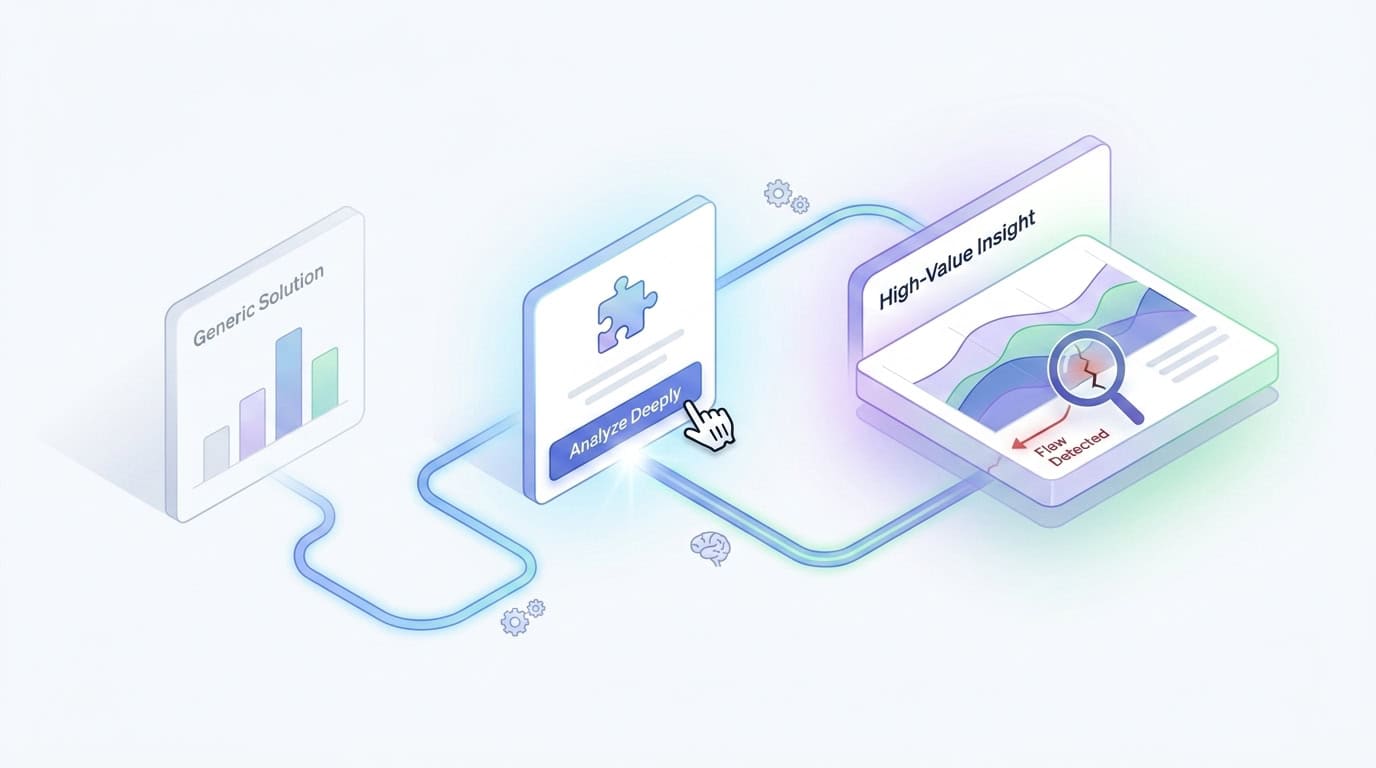
Understanding Cognitive Friction: From UX Obstacle to Strategic Asset
Cognitive friction refers to the mental effort required to process information, make decisions, or complete tasks when interacting with products, services, or systems. Cognitive friction refers to the resistance or difficulty users experience during these interactions and is often viewed as a failure in user experience design. Traditionally, designers strive to eliminate this resistance to keep users happy and productive.
While excessive obstacles can lead to emotional and interaction friction, certain types of resistance are actually beneficial. Good friction helps guide users, prevent errors, and deliberately creates delays regarding specific actions. For example, two-factor authentication adds an extra step to user logins to reduce the risk of unauthorized access and protect users from their own potential oversight.
The relentless pursuit of a frictionless experience has created a landscape in which brand comparisons occur at a surface level. If everything is too easy to consume, the reader never stops to evaluate the quality of the claims. Shifting your perspective to view friction as a strategic asset allows you to transition the reader from a passive state to an active, evaluative state.
The Psychology of Processing Fluency and Disfluency
Processing fluency refers to the ease with which our brains process information, which often leads to a sense of familiarity and trust. Cognitive friction increases memory retention by forcing the brain to slow down and analyze data more thoroughly. When information is presented too clearly, it feels right to the reader, but this ease often leads to poor long-term retention.
People tend to skim fluent information because their brains perceive it as common knowledge that doesn't require deep analysis. Disfluency occurs when information is slightly more difficult to process, requiring more cognitive effort. Mental heavy lifting results in deeper encoding of the information within the brain's memory structures.
A 2024 study by a Spanish university confirmed that even when humans make accurate initial judgments, incorrect AI support can anchor their final decisions if the process is overly fluent. When you intentionally introduce disfluent elements into your content, you force the reader to pay closer attention to specific details. Active mental engagement provides an opportunity to effectively highlight a competitor's lack of technical depth or service quality.
By making the reader work to understand a complex advantage, you ensure that the advantage sticks in their mind far longer than a feature-only value proposition. You should aim for a balance that challenges the intellect without causing frustration.
Distinguishing System 1 and System 2 Thinking
Daniel Kahneman's dual-process theory describes two distinct modes of thinking, where System 1 is fast and intuitive, while System 2 is slow and logical. Most brand comparisons occur within System 1, where buyers make snap judgments based on aesthetics, price, or familiar buzzwords. Disfluent design triggers analytical thinking by pushing the reader out of their fast, autopilot mode.
A study of knowledge workers conducted by Microsoft and published in April 2025 concluded that higher confidence in GenAI is associated with less critical thinking. When users feel the process is too easy, they stop questioning the outputs. Autopilot evaluation is a dangerous state for a buyer evaluating high-stakes corporate solutions where technical accuracy is paramount.
System 2 thinking is more analytical and allows the reader to perceive the nuanced weaknesses in a competitor's offering that they would otherwise overlook. A 2026 Microsoft paper found that participants who were forced to complete reflection steps were significantly less reliant on AI and achieved higher accuracy. By slowing the reader down, you give them the space to realize that a competitor's simple solution might actually be full of hidden gaps.
Integrating dual-process theory is essential for structuring long-form content that needs to be more than just skim-friendly. If you want a buyer to choose your brand for its technical depth, you must compel them to use the parts of their brain that recognize that depth. Applying analytical thinking creates a lasting impression that cannot be easily overwritten by a rival's simpler marketing claims.
The Strategic Shift: Why Friction Can Be Your Greatest Competitive Advantage
A strategic shift toward intentional friction involves deliberately placing design and linguistic barriers to slow information processing. In a saturated market, being easy to use is no longer a true differentiator because it's now a baseline requirement for any professional service. Effective competitor differentiation requires more than a list of features. It demands a psychological shift in how the buyer evaluates those features.
If your only claim to fame is that you're frictionless, you're competing on a metric that has already been commoditized by every other brand in your space. The real advantage lies in your ability to communicate complex value that your rivals cannot replicate. Brands can use strategic friction to stall the customer's journey at critical moments, ensuring the customer fully grasps a complex value proposition.
Instead of rushing a lead to a 'Buy Now' button, you might guide them through a detailed technical comparison or a challenging diagnostic tool. Strategic resistance ensures they understand why your solution is necessary, making them more likely to value your brand over a simpler, less effective alternative. Understanding this shift leads directly to uncovering the gaps in a rival's frictionless narrative.
Moving Beyond the Frictionless Obsession
When a brand removes all barriers in the buyer's journey, it often inadvertently signals that its product is a simple commodity. In a 2004 study by the U.S. National Institutes of Health, speed humps were associated with a 53% to 60% reduction in the odds of injury or death among children struck by an automobile. Similarly, digital friction forces a buyer to slow down and consider the gravity of their choice rather than just clicking through a frictionless single-click checkout.
The IKEA effect suggests that customers place a significantly higher value on products or ideas that they have worked to build or understand. By making your audience engage with high-level corporate strategy content that requires focus, you're building a stronger psychological bond with them. They'll value the insights they've gained from your content more because they had to put in mental effort to attain them.
Leveraging the IKEA Effect for Strategic Ownership
By requiring users to construct their own strategic insights, you invoke the IKEA effect. The psychological phenomenon ensures that potential buyers place a higher value on conclusions they reach through mental effort than on information presented to them passively. When a buyer 'builds' their understanding of why your competitor's model is flawed, they develop a sense of ownership over that conclusion that is difficult to disrupt.
Nextdoor found that adding friction to their posting process, such as asking for specific details, helped people slow down and consider their own internal biases. While this led to a 50% increase in users abandoning the form, it also resulted in a 75% decrease in racial profiling. The Nextdoor study demonstrates that while friction might reduce the total volume of activity, it dramatically improves the quality and integrity of the interactions that remain.
The Role of Cognitive Load in Critical Decision-Making
High-stakes B2B decisions require a certain amount of healthy friction to ensure the buyer isn't making a snap judgment based on flawed marketing. A study by Pennycook et al. testing accuracy prompts found that participants were significantly less likely to share false information when they were prompted to think about accuracy first. In a business context, prompting a buyer to think critically about technical specs can prevent them from choosing a rival with a thin offering.
Increasing cognitive load at the right moment can expose the lack of substance in a competitor's service-level agreements or technical specifications. When a buyer is in a state of deep focus, they're much more likely to notice when a competitor's claims don't hold up under scrutiny. A higher cognitive load acts as a filter, separating serious prospects who value quality from those who are just looking for the quickest and cheapest fix.
Anchoring Trust Through Verified Technical Disfluency
When readers encounter technical data that requires focus, they are less likely to be influenced by initial misconceptions or competitor marketing claims. The process of anchoring allows your brand to set the baseline for what constitutes a high-quality solution. By forcing a moment of verification through disfluent text or complex diagrams, you replace the competitor's simple 'anchor' with your own technically superior one.
Facebook found that engagement per post in groups that repeatedly posted misinformation dropped by 16% to 31%. In comparison, posts linking to websites with at least two false articles experienced a 45% drop. Facebook's findings show that when people are forced to consider the validity of information, their behavior changes immediately. By introducing friction that demands verification, you can lead a buyer to realize that your competitor's marketing is built on a foundation of simplified half-truths.
Identifying Competitor Weaknesses Worth Highlighting Through Friction
Identifying competitor weaknesses involves uncovering hidden structural flaws that require analytical thinking to comprehend fully. Not every flaw in a competitor's business model is worth a dedicated friction point in your content strategy. You must be selective, focusing on structural weaknesses that the average buyer might not notice during a cursory review.
By applying principles of marketing psychology, you can transform a standard comparison guide into a tool that exposes the structural flaws of your rivals. You aren't just pointing out a surface-level problem. Instead, you're educating the buyer on a fundamental risk they hadn't considered. Exposing fundamental structural risks builds authority and trust because it shows you're looking out for the buyer's long-term success rather than just making a quick sale.
Focusing on deep-seated issues is particularly effective when targeting high-level decision-makers who value technical integrity. It ensures that the reader's final decision is based on a thorough understanding of the market landscape.
Analyzing Competitor Value Propositions for Surface-Level Strengths
Many competitors rely on buzzword compliance to appear competent without actually having the infrastructure to back up their claims. They use terms like "AI-driven" or "enterprise-grade" as shortcuts to win trust through System 1 thinking. To counter this, you can use friction-heavy content to force the reader to stop and ask exactly how the competitor delivers on those vague promises.
When Nextdoor required users to provide specific details about a party's hair, build, and clothing, it prevented them from moving forward with a vague description alone. You can apply the same logic by creating content that asks readers to look for specific, detailed evidence in a competitor's documentation. When the competitor can't provide that level of detail, their surface-level strengths begin to look like significant weaknesses.
Forcing this level of scrutiny reveals a lack of substance that would have been ignored in a standard, frictionless marketing environment. Your content serves as a diagnostic tool for evaluating the entire market, ensuring that as long as your claims are backed by data, you emerge as the clear winner in high-scrutiny environments.
Uncovering Structural Flaws in Rival Product Offerings
Structural flaws like technical debt, lack of scalability, or poor customer support models are often invisible to a casual observer. These are the ticking time bombs that can derail a company's progress years after they've signed a contract with a sub-par provider. To highlight these, you should use complex comparisons that require the reader to engage their analytical mind to see the long-term risks involved.
You might frame these flaws by presenting a detailed scenario that highlights where a competitor's architecture would fail under stress. Instead of saying they aren't scalable, you provide a technical breakdown of how their database structure handles a 10x increase in load compared to your own. This requires more effort from the reader to understand, but once they do, the competitor's flaw becomes a permanent part of their evaluation criteria.
Framing these issues through the lens of risk management encourages the buyer to move away from a feature-matching mindset. It forces them to consider the total cost of ownership and the long-term viability of the partnership. By making the comparison complex and intellectually demanding, you ensure the buyer feels the weight of the decision and respects your brand's technical foresight.
Strategic Implementation: Techniques to Introduce Intentional Reading Friction
Strategic implementation of cognitive friction involves the deliberate placement of design and linguistic barriers to slow down information processing. You must move away from the skim-friendly templates that dominate the web and embrace disfluent design and intellectual speed bumps. These techniques aren't meant to make the content unreadable, but rather to signal to the brain that certain sections require a higher level of focus.
When developing an enterprise content strategy, you should identify the most critical moments where a buyer needs to slow down. Intentional friction should be used sparingly and strategically, much like a speed hump on a residential street. The key is to place these speed bumps exactly where you are discussing your most critical competitive advantages or your rival's most significant flaws.
By using competitor content gap analysis, you can find the specific areas where rivals are being overly simplistic. This allows you to introduce friction in the exact places where the reader is most likely to be misled by a competitor's marketing. This precision is what makes the strategy effective without being annoying to the user.
Designing Intellectual Speed Bumps for Technical White Papers
To maximize the IKEA effect in technical white papers, you should design the layout to encourage active participation. Instead of presenting all conclusions at the start, you can guide the reader through a problem-solving process that mirrors a B2B competitive analysis framework. This forces the reader to mentally build the solution alongside your experts, making the final result feel more valuable.
One effective method is to include interactive elements or thought experiments that require the reader to input their own data or scenarios. When a reader applies your strategic concepts to their own business context, the information is processed more intensely. Active mental processing results in the analytical depth required to truly differentiate your brand from the competition.
You can also use non-linear structures that require the reader to choose their own path through the information based on their specific needs. This forces an active decision-making process at every stage of the white paper. By the time they conclude, they have a personalized understanding of why your brand is the only logical choice for their unique situation.
Using Complex Typography and Layout to Force Deep Processing
Visual friction is a tactical tool that can significantly increase the amount of information a reader retains from a page. Studies suggest that harder-to-read fonts or non-standard layouts can actually boost comprehension because the brain has to work harder to decode the characters. While the overall content must remain accessible, you can strategically vary the visual weight of text around your most important comparison sections.
Instead of a standard bulleted list for a technical comparison, you might use a more complex layout that requires the reader to follow a logical flow. This visual change signals to the reader's brain that this specific information is different and requires more focus than the surrounding text. It breaks the scanning behavior that most people use when reading online content.
Varying the typography can also serve as a mental reset for the reader, pulling them out of a passive state. By changing the font style or size for a critical insight about a competitor's weakness, you create a visual anchor. The reader's eyes are drawn to the friction point, and their brain prepares for the extra effort needed to process the highlighted information.
The Power of Rhetorical Questions and Pattern Interrupts
Linguistic friction is one of the most effective ways to stop a skim-reader in their tracks and force them to engage with your message. Using challenging rhetorical questions that contradict common industry wisdom forces the reader to pause and evaluate their own assumptions. For instance, asking "Why do most cloud providers hide their actual latency data behind 'average' metrics?" creates immediate curiosity and suspicion about rivals.
Twitter conducted an experiment in which it introduced a feature that warned users when their replies contained potentially offensive language and gave them the option to revise before posting. Many users chose to edit or abandon their replies after seeing the prompt, as the friction prompted them to reconsider their initial impulse. You can use similar prompts in your content to prompt readers to reconsider their initial impulse toward a competitor's easy solution.
A pattern interrupt, such as a sudden shift in tone or the introduction of a counterintuitive fact, can break the reader's autopilot mode. If the article has been clinical and data-driven, a sudden, direct address to the reader's common sense can be very effective. This sudden change in the content's vibe forces the brain to re-engage and focus on the specific shortcoming you are highlighting in a rival's product.
Framing Complex Data to Slow Down the Skim-Reader
Data visualization is often praised for making things simple, but sometimes simplicity is the enemy of true understanding. Some charts should be designed to require a moment of study to fully grasp the data's technical implications. This data friction ensures the reader doesn't just see a line going up but actually understands the variables that make your performance superior to a competitor.
WhatsApp's restriction on message forwarding was found to slow the spread of misinformation across the network when the limits were implemented. This shows that by limiting the ease of sharing and consumption, you can improve the quality of information processing. Research has shown that placing limits on network depth and network breadth improved the ratio of true to false messages.
You can apply this by designing comparisons that limit the reader's ability to make broad generalizations about your industry. Instead, force them into the depths of specific technical nuances where your brand holds the clear advantage. By the time they've decoded your complex data set, they have a logical, System 2-backed reason for preferring your solution over a competitor's simple marketing slogan.
Enhancing AI Overviews and Search Visibility with Unique Psychological Frameworks
Enhancing search visibility in AI environments requires using unique semantic entities and high-information-gain frameworks. The modern SEO landscape is no longer just about keywords; it's about how AI-driven search engines interact with unique and complex content. AI overviews and Natural Language Processing (NLP) systems prioritize content that provides significant information gain for populating Knowledge Graphs, often bypassing generic summaries.
By introducing unique psychological frameworks and complex definitions, you provide the raw material that AI models look for when identifying authoritative sources. When your content includes proprietary concepts or nuanced strategic advice, AI is more likely to cite your brand as the primary source. Providing proprietary concepts allows you to maintain visibility even as the search landscape shifts toward a zero-click environment.
You can use the featured snippet optimization strategy to ensure your definitions are the ones captured by these systems. Large Language Models are increasingly prioritizing high-information gain and unique semantic entities when determining source authority for complex B2B queries. Providing this depth ensures your brand is seen as a leader by both humans and machines.
Optimizing for Semantic Depth and Unique Definitions
To stand out to both humans and algorithms, you should integrate unique behavioral psychology terms with your corporate strategy. Creating a new vocabulary, such as intentional cognitive disfluency, gives AI models a specific entity to associate with your brand. This semantic depth signals to search engines that your content is not just another generic blog post, but a primary source of industry-specific knowledge.
Being the primary source for a specific strategic concept is a powerful way to dominate the search environment. When a user or an AI looks for information on how to use psychology in B2B marketing, your unique definitions will be the ones that are cited. Establishing primary source authority creates a moat around your content that competitors cannot easily cross by simply writing a simpler version of your article.
Semantic triples, which define relationships between a subject, predicate, and object, are more easily identified by AI when the language is precise and unique. Instead of using vague marketing language, use friction-heavy terms to define exactly how your product solves a problem. Providing granular technical detail helps LLMs understand the specific 'how' behind your claims, which they then relay to users as authoritative facts.
Teaching AI to Recognize and Prioritize Your Brand's Strategic Nuance
The complexity and friction in your content actually help Large Language Models understand the depth of your brand's expertise. AI is getting much better at identifying authoritative content that doesn't just repeat common knowledge found across the web. When your content challenges the status quo, LLMs recognize it as a high-information source, which improves your brand's reputation in their training data.
When a user asks an AI about the difference between your brand and a competitor, the AI will pull from the most detailed and nuanced sources available. If your content is the only one that explains a rival's structural flaws using complex data, the AI will highlight those specific advantages. The friction you've built into your content ensures that the AI doesn't just give a generic answer.
Embracing complexity ensures that your strategic nuance is preserved and even prioritized by AI models during the summary process. By slowing down the human reader, you are simultaneously providing more hooks for the AI to grab onto as it evaluates your authority. It's a dual-benefit strategy that improves both human engagement and machine-driven visibility as digital search behaviors evolve.
Ethical Considerations and Risks of Intentional Cognitive Friction
Ethical considerations in persuasive design require a clear distinction between using friction to highlight truth and using it to deceive. While intentional friction is a powerful tool, there is a very fine line between challenging a reader and simply frustrating them. If the friction is too high or feels arbitrary, the reader will bounce from your page before they ever get to your main point.
The goal is to create intellectual engagement, not to build a wall that prevents people from accessing your insights. Misusing these techniques can damage your brand's reputation if the reader feels like you're being difficult for no reason. You must always ensure that the mental effort you're asking for is rewarded with a high-value insight that justifies the work.
If the reader feels that they've worked hard to understand a point that turns out to be trivial, they'll lose trust in your brand's expertise. Transparency is key to maintaining an ethical balance. You should clearly communicate why a section is complex and how it benefits the reader's understanding of the subject matter.
Balancing User Frustration with Cognitive Engagement
Finding the Goldilocks zone of friction is essential for a successful content strategy. You want enough resistance to trigger System 2 thinking, but not so much that you trigger emotional friction and cause the reader to give up. Good friction should help guide users, prevent errors, and deliberately create delays regarding specific actions, such as confirmation dialog boxes before deleting data.
To maintain this balance, you should use release points where clear, high-value insights immediately follow the friction. After a complex chart or a challenging rhetorical question, provide a summary that rewards the reader for their cognitive effort. This tension-and-release cycle keeps the reader engaged without leading to burnout or frustration.
It's also important to provide multiple paths through your content for different types of readers. While the main body of the article might use disfluent design, you can still provide a key takeaways section for those who truly don't have time to engage. This shows respect for the reader's time while still providing a deeper, more challenging experience for those in a critical decision-making mode.
Avoiding the Dark Patterns Trap in Persuasive Design
The ethics of using psychological triggers in marketing depend entirely on your intent and the truthfulness of your claims. Dark patterns often use friction to hide important information, such as making it difficult to find the cancel subscription button. Strategic cognitive friction is the opposite; it's used to make important, complex information more visible and memorable.
You're using psychology to ensure the buyer sees the whole picture, including the risks they might be taking with a competitor's simpler solution. Emphasize transparency in your content by being upfront about why you're presenting information in a complex way. For example, you might start a technical section by saying, "This comparison is complex because the underlying technology is critical to your success."
By being honest about the work required, you build a more mature and respectful relationship with your audience that rivals cannot easily match. Transparent complexity is what separates an authoritative brand from one that uses psychological tricks. Ethical friction helps the buyer make a better-informed decision, leading to greater satisfaction and lower churn over the long term.
The Risks of Over-Optimization
While friction is a valuable tool for complex messaging, applying it to basic navigational elements can be detrimental. You should avoid introducing resistance on pages where the user's intent is purely functional, such as a pricing table or a contact form. In these areas, friction is an unintended obstacle that negatively affects user experience and conversion rates.
Bad friction is any unintended obstacle that causes emotional or interaction friction for the user. If a prospect is ready to book a demo, any delay in that process can lead to frustration and abandonment. Your goal is to use friction to educate, not to hinder the buyer's final steps in the journey.
Regularly auditing your content for unintended friction ensures that your strategy remains focused on high-value engagement. You can use tools like heatmaps or session recordings to identify where users are struggling with your design. By removing friction from transactional paths while maintaining it in educational sections, you create a perfectly balanced SaaS content marketing strategy.
Measuring the Success of Friction-Based Content Strategies
Measuring the success of friction-based strategies requires a shift from volume-based metrics to depth-based engagement signals. Traditional marketing KPIs like click-through rates and bounce rates can be highly misleading when you're using intentional friction. A high bounce rate might actually mean that you're successfully filtering out unqualified leads who aren't willing to engage with your complex value proposition.
Success should be measured by the depth of engagement and the quality of the resulting conversions, rather than just the sheer volume of traffic. If people are spending five minutes on a single page of technical content, that's a much stronger signal of success than a hundred people who spend ten seconds. You're looking for indicators that the reader's System 2 thinking was successfully engaged.
Tracking how the content performs across different segments of your audience provides a clearer picture of its impact. You want to see that your highest-value prospects are the ones engaging most deeply with your disfluent sections. This confirms that your friction is attracting the right type of attention.
Beyond Simple Click-Through Rates: Analyzing Time on Page and Recall
Dwell time and scroll depth are far more important indicators of success for friction-based content than simple page views. If a reader is slowly working through a complex comparison, their time on the page will be significantly higher than average. You can track scroll pauses to see exactly where readers are stopping to process your intellectual speed bumps, allowing you to refine your content over time.
Brand lift studies and post-read surveys can help you measure whether readers actually remember your competitor's weaknesses. Ask readers to recall specific technical points or risks discussed in the article to see whether deeper encoding occurred. If the group that read the friction-heavy version has higher recall than the group that read a simplified version, your strategy is working.
Recall is the ultimate metric for competitor differentiation because it determines what the buyer thinks about when they're not looking at your website. If they're in a meeting with a rival and they suddenly remember a structural flaw you highlighted, you've won. Measuring this residual impact is key to understanding the true ROI of your psychologically driven content.
Tracking Conversion Quality and Brand Association
While friction might reduce the quantity of leads you generate, it should significantly increase the quality of those leads. The buyers who successfully navigate your disfluent content are more educated and more likely to have a higher lifetime value. You can track this by looking at the conversion rate from lead to closed-won for people who have engaged with your friction-heavy content.
You should also look for evidence of your strategy in sales calls and customer interviews. If a prospect cites a specific friction point or complex data set as the reason they chose you, you know the strategy has reached the bottom of the funnel. These anecdotes are powerful evidence that your content is doing more than just driving traffic; it's actively shaping the buyer's decision-making process.
Finally, monitor how your brand is associated with specific strategic terms over time. If search engines and AI models start linking your brand name to terms like technical integrity, your strategy is succeeding. You're no longer just another provider. You're the authoritative source that forces the entire industry to step up its game and achieve double-digit improvements in lead quality.
Leverage Strategic Content to Dominate Your Industry Today
Intentional cognitive friction is a sophisticated tool that enables modern brands to assert industry authority by moving beyond superficial digital marketing trends. By slowing the reader down, you ensure that your most important competitive advantages are deeply understood and remembered for the long term. Intentionally slowing the reader down transforms your content into a powerful psychological asset that consistently exposes your rivals' weaknesses.
Embracing the complexity of your own solution and the structural flaws of your competitors requires a commitment to technical transparency and rigorous design. Instead of fearing resistance, you can use it to build an educated and loyal customer base that values technical depth. By implementing these techniques, you position yourself as the clear choice for buyers looking for real substance over feature-only value propositions.
Creating this level of nuanced content is difficult to do at scale, but it's where we excel. At Brand Voice, we build this psychological nuance into every piece of content we produce. Our ready-to-publish articles don't just fill a blog. They use intentional friction to ensure your audience understands why your solution is the only logical choice. Schedule a demo today to see how we can help you highlight your competitor's weaknesses and drive significantly higher recall rates among your target B2B buyers.