- Search engines are increasingly prioritizing the "Experience" factor within E-E-A-T by rewarding creators who demonstrate practical, real-world application over synthesized research.
- Google’s Information Gain patent favors unique documents that offer new data points or original observations that differentiate a page from previously viewed search results.
- Linguistic markers such as first-person pronouns, sensory details, and mentions of proprietary workflows serve as critical natural language processing signals that verify firsthand experience.
- Transitioning from a "what is" structure to a "how I did it" narrative helps protect content from AI-driven homogenization by focusing on specific human-led processes and outcomes.
- Leveraging Subject Matter Experts for internal interviews and original data allows brands to establish topical authority and act as primary sources rather than content aggregators.
The digital landscape is shifting as vector-based search retrieval changes how search engines and readers perceive content value. We've moved past the era where gathering facts from existing websites was enough to maintain a competitive edge.
Content consumers now look for evidence of real-world application before they trust a piece of writing. Prioritizing these firsthand insights is the most effective way to protect your digital presence against shifting search trends. Understanding the mechanics of these experience signals is the first step toward hardening your content strategy against the erosion of trust in the digital age.
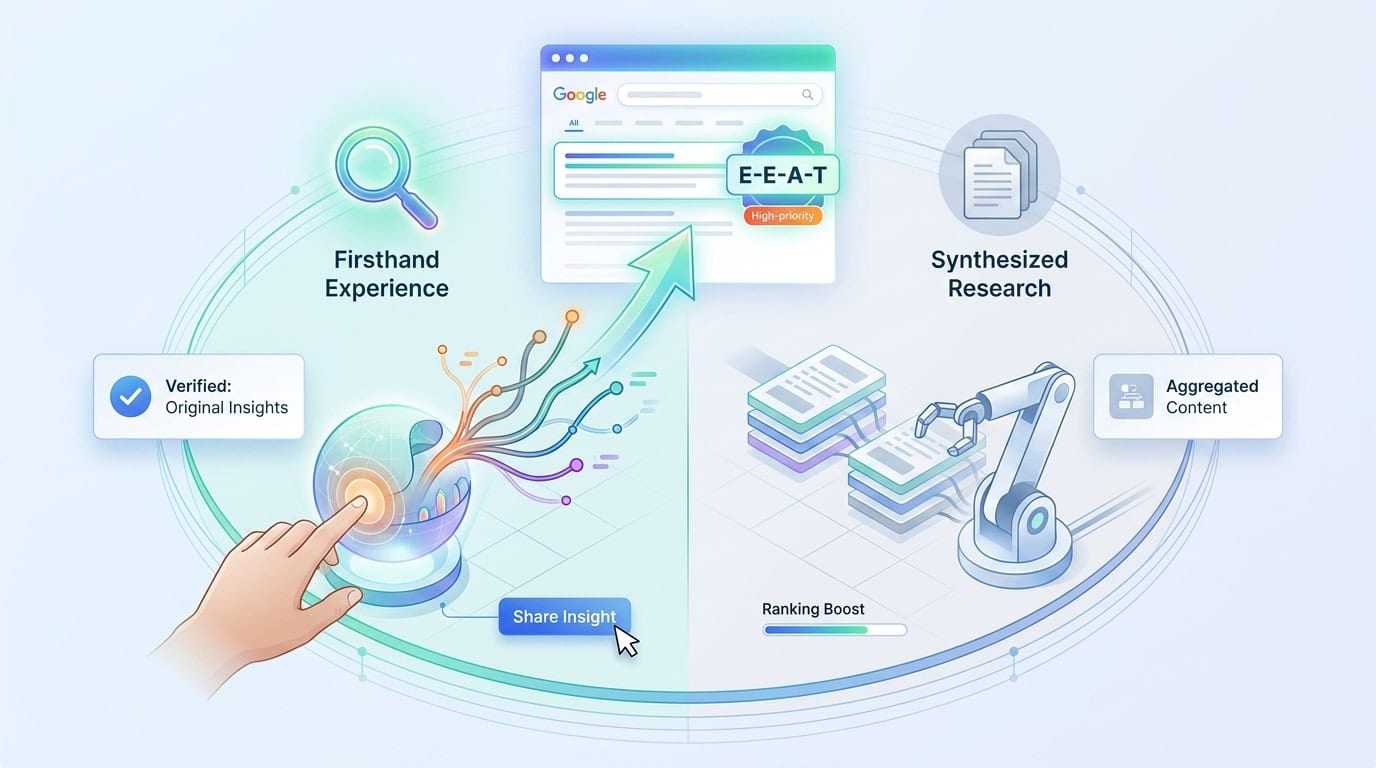
The Paradigm Shift: From Information Aggregation to Authentic Experience
The early days of search engine optimization focused heavily on aggregation and the curation of existing data. It was possible to rank highly by simply being the best at summarizing what others had already said on a specific topic. The curation era rewarded the ability to compile facts into a readable format, but it often lacked the operational nuances of professional execution.
The aggregation model is quickly fading as the internet becomes saturated with synthesized research that offers no new perspective. Readers are tired of clicking on multiple articles only to find the same recycled statistics and advice. When every search result feels like a variation of the same template, the value of those results plummets for the user.
We're now entering the experience era, where the primary currency of content is unique insight derived from actual practice. Scholars emphasize that firsthand experience, which involves spending time onsite observing people and places, is crucial to establishing true authority. Transitioning from a content aggregator to a primary source is now the dominant factor in building topical authority and long-term trust with both search engines and human audiences.
Why Search Engines Are Prioritizing the "Extra E" in E-E-A-T
Search engines have refined their evaluation frameworks to better distinguish between generic summaries and lived experience. The shift toward rewarding lived experience represents a move toward favoring creators who have actually performed the tasks they describe. It's no longer enough to be an authority in name only.
Understanding the Difference Between Expertise and Experience
There's a subtle but important distinction between having theoretical expertise and possessing practical experience. An expert might understand the mechanics of a complex process, but an experienced person understands the friction that occurs during execution. Expertise is the study of a subject, while experience is the mastery of its application in the real world.
Experience assesses whether the content creator has actually touched the tools or navigated the environment they're discussing. A software developer writing about debugging techniques offers more value than a researcher who has only read about code. It's the difference between knowing how a machine should work and knowing why it often fails in practice.
Google utilizes E-E-A-T guidelines to evaluate content quality. These raters look for evidence that the author has used the product or lived through the scenario. Without this evidence, content feels hollow and fails to satisfy modern quality standards.
The Impact of Google's Helpful Content System on Secondary Research
The Helpful Content System was designed to identify and demote articles that seem to have little value for human readers. This system is now a site-wide signal integrated directly into the core ranking systems of modern search engines as of the 2024 Core Update. It targets content that appears to have been created primarily for search engines rather than for people.
Content that merely summarizes what other websites have already said is frequently flagged as unhelpful. Search engines are actively looking for hidden gems, or forum-based discussions where real-world perspectives are shared freely. They want to reward the source that adds something new to the global conversation.
Relying solely on secondary research creates a significant risk for long-term search visibility. If your content doesn't provide anything beyond a synthesis of existing web data, it'll likely be downgraded in favor of more sources. True helpfulness lies in the unique details only a practitioner can provide.
Implementing experience-driven content helps satisfy these automated classifiers. When you avoid the "me-too" content trap, you build a resilient domain. Focusing on original experience prevents your site from being swept away during volatile algorithmic shifts.
The Information Gain Patent: Why Uniqueness is a Ranking Factor
The concept of Information Gain is a technical approach to ensuring that users aren't presented with redundant information. Search engines want to show a diverse range of perspectives rather than ten versions of the same article. If every result on the first page says the same thing, the user hasn't gained anything by clicking on the second or third result.
A Technical Deep Dive into Google's Information Gain Patent
Google's Information Gain patent assigns an Information Gain score to rank web pages based on additional information beyond what was in previously viewed documents. Information Gain scores determine the ranking of unique documents. If your article provides a new data point or a unique observation, it has a higher chance of ranking.
The system works by comparing a candidate document against a set of documents the user has already seen. If the new document contains substantial information that is not present in the original set, it receives a higher score. The Information Gain scoring system encourages creators to move beyond basic curation and toward producing original data.
Firsthand experience is the most efficient way to achieve high Information Gain scores. When you write from experience, you naturally include details that others haven't documented. You're not just repeating the same five tips found in every other blog post.
Beyond the Echo Chamber: Breaking the Cycle of Content Homogenization
The SEO industry often falls into the trap of circular reporting, where everyone cites the same three statistics or studies. Circular reporting creates an echo chamber where information is recycled so many times that it loses its original context. It leads to content homogenization, making it difficult for any brand to stand out.
Firsthand experience breaks this cycle by introducing new data points and unique observations. When you're the source of the information, you're no longer part of the echo chamber. You become the entity that others cite, which builds a much stronger backlink profile and brand authority.
Being the source rather than the summarizer changes your position in the market. It allows you to present contrarian viewpoints based on your actual results. These unique perspectives attract more attention because they challenge the status quo established by generic research.
How Search Engines Detect Experience Signals in Textual Content
Search engines use Natural Language Processing (NLP) to differentiate between a practitioner and a researcher. There are specific linguistic markers that indicate someone has actually done the work. The use of first-person pronouns like "I" or "we" is one of the most obvious signals.
Specific sensory details and the mention of proprietary workflows also serve as strong markers of experience. A practitioner will mention the specific weight of a tool or the exact temperature of a room during a test. These granular details are difficult to fake and are rarely found in synthesized research.
Search engines look for specific E-E-A-T signals, such as author credentials and verified project outcomes, to determine authenticity. Named entity recognition also plays a role. Mentioning specific tools, such as Cypress for end-to-end testing, is a stronger signal of experience than simply saying "testing software."
NLP systems can also detect the difference between a how-to guide written by someone following a manual and one written by someone who has faced unexpected problems. The practitioner's guide will include warnings about common mistakes and workarounds that aren't in the official documentation. These signals tell the algorithm that the content is grounded in reality.
The LLM Paradox: Why AI Synthesis is Increasing the Value of Human Experience
Large Language Models have made it incredibly easy to generate synthesized research at scale. As a result, the internet is being flooded with commodity content that looks professional but lacks original insight. The massive saturation of AI-generated synthesis is creating a paradox in the content marketing world.
The Limitations of Predictive Text and Hallucinations
Large Language Models are essentially sophisticated next-word predictors that rely on statistical patterns in text. They don't have a physical presence or the ability to conduct experiments in the real world. This lack of grounded reality makes it difficult for them to provide granular details in specialized niches.
One of the most significant issues with these models is the occurrence of hallucinations. LLM hallucinations emerge because they're unable to discern truth from falsehood and don't possess dependable reasoning processes to ensure accuracy. They might invent a technical detail that sounds plausible but is completely wrong in practice.
Because LLMs generate content based on existing datasets, they cannot offer the unique or original insights that Google now prioritizes. They're trained on the existing web, which means they're the ultimate aggregators. While they're efficient, they're incapable of producing the extra E of experience.
The Necessity of Human-AI Hybrid Editing
While LLMs can parse code and follow instructions, they often miss the experience that only a human can provide. A human-in-the-loop editing process adds a trust signal that AI-only content often lacks. A human practitioner provides a level of accuracy that a case study or predictive text cannot match.
When you describe a project you completed, you're reporting on a grounded reality. There's no need for the system to guess what happened because you're there to provide the actual evidence. Human editors must bridge the gap between AI efficiency and authentic storytelling.
Sustainable results require a mix of technology and lived experience. Using a ready-to-publish SEO content service that prioritizes this balance is a significant advantage. This ensures your brand doesn't fall into the commodity content trap.
Moving From "What is" to "How I Did It"
The traditional informational article often focuses on a "What is" structure that provides broad definitions and general overviews. While these are useful for beginners, they're the easiest types of articles for AI to replicate. They don't require any history or personal involvement to produce.
There's a growing need to shift toward "How I did it" narratives that focus on process and outcomes. A process-oriented structure is naturally resistant to AI replication because it requires a specific history of actions. It allows the writer to share the unique hurdles they faced and the specific steps they took to overcome them.
Process-oriented writing is more engaging for readers who are looking for a roadmap rather than a definition. It provides a level of detail that a broad summary can't reach. By focusing on your personal or brand history, you create fundamentally unique content.
Tactical Methods for Injecting Subject Matter Expertise
Transitioning from synthesized research to experience-driven content requires a change in your production methodology. You can't rely on desk research alone if you want to stand out in the modern SEO landscape. You must find ways to draw on the knowledge of the people who are actually doing the work.
How to Optimize B2B Content for E-E-A-T
Framing your content strategy around Subject Matter Experts (SMEs) is the most effective way to ensure authenticity. This involves moving beyond the screen and into your team's workspace. It's about capturing the knowledge nuggets that haven't been written down yet.
An SME-led approach ensures that every piece of content you publish has a unique perspective. It prevents your brand from sounding like every other competitor in the search results. It's the difference between being a voice in the crowd and being the voice people listen to.
Interviewing internal experts is a powerful way to extract insights that aren't available online. Your product heads, engineers, and specialists have years of unspoken knowledge that can serve as the core of an article. A twenty-minute conversation can often yield more original information than five hours of Google searching.
Establishing Author Entities through Social Proof
Search engines look beyond the text on the page to verify the identity of the author. By linking your content to verified social profiles and professional portfolios, you strengthen the relationship between the content and a real-world entity. This creates a resilient knowledge graph entry that confirms your expertise and experience to both human readers and algorithmic crawlers.
Demonstrating Experience in Niche Technical Writing
The key to a successful interview is preparation and the right questioning technique. Don't just ask them to define a concept. Instead, ask them about the last time they had a problem with it. Ask them what most people get wrong about their field or what they wish they had known when they started.
Once you have these insights, integrate them into the article as the primary experience signals. Use direct quotes or describe specific scenarios the SME mentioned. This turns a generic guide into a proprietary piece of thought leadership that can't be found anywhere else.
Technical writing should always focus on the actual application. Mentioning specific file paths, configuration settings, or command-line arguments acts as proof of work. These details satisfy both search engines and technical readers.
Incorporating Original Data and Primary Research in Marketing
Conducting original experiments or sharing internal data is the ultimate form of firsthand experience. It provides concrete proof that your brand is active in its field and isn't just a spectator. Even small-scale tests or failed experiments provide more value than a perfectly polished synthesis of old data.
Conducting primary research in marketing allows brands to generate their own statistics instead of relying on outdated industry reports. Sharing your results, especially the unexpected ones, builds verifiable trust metrics with your audience. It shows you're willing to be transparent about your process and value truth over a perfect narrative.
Original data also serves as a link magnet for other creators. When you produce a unique statistic or a new finding, other websites will reference your work as the primary source. This boosts your search authority and establishes your brand as a leader in your industry.
Utilizing Multimedia as Proof of Experience
Original photography and video serve as non-textual signals of authenticity that reinforce the written word. A screenshot of a real workflow or an over-the-shoulder video shows the reader that you're actually using the tools you're talking about. These elements act as proof of work for both search engines and users.
Search engines are increasingly capable of understanding the context of images and videos. When you include original media that's directly related to the text, it reinforces the page's overall experience signals. It's much more effective than using generic stock photos that don't provide any information.
Multimedia also makes the content more engaging and easier to digest. A reader might skim a long paragraph but stop to look at a chart or a photo of a specific mechanical part. These visual aids ground the content in the physical world and make the experience feel more tangible.
The Strategic Importance of First-Person Narrative
There has historically been a taboo against using first-person language in professional or academic writing. Many brands felt that using "I" or "we" made them sound less objective or less authoritative. This trend is now being reversed as the need for human connection becomes a priority.
Using personal pronouns establishes a direct connection between the writer and the reader. It signals that a human being is standing behind the claims made in the text. It makes the content feel more like a conversation and less like a lecture from a faceless entity.
The key is to balance professionalism with personal narrative. You don't need to turn every article into a diary entry, but you should use first-person language when sharing a specific insight or experience. This subtle shift in tone can significantly increase your audience's trust and engagement.
Structural Frameworks for Experience-Driven Pillar Content
Structuring long-form articles requires a plan that weaves experience throughout the text. Experience shouldn't be tacked on as a sidebar or a brief introduction. It should be the foundation upon which the entire piece is built.
Architecting Content with Experience Blocks
An Experience-First architecture involves creating specific experience blocks within your guides. These blocks are dedicated to sharing real-world applications, warnings, and results. They ensure that the reader never goes too long without seeing evidence of your firsthand knowledge.
Using experience blocks helps maintain narrative flow and keep the reader engaged. It transforms a boring technical manual into a compelling story of problem-solving. By using these frameworks, you ensure that your content remains both informative and authentic.
These blocks should be visually distinct or clearly introduced. Use phrases like "In our tests" or "During my time at" to lead into these sections. Clearly defining these sections helps search engines isolate and appropriately weight these signals.
The Problem-Action-Result Narrative Arc
Using a narrative arc within informational content is a great way to demonstrate experience. Instead of just listing features or steps, you describe a specific problem you faced. This sets the stage and gives the reader a reason to care about the information you're providing.
Follow the problem with the specific actions you took to resolve it. Be detailed about the tools you used and the mistakes you made along the way. Sharing specific hurdles and failures provides transparency that shows you have navigated the task's complexities.
Finally, share the result of your actions. Whether it was a success or a partial failure, the outcome is the most important part of the story. It provides the proof that your process works in a real-world setting.
The Value of Negative Knowledge
Synthesized research rarely covers failures because it's usually focused on the best practices that everyone agrees on. Firsthand experience, however, is full of things that didn't go as planned. Sharing these negative results is a powerful way to build trust with your audience.
When you tell a reader what doesn't work, you're saving them time and resources. It confirms that you've actually done the work and have seen the pitfalls that a theoretical expert might miss. This negative knowledge is often more valuable than a list of standard tips.
Embracing the messy reality of your field makes your content more relatable. It shows that your brand isn't just a marketing machine but a group of practitioners who are constantly learning. This authenticity is what differentiates a high-authority site from a generic content farm.
The Economic Impact of Content Homogenization
The cost of producing recycled content is higher than most brands realize. When your content looks like everyone else's, your conversion rate naturally suffers. Users have no reason to choose your brand over a competitor if your advice is identical.
Content homogenization leads to a race to the bottom on price. Failing to differentiate your expertise results in a documented loss of high-value conversions and leads.
Investing in experience-driven content is an investment in brand equity. It allows you to charge premium prices because you are providing unique value. High-quality insights attract high-quality customers who value expertise over generic summaries.
Future-Proofing Content Against Algorithmic Volatility
Centering your content strategy on firsthand experience creates a moat that protects your website from future updates. While search algorithms change constantly, the human desire for authentic testimony is a constant. By focusing on experience, you're building a foundation that doesn't rely on temporary SEO tricks.
Search engines will always favor content that provides the best answer to a user's query. As AI synthesis makes it harder to find original thoughts, the value of your unique insights will only grow. You're essentially future-proofing your brand by being irreplaceable.
Sustainable SEO isn't about chasing the latest algorithm. It is about being the most helpful source in your niche. If you consistently provide experience-driven content, the search engines will eventually find and reward you. It's a long-term strategy that pays dividends in both traffic and trust.
Understanding these E-E-A-T signals is only the beginning. You must apply them consistently across your entire domain. This commitment to quality is what separates winners from losers in the AI age.
Scale Your Experience-Driven Content with Brand Voice
Moving away from synthesized research is the only way to remain competitive in the modern SEO era. By prioritizing E-E-A-T and Information Gain, you ensure that your brand remains a leader in an increasingly automated world. Brand Voice is designed to help you bridge the gap between technical requirements and authentic storytelling.
We understand the challenges of scaling high-quality content without losing the human touch that drives real results. Our hybrid human-AI approach is designed to inject genuine subject-matter expertise into every article we produce. We specialize in creating ready-to-publish, SEO-optimized content that focuses on granular audience targeting and high-intent topics. Whether you're an agency, a brand, or a website owner, we can help you deliver authoritative content at scale without the overhead of traditional agencies.
Brand voice can help audit your existing strategy and identify opportunities for massive information gain. Schedule a demo today to learn how we can boost your search visibility and drive qualified traffic through experience-driven content.