- A sustainable content marketing strategy shifts focus from temporary trends to a repeatable content engine that delivers compounding returns and long-term organic growth.
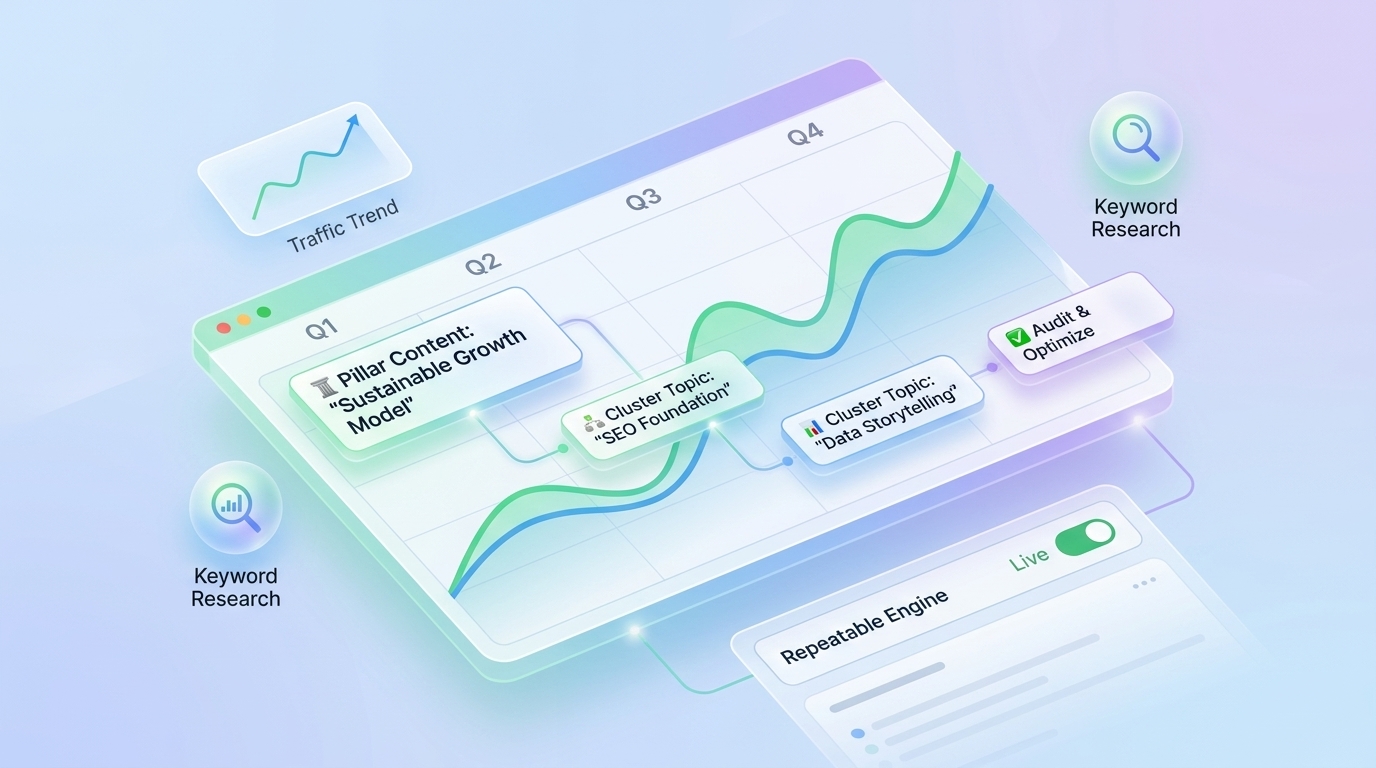
- Organizing assets into a pillar-cluster architecture helps establish topical authority and enhances search visibility by creating a logical internal linking structure.
- Implementing advanced schema markup and optimizing site architecture are essential technical SEO components that improve crawl efficiency for a digital growth blueprint.
- Prioritizing original research and data-driven storytelling helps satisfy Google’s E-E-A-T requirements and builds a competitive moat that AI-generated content cannot replicate.
- Documenting a clear content marketing mission statement and tracking specific KPIs can increase marketing returns by 33% while ensuring alignment with core business goals.
Most digital growth initiatives fail because they're built on the shifting sands of temporary trends rather than a solid structural foundation. Shifting your focus toward a sustainable content engine allows your brand to move away from exhausting short-term campaigns and toward a model of compounding returns.
A high-performance strategy does more than fill a blog with articles. It creates a library of assets that gain value over the months and years. Understanding the mechanics of these systems is the first step toward securing a dominant market position against your competitors.
Why Sustainability is the Core of Modern Content Marketing
Digital marketing has moved through several distinct eras, transitioning from simple keyword stuffing to the complex, intent-driven landscape we see today. Brands can no longer rely on temporary gimmicks or viral spikes to sustain their revenue targets in a competitive environment. Success now requires a focus on evergreen value that serves the audience's needs regardless of the current social media weather.
A data-backed digital growth blueprint functions as a long-term engine that drives consistent results without requiring a constant, linear increase in spending. As your content library grows, it begins to compound in value, attracting organic traffic and building authority even when you aren't actively launching new campaigns. The compounding effect eventually reduces the cost per lead and makes the entire marketing department more efficient.
The shift toward sustainability is becoming an industry standard rather than a niche preference. Recent data shows that 81% of marketers say content marketing is a core business strategy in 2025. Widespread adoption of these methods proves that the world's most successful brands are moving away from ephemeral tactics in favor of reliable, long-term growth frameworks.
The Pitfalls of the Churn-and-Burn Content Model
The pressure to produce high volumes of content often leads to a churn-and-burn approach where quantity is prioritized over depth. The churn-and-burn model relies on frequent, low-quality updates that fail to provide real value to readers or search engines. While it might provide a temporary boost in visibility, it eventually leads to brand fatigue as the audience grows tired of shallow, repetitive messaging.
Relying on mere frequency without expertise also damages your long-term SEO performance. Modern search algorithms are designed to reward topical depth and actual authority rather than just the number of pages on a site. If your strategy lacks depth, your marketing budget is essentially being drained by an inefficient process that doesn't build lasting equity.
Consistency is still important, but it must be paired with high standards for informational quality to be effective. Approximately 91% of global brands report using content marketing in some form as of 2025, making the competition for attention fiercer than ever. Standing out requires a move away from the noise of content churn and toward a strategy that prioritizes expertise.
Defining the Sustainable Content Engine
A content engine is a holistic system that integrates people, processes, and technology to produce high-quality assets predictably. Unlike traditional production, which often feels like a series of disconnected tasks, an engine is a repeatable framework. A sustainable content engine generates compounding organic traffic for the brand over time.
The goal of this engine is to create a rhythm that prevents team burnout while maintaining a steady output. When your processes are documented and your technology stack is optimized, the team can focus on creative and strategic work. Operating within this structure allows the brand to scale its efforts without the typical growing pains associated with increasing volume.
Building this engine requires a clear understanding of how each component supports the others. The people provide the expertise, the processes ensure consistency, and the technology handles the heavy lifting of distribution and analysis. When these elements work together, you create a digital growth blueprint that is resilient enough to withstand market shifts.
The Compound Interest of Digital Growth
Content marketing is one of the few marketing channels that behaves like a financial investment. High-ranking informational content continues to attract new users years after it was first published and promoted. The long-term nature of these assets is why content marketing delivers a three-year average ROI of 844% and outperforms many shorter-term advertising methods.
Every new article added to a well-structured library increases the total surface area of your brand's digital presence. Instead of relying on one-off viral hits that disappear within a week, you're building a network of assets that support each other. SEO and blog content specifically deliver an average ROI of 748% for B2B companies, highlighting the power of a long-term approach.
The cumulative power of a digital growth blueprint is what separates market leaders from also-rans. By focusing on the long-term health of your content library, you create a barrier to entry for competitors. They can't simply buy their way into the position you've built through consistent, high-value informational output.
Technical SEO Infrastructure for Content Hubs
A sustainable content engine requires more than just words on a page. It needs a robust technical foundation. Modern search engines rely on structured data to understand the context and hierarchy of your informational assets. Implementing specific schema markup types helps search engines parse the content engine more effectively.
Implementing Advanced Schema Markup
Article schema is the most basic requirement for informational content. It allows search engines to identify the headline, author, and publication date with absolute precision. Implementing structured data provides machine-readable metadata directly in the code, improving crawl efficiency.
Breadcrumb schema is equally important for maintaining a logical site hierarchy. It helps search engines understand the relationship between a specific cluster article and its parent pillar page. Mapping out the 'Hub and Spoke' model for the crawler reinforces your topical authority.
FAQ schema can significantly increase your visibility in search results. By marking up specific questions and answers, you increase your chances of appearing in the "People Also Ask" section. JSON-LD markup provides a direct path to capturing users in the early exploration phase of their journey.
Optimizing for Crawl Budget and Site Architecture
Crawl budget refers to the number of pages a search engine bot crawls on your site during a specific timeframe. A messy site architecture wastes this budget on low-value pages, such as archives or tag pages. Organizing your content into clean directories ensures that bots prioritize your most important pillar pages and high-intent clusters.
Your internal linking structure should facilitate a seamless flow of link equity. High-authority pages should link down to supporting clusters, and those clusters should link back to the main pillar. Strategic internal linking creates a loop of authority that helps new content rank faster and sustains the rankings of older assets.
Establishing Your Strategic Foundations
A strategy is only as strong as its foundation, and skipping the planning phase is a recipe for wasted resources. You must align your content goals with your broader business objectives to ensure every word you write contributes to the bottom line. Alignment between goals and objectives bridges the gap between high-level vision and the tactical execution required to see real growth.
Crafting a Content Marketing Mission Statement
A documented mission statement for your content serves as a north star for every creator on your team. It defines exactly who you're helping, how you're helping them, and what unique value you provide through your articles. Without this clarity, your content can easily drift from the brand's identity and fail to meet your target audience's needs.
Documented strategies increase marketing returns by 33% compared to companies that operate without one. For a SaaS business, a strong mission statement might focus on providing actionable technical insights to help IT directors solve security challenges. Focusing on the user's professional success rather than the product's features ensures that the content remains relevant.
Setting Measurable Goals and Core KPIs
Setting realistic and scalable goals requires using the SMART framework to ensure every objective is specific and time-bound. You should track a mix of leading indicators, such as organic traffic growth, and lagging indicators, such as lead conversion rates. Using both leading and lagging indicators provides a complete picture of the health of your conversion-focused digital growth blueprint.
Measuring your progress against these KPIs allows you to adjust your tactics based on what's actually working. Content marketing generates three times as many leads as traditional marketing while costing 62% less, making it a highly efficient lead-generation tool. Tracking time on page and backlink acquisition helps you understand if your content is truly resonating with the market.
Documentation remains a major differentiator in the professional marketing landscape. Only about 43% of B2B marketers have a documented content marketing strategy, leaving a significant opportunity for those who take the time to plan. Having a clear set of KPIs ensures that your team stays focused on the metrics that drive actual business growth.
Calculating the Total Cost of Ownership (TCO) for a Content Marketing Strategy
Many brands underestimate the total cost of ownership associated with a high-performance content engine. Beyond the initial writing fee, you must account for research, editorial governance, technical SEO maintenance, and distribution costs. A conversion-focused digital growth blueprint requires a dedicated budget for these ongoing operational needs.
Calculating TCO helps marketing leaders justify the initial investment to stakeholders. You're not just paying for an article; you're building a revenue-generating asset that requires periodic maintenance and promotion. Understanding these costs upfront prevents the strategy from stalling due to unexpected resource gaps.
Identifying Your Unique Market Positioning
Standing out in a crowded digital landscape requires finding your "Content Tilt" or unique angle. This involves identifying a specific niche or perspective that your competitors are currently ignoring. By finding this gap, you can position your brand as the primary source of truth for that specific subject area.
Conducting a thorough competitor analysis is the best way to find these informational gaps. Look for topics where the existing content is outdated, shallow, or lacks the practical data that professionals need. Filling these gaps with original insights or proprietary data makes your brand's voice indispensable to your audience.
Your positioning should be reflected in every piece of content you produce to build a recognizable brand identity. When you consistently provide a unique perspective, you move from being a commodity to being an authority. Establishing a unique market position is the key to building a sustainable advantage that competitors cannot easily replicate.
Understanding the Modern Digital Buyer
Modern marketing must be audience-centric to be effective, as consumers have become more adept at filtering out irrelevant noise. The sustainability of your strategy depends on your ability to answer the specific questions your audience faces every day. Moving beyond basic demographics allows you to address the deep psychographic motivations that drive purchasing decisions.
Developing Data-Driven Audience Personas
Building effective personas requires you to look far beyond age, gender, and job titles. You should use social listening, customer interviews, and CRM data to understand the real professional challenges your audience faces. A deep understanding of the customer allows you to create content that addresses their specific pain points and motivations.
When content is tailored to these detailed personas, it naturally achieves higher engagement and relevance. You aren't just writing for Marketing Managers, but for Mid-sized SaaS Marketing Directors struggling with attribution models. Granular specificity ensures that your content feels like a personalized solution to user problems.
Using data to inform these personas prevents your team from making assumptions that could lead the strategy astray. Regularly updating these profiles based on new customer feedback keeps your content engine aligned with the changing market. Highly relevant content is the fuel that keeps your digital growth blueprint moving forward.
Mapping the Nonlinear Customer Journey
The modern customer journey is rarely a straight line and often resembles a messy middle of exploration and evaluation. Potential buyers move back and forth between learning about a problem and comparing different solutions. Your content must be strategically mapped to these Awareness, Consideration, and Decision stages to be effective.
Informational pillar content plays a vital role in capturing users during the early exploration phase. By providing deep education without a hard sales pitch, you build trust and establish your brand as a helpful advisor. Creating an early connection makes the buyer more likely to choose your brand when they finally reach the decision stage.
You should create a mix of content types that cater to each part of this nonlinear path. For example, a high-level guide might serve the awareness stage, while a detailed comparison chart helps during evaluation. Providing the right information at the right time keeps the buyer moving through the journey toward a conversion.
Trust is built through the consistent delivery of value before any transaction takes place. As users interact with your content across multiple touchpoints, your brand becomes a familiar and reliable presence. Prioritizing long-term relationships over quick sales is the hallmark of a sustainable, education-first strategy.
Intent-Based Keyword Research and Analysis
Successful SEO has shifted from chasing high-volume keywords to targeting high-intent keywords that signal a readiness to act. You must distinguish between informational intent, where users want to learn, and transactional intent, where they want to buy. A sustainable strategy requires a healthy mix of both to capture traffic at every stage.
Long-tail keywords are particularly valuable for capturing niche audiences who are closer to making a final decision. These terms might have lower search volumes, but they often have much higher conversion rates. Focusing on these specific queries allows you to compete in areas where broader, high-volume terms are too saturated.
Analyzing search intent helps you ensure that the content you produce actually satisfies the user's query. If a user is looking for a how-to guide and you provide a product page, they'll leave your site immediately. Building topical authority through intent alignment is the best way to improve your rankings and keep your audience engaged.
The Content Architecture: Building Pillar Pages and Topic Clusters
Organizing your site using a Hub-and-Spoke or Pillar-Cluster model is the most effective way to build topical authority. Using a hub-and-spoke architecture helps search engines understand the relationships between your different pages and how they cover a subject. It's the technical core of any digital growth blueprint designed for long-term SEO dominance.
The Role of the Foundational Pillar Page
A pillar page is a comprehensive, high-level guide that covers all aspects of a broad topic on a single page. This article itself is an example of a pillar page designed to serve as a central resource for a complex subject. High-authority content builds domain expertise by addressing a topic with exhaustive detail.
From an SEO perspective, these pages serve as the primary entity for a specific topic in search engines' eyes. They're designed to rank for broad, competitive head terms while providing a logical structure for the rest of your content. A well-structured pillar page makes it easy for both users and crawlers to navigate your most important information.
The depth of a pillar page proves your brand's expertise to both your audience and search algorithms. It should cover all subtopics relevant to the main subject, serving as a one-stop shop for information. This comprehensive approach increases the likelihood of earning backlinks and social shares.
Expanding Reach with Topic Clusters
Topic clusters are the supporting articles that dive deep into the specific subtopics mentioned on your main pillar page. While the pillar provides the overview, the clusters provide the detailed how-to and why-it-matters for every facet of the subject. A pillar-and-cluster structure ensures that no informational gaps are left for your competitors to exploit.
Creating these clusters allows you to target a wide variety of long-tail keywords that the main pillar page might not cover in detail. For instance, if your pillar is about content marketing, a cluster article might focus specifically on budgeting for content. Targeting niche subtopics helps you capture a much broader range of search traffic.
Clusters also help to reinforce the authority of the main pillar page through strategic internal linking. By covering every possible angle of a topic, you signal to search engines that your site is the ultimate authority on that subject. Leveraging topic clusters is a key component of a data-backed digital growth blueprint.
Internal Linking Logic and Semantic SEO
Strategic internal linking is the glue that holds your pillars and clusters together, passing link equity throughout your site. You should always link from your cluster articles back to the main pillar page using descriptive anchor text. Descriptive anchor text helps search engines understand which page is the most important resource for that broad topic.
On-page SEO, keyword research, and internal linking are standard practices, used by 91.60%, 87.39%, and 87.39% of companies, respectively. However, the real advantage comes from applying semantic SEO, which focuses on topics and meanings rather than just individual words. Applying semantic SEO helps search engines see the conceptual relationships between your different pieces of content.
Effective linking also helps Google crawl your site more efficiently, ensuring that new content is indexed and ranked quickly. By creating a logical web of related information, you provide a better user experience and a clearer map for the crawler. A logical web of related information allows your content to rank for hundreds of variations of a single term.
Model Tech Stack for a $10M SaaS Brand
Scaling a content engine to support a growing SaaS business requires a sophisticated technology stack. You need tools that can handle multichannel distribution, team collaboration, and deep performance analysis. Choosing the right infrastructure allows your team to maintain a high content velocity without sacrificing quality control.
Headless CMS and Multichannel Distribution
A headless CMS separates the content repository from the presentation layer, allowing you to distribute articles across multiple platforms simultaneously. A headless architecture provides the flexibility essential for brands that want to reach audiences on mobile apps, websites, and partner portals from a single source. It reduces the manual effort required to keep information consistent across all touchpoints.
By using a headless architecture, your developers can optimize the front-end experience for speed and mobile responsiveness. Improving Core Web Vitals through optimized front-end experiences directly supports your SEO goals. It also allows for easier integration with AI personalization engines that tailor content to individual user profiles.
Vector Databases for AI Personalization
Vector databases are becoming a critical component of the modern content stack for high-growth brands. Vector databases store content as high-dimensional embeddings. This allows Large Language Models (LLMs) to perform accurate semantic searches and deliver hyper-personalized recommendations based on user intent.
Implementing a vector-based recommendation engine increases user engagement and dwell time on your site. Instead of simple tag-based suggestions, you provide a highly personalized experience that closely mirrors a human advisor's. High-level personalization helps your content engine stand out in an increasingly crowded digital landscape.
Building a Resilient Content Production Workflow
Strategy often fails during execution due to a lack of operational excellence and repeatable workflows. Without a clear blueprint for your content engine, even the best ideas will struggle to reach publication. You need a documented process that ensures quality stays high while the team works efficiently.
Editorial Governance and Quality Control
Setting high standards for content quality and brand voice is necessary for maintaining a professional image as you scale. You should implement an editorial style guide that defines your tone, formatting preferences, and preferred terminology. Following a style guide ensures that every piece of content feels as if it were written by the same authoritative brand voice.
A clear approval process prevents low-quality or off-brand content from ever reaching your live website. As you add more writers or scale your operations, governance becomes the safeguard that protects your brand's integrity. Consistency in quality is what builds long-term trust with your audience and search engines alike.
Editorial governance also includes regular reviews of your older content to ensure it still meets your current standards. By treating your content as a living library, you ensure that even your oldest assets continue to reflect your brand's expertise. Auditing your digital PR authority is a hallmark of a sustainable strategy.
Designing the Content Lifecycle
Every piece of content should move through a documented lifecycle that includes research, drafting, editing, design, and publication. When every team member knows their specific responsibilities at each stage, the entire process becomes more predictable. Maintaining clear process documentation allows you to manage deadlines without compromising the depth of the work.
Managing the lifecycle effectively means you can identify bottlenecks in the production process before they cause major delays. For example, if the design phase is always the slowest part, you can allocate more resources there to keep the engine running. A smooth workflow is essential for maintaining the consistency required for long-term growth.
The drafting and editing stages should be particularly rigorous to ensure the technical accuracy of the informational content. Deep research should always precede the writing to ensure that every article provides unique value. A structured content lifecycle ensures that your digital growth blueprint remains a reliable source of high-quality assets.
The Limits of AI in Content Sustainability
While AI offers incredible efficiency gains, it has fundamental limits that can undermine the sustainability of a content engine if left unchecked. Purely automated systems often produce generic content that lacks the unique insights required to build topical authority. Maintaining a balance between machine speed and human expertise is the only way to ensure long-term success.
The Human-in-the-Loop (HITL) Requirement
Purely automated content generation often fails because it cannot replicate the lived experience of a subject matter expert. A human-in-the-loop requirement ensures that every piece of content is vetted for technical accuracy and brand alignment. AI serves as a high-speed data-processing layer that reduces first-draft latency by 40% while still requiring an expert touch.
Human editors provide the strategic context that AI lacks, ensuring that the content actually solves the user's professional challenges. They can weave in proprietary data and original research that search engines value highly. A human-centric approach protects your brand from the risks of AI hallucinations and generic messaging.
Protecting E-E-A-T in an AI World
Google's focus on Experience, Expertise, Authoritativeness, and Trustworthiness makes human oversight more critical than ever. AI cannot demonstrate experience or provide first-person accounts of industry challenges. Your content must reflect your team's actual insights to maintain its competitive edge in search results.
Subject matter experts should be involved in the outlining and final review stages of the content lifecycle. Involving subject matter experts ensures that the nuance and technical precision required for high-impact articles are preserved. By prioritizing E-E-A-T, you build a content moat that purely AI-reliant competitors cannot easily replicate.
Creating High-Impact Informational Content
There is a significant difference between filler content and high-impact content that actually moves the needle for a brand. For a pillar strategy to work, your articles must be demonstrably better than what is currently ranking on the first page. Focusing on the E-E-A-T framework ensures that your content meets the high standards of both users and search engines.
Data-Driven Storytelling and Original Research
Original data is one of the most powerful tools for earning backlinks and establishing topical authority. By conducting surveys or analyzing your own internal data, you can create unique content that other sites will want to reference. This naturally earns high-quality links that improve your site's overall search performance.
Weaving this data into a narrative that resonates with your audience's challenges makes the information more memorable. Instead of just presenting a list of statistics, explain what the data means for the reader's day-to-day professional life. Data-driven storytelling combines the power of hard evidence with the engagement of a good narrative.
Original research also positions your brand as a leader in your industry rather than just a follower. When you provide new insights into market trends, you become the source that other experts look to for information. This level of impact is what drives the compound interest of digital growth over time.
Case Study Template and Visualization Checklist
A professional case study should follow a specific structure to maximize its persuasive impact. Start with the challenge, move to the strategic solution, and end with the quantifiable results achieved. Use specific numbers and growth percentages to ground your claims in reality rather than vague marketing speak.
Your data visualization checklist should include clear labels, high-contrast colors, and a responsive design for mobile users. Every chart should have a specific purpose and help the reader understand a complex technical point more quickly. Visual attention to detail improves readability and makes your informational content more accessible to busy professionals.
Multichannel Distribution and Amplification
The idea that if you build it, they will come is a dangerous myth that leads to many failed content strategies. Even the best informational content needs a robust distribution plan to ensure it reaches the right people across different platforms. A sustainable strategy requires you to actively promote your assets to jump-start their growth and visibility.
Optimizing for Organic Search Dominance
On-page SEO best practices are the baseline for ensuring your pillar content is discoverable by search engines. This includes using meta tags, clear header structures, image alt text, and ensuring the site is mobile-responsive. Organic search is the primary driver of digital visibility, accounting for 53% of all website traffic.
When you optimize for a broad topic using a pillar-cluster model, your content can rank for hundreds of related keyword variations. This increases your total organic reach far beyond what a single targeted keyword could achieve. Consistent attention to these technical details ensures that your high-quality content actually gets seen by your audience.
Organic search dominance provides a steady stream of traffic that doesn't require a constant advertising spend. While it takes time to build, the long-term benefits of ranking highly for competitive terms are unparalleled. Technical optimization is the bridge that connects your expert content with the people searching for it.
Building Social Ecosystems as Signal Amplifiers
Repurposing your pillar content for social media platforms is a highly efficient way to reach your audience where they already spend time. You should treat social media as a signal amplifier for your primary SEO assets rather than a separate silo. Repurposing primary SEO assets drives traffic back to your main site while providing immediate value on social platforms.
Platforms like LinkedIn and X require different formatting and tones to be effective, so you should adapt your content accordingly. Search-intent data should inform your social media hooks to ensure they resonate with your target audience's current needs. Adapting messaging for specific platforms ensures that your voice remains consistent across the entire digital ecosystem.
Building a social ecosystem around your content helps to amplify your brand's voice and reach new segments of your audience. When your followers share your repurposed insights, they're essentially acting as a volunteer distribution team for your brand. Maintaining a cross-platform presence reinforces your authority and keeps your content engine top of mind.
Leveraging Video Content for Multi-Format Sustainability
Expanding your written pillars into short-form and long-form video content increases the lifespan and reach of your core research. Video assets hosted on platforms like YouTube or embedded in blog posts improve dwell time and provide additional signals of authority to search engines. By transcribing and repurposing video insights, you create a circular content economy where every format feeds back into your primary digital growth blueprint.
The Financials: Budgeting and Funding Your Content Engine
Transitioning from viewing content as a monthly expense to a long-term business asset is a major shift for many brands. Funding a sustainable engine requires a strategic approach to resource allocation that considers the total lifetime value of the assets you're creating. Understanding the business side of content marketing is what allows you to secure the budget needed for long-term success.
Resource Allocation: In-house vs. Outsourced
Building an internal content team gives you complete control over your production, but comes with high overhead costs in salaries and management. Hiring a specialized agency or a SaaS partner can provide the expertise you need without the same level of long-term financial commitment. The right choice depends on your company's current growth stage and the specific goals of your marketing strategy.
Outsourcing certain parts of the content engine, such as research or drafting, can help you scale your volume more quickly than hiring in-house. You must ensure that your external partners understand your brand voice and your high standards for technical accuracy. A hybrid model is often the most sustainable for mid-sized companies looking to grow.
You should evaluate the costs of both models by considering the total cost per piece of content produced. While an internal team might seem cheaper in the long run, a partner's flexibility and specialized tools can often deliver a better ROI. Strategic resource allocation is about finding the most efficient way to fuel your digital growth blueprint.
Measuring Content ROI and Attribution
Measuring the ROI of long-form informational content is complex because it often takes multiple touchpoints before a lead converts. Multi-touch attribution models are generally better than first-touch or last-touch models for understanding the true value of your content. These models give credit to the educational articles that helped move the buyer through the messy middle of their journey.
The average ROI per $1 spent in 2025 is $7.65, a compelling argument for continued investment, according to industry reports. To get an accurate picture, you should also calculate the lifetime value of the leads generated through your content. High-quality informational content tends to attract better-informed leads who are more likely to remain loyal customers.
Tracking these financial metrics allows you to justify your content budget to leadership with hard data. When you can show that your content engine is driving revenue at a lower cost than other channels, it becomes a permanent part of the business strategy. This financial clarity is essential for the long-term sustainability of your marketing efforts.
Auditing and Refreshing for Perpetual Relevance
Content is not a static asset but a living part of your website that requires regular maintenance to stay effective. A sustainable strategy must include a plan to audit and refresh your existing library to prevent content decay. Regular auditing keeps your engine running efficiently and ensures that your older assets continue to provide value.
The Content Pruning Framework
Content pruning is the practice of removing or consolidating underperforming pages to improve the overall health of your site. Removing low-value pages can actually increase your crawl budget and boost the authority of your most important assets. Pruning ensures that your site remains a concentrated source of high-quality information.
You should prune content that is outdated, thin, or has no organic traffic after several months. For pages that cover similar topics, merging them into a single comprehensive guide is often the best path forward. This prevents keyword cannibalization and allows you to focus all your link equity on one authoritative resource.
Identifying and Managing Content Decay
Content decay is the gradual loss of traffic and search rankings that happens as information becomes outdated or competitors release better content. You should use analytics tools to regularly identify pages that are losing performance so you can diagnose the cause. Sometimes it's a simple matter of a broken link, but often it's because the informational content is no longer the best available.
Catching decay early allows you to fix the problem before it leads to a significant loss in total site traffic. If a once-popular guide is starting to slip in the rankings, it's a signal that the market's needs or the search engine's expectations have shifted. Managing decay is a proactive part of maintaining your digital growth blueprint.
Regularly auditing your content also helps you identify which topics are no longer relevant to your current business goals. If an old article is still attracting traffic but is completely off-brand, it might be time to remove or redirect it. Maintaining a focus on relevance ensures that your content library remains a high-value asset.
Scaling Internationally and Expanding Your Reach
Taking your content strategy global offers massive opportunities for growth but also introduces new challenges in technical SEO and cultural adaptation. A truly comprehensive digital growth blueprint must eventually consider how to reach international audiences effectively. This expansion requires more than just translating your existing pages into different languages.
Global Keyword Localization
Localization involves adapting your content to cultural nuances, local idioms, and regional search behaviors that a direct translation would miss. A sustainable content engine might have different search volumes or synonymous equivalents in the UK versus the US or APAC markets. Adapting to cultural search behaviors is what builds deep, long-term trust with international buyers.
Localized content shows that your brand respects and understands the specific needs of the local market. For example, a how-to guide for a US-based audience might use different examples or references than a guide for a Japanese audience. This cultural sensitivity is an investment in your brand's global authority and a key part of a sustainable international strategy.
Global SEO and Technical Considerations
Managing international content requires specific technical setups, such as using hreflang tags to tell search engines which language version of a page to show. You also need to decide on a regional domain strategy, whether that's using subdomains, subdirectories, or local country-code domains. These technical details are essential to ensuring your content ranks well across different global markets.
Search intent can also vary significantly from one country to another, even if the same language is spoken. A user in the UK might search for a topic using different terms than a user in the US, requiring separate keyword research for each region. Technical SEO provides the infrastructure that allows your global content engine to function correctly.
Ensuring your site's performance and speed are consistent worldwide is another important technical consideration. Using a Content Delivery Network helps to serve your content quickly to users regardless of their physical location. A fast, technically sound international site is the foundation of global organic search dominance.
Scale Your Digital Growth Blueprint with Brand Voice Today
Building a sustainable content marketing strategy is a complex process that requires a deep commitment to quality, structure, and long-term thinking. By focusing on pillar-cluster architecture and a resilient production workflow, you create an engine that compounds in value over time. Sustainable growth in 2025 comes to brands that transition from temporary campaigns to a model of perpetual organic returns.
Our expertise at Brand Voice is designed to help you implement this exact blueprint by providing ready-to-publish, SEO-optimized articles that maintain the highest standards of authority. We specialize in creating the deep, informational articles your audience needs to trust your brand and choose your solutions. Schedule a demo today to see how our platform can help you scale your content engine and drive real, sustainable growth for your business.