- Implementing search intent mapping allows marketers to align informational, commercial, and transactional keywords with the non-linear buyer journey to build a sustainable revenue engine.
- Top-of-funnel awareness content must prioritize educational formats like beginner guides and multimedia without using high-friction sales tactics that could damage early brand trust.
- Consideration stage blog posts should utilize transparent product comparisons, expert guides, and social proof to address user friction and help buyers confidently evaluate marketplace solutions.
- High-converting decision-stage articles must target transactional keywords with alternative-to pages, pricing details, and customer proof to provide the final push required to close the deal.
- Building a unified SEO content funnel requires strategically linking individual blog posts and utilizing a progressive call-to-action framework that matches the reader's specific cognitive state.
When high organic traffic fails to generate actual sales, the culprit is usually a mismatch between search intent and content format. To bridge this gap, you must map your blog posts directly to the buyer's journey, delivering specific information at the precise moment a searcher needs it. Aligning your SEO content with different journey stages allows you to capture attention early and guide users toward a purchase without friction.
Understanding the mechanics of these search patterns is the first step toward building a sustainable revenue engine through content. The intent-mapping framework helps you identify shifts in search intent and implement actionable call-to-action strategies for every reader. Mapping your content ensures that your blog remains a helpful resource while simultaneously functioning as a high-performing marketing asset.
Understanding the Customer Journey: The Modern, Non-Linear Search Funnel
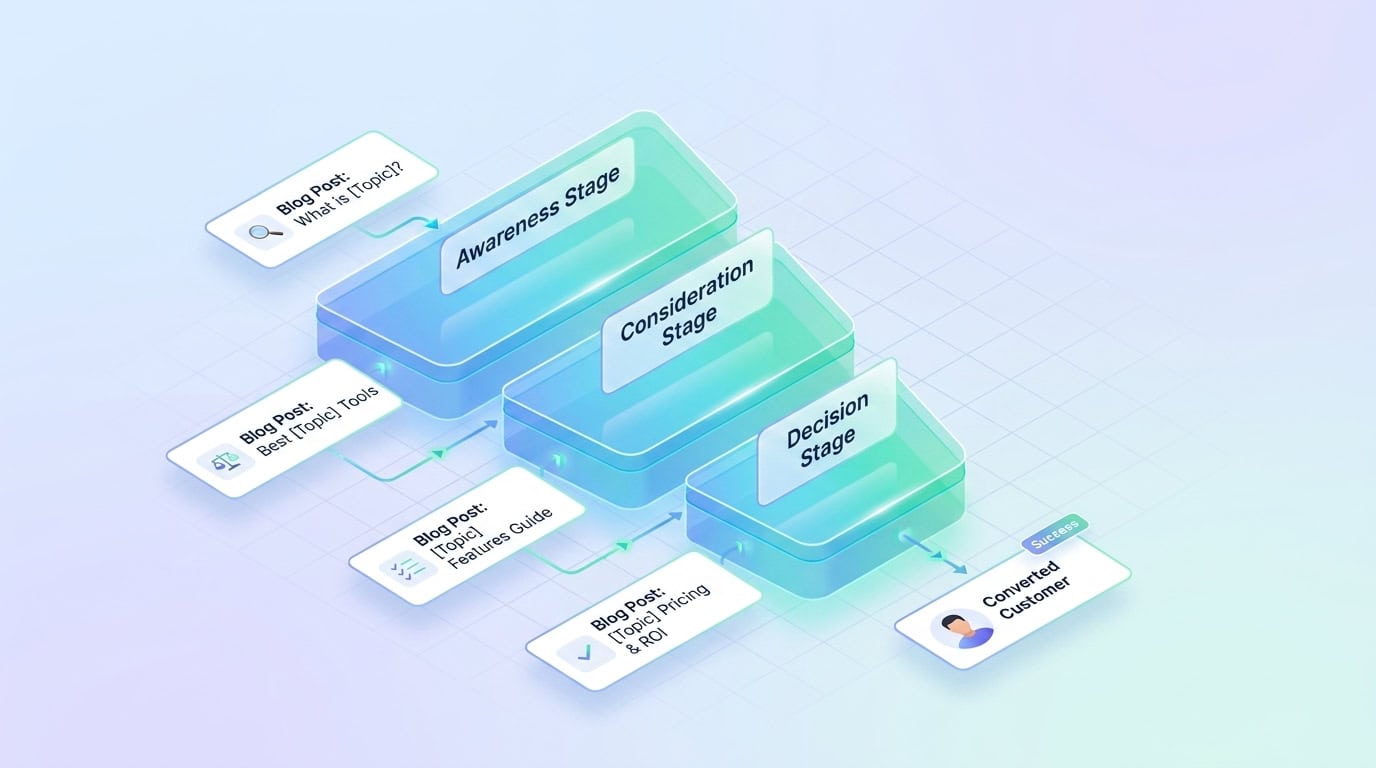
Content mapping is the strategic process of aligning your content types (informational, commercial, and transactional) with a user's cognitive state as they move from identifying a problem to finalizing a purchase decision. The traditional concept of a linear sales funnel has changed significantly as search technology becomes more sophisticated. Modern searchers don't move predictably from one step to the next, which means your content must serve as an ongoing support system.
The Evolution of the Three Classic Funnel Stages
The foundational levels of the marketing funnel consist of top-of-funnel (TOFU), middle-of-funnel (MOFU), and bottom-of-funnel (BOFU) stages. These levels correspond directly to the buyer's cognitive state as they identify a pain point, evaluate solutions, and eventually make a purchase decision. Search engines remain the primary tool for users as they navigate these distinct mental shifts.
- Awareness Stage: Users identify a problem and seek informational content.
- Consideration Stage: Users compare solutions and seek commercial content.
- Decision Stage: Users are ready to purchase and seek transactional content.
| Funnel Stage | User Cognitive State | Search Intent Type | Key Blog Formats | Example Query Modifiers |
| Top-of-Funnel (TOFU) | Problem-Aware, Solution-Unaware | Informational | Beginner Guides, Checklists, How-To Articles | how, why, what is, guide |
| Middle-of-Funnel (MOFU) | Solution-Aware, Vendor-Unaware | Commercial Investigation | "Vs" Comparisons, Best-of Roundups, Expert Guides | best, versus, top, review |
| Bottom-of-Funnel (BOFU) | Vendor-Aware, Ready to Buy | Transactional | Alternative-To Pages, Pricing Guides, Walkthroughs | pricing, buy, alternative, cost |
Forrester found that 74% of people use search engines for the consideration and purchase phases. This data emphasizes that your visibility must remain high throughout the entire process. If you only target the beginning of the journey, you risk losing prospects to competitors who provide more detailed bottom-of-funnel information.
Deconstructing the Messy Middle and Non-Linear Search Paths
With the rise of AI-powered search and conversational engines, the boundaries between the awareness and consideration stages have dissolved. Searchers now operate in a "messy middle," looping back and forth between exploring high-level concepts and evaluating specific solutions. Rather than following a neat, linear progression, modern users may seek quick definitions, jump to a video review, and then backtrack to a comprehensive comparison guide all within a single session.
Any informational gap in your content portfolio creates an exit point where prospects can slip away to competitors who offer more thorough answers. To prevent this, your blog must provide comprehensive coverage across every possible question a searcher might ask during these complex loops. Modern search results have evolved beyond simple keyword matching to favor deeply authoritative, contextually rich resources.
As Google increasingly integrates forum discussions, social media signals, and AI Overviews directly into search results, your articles must meet the highest standards of E-E-A-T to be cited. Structuring your content into clear, intent-driven categories is the most effective way to ensure your brand remains visible across both traditional search and AI answer engines.
Implementing Search Intent Mapping for Every Funnel Stage
Search intent mapping transforms traditional keyword research into a revenue-driving content map. By categorizing keywords by their underlying user intent, you can align specific articles with the searcher's exact expectation. Our Brand Voice hybrid human-AI approach handles competitor intent analysis, combining automated SEO data with manual human review to identify and bridge gaps in the messy middle.
Identifying Informational Intent for Awareness Stage Content
You can identify informational search intent by looking for specific keyword modifiers such as how, why, what is, and guide. These terms signal that a searcher is looking for education rather than a direct sales pitch at this point in their process. For example, a user searching for "how to track remote team productivity" is seeking to define and solve a managerial challenge they are just beginning to navigate.
Data shows that 93% of business-to-business (B2B) experiences begin with an online search, with 72% of those journeys starting on Google. Since 69% of buyers read blogs during the awareness stage, providing clear, helpful answers is essential to building early brand recognition. These informational queries allow you to establish authority by solving problems without immediately asking for a sale.
High-quality educational content helps you capture the 82% of shoppers who begin their buyer journey on a search engine. When a user lands on an informational post, they expect a deep, thorough, and objective resource that fully answers their query. Forcing a hard pitch or product trial too early disrupts their research, damages brand trust, and drives high bounce rates.
Uncovering Commercial Intent for Consideration Stage Content
Commercial investigation intent relates to consideration stage articles, where users are comparing their available options. You can spot this intent by looking for modifiers such as best, versus, top, and review within the search query. These terms indicate that the reader has already defined their problem and is now seeking an authoritative comparison to help narrow their choices.
With 50% of B2B buyers consuming up to 13 pieces of content before taking action, prospects require balanced, transparent information that highlights the strengths and weaknesses of various marketplace solutions. Rather than using biased marketing fluff, consideration stage articles should prioritize objective, side-by-side comparisons that help readers evaluate your offering against established industry standards.
Publishing these comparisons directly on your blog keeps users engaged on your site, preventing them from leaving to seek unbiased reviews on third-party platforms. This transparency builds long-term authority. It allows you to introduce your product or service with a tone of empathetic expertise, demonstrating exactly how your features resolve the frustrations identified during their initial research.
Targeting High-Intent Transactional Keywords for the Decision Stage
High-performing transactional blog content focuses on bottom-of-funnel queries where the user is on the verge of making a purchase. These queries often include modifiers like pricing, buy, alternative, or specific cost-related terms. At this point, the buyer is looking for a final vote of confidence to choose one brand over another.
Because 80% of buyers select from a narrow shortlist of only three vendors, decision-stage content must be highly persuasive and friction-free. These targeted articles help close the deal by providing absolute pricing transparency, technical specifications, and setup details. Since organic search contributes an average of 44.6% of revenue across major business sectors, optimizing these high-intent conversion pages directly impacts your bottom line.
Targeting specific, high-intent phrases like "enterprise CRM implementation cost" allows you to capture buyers who are ready to convert. High-performing transactional blog content focuses on systematically dismantling the final barriers to entry (such as software integration, compliance standards, and migration support), ensuring your brand stands out as the lowest-risk option on their shortlist.
Top-of-Funnel Formats: Building Awareness with Buyer Journey Blog Posts
At the top of the funnel (TOFU), your primary goal is to capture searchers who are experiencing a specific pain point but have not yet identified a solution. Successful TOFU content establishes early trust by addressing their core questions with high-quality, educational information.
Key Blog Formats and Angles for Awareness Content
The best formats for awareness-stage blog posts include beginner guides, detailed checklists, and foundational educational resources. Structure these articles to address specific pain points directly, such as explaining why legacy databases slow down during peak trading hours. This approach attracts organic traffic by directly resolving the searcher's initial query.
You should also create multimedia content like infographics or short videos that AI overviews can easily extract. Google now prioritizes contextual relevance and broad-based authority by pulling in related content from various social channels. Using these diverse formats ensures your awareness content is visible regardless of how the user chooses to search.
Acquiring links through high-quality educational content also generates more awareness across the web. When your blog posts solve a common problem, other websites are more likely to reference your work as a trusted source.
Defining Search Intent and User Mindset
At this stage, the user is problem-aware but solution-unaware; they can articulate their day-to-day struggle but do not know what tools, services, or frameworks exist to solve it. Your primary goal is to answer their core questions exhaustively to build early goodwill. This matches buyer preferences, as 71% of B2B buyers prefer educational content over promotional material during their initial research.
By addressing their concerns with empathy and clarity, you keep the reader engaged with your brand for a longer period. This engagement is fundamental because 57% of the buying process happens before a salesperson is ever contacted. If your awareness content is helpful, you become a natural choice when the user eventually moves into the evaluation phase.
Crafting Blog Posts for the Consideration Stage: Evaluating the Options
Once buyers enter the consideration stage (MOFU), they understand their core problem and are actively researching and comparing potential solutions. Your content must shift from general education to transparent, detail-rich comparisons that demonstrate how your solution matches their operational requirements.
Effective Formats: Vs. Articles, Best-Of Lists, and Expert Guides
Effective formats for the middle of the funnel include product-to-product comparisons and best-of roundups. Utilize deep-dive expert guides and industry-specific practitioner insights to build genuine, authoritative trust. Research shows that 63% of buyers consume three to five different types of content every week during this evaluation period.
Transparency is a major factor in building long-term authority at this stage of the journey. You shouldn't hide the strengths of your competitors, as an objective tone actually makes your own recommendations more believable. By providing honest comparisons, you help the 75% of buyers who use case studies and third-party reviews to evaluate their options.
Aligning Value Messaging to Address User Friction
Consideration stage content must proactively address common evaluation friction points, such as software integration, system compatibility, and feature limitations. You can weave in proof of your capabilities organically by referencing customer success stories or utilizing interactive product tours. This helps lower barriers to entry by showing the user exactly how your solution performs in a real-world scenario.
Since 72% of buyers are influenced by social proof during the consideration phase, including testimonials is a smart strategy. Introduce your products naturally, demonstrating exactly how they resolve the specific frustrations you outlined during the awareness stage. Strategic alignment helps the user feel confident that your brand understands their unique situation.
Publishing High-Converting Decision Stage Blog Posts: Closing the Deal
At the decision stage (BOFU), prospects are highly qualified and on the cusp of making a purchase. Your blog posts must address their final points of friction, clarify technical details, and present a compelling argument for why your brand is the best fit for their needs.
Creating Deep-Dive Alternative and Alternative-To Pages
Highly effective "alternative-to" or brand comparison posts allow you to position your product or service as the superior choice for a specific user persona or use case. Clearly define your unique selling proposition (USP) and explain exactly why your architecture or pricing model provides better value than your competitors. Interactive decision tools, such as direct comparison tables or downloadable feature sheets, are highly effective here.
These resources allow users to verify that your offering meets their technical requirements or budget constraints. When you provide this information clearly, you reduce the risk of the user abandoning their purchase due to a poor information experience. Providing content that is easy to share with other decision-makers helps move the process forward more quickly.
Using Customer Proof and Detailed Walkthroughs
Integrating user reviews and step-by-step product walkthroughs into your decision-stage posts makes them highly actionable. You can also use case studies to demonstrate real-world results that validate your claims. Since 68% of decision-makers say content impacts their consideration most, providing detailed evidence is a necessary part of the process.
For many B2B purchases, 73% of buyers require stakeholder consensus before they can finish a transaction. You can also share onboarding guides and usage tips at this stage to show that you support your customers even after the sale is complete. Practical post-purchase guides (such as step-by-step software configuration tips or hardware maintenance schedules) help users extract maximum value from their purchase.
The Post-Purchase Stage: Using SEO Content to Drive Loyalty and Retention
Retention is a major revenue driver that many brands overlook in their SEO strategy. Research from Gitnux indicates that 83% of loyal customers spend 67% more than new customers. By creating post-purchase content, you can turn a one-time buyer into a long-term advocate for your brand.
Content for this stage should focus on product mastery, troubleshooting, and advanced use cases. Practical post-purchase guides (such as step-by-step software configuration tips or hardware maintenance schedules) help users extract maximum value from their purchase. This ongoing support is necessary because 89% of customers stay loyal to a brand due to great service after the sale.
Proactive support content significantly reduces churn and improves customer satisfaction scores. Data shows that 52% of customers churn due to poor onboarding, making your post-purchase guides a vital retention tool. When you nurture existing customers, you tap into the 70% of the buyer’s journey that occurs through independent research and word-of-mouth.
When customers feel genuinely supported by a brand, they almost always come back to buy again. Statistics indicate that 94% of satisfied customers will repurchase, and 75% of revenue comes from repeat buyers. By mapping content to the loyalty phase, you increase the likelihood that a first-time visitor becomes a repeat customer.
Preventing User Drop-Off: Aligning CTAs with the Reader’s Cognitive State
Driving high-intent traffic to your blog is only half the battle; you must also convert that attention into action. To prevent high drop-off rates, every call-to-action (CTA) must match the buyer's current stage in the search funnel.
The Danger of High-Friction CTAs on TOFU Content
Placing high-friction calls-to-action like "book a demo" or "buy now" on a top-of-funnel educational post is a primary cause of high bounce rates. Because the searcher is still diagnosing their core problem, they are not ready for a sales conversation. Pushing a product trial too early damages trust and causes visitors to view your brand as transactional rather than consultative.
Data suggests that 60% of buyers abandon purchases if they have a poor sales experience, and this includes digital interactions. If your blog feels like a constant sales pitch, users will find another resource that prioritizes their education. You must respect the psychology of the reader by offering something that matches their current level of interest.
Designing a Progressive CTA Framework
A progressive CTA framework matches your requests with the reader's readiness to commit. For awareness posts, use low-friction offers like newsletter subscriptions or ungated checklists. As readers transition to consideration articles, elevate to medium-friction, semi-gated content such as templates, spreadsheets, or webinar invitations. These micro-commitments nurture the lead naturally without forcing a premature decision.
Once the user reaches a decision-stage post, you can finally feature direct paths to purchase or demo bookings. A progressive CTA framework works because it matches the user's readiness to take the next step. Since 85% of buyers prefer a self-service checkout process, making the final path to purchase seamless is a fundamental requirement.
Building a Unified SEO Funnel: Internal Linking and Content Sequencing
An effective buyer journey strategy does not treat blog posts as isolated landing pages. To guide users smoothly from awareness to conversion, you must design a logical, highly structured site architecture using internal links.
Structuring Internal Links to Guide Users Down the Funnel
Structure your internal links to form a logical pathway that leads from high-level awareness articles to deeper, relevant consideration posts. For example, a beginner guide on "how to manage remote engineering teams" should link directly to a comparison post evaluating the "best project management tools for software development." This flow establishes a clear topic hierarchy for search engine crawlers while guiding users naturally toward conversion.
Using topic silos is an effective way to plan which content lives in your main navigation and which stays on the blog. As people browse your website, you can present other helpful assets like e-books that assist them along their journey. A unified funnel ensures that your 71% of people who use search for discovery find a clear path to conversion.
Implementing Self-Service Libraries and Pillar Hubs
Structuring content into organized hubs or pillar pages allows self-directed buyers to research at their own pace. Because many users skip stages of the traditional funnel, a non-linear hub design accommodates diverse search behaviors. Incorporating sticky tables of contents and multi-stage pillar resources makes it effortless for visitors to jump to the exact subsection that addresses their immediate question.
Self-service options are increasingly popular, as 92% of buyers prefer to complete their purchases online whenever possible. Providing a knowledge base or an organized library of guides also supports your customers after they've made a purchase. Ongoing content for existing customers through newsletters and knowledge bases helps maintain brand engagement over time.
Measuring, Auditing, and Optimizing Your Buyer Journey Content
An effective intent-aligned content strategy requires continuous evaluation and refinement. To scale your organic growth, you must track specific metrics for each funnel stage and audit your catalog regularly to prevent performance leaks.
Key Metrics to Track Across Funnel Stages
For the awareness stage, measure top-line metrics like impressions, Google Search Console position, and organic click-through rates. Middle-of-funnel KPIs should track content-upgrade downloads, newsletter sign-ups, and engaged session dwell times. These indicators show whether your educational resources are successfully moving searchers from problem diagnosis to active evaluation.
Bottom-of-funnel metrics focus heavily on financial outcomes, such as page value and lead-to-opportunity conversion rates, while behavioral metrics like scroll depth and exit rate help pinpoint exactly where buyers lose interest. You should track assisted conversions to understand how informational blog posts contribute to the final sale. Using Google Analytics 4 (GA4) path analysis and customer relationship management (CRM) integration can help you visualize how different pages work together to generate revenue impact.
Performing a Content Gap and Intent Cannibalization Audit
A rigorous content audit identifies missing assets in your funnel and prevents keyword cannibalization issues. To begin, inventory your existing blog posts and map each URL to a single, primary buyer persona and journey stage. This audit highlights structural imbalances (such as having dozens of high-traffic awareness posts but no middle- or bottom-of-funnel conversion assets).
- Export current rankings: Pull your ranking and click data from Google Search Console to see what is currently driving traffic.
- Categorize each URL: Map each high-traffic page to its corresponding funnel stage (TOFU, MOFU, or BOFU) based on its primary search intent.
- Identify content clusters: Pinpoint topic clusters where you have high search volume but low conversions to find optimization and internal linking opportunities.
Refreshing older content is a necessary part of this audit to ensure it aligns with current user search intent. You can use tools like Google Search Console to measure SERP presence and find low-click keywords that might need better optimization. By assigning distinct keywords with unique modifiers to specific pages, you ensure your posts don't compete with each other.
Frequently Asked Questions About Buyer Journey Blog Posts
The following guide addresses common questions marketers face when mapping their content strategies, providing concise information to help improve search visibility.
How do you transition a reader from an awareness post to a consideration post?
To transition a reader effectively, follow these three core steps:
- Use contextual internal links: Embed natural anchor text in your awareness post that points to related, deeper comparison articles.
- Offer content upgrades: Provide a downloadable, low-friction asset like a checklist, template, or comparison sheet that helps solve their next logical question.
- Capture contact details: Invite the reader to join your newsletter to receive weekly educational insights, keeping your brand top-of-mind.
Can a single blog post target multiple stages of the buyer's journey?
Yes, a comprehensive pillar page or "ultimate guide" can address multiple stages of the buyer journey, but it must be meticulously structured. To do this successfully, use a clear table of contents with anchor links and distinct subheadings (H2s and H3s) that cater to different intents (starting with high-level educational definitions at the top, and moving into concrete product comparison tables towards the bottom). This allows users to jump directly to the section that matches their current cognitive state without being forced to read irrelevant information.
How do you avoid keyword cannibalization when writing for different funnel stages?
To prevent keyword cannibalization across funnel stages, assign unique primary keywords and modifiers to each stage. For example, target "project management software features" (informational/TOFU) on one page, and "project management software pricing" (transactional/BOFU) on an entirely separate page. Map your keywords to a centralized sheet before writing to ensure no two pages compete for the exact same query, and use internal links to signal their hierarchy to search engine crawlers.
What is search intent mapping, and why is it essential for SEO return on investment (ROI)?
Search intent mapping is the process of aligning your content strategy with the explicit needs, expectations, and goals of the user behind a search query. It is essential for maximizing SEO ROI because driving high volumes of traffic does not guarantee conversions. By ensuring that the intent of your landing page matches the searcher's intent, you reduce bounce rates, increase session duration, and guide qualified traffic directly to the appropriate call-to-action.
Scale Your SEO Content Strategy with Brand Voice
Aligning your blog posts with the buyer journey is a complex process that transforms your website into a powerful revenue engine. By understanding search intent, building trust through education, and providing the right proof at the right time, you can significantly improve your conversion rates. Executing a full-funnel strategy requires consistent effort, thorough competitive analysis, and a deep understanding of your audience's needs.
Our expertise in creating ready-to-publish articles helps you implement this framework without the usual overhead of managing a large writing team. We use a hybrid human-and-AI content model to handle every aspect of your campaign, from initial strategy and topic research to professional writing and optimization.
If you're ready to drive qualified traffic and boost your conversions, let us help you build a content strategy that works. Book a demo today to see how our human-led expertise can scale your organic growth and achieve your marketing goals.