- Relying on unstructured operations and disjointed freelance networks increases production time by 20 percent per asset and causes severe brand voice dilution.
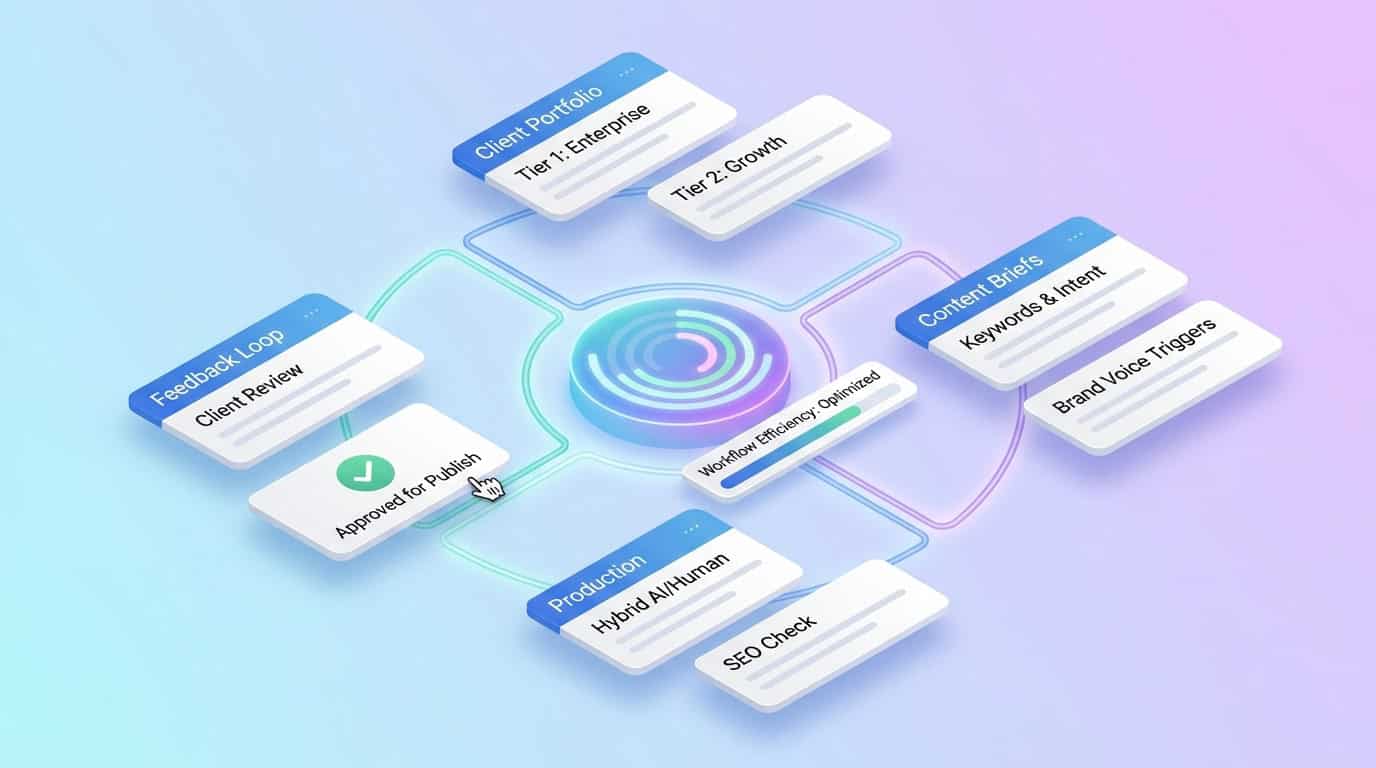
- Categorizing your agency client portfolio by complexity, industry vertical, and priority tiers ensures optimal resource allocation for scalable copywriting workflows.
- Constructing scalable content briefs that detail primary keywords, search intent, and unique brand voice triggers eliminates ambiguity and improves first-draft approval rates.
- Implementing a centralized tech stack to track assets across six core editorial milestones eliminates production bottlenecks and streamlines SEO content optimization.
- Leveraging strategic partnerships like white-label SEO content services and hybrid human-AI methodologies allows agencies to scale production capacity without increasing internal overhead.
- Establishing dedicated client workspaces and strict service level agreements for feedback loops accelerates the approval lifecycle and prevents costly publication delays.
Growing an agency from five to 50 accounts often leads to a breakdown in production quality and profit margins. When your scaling copywriting workflows rely on loose freelancer networks, the resulting friction causes missed deadlines and brand dilution. To maintain high-intent search visibility for a complex agency client portfolio, you must transition toward structured agency content operations. This article provides a blueprint for building editorial workflow systems that reduce cognitive load while increasing content volume and search engine optimization (SEO) performance.
The Critical Fractures in Unstructured Agency Content Operations
Operational inefficiencies, such as manual status updates in spreadsheets and hunting down drafts across emails, introduce significant administrative overhead during scaling phases. Relying on ad-hoc tools and disjointed chat channels leads to widespread client dissatisfaction. These challenges are usually structural failures rather than issues with individual performance. Systems must replace manual effort to ensure the agency remains profitable as the client list expands.
Severe Context Switching and Brand Voice Dilution
Jumping between technical B2B software topics and consumer lifestyle campaigns in a single afternoon creates massive psychological overhead, draining focus and making high-quality output difficult to sustain.
Juggling multiple brands often leads to homogenized content that dilutes each client's unique brand identity. When writers are overextended, they frequently default to standard phrasing that lacks specific nuance. The resulting assets may meet word count requirements but fail to resonate with the intended target audience. Consistency suffers when a writer cannot fully immerse themselves in a single brand's perspective.
Preserving unique brand style guidelines requires a conceptual framework that treats each voice as a distinct asset. Agencies must implement specific protocols that help writers reset their focus before starting a new project. Without these safeguards, the strategic risk of voice dilution becomes a permanent obstacle to client retention and brand authority. Dedicated brand immersion periods can mitigate this risk by allowing writers to refocus.
The Bottleneck of Uncoordinated Freelance Networks
Relying on loose networks of freelance writers presents significant structural limitations for growing agencies. Unpredictable writer availability often clashes with urgent client deadlines, creating a cycle of reactive management. Varying quality standards also make it difficult to provide a consistent experience across the entire client portfolio. Such erratic quality forces senior editors to spend excessive time on basic revisions.
Managing dozens of separate freelance agreements and individual communication channels consumes valuable account management time. These administrative tasks distract leadership from high-level strategy and business development. This operational capacity problem prevents true scalability by tying production growth to a corresponding increase in manual management effort. Agencies often find that the cost of managing freelancers eventually outweighs the benefits of their flexibility.
Freelance pools often lack the necessary alignment with modern search-optimized content requirements. This gap forces internal editors to perform additional heavy lifting, which further reduces the agency's profit margins. Moving toward a more integrated model is the only way to break free from these recurring production constraints. Integrated teams develop a shared understanding of SEO goals that solo freelancers rarely achieve.
Fragmented Client Communication and Disjointed Review Chains
Unstructured client feedback loops significantly extend the approval lifecycle, delaying publication and search engine indexing. When comments are scattered across disconnected platforms like Slack and email, the absence of a structured feedback pipeline leads to endless revision rounds. These delays ultimately result in lost billable hours and strained relationships with key stakeholders.
Unorganized feedback ruins production momentum and introduces significant room for human error in final drafts. When comments are not centralized, an editor might miss a specific client request or a required compliance update. This lack of clarity forces teams to work twice as hard to achieve the same result. Centralized feedback systems eliminate this confusion by providing a single trail of communication.
Establishing a single source of truth for all client communications is a requirement for any agency that wants to scale. Streamlining the review chain ensures that every stakeholder knows exactly where a project stands at any given moment. This transparency reduces anxiety and allows the production team to focus on the work itself. Clear communication protocols protect the agency's time and the client's interests simultaneously.
How to Manage a Client Portfolio for Scalable Content Production
An agency's client roster must be treated as a diversified portfolio that is segmented for maximum operational efficiency. Grouping clients by shared parameters allows for logical resource allocation rather than treating every deliverable as a custom project. Account managers assign clients to complexity tiers to match specialist writers with technical search intent. This strategic categorization is the first step toward scaling copywriting workflows without adding unsustainable overhead to your team.
Categorizing Clients by Complexity, Industry Vertical, and Scale
Client portfolio management requires a clear understanding of subject matter difficulty and technical requirements. A generalist approach fails when writing for highly regulated fields such as legal services or enterprise technology. These sectors demand a level of expertise that goes beyond basic copywriting skills. Specialized knowledge ensures the content remains authoritative and compliant with industry regulations.
Mapping clients to specific complexity tiers ensures that the right expertise is matched to each asset from the start. High-complexity clients require writers with specific certifications or years of experience in a particular niche. Conversely, general lifestyle clients can often be handled by versatile writers who specialize in broader consumer engagement. Matching the writer's skill level to the project's difficulty optimizes the quality of the output.
Categorization by industry vertical also allows for better research efficiency across the team. When writers work within a specific cluster of industries, they develop a deeper understanding of common pain points. This expertise translates into faster turnaround times and higher first-draft approval rates for the agency. Familiarity with industry jargon allows writers to produce more convincing and authoritative copy.
The Anatomy of a Scalable Content Brief
Constructing a scalable content brief is the most effective way to eliminate ambiguity during the production cycle. Every brief must include primary and secondary keywords, target word counts, and a clear analysis of search intent. You should also define primary entities and internal link targets to ensure the piece fits into a broader SEO strategy. A well-documented brief serves as a contract between the strategist and the writer.
Briefs should provide suggested heading structures and competitive reference links to give the writer a clear roadmap. Unique brand voice triggers and specific banned terms must be included to maintain brand integrity across the portfolio. This level of detail prevents the writer from guessing the client's expectations or technical requirements. When the brief is comprehensive, the first draft is much more likely to meet the client's needs.
A standard briefing template creates a consistent language between the strategy team and the production team. This consistency reduces the time spent clarifying instructions and allows the writers to focus on creative execution. It also provides a benchmark for editors to use when reviewing the initial drafts for compliance. Professional briefing processes are the backbone of high-volume agency content operations.
Designing Tiered Content Production Frameworks
Structuring content deliverables into defined priority tiers allows an agency to focus its best resources on high-value work while protecting overall profitability. This tiered production framework is summarized below:
| Priority Tier | Content Type & Scope | Resource Allocation & Expertise |
| Tier 1: Core Pillars | High-value commercial pillar pages requiring deep research, competitive analyses, and comprehensive expert editing. | Senior-level copywriters and specialist subject-matter expert (SME) editors. |
| Tier 2: Cluster Articles | Supporting search-optimized blog posts designed to build topical authority and drive consistent traffic. | Versatile, SEO-trained writers and core internal editorial QA. |
| Tier 3: Maintenance Content | FAQ updates, brief blog refreshes, micro-copy, and light social teasers to maintain current engagement. | Junior writers, automated formatting templates, and rapid editor review. |
5 Essential Editorial Workflow Systems for Scaling Agency Operations
Standardized editorial workflow systems automate the production of search-optimized articles for agency clients. These systems act as the engine of any scaled agency by providing a roadmap for every piece of content. Transition phases, status updates, and clear hand-offs are critical for maintaining production speed and reducing human oversight. A highly structured system allows teams to track progress without manual intervention.
Building a Tech Stack for Scaled Agency Content Operations
An effective content operations tech stack must go beyond basic spreadsheets to manage high-volume, multi-client pipelines. To keep operations organized, agencies should integrate tools across three core categories:
- Workflow & Project Management: Platforms like ClickUp, Asana, or Monday.com to track tasks, assign deadlines, and define clear milestones.
- SEO Optimization & Content Grading: Semantic SEO tools such as Clearscope, Surfer, or Semrush to ensure writers target high-intent search entities.
- Collaboration & Quality Editing: Shared writing spaces like Google Workspace combined with editorial tools like Grammarly or Hemingway Editor to maintain high standards.
Structuring the Production Pipeline: The Six Core Editorial Milestones
A content piece must navigate several exact stages from initial ideation to live publication to ensure quality. Breaking this process into milestones allows management to identify bottlenecks and allocate resources effectively. The following six milestones define the standard agency content pipeline:
- Briefing Phase: Strategy teams define keywords and search intent while creating the technical outline.
- Drafting Stage: Assigned writers complete the primary creative work under a strict deadline.
- Editorial Review: Human editors verify the tone, brand alignment, and factual accuracy of the draft.
- Optimization Stage: SEO specialists refine the content to meet specific performance and ranking goals.
- Client Approval: Stakeholders review the asset and provide final feedback or approval for publication.
- Publication Phase: Technical teams upload the final version to the appropriate content management system (CMS) and check formatting.
Each of these milestones must have a single assigned owner who is responsible for the quality of the work. This structured approach prevents individual assets from getting lost or forgotten during busy production cycles. By tracking the progress of each piece through these six milestones, management can identify exactly where delays occur. This visibility is necessary for making data-driven decisions about team capacity and resource allocation.
Automating Semantic Internal Linking
Manually tracking internal links across dozens of client domains is a common scaling bottleneck. To automate this process, agencies can utilize dedicated SEO plugins like Link Whisper for WordPress sites, semantic SEO software like InLinks, or build custom master indexing sheets in Google Workspace using automated lookup formulas. Automating this step ensures new articles consistently link back to core pillar pages, strengthening the site's topical authority without requiring hours of manual site audits.
Implementing Scalable Quality Control and SEO Content Grading
Professional quality assurance and SEO compliance must be verified before any piece is sent to the client. Implementing a formal content grading process allows you to systematically check drafts against optimization criteria and readability scores. This gate ensures that only the best work leaves the agency, which directly protects your professional reputation. Consistent quality control builds long-term trust with every client in your portfolio.
To reduce client revision cycles and keep production moving efficiently, every draft must pass a standardized content quality gate checklist before submission:
- SEO Optimization: Achieve a target score (such as 75+ in Surfer SEO or Clearscope) by naturally integrating primary and secondary entities.
- Factual Integrity: Verify all external data, stats, and quotes back to primary sources, ensuring no hallucinated or outdated claims.
- Brand-Voice Match: Check the draft against the client's brand style guide, verifying that specific tone triggers are used and banned words are excluded.
- Formatting & Scanability: Ensure proper heading hierarchies, short paragraph structures, and clean bullet lists to optimize readability.
Leveraging Strategic Partnerships: White-Label and Hybrid Copywriting Workflows
Scaling agency content operations requires a balanced resourcing strategy that goes beyond simple hiring. Agencies can choose between in-house teams, freelance pools, and modern white-label content production services to meet their needs. By utilizing white-label SEO content for agencies, you can fulfill high-volume requests without the administrative burden of traditional hiring. Strategic partnerships allow you to unlock unlimited production capacity without taking on the financial liability of a bloated internal headcount.
The Economics of In-House Teams vs. External Production Partners
Hiring permanent in-house copywriters involves high costs that can impact an agency's bottom line. Salaries, benefits, and office space are just the beginning of the financial commitment required for a full-time staff. Onboarding time also represents a major investment that does not produce immediate revenue for the company. Agencies must balance these fixed costs against the variable nature of client contracts.
External production networks offer a variable cost model that aligns expenses directly with active client revenue. This flexibility is especially useful during seasonal lulls or when a client pauses their marketing budget. Agencies can scale their production up or down without the painful process of layoffs or the stress of empty bench time. This agility is a significant competitive advantage in a fluctuating market.
Relying solely on an in-house team can also limit the diversity of expertise available to your clients. External partners often have access to a wider range of specialist writers who can handle technical topics with ease. This access allows the agency to take on more complex projects without the risk of overextending its internal staff. Specialized partners bring a depth of knowledge that is hard to replicate with a small internal team.
Utilizing White-Label Content Production for Financial Return on Investment (ROI)
Partnering with a white-label content production service allows agencies to scale rapidly by acting as a silent back-end engine. These services deliver ready-to-publish articles that you can rebrand as your own work. This model eliminates the overhead costs of recruiting, training, and managing an internal copywriting team from scratch. You only pay for the content you need, which protects your margins during growth phases.
Operational benefits include predictable fixed pricing and guaranteed turnaround times for every project. High first-draft approval rates are a hallmark of professional white-label services that understand the needs of agency clients. This reliability allows your core team to focus entirely on high-level strategy and building stronger client relationships. You can spend more time on high-value consulting and less time on production management.
A white-label partner also provides a level of scalability that is difficult to achieve with individual freelancers. They can handle a sudden influx of work by tapping into their established infrastructure and management systems. This partnership ensures that your agency never has to turn away a new client due to a lack of writing capacity. Scaling becomes a matter of requesting more assets rather than managing more people.
Implementing Hybrid Human-AI Editorial Workflows
To successfully implement a hybrid workflow, agencies must draw clear boundaries between automated generation and expert human craftsmanship:
- AI-Assisted Efficiency: Use tools to quickly parse competitor heading structures, generate keyword brief lists, draft structured outlines, and spin out basic metadata or social copy variations.
- Human-Only Editorial Gates: Assign skilled writers and editors to conduct interviews with subject matter experts, insert authentic first-person insights or case studies, check factual accuracy, and calibrate style to align with client brand guidelines.
Optimizing Client Communication and the Approval Lifecycle
Managing the client-facing side of content operations is just as critical as the writing process itself. The way you gather approvals can either accelerate a campaign or drag it into a state of permanent delay. Agencies must establish structured communication protocols that remove friction for the client while protecting the internal production schedule. Efficient communication is the glue that holds a complex portfolio together.
Creating Dedicated Client Workspaces to Prevent Context Overhead
Dedicated client-specific workspaces or portals eliminate the confusion that often comes with managing multiple accounts. Housing a client's content calendars and historical assets in one location creates a single source of truth. This organization prevents the scattering of information across various email threads and chat channels. It also gives the client a professional window into the agency's progress.
This isolation of client data ensures that team members can transition context cleanly between different brands. When an editor moves from a tech client to a healthcare client, they can find everything they need in the dedicated workspace. This clarity reduces the risk of mixing up brand guidelines or tone preferences during the production process. Clean context transitions are essential for maintaining high editorial standards.
Workspaces also give the client a sense of ownership and transparency over their projects. They can log in at any time to see the status of their content and provide feedback in a structured way. This professional presentation builds trust and makes the agency's operations feel more like a premium partnership. Transparency is a powerful tool for client retention and satisfaction.
Establishing Service Level Agreements (SLAs) for Client Feedback Loops
Establishing clear Service Level Agreements (SLAs) prevents client review cycles from stalling your content calendar. Implement these standard policies during client onboarding:
- The 48-Hour Feedback Window: Clients have 48 hours to request revisions on any draft. If no feedback is received, the content is automatically approved for publishing.
- Cap on Revision Rounds: Limit standard project scopes to two rounds of revisions. Any subsequent changes require separate hourly billing or scope adjustments.
- Consolidated Revision Requests: Require client stakeholders to compile all feedback into a single central thread or document rather than sending scattered messages.
Key Performance Indicators for Agency Content Operations
Measuring operational data is essential for the continuous improvement of any content team. Without tracking specific performance metrics, agencies cannot accurately locate bottlenecks or evaluate the profitability of their copywriting workflows. monitoring these critical key performance indicators (KPIs) provides the insights needed to refine your systems and grow your agency with confidence. Data-driven management removes the guesswork from the scaling process.
Tracking Production Velocity and Turnaround Times
To systematically monitor production velocity, agencies should track three specific operational metrics:
- Brief-to-Draft Time: The total business days required to move an asset from keyword strategy or briefing to the first complete draft.
- Internal Editorial Cycle: The total business hours spent in editorial QA and semantic SEO optimization before client delivery.
- Approval Cycle Time: The duration between first-draft submission and final client approval.
Analyzing these milestones helps isolate whether production bottlenecks reside internally with production staff or externally with client feedback loops.
When a client knows exactly when to expect their content, they can plan their own marketing activities more effectively. This predictability is a hallmark of a professional agency that has mastered its internal operations. Reliable delivery schedules allow clients to coordinate social media and email campaigns with confidence. A predictable agency is a valuable partner for any growing business.
Monitoring First-Draft Approval Rates and Revision Ratios
To evaluate your agency's content quality control, establish and track these two key metrics:
- First-Draft Approval Rate: Target an approval rate of greater than 80% with zero or minor changes. A lower rate typically indicates weak briefs or misaligned brand guidelines.
- Revision-to-Asset Ratio: Target an average of fewer than 1.5 revision cycles per asset. Ratios above this suggest a lack of technical training, poor writer selection, or out-of-scope client demands.
Scale Your Agency Writing Workflows with Brand Voice
Building scalable and bottleneck-free agency content operations requires a commitment to structured frameworks and repeatable editorial systems. By segmenting your portfolio and implementing clear production milestones, you can move away from the chaos of uncoordinated freelance networks. This professional approach to management allows your agency to grow its revenue while maintaining the high-quality standards that your clients expect. Transitioning from chaos to structure is the only way to ensure long-term profitability.
Partnering with Brand Voice allows you to implement these strategies without the technical overhead of managing an internal team. Our hybrid human-AI approach and dedicated multi-client workspace system allow us to act as a silent and powerful back-end partner for your business. We deliver fully optimized and ready-to-publish articles that you can confidently rebrand as your own work every single time. Book a demo today to learn how Brand Voice can streamline your content pipeline so you can focus on scaling your agency.