- Prioritizing high-intent keyword research over broad, high-volume vanity search traffic is essential for driving bottom-of-funnel content conversions and sustainable revenue growth.
- Implementing a long-tail keyword strategy captures niche, ready-to-buy customers, yielding an average conversion rate of 36 percent and significantly reducing customer acquisition costs.
- Highly specific "zero search volume" keywords frequently indicate motivated buyers using precise language that standard SEO databases overlook due to data lag.
- As AI search overviews increasingly cannibalize clicks for simple informational queries, brands must shift their SEO blog post topics toward specialized, multi-layered commercial intent.
- B2B SEO strategies must address a complex buyer's journey by targeting middle-of-funnel comparison topics that satisfy the unique search intent of the 6 to 15 different stakeholders involved in purchasing decisions.
- Shifting reporting away from raw pageviews toward business-focused metrics reveals that targeted organic SEO leads typically convert at twice the rate of cold paid leads.
You finally hit your organic search goals, but revenue hasn't budged. It is a frustrating scenario that leaves marketing teams scrambling to justify their budgets. Learning how to choose search engine optimization (SEO) blog post topics that attract ready-to-buy customers is the most direct path to increasing bottom-line performance. Applying a data-driven business blogging strategy allows you to identify high-intent keyword research opportunities, prioritize bottom-of-funnel content, and move completely beyond vanity metrics.
Prioritizing conversion-focused terms aligns your content directly with the active purchase goals of your target buyers. This approach builds a resilient organic engine that converts traffic into revenue, surviving the volatility of modern search algorithms.
The Core Shift: Why High-Volume Keywords Without Search Intent Kill Your Return on Investment (ROI)
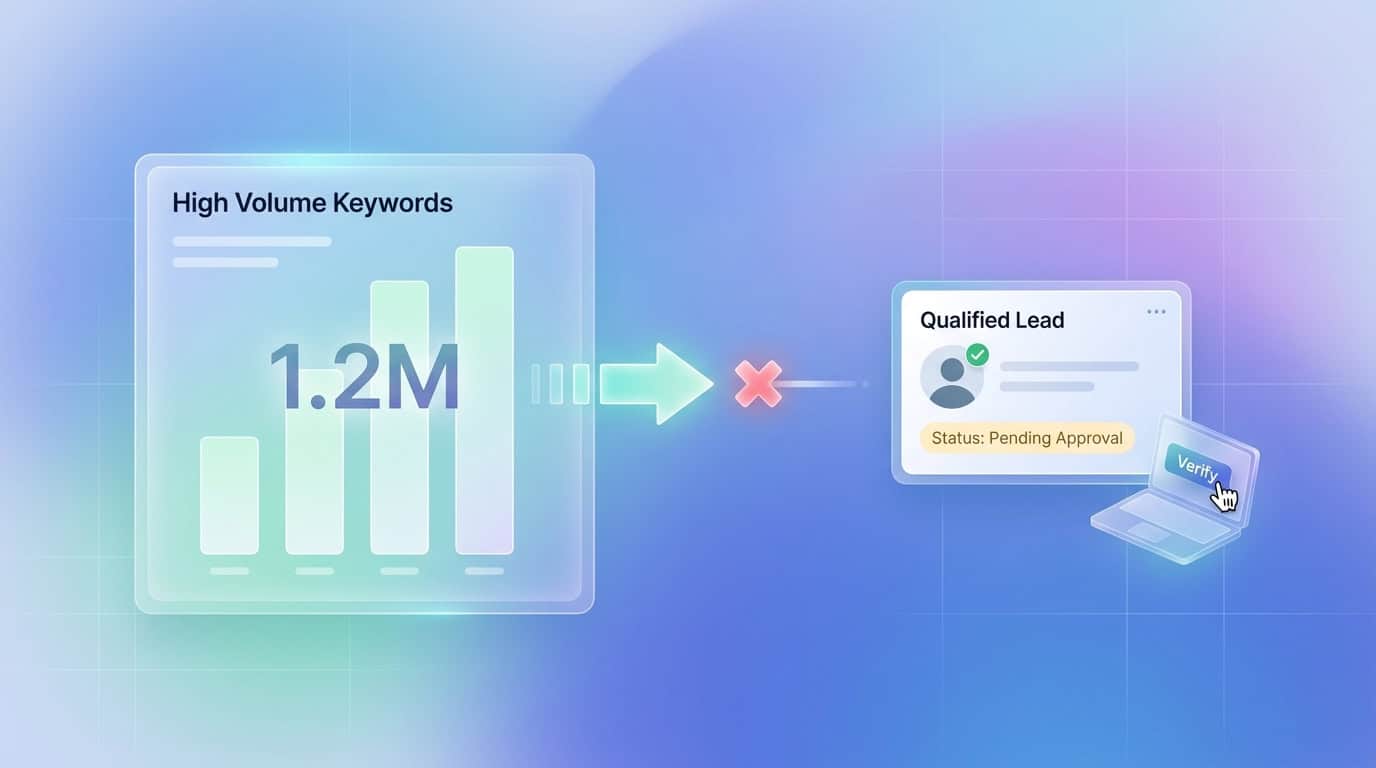
Traditional marketing metrics often place an unhealthy emphasis on raw traffic increases regardless of the quality of those visitors. According to a recent Stratabeat SEO Performance Report, 37.1% of business-to-business (B2B) software-as-a-service (SaaS) websites experienced a traffic decline in 2024 and 2025, even when their search rankings remained stable or improved. The decline highlights a growing gap between maintaining a position on a search engine results page and capturing the attention of a human lead.
Prominent marketing platforms such as HubSpot saw a 70% to 80% decline in organic traffic between 2024 and 2025 while maintaining their rankings, according to The Digital Bloom's 2025 Organic Traffic Crisis Report. The resulting "dashboard effect" creates a false sense of security that prevents companies from addressing the real needs of their target market. Chasing massive search volume frequently results in high bounce rates and disappointing conversion figures.
What is Vanity Search Traffic and Why is It Misleading?
Vanity search traffic refers to visitors who arrive at a website through broad, informational queries that lack any commercial drive. Popular SEO databases often report search-volume numbers that can be highly deceptive for strategic planning. A traffic data accuracy study by Promodo comparing third-party metrics against actual Google Search Console data across 184 websites revealed average error rates of 61.58% for Semrush and 48.63% for Ahrefs.
Such inaccuracies mean that marketing teams frequently celebrate artificial wins based on inflated analytics while the sales pipeline remains stagnant. High-volume queries often target users who have no intention of purchasing a product or service. Relying on broad data points often leads to a content strategy that ignores the specific problems real buyers are trying to solve.
For websites receiving fewer than 5,000 monthly clicks, the reliability of these industry-standard platforms drops even further. Niche B2B sites are particularly vulnerable to making poor strategic decisions based on these skewed volume metrics. Shifting away from these metrics is necessary for long-term growth.
The Financial Opportunity Cost of Chasing High-Volume Trophy Keywords
Chasing broad trophy keywords burns through your time, budget, and creative energy. These terms possess significant search volume, but they often carry very low transactional value for a specific brand. Small and mid-sized companies find themselves fighting an uphill battle against giant established media sites that have dominated these general terms for years.
The opportunity cost of this approach often manifests as a 30% to 50% increase in customer acquisition costs compared to targeted long-tail strategies. Instead of producing highly targeted middle-of-funnel content, writers spend weeks crafting broad guides that users skim and then abandon. These pages typically see high bounce rates because the content is too general to help a searcher with a specific business requirement.
Devoting an entire team to informational guides that do not convert drains the energy available for high-impact projects. A focused strategy targets the segments of the market where the brand actually has a competitive advantage. Constant competition for high-volume terms rarely yields the return on investment that sustainable business growth requires.
Understanding the Search Intent Spectrum: Matching Topics to the Buyer's Journey
What is Search Intent? Search intent is the primary goal a user has when typing a query into a search engine. When a content strategy fails to align with this specific goal, it ruins the overall performance of the SEO program. Identifying what a user truly wants to achieve is more important than the number of people performing the search.
Marketers generally divide the buyer's journey into three specific stages that define a user's progress toward a purchase. These stages include:
- Awareness Stage: Users identify a problem and seek informational content.
- Consideration Stage: Users compare solutions and seek commercial content.
- Decision Stage: Users are ready to purchase and seek transactional content.
Identifying the precise intent behind a search query is the foundation for mapping out high-performing blog topics. A comprehensive search intent study by SparkToro and Datos reveals that only about 14.5% of Google searches are commercial, while a mere 0.69% are purely transactional in nature. These high-intent terms represent a small portion of total queries, but they carry the highest potential for immediate revenue.
To align your content strategy with real revenue, you must match your topics to where a buyer stands in their purchase cycle. Summarized below is the search intent spectrum and its business value:
| Intent Type | User Goal | Keyword Modifiers | Conversion Potential |
| Informational | Understand a basic concept or diagnose a high-level problem. | "what is," "how to," "guide," "examples" | Low (<0.5%) |
| Commercial | Compare specific solutions, software tools, or service options. | "best," "versus," "alternatives," "reviews" | Medium (1.0% - 2.0%) |
| Transactional | Make an immediate purchase or request a direct sales demonstration. | "pricing," "buy," "free trial," "demo" | High (2.0% - 5.0%+) |
The Foundations of High-Intent Keyword Research for Commercial Growth
High-intent keyword research identifies the specific search queries of motivated buyers. Focusing on urgency differs fundamentally from traditional methods that focus on total volume. Successful research focuses on the actions searchers want to take and the specific problems they need to solve right now.
Teams should use Google Search Console and Google Analytics 4 to evaluate core ranking entities, click-through rates, and semantic vector associations to understand existing performance. These platforms provide concrete technical nuance that third-party tools sometimes miss. Analyzing your own search data allows you to find keywords that already drive high-quality leads.
Search intent mapping transforms keyword research into a revenue-driving strategy. It allows you to prioritize topics that have high earning potential, even if the search volume appears low. High-intent research builds a foundation for long-term authority and customer trust.
Mapping the Core Pain Points of Your Ideal Customer Persona
To choose blog topics effectively, you must align them with the genuine frustrations of your customers. Start by putting yourself in the position of your ideal client and listing the obstacles they face. Rather than targeting broad topic areas, map specific frustrations to solution-focused keywords. For instance, instead of writing an informational guide on 'how to manage HVAC technician schedules' (high-volume, low-intent), target a precise search query like 'HVAC dispatch software with real-time GPS tracking' (low-volume, high-intent) to capture users who are actively looking to purchase a tool today.
Valuable insights often hide within your customer service tickets and survey campaigns. Your front-line sales representatives can reveal the common questions or phrases people use when they are evaluating their options. The language used in these daily interactions often mirrors the exact search terms people use when they are ready to buy.
Mining your reviews and online forums for recurring complaints also provides a goldmine of content ideas. Translating these real-world complaints into optimized blog posts creates a highly targeted organic funnel. Review mining ensures you capture motivated searchers looking for the specific relief your product provides.
Utilizing Competitor Gap Analysis to Identify Unlocked Revenue
Competitive intelligence is a powerful tool for selecting topics that have already proven to be profitable. Your competitors may already be capturing buyer intent searches that you have not yet targeted in your own strategy. Analyzing their domains can reveal the exact commercial keywords that are driving their organic conversions.
To execute this in tools like Ahrefs or Semrush, enter your top competitor's domain in the Site Explorer, navigate to their Organic Keywords report, and apply an 'Include' filter with word modifiers like best, vs, alternative, pricing, and review. Then, sort the list by Cost-Per-Click (CPC) descending to isolate keywords that competitors are paying to capture immediately.
Once you identify these gaps, focus on creating superior and higher-value alternatives to their existing articles. Address the same search queries but provide more depth, better data, or more recent insights. Creating better resources allows you to claim a share of the high-intent traffic that your competitors are currently monopolizing.
A Step-by-Step Process to Choose Blog Topics That Drive Immediate Conversions
Following a structured framework helps demystify the selection of high-intent keywords. The structured workflow provides a clear pathway to win high-value featured snippets and increase lead acquisition. By organizing your efforts, you can ensure every piece of content serves a specific business purpose.
Establishing this repeatable methodology is essential for connecting SEO to business value. The prioritization framework moves beyond simple volume metrics to prioritize topics based on their proximity to a sale. Every step in this process is designed to turn organic search into a predictable sales pipeline.
Step 1: Brainstorming Solutions to High-Value Customer Obstacles
The initiation phase involves listing every major friction point a prospect faces before finalizing a purchase. Identify the common objections and hurdles that might cause a potential customer to hesitate. These obstacles represent the final questions that must be answered to move a lead across the finish line.
To bridge this gap, map sales objections directly to pre-qualifying blog topics using this framework:
- Objection: 'How difficult is the setup or data migration process?' → Blog Topic: Step-by-Step Migration Guide: Moving from [Competitor] to [Our Product]
- Objection: 'Is this tool secure enough for enterprise data?' → Blog Topic: An Inside Look at [Our Product] Enterprise Security Protocols and Certifications
- Objection: 'Why is this software more expensive than basic alternatives?' → Blog Topic: [Our Product] Pricing: Why We Cost More (and How We Drive Higher ROI)
Step 2: Deciphering Money Keywords in Search Engine Results Pages (SERPs)
A manual audit of the search results is the best way to validate the commercial viability of a topic. If you see Google Shopping blocks or multiple product pages, the search engine has interpreted the query as having high purchase intent. These visual cues serve as proof that users are looking to spend money when they use those specific terms.
Terms like discount, deal, or free shipping strongly indicate a buyer looking for a transaction. For example, a query like 'B2B CRM software pricing' or 'custom logistics software development' is highly transactional and will typically trigger sponsored Google Ads or detailed product feature snippets. You can target these high-intent queries using pricing pages, feature breakdowns, and transactional comparisons to capture ready-to-buy users.
Search engine behavior is the most reliable validation tool available before you begin writing. Pay attention to how localized map listings or sponsored advertisements appear for your target terms. When these elements dominate the page, you have found a topic that is worth the investment of your time and resources.
Step 3: Filtering Keywords by Commercial Search Intent and Difficulty
After brainstorming, use SEO tools to qualify and prioritize your list based on data. A high cost-per-click value often correlates with high buyer intent because advertisers are willing to pay more for keywords that convert. Examining these metrics helps you identify which topics have the highest earning potential for your brand.
Research shows that long-tail keywords have an average conversion rate of 36%. Such performance is significantly higher than the 11.45% average for standard landing pages. You should use dedicated research tools to filter your lists for commercial or transactional intent specifically.
Targeting highly specific variations ensures you aren't wasting resources on overly broad terms. Smaller brands can often outrank larger competitors by focusing on these niche transactional queries. Selecting keywords with clear intent markers is the most efficient way to build a profitable organic presence.
Step 4: Mapping Topics to High-Converting Content Formats
The success of a high-intent topic depends heavily on selecting the optimal content structure. If a keyword includes terms like best or versus, the searcher is likely looking for a comparison list or a listicle. You must ensure the type of content you provide matches exactly what the user expects to find.
To match user expectations, map your target search queries to these specific content templates:
- 'Best' or 'Top' Queries: Best resolved with curated comparison guides or software roundups that weigh pros, cons, and pricing of leading market solutions.
- 'Versus' Queries: Best resolved with side-by-side product comparisons (e.g., '[Our Product] vs. [Competitor]'), highlighting your unique value proposition.
- 'Alternative' Queries: Best resolved with product-alternative listicles targeting dissatisfied users searching for better solutions.
Step 5: Structuring the Content for Skimmability and Immediate Question Resolution
Modern search platforms and AI-driven systems reward content that is structured for easy reading. Online readers tend to skim, so unbroken blocks of text exceeding five sentences will cause them to bounce before finding the answer. Using short paragraphs and clear headers makes your key takeaways stand out to both users and search engines.
To satisfy both human skimmers and AI overview search models, adopt an inverted pyramid style of writing. Place a clear, direct answer to the user's primary query within the first 100 words of the article, then expand on the nuances, checklists, and step-by-step processes below.
The Trap of High-Volume, Low-Intent Informational Queries in the AI Era
Search engines have evolved to provide answers directly on the results page through featured snippets and AI overviews. These features satisfy simple informational queries without requiring the user to click through to a website. As a result, targeting broad topics is becoming a declining strategy for lead generation.
AI overviews now appear in 31% to 47% of Google searches, which significantly cannibalizes clicks from traditional organic positions. Multiple studies show that organic click-through rates can drop by as much as 68% when these AI summaries are present. Approximately 60% of US searches in 2024 ended without any clicks at all.
AI search queries average 23 words, while traditional search queries average only three to four words. The change indicates that users are asking much more specific and multi-layered questions. Websites ranked first on Google appear in AI answers only 25% of the time, even though most citations come from top-10 results.
The "Messy Middle" and B2B Stakeholder Search Patterns
Modern B2B buyers operate in a complex digital environment, constantly comparing options and seeking alternative solutions on their own terms. The evaluation phase heavily involves reviewing specific pricing details and side-by-side feature comparisons long before they ever reach out to a sales representative, making bottom-of-funnel content highly critical.
According to Gartner's B2B buying journey research, a typical complex B2B buying group involves 6 to 10 decision-makers, each armed with 4 to 5 pieces of independently gathered information. These stakeholders include champions, technical evaluators, CFOs, and procurement officers, all searching at different times with distinct intent. A single monthly search volume metric cannot capture these complex buying dynamics or the multiple touches required to close a deal.
Each stakeholder search represents a unique buying signal that an effective content strategy must address. Middle-of-funnel content that provides clarity during this evaluation stage is critical for maintaining momentum in the pipeline. Targeting specific phrases like "stainless steel industrial valve with flange connection" generates high-quality inquiries from buyers at the final stage of procurement.
Leveraging Topic Clusters to Dominate High-Intent SERPs
A single high-intent article rarely ranks in a vacuum. Building comprehensive topic clusters around your core transactional pages signals immense topical authority to search engines. When you strategically interlink supportive informational guides directly to your bottom-of-funnel conversion pages, you distribute ranking power while simultaneously guiding the user toward a purchase.
The Power of the Long-Tail: Why Niche, Low-Volume Keywords Win
Shifting focus to the long tail of search offers significant financial advantages for most businesses. These niche keywords face lower competition from major brands and contain a higher concentration of buyer intent. By dominating these smaller segments, a brand can build a more predictable and cost-effective sales engine.
High-intent keywords often generate more sales-qualified leads than broad terms despite having much lower search volume. Consider a keyword with 10,000 monthly searches that converts at a fraction of a percent. A broad query might result in a handful of leads, many of which are unqualified or cold.
In contrast, a niche keyword with only 150 searches might convert at a rate of 5% or higher. Targeted traffic frequently leads to more revenue at a significantly lower customer acquisition cost. Industry reports suggest that keywords under 100 searches per month drive three times higher conversion rates than those with over 1,000 searches.
The Math Behind High-Intent Keywords and Conversion Rates
According to a B2B search analysis by Onely, low-volume keywords under 50 searches per month drive up to 50% of total B2B conversions, with terms under 100 searches per month converting at a rate three times higher than head terms over 1,000 searches per month.
Implementing a long-tail keyword strategy typically reduces customer acquisition costs by 30% to 50% compared to paid search campaigns. Shifting focus to intent naturally leads to highly relevant user experiences, resulting in lower bounce rates and shorter sales cycles.
Demystifying "Zero Search Volume" Keywords
Many marketers believe that keywords showing zero search volume in SEO tools are not worth the effort of targeting. The zero-volume misconception ignores the fact that search databases often fail to log highly specific terms due to data lag. Real buyers search for very precise solutions that traditional tools might group together or overlook entirely.
Ignore standard metrics and harvest zero-volume keywords directly from your internal operations:
- Sales & Customer Support Interviews: Record the exact, verbatim objections and phrasing prospects use during live product demonstrations.
- GSC Performance Filtering: Search Google Search Console for multi-word queries that register real impressions but display zero search volume in third-party SEO databases.
- Chatbot & In-App Search Logs: Analyze internal search strings and customer query logs from your website's support widgets or live-chat systems.
Proving Content ROI: How to Justify Low-Volume SEO to Stakeholders
Content managers often face difficulty explaining a dip in overall traffic even when lead quality is increasing. Non-technical stakeholders frequently look at total pageviews as the primary measure of success for a marketing program. Overcoming this friction requires a shift in how success is communicated and measured within the organization.
Teams must shift their reporting structures away from impressions and toward business-focused metrics. Pageviews alone do not tell the story of how content is contributing to the bottom line. Success should be measured by sales-qualified leads, pipeline value, and the total lifetime value of customers acquired through search.
Organic SEO leads typically convert at approximately twice the rate of cold paid leads. Higher conversion happens because prospects find your brand during the research stages that are already aligned with their purchase intent. Highlighting these conversion rates helps justify the investment in targeted content even when the total reach seems smaller.
Constructing a High-Intent Content ROI Calculator
Equip your team with a concrete ROI model by using this formula: Content Annual ROI = ((Monthly Search Volume CTR Conversion Rate Sales Close Rate Annual Contract Value 12) - Production Cost) / Production Cost 100. For example, a low-volume B2B keyword with:
- Monthly Volume: 150 searches
- CTR: 10% (15 clicks)
- Conversion Rate: 5% (0.75 leads/month)
- Sales Close Rate: 20% (0.15 deals/month or 1.8 deals/year)
- Average Annual Contract Value: $12,000
- Annual Revenue Generated: $21,600
- Production Cost: $1,500
This results in an Annual ROI of 1,340%, demonstrating the massive profitability of low-volume, high-intent targeting.
Comparing these results against the production costs of the article provides a clear picture of the return on investment. You can demonstrate how a low-volume article with a high conversion rate is more profitable than a high-volume post with no conversions. This mathematical approach removes the emotion from the conversation and focuses on financial outcomes.
Case Studies: High-Volume Flops vs. Low-Volume Triumphs
Pitting vanity traffic against revenue-focused intent reveals a stark contrast in performance. Thousands of top-of-funnel visitors often fail to equal the bottom-line value of a few highly targeted leads.
One software company achieved a number one ranking for the broad informational keyword "how to focus at work." The standalone piece attracted over 100,000 visitors every month but failed to yield even a single subscription. The search intent was completely misaligned with the enterprise software the company was actually selling.
In contrast, AutoPro Technologies targeted 18 unique long-tail technical specification keywords. The successful strategy focused on highly specific certification terms like International Organization for Standardization (ISO) and Restriction of Hazardous Substances (RoHS). The targeted methodology resulted in over 20% inquiry growth within just three months, proving that niche targeting drives substantial business outcomes.
Scale Your Bottom-of-Funnel Content Engine with Brand Voice
Brand Voice manages the entire content lifecycle for agency partners. We specialize in targeting high-intent buyer keywords through deep competitor gap analysis and persona-specific research. From initial keyword strategy and competitor analysis to delivering ready-to-publish articles, Brand Voice helps you drive qualified leads and boost search visibility without the overhead of a traditional agency.
Book a demo with us today to see how we can turn your organic traffic into a powerful lead-generation engine for sustained business growth.