- Long-tail keywords account for 70% of all search traffic and convert 2.5 times better than broad head terms by addressing specific user needs and pain points.
- Targeting low-competition queries with high-intent modifiers allows smaller brands to lower customer acquisition costs and bypass enterprise-level competitors with high domain ratings.
- High-ROI opportunities can be uncovered by mining zero-volume search terms and using Google Search Console to identify queries that generate impressions despite low reported volume.
- The Jobs to be Done framework helps marketers identify high-converting keywords by focusing on the specific functional and emotional struggles users are attempting to solve.
- Establishing topical authority through the topic cluster model creates a resilient content moat that protects against algorithm changes while scaling organic revenue.
Online markets are currently crowded with brands competing for the same high-volume search terms. Many marketers believe that ranking for broad keywords with thousands of monthly searches is the only way to drive growth. Targeting broad, high-volume terms often leads to high costs and low engagement because these terms lack specific intent.
Focusing on the user's actual needs yields much better results than chasing vanity metrics. High-volume terms might look good on a report, but they rarely lead to a direct sale. Understanding the mechanics of intent-driven search is the first step toward building an SEO strategy that actually generates revenue.
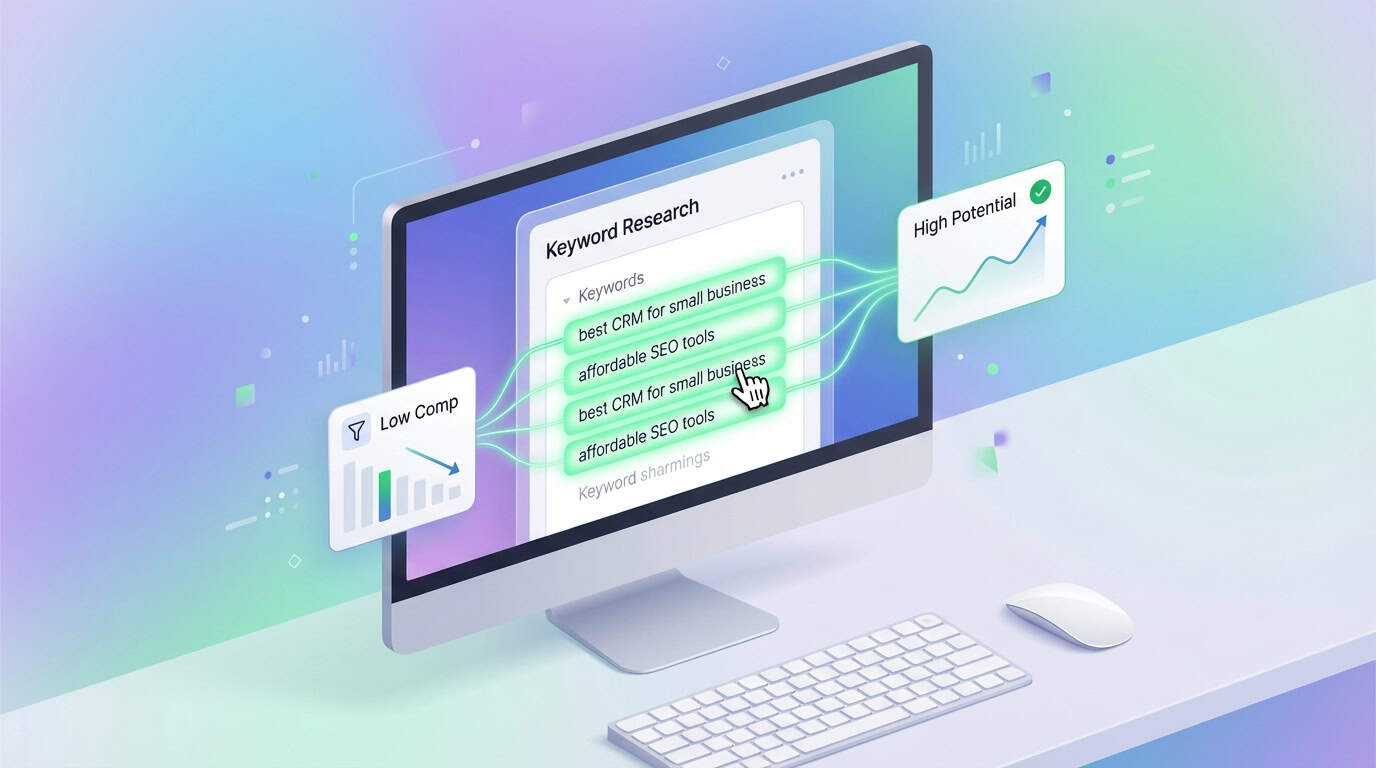
The Evolution of Keyword Research: Beyond High Search Volume
Keyword research has undergone a significant transformation as search engine algorithms have become more sophisticated. Early SEO strategies focused on identifying high-traffic terms and maximizing keyword density across a page. Today, search engines prioritize the relevance and depth of content over simple keyword density.
Modern long-tail keyword research requires a shift in focus from volume to the specific pain points of a niche audience. According to JEMSU (2025), low-competition long-tail keywords account for 70% of all search traffic. Focusing on smaller queries ensures that the most valuable opportunities are found within specific searches that represent real user needs.
Smaller brands find it increasingly difficult to compete for top-tier keywords against enterprise-level competitors with Domain Rating (DR) scores above 80. Broad terms like "software" or "shoes" are saturated with competitors who have established historical backlink profiles and high topical authority scores. Attempting to outrank these giants requires a massive budget and years of effort.
Targeting low-competition queries provides a clear competitive advantage in a crowded market. These keywords represent specific problems or questions that larger competitors often overlook. When you solve a specific problem for a user, you build trust immediately. Prioritizing intent over vanity metrics allows you to reach a dedicated audience that is more likely to engage with your business.
The Strategic Shift from Search Volume to Search Intent
Search volume is a quantitative metric that often lacks qualitative depth, as it tells you how many people are searching but not why. A high number of searches doesn't guarantee a high number of customers.
Categorizing Intent: Navigational, Informational, and Transactional
Identifying the specific type of search intent is critical for converting visitors into customers. Most searches fall into three categories: navigational, informational, or transactional. A navigational search happens when someone is looking for a specific brand or website they already know.
Informational searches occur when a user wants to learn something or solve a problem. A person searching for "typical car accident injury settlement" is in the awareness stage. They're gathering information but aren't necessarily looking to hire a personal injury lawyer today. You should create content for these users to build authority, but you shouldn't expect an immediate sale.
Specific modifiers signal a shift from the awareness stage to the consideration stage or decision stage. Words like "buy," "best," "review," and "pricing" indicate that the user is comparing options. Aligning your content with these high-intent phrases ensures you're reaching people at the exact moment they're ready to spend money.
Why Search Volume is Often a Misleading Metric
High search volume doesn't always translate to revenue for your business. Many broad terms attract "window shoppers" who are just looking for general information or inspiration. By prioritizing high-intent search queries over generic terms, marketers can capture users at the exact moment of a purchasing decision.
According to Conductor, long-tail keywords convert 2.5 times better than head terms. High conversion rates occur because specific queries indicate that the user has already done their research and is ready to take action. Users are not just browsing for ideas. They are looking for a specific answer to a problem they currently face.
Zero-volume keywords often drive the most qualified traffic to a website. Most SEO tools rely on historical data that might underreport the actual number of searches for highly specific or technical queries. These "zero-volume" terms are frequently used by people with a very high level of intent who need niche solutions.
The "long tail" theory holds that the combined volume of many small keywords often outweighs the traffic from major head terms. While a single long-tail phrase might only get ten searches a month, ranking for hundreds of these phrases creates a massive stream of targeted traffic. The combined volume of hundreds of niche phrases provides a stable foundation for growth and protects you from market fluctuations.
The Power of Long-Tail Keywords in Niche Markets
Long-tail keywords are highly specific phrases that usually consist of three or more words. These terms represent the low-hanging fruit of SEO because they typically have lower competition but significantly higher conversion rates.
Lowering Customer Acquisition Costs (CAC) Through Specificity
Targeting long-tail keywords offers significant economic benefits for growing brands. Bidding wars on broad terms drive up cost per click in paid advertising, making organic competition incredibly fierce. Effective niche market targeting allows smaller brands to establish authority without competing against enterprise-level budgets.
Google Ads averaged a 6.42% click-through rate in 2024, but organic search results achieved a much higher 27.6%. By winning at organic long-tail search, you reduce your reliance on expensive paid campaigns. Low-competition keywords typically have a Keyword Difficulty (KD) score below 20 and a moderate search volume of 100 to 1,000 monthly searches.
Specific queries attract users further down the sales funnel, who have already moved past the 'what is' phase and are seeking a specific solution. Targeting narrow search criteria leads to higher click-through rates because your content perfectly matches the user's immediate needs.
Focusing on specificity also helps you avoid wasting time on unqualified leads. When you rank for a broad term, you'll attract many people who aren't a good fit for your product or service. Long-tail keywords act as a filter, ensuring that only the most relevant users find your site while reducing the workload for your sales team.
Dominating Micro-Niches with High-Intent Queries
Micro-niche targeting allows a brand to become an authority in a very short amount of time. You can dominate a small segment of the market by answering highly specific questions that your larger competitors ignore. Large companies often can't afford to create content for keywords with only 50 searches a month.
Building trust is easier when you position your company as the go-to expert for a particular problem. When a user finds a detailed, helpful answer to a niche question, they're likely to view you as a specialist. Building a reputation as a specialist makes customers more comfortable choosing you over a generic big-box competitor.
Consistently producing content for micro-niches creates a moat around your brand. As you cover more specific topics, search engines begin to view you as a topical authority in that entire category. Developing high topical authority eventually makes it easier to rank for competitive terms as your domain strength grows.
Technical Methods for Uncovering Hidden Keyword Opportunities
The best keywords aren't always found in a database. Often, you have to look where your target audience is actually talking or use internal data to find the most valuable search terms that others are ignoring.
Mining Zero-Volume Keywords for Maximum ROI
Zero-volume keywords are terms that SEO tools claim have no monthly searches. Despite what the software suggests, these terms are often searched by real people seeking very specific answers. Ahrefs data found that 94.74% of all keywords get 10 or fewer monthly searches, meaning the tools miss most of the market.
New or emerging trends often show up as zero-volume in traditional tools. Slang, highly technical jargon, and brand-new product categories take time to appear in the databases of major SEO software. Targeting these terms early allows you to establish a ranking before the rest of the market catches on and the keyword difficulty rises.
You can use specialized keyword research tools to analyze the Search Engine Results Page (SERP) and determine keyword difficulty. For example, the LowFruits SERP Difficulty Score uses a scale from 1 to 3 to identify easy keywords. A score of 1 indicates that keywords with low competition, such as those on forums or low-authority sites, appear in the top 10 results.
Calculating the Keyword Golden Ratio (KGR) for Rapid Results
The Keyword Golden Ratio is a data-driven method for finding keywords that should rank in the top 50 as soon as your content is indexed. You calculate this by dividing the 'allintitle' results by the monthly search volume. If the ratio is less than 0.25, you have found a significant opportunity for quick ranking. This formula helps you quantify competition beyond the generic difficulty scores provided by SEO software.
Identifying Hidden Gems with Google Search Console
Google Search Console is one of the best places to find hidden opportunities that tools like Semrush might miss. Analyze the Search Results report to identify queries with high impressions but low CTR and average positions between 10 and 20. These impressions indicate that people are searching for the term, even if the volume data in your paid tools suggests otherwise.
You can use this information to inform your content marketing strategy. If you see a query getting hundreds of impressions but you don't have a dedicated page for it, you are failing to capture revenue from prospects who are clearly searching for your expertise. Creating specific content for these queries captures traffic that your competitors are likely ignoring.
Don't overlook the "People Also Ask" and "Related Searches" sections on Google during your research. These sections show the actual questions users type into the search bar in real time. Since Google is providing this data directly, you know these are real topics that people care about right now.
Using Google Autocomplete for Real-Time Intent
Google Autocomplete provides a window into real-time user behavior by suggesting queries based on popular, trending searches. By typing your core keyword followed by different letters or 'how to,' you can uncover long-tail variations that haven't yet reached the databases of major SEO tools. This method allows you to identify emerging needs and consumer trends weeks or months before your competitors.
Extracting Gold from Social Platforms and Forums
Mining user-generated content (UGC) on community platforms like Reddit and Quora provides critical social listening data. These forums are where people go to complain about problems or ask for recommendations when they're frustrated. By reading these threads, you can identify recurring pain points that haven't been addressed by existing content.
Analyzing customer support tickets and sales call transcripts can also reveal the exact obstacles that lead to a purchase. Look for questions that your sales team has to answer over and over again. If a prospect asks a question on a call, they likely searched for it online first and couldn't find a satisfactory answer.
Your company's own data is a unique asset that your competitors can't access. Internal site search logs represent a direct request from your most valuable audience for new content or features.
The "Jobs to be Done" Framework for Keyword Research
The "Jobs to be Done" theory suggests that customers "hire" a product or service to perform a specific job or solve a specific struggle. This framework shifts the focus from who the customer is to what they're trying to achieve.
Understanding the User's Real Problem
Users don't search for features; they search for solutions to their struggles. When you apply the JTBD framework to SEO, you stop brainstorming keywords based on your product's name. Long-tail keywords represent specific user problems. Instead, you start brainstorming based on the emotional and functional "jobs" your audience is trying to accomplish.
Functional jobs are the practical tasks a user needs to complete. Emotional jobs are how the user wants to feel or avoid feeling while doing those tasks. A high-converting keyword often addresses both of these aspects at once, making the content feel much more relevant to the reader's actual life.
Brainstorming around struggles helps you find keywords your competitors might not even consider. These "struggle" keywords are often low-competition because they don't include the product category name. Capturing a user at this point allows you to shape their entire perspective on the solution before they see a competitor.
Translating Struggles into High-Converting Keywords
To use the JTBD framework effectively, you must map specific user frustrations to search queries. This process involves identifying the core struggle and finding the words a user would type when they've reached their breaking point. Here is a step-by-step example of how to translate a struggle into a high-intent keyword:
- Identify the struggle: "I am losing high-quality leads because my current CRM is too complex for my small team to manage."
- Identify the functional job: Find a simpler way to track customer interactions without manual data entry.
- Translate to a keyword: "HubSpot vs alternatives for small business" or "easy to use CRM for 5-person team."
- Create the content: A comparison guide focusing on ease of use and automated entry features.
The 'Jobs to be Done' method ensures that your keyword list is grounded in reality rather than in software data alone. By focusing on the "why" behind the search, you create content that speaks directly to the user's situation. Precise intent alignment significantly increases the likelihood that visitors will trust your recommendation and convert.
Mapping Search Queries to the Customer Journey
The language a user uses changes as they move closer to making a purchase. In the awareness stage, they use broad terms to understand a problem. In the consideration stage, they look for specific types of solutions and compare different approaches to their problem.
Matching your content to the expectations of each stage is vital for conversion. If a user is in the awareness stage, they want a helpful guide, not a sales pitch. If you show them a pricing page too early, they'll likely bounce and look for a different resource that better fits their needs.
Properly mapping these queries ensures that your internal linking strategy makes sense. You should guide a user from an informational awareness article to a more detailed consideration piece. A logical content flow mimics the natural progression of a buyer's journey, keeping users on your site longer.
Targeting High-Intent Modifiers and Phrases
Certain words, when added to a search term, drastically change the likelihood of a conversion. These modifiers act as filters that separate general interest from commercial intent and financial readiness.
The Psychology Behind "Best," "Vs," and "Alternative"
Comparison keywords are highly effective because they capture users in the final evaluation stage. A search for "[Product A] vs [Product B]" indicates that the user has already narrowed their choice down to two options. Implementing conversion-focused SEO involves more than just finding words; it requires understanding the psychological triggers behind specific modifiers.
These "Bottom of Funnel" searches are some of the most profitable keywords you can target. A SaaS SEO case study showed that a blog post ranking for a "competitor alternative" keyword generated 28,800+ impressions and 247 high-intent clicks in a single month. Acquiring organic traffic through comparison queries requires no paid promotion, as user intent is already high.
Keywords like "best [Service] for [Specific Use Case]" are equally powerful. They show that the user has a specific need and wants a solution that's tailored to them. By creating content that addresses these specific use cases, you prove that your product is the best fit for their situation and technical requirements.
Commercial intent can often be identified by the presence of specific industry "buying" terms. These include words such as "consulting," "software," "services," and "agency." When a user adds these to their query, they're looking for a partner or a tool rather than just information. Focusing your efforts on these terms ensures that your traffic consists of potential customers.
Using Negative Keywords to Refine Search Strategy
Avoiding low-intent traffic is just as important as attracting high-intent traffic. While modifiers tell you who to target, negative keywords tell you who to exclude to protect your ROI. You don't want to waste your time and resources ranking for terms that will never lead to a sale.
For example, keywords that include "free," "jobs," or "definitions" often attract people who aren't looking to spend money. These visitors might inflate your traffic numbers, but they won't help your bottom line. A person searching for the "history of marketing" is curious, while someone searching for "marketing automation for law firms" is shopping.
Refining your keyword list to exclude non-commercial terms improves your overall ROI. You should prioritize the terms with a much higher intent to buy. Adopting a proactive approach to keyword exclusion makes your site a more useful resource for potential buyers.
Scaling Your High-Conversion Keyword Strategy
Winning a few individual keywords is a great start, but the real power of SEO comes from a sustainable, long-term engine. You need a system that allows you to repeatedly find and capture these opportunities at scale across your entire website.
Building Topic Clusters Around Low-Competition Terms
The "Hub and Spoke" or "Topic Cluster" model is the best way to organize your niche content. In this model, you create a broad pillar page that covers a major topic. You then link that pillar to several smaller pages that target low-competition, high-intent keywords to build authority.
Internal linking between these pages signals your expertise to search engines. When Google sees that you have dozens of detailed articles about a specific niche, it's more likely to rank you as an authority. You can use long-term strategies like this to build a content moat that larger competitors cannot easily replicate.
Topic clusters also make your site more resilient to algorithm changes. Because your traffic is spread across many different pages, you aren't dependent on a single ranking. If one keyword loses its position, the rest of the cluster continues to drive traffic and maintain your lead generation pipeline.
When to Transition to High-Volume Terms
Once you have dominated your micro-niches, you can begin to move toward more competitive terms. A custom long-tail keyword strategy provides the foundation of topical authority needed to compete for broader head terms. Avoid jumping into high-volume keywords until you have a proven track record, as transitioning too early can waste resources on terms you aren't ready to rank for.
Instead, look for "bridge" keywords with slightly higher volume that still maintain specific intent. These terms allow you to grow your reach without losing the conversion focus that built your initial success.
As you scale, you may need to outsource SEO article creation to maintain consistency. Scaling production while keeping the technical accuracy required for high-intent audiences is a significant challenge. Outsourcing allows your internal team to focus on high-level strategy while the execution remains on track.
Measuring Success Beyond Organic Rankings
Rankings alone aren't the best KPI for a high-intent keyword strategy. Search intent defines your content strategy, so your success should be measured by how well that intent is satisfied. Since the volume of these terms is often low, you should track conversion rates and the total quality of the leads being generated.
Assisted conversions are another important metric to monitor. A user might find your site through a low-competition informational query and then come back later via a brand search to make a purchase. If you only look at the last click, you'll miss the fact that the niche article was the source of the lead.
Engagement metrics like time on page and bounce rate provide valuable feedback on your content quality. High engagement signals to search engines that your content is helpful, which can lead to even better rankings over time. Always prioritize visitor quality over the sheer number of visitors in your report.
Analyzing Competitor Content Gaps to Find Opportunity
Conducting a content gap analysis involves identifying the keywords your competitors rank for that your site currently misses. By using tools to compare your domain against three or four competitors, you can find high-intent terms that are already driving revenue for others in your niche. Focus on terms where multiple competitors rank in the top 10, but your site is nowhere to be found, as these represent validated market demand.
Common Pitfalls in High-Intent Keyword Research
A common oversight is selecting a niche so narrow that it lacks sufficient market demand. While low-competition keywords are great, there must still be a core audience searching for a solution. You must balance your desire for specificity with the reality of market needs and search behavior.
Another common failure is ignoring the actual search intent in favor of a keyword that sounds cool. You must always analyze the existing SERP to see what kind of content Google actually wants to show for that query. Focus on keywords with a KD score under 30 for a real shot at the first page.
Marketers also frequently fail to update their content as search trends and user needs evolve. SEO is not a 'set it and forget it' task. The process requires ongoing maintenance and refinement. Regularly reviewing your top-performing pages ensures they continue to meet your audience's needs and remain accurate in a changing market.
Finally, don't make the mistake of completely ignoring "reach" keywords while chasing low-competition terms. Balancing easy wins with a few more ambitious goals helps you build a well-rounded and sustainable presence.
Grow Your Organic Visibility With Brand Voice
Targeting high-intent, low-competition keywords is the most effective way to drive sustainable SEO growth and higher ROI. By moving away from vanity metrics and focusing on your customers' actual needs, you create a more efficient marketing engine. The goal of every keyword research session should be to find people who are ready to buy, not just those looking for a distraction. Success in the modern search landscape belongs to those who prioritize intent and relevance over sheer volume.
High-intent content is the fuel for sustainable growth, but execution requires consistency and technical precision. Brand Voice provides the ready-to-publish, SEO-optimized articles you need to dominate these low-competition niches without the overhead of a traditional content team. We create content that not only ranks but also engages your audience and delivers real business results.
Schedule a demo today or request a free SEO article to see how our process can scale your organic revenue and dominate your niche with high-intent content.