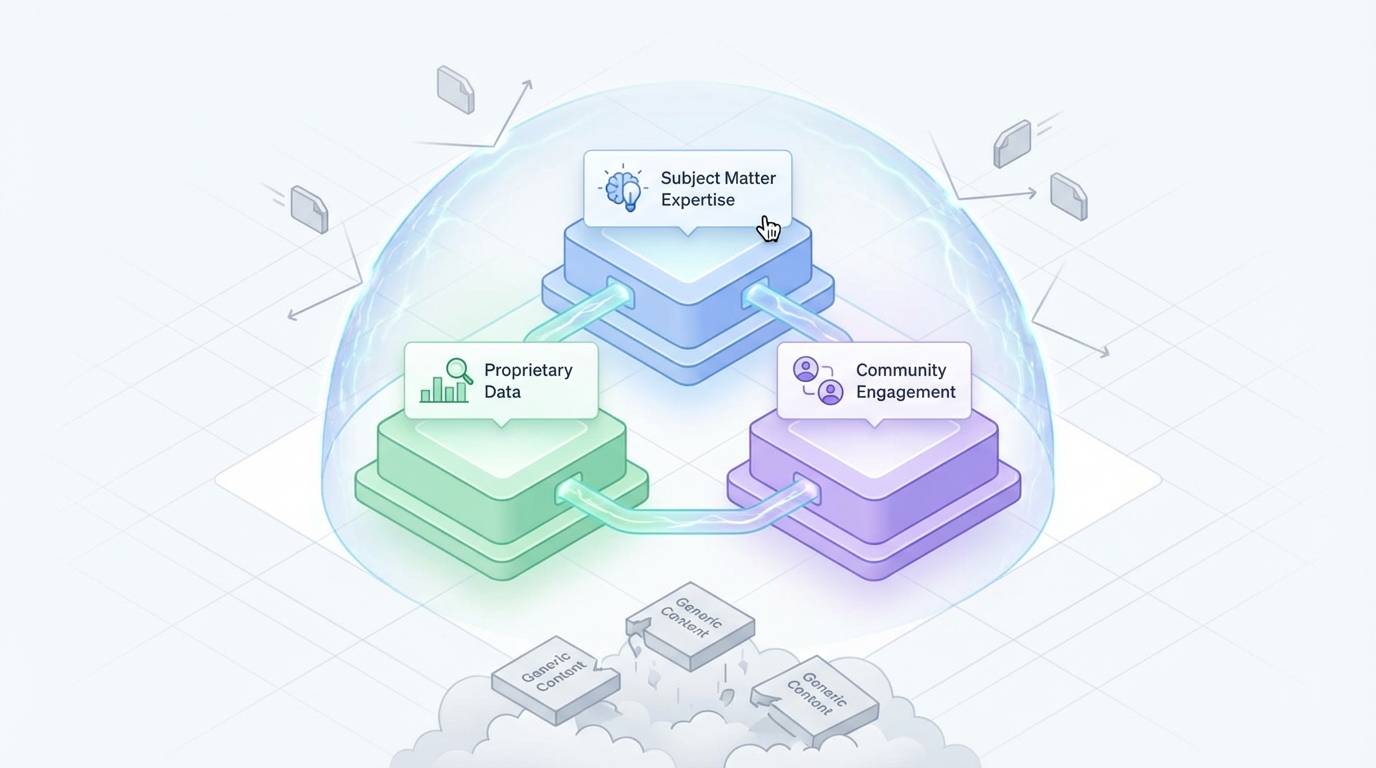
- Building a robust content moat through domain authority and topical relevance creates a sustainable competitive advantage that protects organic search traffic from high-authority aggregators.
- Leveraging proprietary data and original research establishes your brand as a primary source of truth, generating high-quality backlinks that are nearly impossible for competitors to replicate.
- Infusing articles with deep subject matter expertise and unique human perspectives ensures authenticity and trust, helping specialized brands maintain market share against generic AI-generated content.
- Implementing a strategic framework of topical clusters and compounding long-form posts can drive significant business growth, delivering an average content marketing ROI of 825% over three years.
Search engines remain the primary gateway to the internet, with 68% of all online experiences starting with a search engine. While social media captures significant attention, organic search remains the dominant driver of sustainable traffic. Research shows that 85.19% of all blog traffic originates from organic search rather than paid or social channels.
Building a presence that survives shifting algorithms requires a strategy that goes beyond basic keyword matching. Brands that focus on long-term authority goals and unique value propositions see much higher returns on their investment. Understanding the mechanics of these systems is the first step toward hardening your digital defenses against encroaching competitors.
The Evolution of Organic Search: Why Standard SEO Is No Longer Enough
The digital landscape is facing a massive influx of commodity content. This trend is largely driven by the accessibility of generative AI tools that often prioritize volume over factual accuracy. While these tools allow for rapid production, they result in a sea of sameness that lacks the unique insights searchers actually want. This saturation makes it easier for high-authority aggregators to use their domain ratings to outrank smaller brands for generic terms.
Traditional search engine optimization tactics are losing their efficacy because they often prioritize volume over value. When every competitor can produce a thousand-word article on a topic in minutes, the barrier to entry for ranking vanishes. This environment has led to high-DR sites poaching keywords from specialized brands that originally pioneered those topics. Sustainable organic growth now requires a shift from standard optimization to a defensive content strategy.
The global content marketing revenue is projected to reach $107.5 billion by 2026, up from $63 billion in 2022. This growth indicates that while the field is more crowded, the potential for those who can differentiate themselves remains massive. Statistics suggest that organic search delivers the best ROI for 49% of marketers, outperforming social media and paid ads. Establishing a content moat ensures that your brand remains a primary source of truth in an increasingly automated world.
Effective brand authority building relies on the consistent delivery of unique insights that high-authority aggregators cannot easily scrape. Businesses must move away from easily replicable tactics to maintain their search performance. A content moat is the foundation of sustainable organic growth because it creates a barrier that requires more than just a high marketing budget to overcome.
Measuring the Strength of Your Content Moat
An SEO moat refers to the protective advantage a business gains from a strong, established search engine presence. It comprises domain authority, topical relevance, trusted content, and search engine trust. This advantage isn't built solely on the number of pages published, but on the depth of relevance that competitors find difficult to match.
Tracking the growth of your content moat requires looking beyond simple traffic numbers to more meaningful data. Branded search volume is one of the clearest indicators that your moat is expanding. It shows that people are looking for your specific expertise rather than just a general topic. You should also monitor your direct traffic and the rate at which visitors return to your site over time.
ROI Benchmarks and Long-Term Value
Content marketing provides an average ROI of 825% across all verticals when measured over three years. This long-term view is necessary because the benefits of a moat often take time to compound. ROI benchmarks for SEO show that Year 1 typically delivers a 160% return. By Year 2, this figure climbs to 861%, and by Year 3, it reaches 1,223% as authority builds.
The financial impact of a defensive content strategy is significant for stakeholders. Our data shows that the average return on content marketing investment is $22 revenue per $1 spent. This efficiency makes it the top-performing B2B marketing channel, ahead of social media and paid advertising. Measuring content marketing ROI for stakeholders requires highlighting these compounding gains over several years.
Compounding posts are a major driver of this long-term success. For example, 38% of HubSpot's total blog traffic comes from compounding posts published months or years ago. These articles continue ranking because they're comprehensive, well-structured, and periodically updated. Proprietary data strengthens domain authority by ensuring your content remains the primary reference point for others in your industry.
Conversion Quality and Lead Performance
Organic search leads have a 14.6% close rate, making the investment in high-quality content financially sound. This performance stands in stark contrast to outbound leads like cold calling, which only see a 1.7% close rate. When users find your brand through search, they've already identified a need and view you as a solution. This pre-qualification process significantly reduces the friction in the sales cycle.
The quality of your backlink profile remains a fundamental metric for measuring search engine trust. If you're earning links from reputable industry sources naturally, your moat's becoming more defensible. Passive link building occurs when you create resources so valuable that others must cite them. This differs from active outreach, which requires significant overhead to maintain a steady flow of new links.
Strategy 1: Leveraging Proprietary Data and Original Research
Original information serves as a powerful defensive content strategy that increases the cost of entry for competitors. When your brand provides data that doesn't exist anywhere else, you become the primary source for that information. This makes it harder for larger sites to simply summarize your work without acknowledging your unique contribution. Original research generates high-quality backlinks that are nearly impossible for others to replicate with a larger budget.
Conducting Primary Research and Annual Industry Reports
Publishing annual industry reports allows your brand to establish itself as a primary source of truth. Start the process by designing a survey that targets the specific pain points of your client base. You should focus on questions that reveal sentiments or behaviors not currently documented in major reports. This process creates a resource that other writers must cite to support their own claims.
Cleaning internal data is a critical step to ensure your findings are link-worthy. You must remove outliers and verify the integrity of your metrics before concluding. Once the data is clean, interpret the results to find a compelling narrative hook. This narrative-driven data provides the "why" behind the numbers, making it engaging and memorable for readers.
Long-form posts that exceed 2,000 words often yield the strongest results. Research indicates that 39% of bloggers who write posts of this length report strong results. In contrast, only 21% of bloggers writing shorter content see similar success. This depth of coverage ensures your content remains relevant for years rather than months.
Creating Calculators, Tools, and Proprietary Frameworks
Interactive content like ROI calculators provides a type of value that static blog posts cannot match. These custom-built tools are significantly harder for competitors to replicate because they require technical development. Most of the SEO traffic for successful apps like Canva comes from users searching for specific, ready-to-use templates. Creating and distributing these assets can significantly increase your competitive advantage.
Custom tools increase user engagement and dwell time, which are positive signals for search engine rankings. When a user spends five minutes interacting with a calculator, they're developing a functional relationship with your brand. HubSpot provides thousands of marketing templates that remove friction for its users. Because of the power of compounding, they've accumulated assets that take significant effort for new competitors to replicate.
Building a library of proprietary frameworks ensures that your brand becomes a functional part of your customer's workflow. This integration makes it much less likely that they'll switch to a competitor who only offers standard informational content. These assets create a growth loop in which more users generate more data, which in turn improves the tool. This self-sustaining cycle is the ultimate protection against commodity content producers.
Strategy 2: Subject Matter Expertise (SME) as a Defensive Barrier
Deep subject matter expertise provides a level of nuance that generalist writers cannot replicate. While a large site might hire freelancers to cover a topic, they often lack the experience that defines true authority. Infusing your content with real expertise is fundamental to meeting modern search engine trust standards. Establishing a B2B SaaS content strategy framework requires a heavy focus on this deep knowledge.
Infusing Content with SME Interviews and Unique Perspectives
Google's algorithms increasingly prioritize content that adds new information to the index. To execute this, you should conduct a 30-minute technical interview with a lead product engineer or a senior strategist. This process extracts "nuggets" of wisdom that are not found in top-ranking results. These perspectives provide the context that AI-generated or generalist content often misses entirely.
Practical execution involves turning raw expert knowledge into structured, readable articles. You shouldn't just ask an expert to write; you should interview them to find contrarian views or specific technical details. This approach ensures that every piece of content published under your brand has a unique fingerprint. These interviews provide the qualitative depth that rounds out a data-led strategy.
When you consistently offer these unique perspectives, your brand becomes a destination for people seeking real solutions. Readers can tell when an article is written by someone who has actually done the work. This authenticity builds trust that protects your traffic even when higher-DR sites enter your space. Defensive SEO for specialized brands relies on this human-led insight to maintain market share.
The Role of Personal Experience and Case Studies
Case studies and first-person narratives are among the most defensible forms of content because they're tied to your specific history. Documenting your successes and lessons learned creates a narrative that aggregators cannot poach. Case studies demonstrate product efficacy while simultaneously answering complex questions about how your service works in the real world. They serve as both educational resources and sales tools, guiding prospects through the decision-making process.
First-person accounts allow you to address your audience's specific pain points with precision. Aggregators might cover the broad strokes of a topic, but they can't speak to your specific client base. This specificity builds a bond with your readers that a generic information site cannot break. No competitor can tell your brand's story more truthfully than you can, making these documents your ultimate defensive asset.
Strategy 3: Building a Community-Led Content Ecosystem
A content moat is strengthened when the people who consume your content also contribute to its growth. Community-led content shifts your brand's role from being just another search result to being a destination for professionals. When your audience feels invested in your ecosystem, they become advocates who defend your position. A community ecosystem is far harder to copy than standard product features, making it a highly defensible strategy.
Integrating User-Generated Content and Growth Loops
Incorporating customer questions and forum discussions into your strategy ensures your content remains highly relevant. This creates a feedback loop where the community informs your future topics. User-generated templates not only solve scalability problems but also enable a growth loop where new users learn your product. These users gradually become power users who create, share, and sell their own templates.
Companies like Notion operate robust marketplaces where users contribute and access templates tailored to various use cases. Notion has over 80 self-organized communities and 30 monthly in-person events across the globe. This entire program is managed with only three full-time team members, demonstrating the efficiency of community-led growth. Miro now has more than 1,000 community-sourced templates through Miroverse, which serves as one of their strongest growth loops.
The technical benefit of this approach is a massive increase in the breadth of your site's topical coverage. When thousands of community members create content, they cover niches that your internal team might never find. This organic expansion makes your site an indispensable resource that's nearly impossible for a competitor to clone. SEO drives 1,000% more traffic than organic social media, and a community-led ecosystem captures this traffic at scale.
Cultivating Brand Advocacy Through Collaborative Content
Co-creating content with industry influencers or partners creates a network effect that expands your reach beyond your own channels. Expert roundups and collaborative webinars reinforce your brand's authority by associating it with other trusted names. This relationship-building aspect makes your content moat more resilient because a wider network supports it. Collaborative efforts ensure that your brand is mentioned across the web in contexts that search engines value.
HubSpot's Solution Partner Program includes roughly 7,000 agency partners who contribute to its vast ecosystem. By building these partnerships, you ensure that your brand's expertise is distributed through many voices. This multi-voiced approach creates a defensive barrier that a single competitor cannot easily overcome. Even if a competitor has the same codebase as a leader like YouTube, they won't make a dent without the creators and content.
Scale is further achieved through specialized ambassador programs. The annualized total royalty pool for Canva Creators reached $27.6M USD in June 2021, nearly three times the previous year. These incentives drive high-quality contributions that cement the brand's position as a market leader. This level of recognition is the ultimate protection against competitors trying to rank for generic keywords.
Strategy 4: Multi-Channel Authority and Brand-Search Dominance
A true content moat extends beyond the walls of your company blog and into every channel where your audience lives. When you establish a holistic presence, your brand becomes more resilient to specific algorithm updates. Diversifying your content distribution ensures that a single gatekeeper doesn't control your relationship with your audience. Establishing this presence is a key part of building top-tier organic authority.
Creating Content for the Entire Marketing Funnel
It's important to move beyond top-of-funnel keywords and create content that addresses technical questions in the deep funnel. This builds a comprehensive knowledge base that supports the entire customer journey from awareness to purchase. Companies with active blogs generate 67% more leads per month than those that don't invest in this depth. By answering the difficult questions that competitors ignore, you capture high-intent traffic.
Mapping your content to the funnel ensures that you're providing the right information at the right time. When you provide technical guides or comparison pages, you help users make informed decisions about your services. You should use a strategic competitor gap analysis guide to find the topics others have missed. This comprehensive coverage makes your brand the go-to resource for anyone looking for serious answers.
Strategic CTA placement within these deep-funnel pieces is necessary for driving business results. These users are often closer to making a purchase and value the depth of information you provide. A deep-funnel strategy ensures that you aren't just getting clicks, but you're actually growing your pipeline. It creates a seamless transition from educational research to transactional intent.
Content Decay and the Refresh Moat
A content moat must be maintained through regular updates. Search engines favor established authorities, making it harder for newcomers to outrank you if you match their effort consistently. Content decay occurs when older articles lose their relevance or accuracy as the market evolves. By refreshing these assets, you maintain your rankings and prevent high-DR aggregators from poaching your traffic.
Owned media channels like email newsletters and podcasts provide a direct line to your audience that isn't mediated by search engines. These channels allow you to "moat" your relationships by ensuring you can reach customers even if rankings fluctuate. Content marketing achieves a 61% lower cost per lead compared to paid advertising channels. Building an owned audience creates a self-sustaining cycle of engagement that search engines view as a signal of authority.
Defending Your Territory: How to Protect Organic Traffic from High-DR Aggregators
Maintaining your rankings requires proactive defense against high-authority sites that may try to muscle out smaller specialists. SERP volatility is a reality, and larger competitors often target high-volume terms once they see a smaller brand succeeding. To protect your territory, you must leverage your niche expertise and structural SEO advantages. Google tends to favor established authorities, but only if they continue to provide fresh and unique value.
Utilizing Advanced Topical Authority and Semantic Clustering
Search engines increasingly reward websites that cover topics comprehensively through topical authority and cluster articles. By creating content clusters in which dozens of hyper-specific subtopics support a pillar page, you create a web of relevance. This structure makes it difficult for a competitor to outrank your hub page without matching your effort. Strategic clusters improve search visibility by signaling to search engines that you own the entire conversation.
Developing a content ecosystem is similar to building other network effects, where growth eventually becomes exponential. You might see little traction for years, but growth becomes rapid once you hit the inflection point. It took Shopify roughly seven years to reach its first 1,000 apps, but it added 7,000 more in the following seven years. This compounding growth in topical coverage creates a moat that becomes stronger every year.
High-quality backlinks from linkable assets further support these clusters by passing authority through internal links. Even if a competitor writes a similar piece, Google may still prefer your content because you've covered the subject more thoroughly. This topical authority's a technical barrier that prevents general sites from taking your rankings. Building these clusters ensures your brand remains the primary source of truth.
Optimizing for Niche-Specific Intent That Aggregators Miss
Large competitors often overlook long-tail keywords because the individual search volumes are too low for their scale. However, dominating these specific niches is a key part of a sustainable organic growth strategy. These low-volume terms often have much higher conversion rates because they match a very specific user need. Specificity allows you to provide much better answers than a generalist site could manage.
When you focus on niche-specific intent, you're competing on quality and relevance rather than just domain power. This approach allows smaller brands to win by being the absolute best resource for a specialized group. According to research from Sunny Patel, 82% of businesses actively use content marketing as a core part of their strategy. By consistently serving these specific intents, you build a loyal following that views your brand as the expert.
Over time, these niche wins add up to significant traffic and high authority. Users will often skip over a generic aggregator to find the expert they trust when searching for complex solutions. According to Saigon Digital, an SEO moat comprises domain authority and topical relevance earned through years of publishing. This reputation's a powerful defense that protects your traffic from even the largest media houses.
Secure Your Digital Future with a Defensible Content Strategy
Building a content moat is a long-term investment in your brand's equity and search resilience. As AI-generated content becomes the industry standard, the human elements of expertise and community connection are your only defensible assets. By prioritizing quality over commodity production, you ensure that your organic growth remains sustainable for years to come. A well-built moat doesn't just drive traffic; it protects your business from the rising costs of paid acquisition.
Our team helps you scale your content production without sacrificing the unique insights that make your brand valuable. We specialize in building defensive barriers through primary research, technical SME-led articles, and comprehensive topical clusters. Our approach ensures that your brand captures high-intent traffic while establishing itself as a primary authority in your niche. We help you move beyond standard SEO tactics to create a lasting competitive advantage in search results.
Ready to harden your defenses and secure your search dominance? Schedule a demo today to discover how our ready-to-publish articles can help you build a content moat that larger competitors cannot easily replicate. Our team understands how to execute the sophisticated strategies discussed in this article to deliver real results. Contact us to start building the digital equity your brand deserves.