- Search engines now prioritize the Information Gain concept, which rewards unique data points and original research that add new value beyond existing top-ranking results.
- Marketers can displace high-authority competitors by identifying qualitative weaknesses such as outdated statistics, shallow subject-matter expertise, and a lack of actionable takeaways like templates or checklists.
- Addressing user intent mismatches and thin content allows smaller brands to rank higher by providing comprehensive resources that align with specific stages of the buyer's journey.
- Technical and structural improvements, including mobile responsiveness and the use of multimedia elements like custom infographics, create a competitive advantage by enhancing readability and user dwell time.
- A strategic competitor content audit that includes analyzing "People Also Ask" boxes and search intent fractals can reveal up to 40% more keyword opportunities than traditional research methods.
Data-driven methodologies for analyzing the digital landscape have transformed how modern brands approach search engine visibility. Identifying these hidden openings allows marketing teams to move beyond basic keyword lists and address the underlying needs of their target audience.
By focusing on qualitative weaknesses in search results, you can create a more resilient presence that withstands shifts in the algorithm. Understanding the mechanics of these gaps is the first step toward building a sustainable competitive advantage in your niche.
The Evolution of Content Gaps: From Keyword Frequency to Information Gain
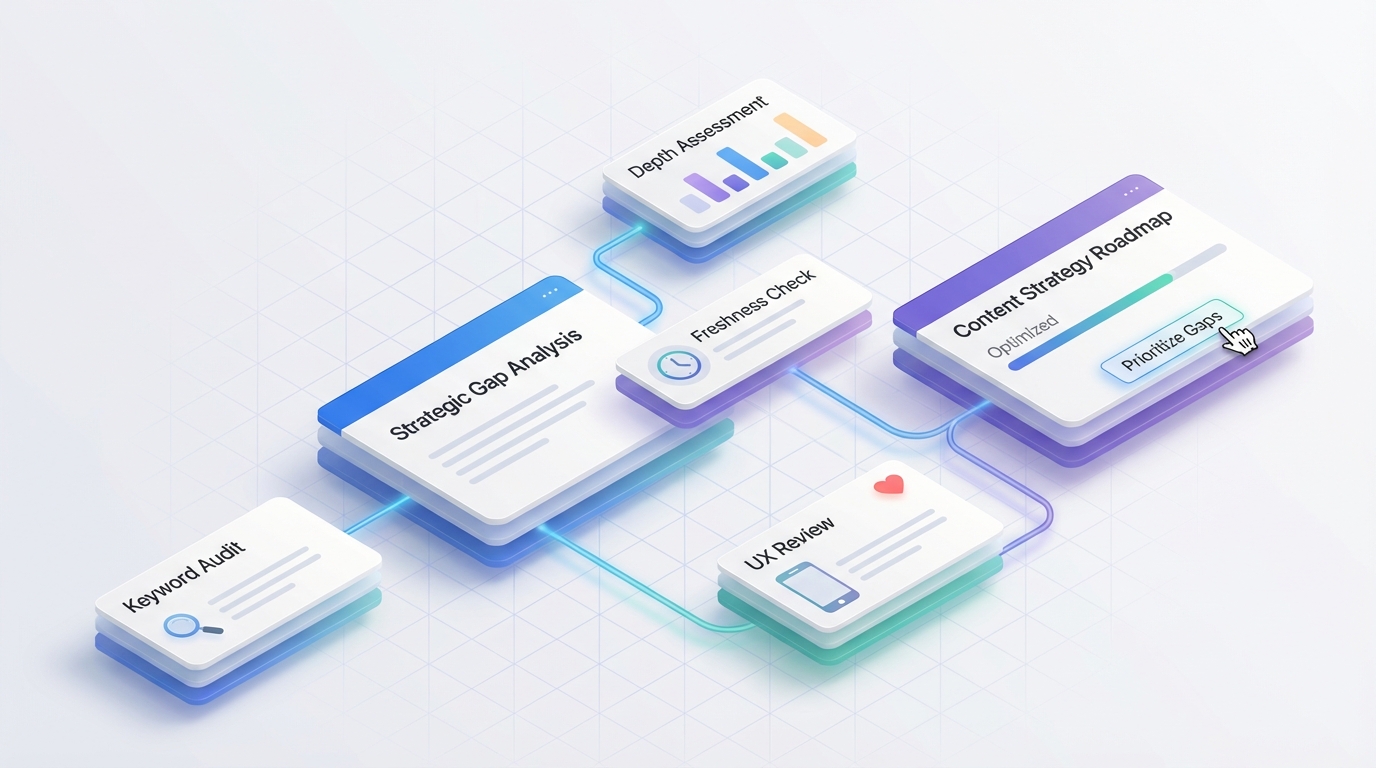
Strategic marketers categorize content gap analysis into competitor-based, topic-based, and buyer-based frameworks. This classification ensures that every aspect of the user's search experience is evaluated for potential improvements. Moving away from simple keyword frequency allows brands to focus on the actual substance that search engines now prioritize.
Keyword overlap and keyword density defined the old era of search engine optimization. Marketers believed that if they could match the exact phrasing and frequency of the top-ranking results, they would eventually displace them. This led to a repetitive cycle where the same information was repackaged across dozens of websites without adding any new value.
Success was often measured by how many boxes a writer could check in a technical optimization tool. The introduction of the Information Gain concept has fundamentally changed how search engines evaluate the quality of a piece of writing. Information gain metrics reward unique data points that aren't present in other top search results. Google aims to reward content creators who bring something new to the index, whether that's a unique case study or original research.
This shift ensures that search results remain diverse and helpful rather than becoming a repetitive feedback loop. This evolution makes manual analysis more important than ever for brands that want to displace established incumbents. You can't rely on automated summaries to tell you where a competitor is being vague or where their examples are becoming irrelevant.
A deep dive into the search landscape reveals the three main types of gap analysis mentioned earlier. Understanding these distinctions allows you to craft a strategy that addresses every aspect of the searcher's needs. Manual reviews allow you to see the invisible gaps that a software crawler might miss entirely. It's during these deep dives that you find the true ranking opportunities that your competitors have overlooked.
Identifying Qualitative Gaps: Where Competitors Fall Short
Content marketing budgets have increased by 300% over the past five years, yet 70% of companies still struggle to stand out. This identifiable market vacancy exists because many high-authority sites rest on their laurels and let their most popular pages stagnate. While a competitor may hold a top position, their content often suffers from significant knowledge decay or shallow research.
Ranking high for a specific keyword does not mean the information provided is still accurate or useful for a modern audience. This creates an opportunity for agile brands to step in and provide a more thorough, up-to-date resource. A comprehensive assessment of topical depth reveals where established leaders are failing to provide real-world utility.
Analyzing Depth of Subject Matter Expertise
It's often easy to spot content written by a generalist who doesn't truly understand the nuances of an industry. These articles frequently rely on vague terminology and fail to address the complex challenges that real professionals face every day. When a writer lacks subject-matter expertise, they tend to stay on the surface and avoid making definitive statements. You should look for these signs of shallow writing when assessing current search results.
Another common sign of a qualitative gap is circular reporting, in which a competitor cites the same few sources. This creates a situation in which the entire first page of Google results is based on a single, potentially outdated study. When you see this pattern, you've found an opportunity to break the cycle by introducing fresh perspectives. Readers can tell when they are reading the same information for the fifth time, and they'll reward the brand that finally tells them something new.
Injecting real-world authority and E-E-A-T into your own content is the best way to fill this expertise gap. You can do this by including direct quotes from internal experts or sharing proprietary data that only your company possesses. In a presentation delivered by Chima Mmeje, founder of Zenith Copy, she explained, "It's about finding holes in your content, specifically missing content that should help the buyer on their journey." By providing this missing level of expertise, you satisfy both the search engine's requirements and the reader's need for reliable information.
Spotting Outdated Data and Stale Examples
A comprehensive audit must focus on the temporal aspect of content quality to identify where information has become dated. You should look for references to statistics from several years ago or mentions of software tools that are no longer in use. These small details signal to a reader that the content hasn't been updated recently and might not be trustworthy. Even if the core advice remains sound, the presence of outdated data makes the entire brand look out of touch.
The psychological impact of stale examples on a reader shouldn't be underestimated because it erodes trust. If a reader is looking for cutting-edge marketing strategies and sees an example from 2017, they'll likely click away. They'll assume that the brand's methods are just as outdated as their references. This results in a high bounce rate and sends negative signals to search engines about the page's quality.
You can leverage the latest industry trends and fresh data to set a new standard for your content on the topic. Consider the case of Victoria Kurichenko, who noticed a drop in her rankings and decided to conduct a content gap analysis. She collected the keywords her competitors were ranking for and used that data to rewrite and optimize her article with fresh insights. This effort resulted in her impressions tripling and her daily clicks increasing from 2 to 5 to as many as 20 to 30.
Identifying Lack of Actionable Takeaways
Many high-ranking articles suffer from a theory-versus-practice gap, in which they define a problem without offering a concrete solution. They might explain why a certain business process is important, but fail to explain how to actually implement it. This leaves the reader frustrated because they have to return to the search results to find a practical guide. If you can provide the specific "how-to" a competitor missed, you'll naturally win the audience's favor.
When reviewing competitor content, you should look for missing step-by-step instructions, templates, or downloadable checklists. These elements provide tangible value and make the content much more useful for the user. A competitor might have narrative-driven long-form content on a topic, but if they lack a clear path to action, the resource remains incomplete. You can fill this gap by creating the most practical and helpful resource available on the subject.
Prioritizing utility improves user dwell time and strengthens overall satisfaction signals. When a user finds a checklist or a template they can actually use, they stay on the page longer. Search engines interpret this engagement as a sign that your page is a high-quality resource. By focusing on action over theory, you create a piece of content that is significantly more valuable than a standard blog post.
Analyzing User Intent Mismatches and Searcher Frustration
Ranking high on the search results page doesn't always mean that a piece of content perfectly satisfies the user's intent. Sometimes a page ranks simply because there are no better options available at the moment. Searcher frustration is a major signal that a strategic gap exists, even if the current leader has a very high domain authority. Identifying user intent mismatches allows you to create content that serves the reader better than the existing top results.
If users click on a result and immediately return to the search page, it's clear their needs aren't being met. This behavior provides a clear opening for a site that can provide the exact information the user seeks. Analyzing these intent failures requires looking at the search results through the eyes of someone trying to solve a specific problem.
Recognizing Thin Content in High-Ranking Positions
It's common to see legacy articles remain at the top of Google search results despite being thin or poorly structured. These pages often benefit from years of accumulated backlinks and a high level of historical authority that protects their position. However, these rankings are often more fragile than they appear because Google is constantly looking for more relevant and comprehensive updates. If the information on these pages is sparse, they are vulnerable to being displaced.
This creates a clear window of opportunity for smaller or more specialized brands to provide a much better resource. You don't always need the highest domain authority to rank if your content is clearly superior in terms of depth. When you provide a comprehensive guide that addresses all facets of a topic, you give search engines a reason to favor your page. The key is to be so much better that the algorithm cannot ignore the difference in quality.
You can quantify this thinness by looking at the ratio of fluff to actual information in a competitor's article. Fluff consists of repetitive sentences, obvious statements, and introductory filler that doesn't add value. If a two-thousand-word article only contains three original ideas, it's a prime candidate for displacement. Your goal should be to create a piece where every paragraph provides meaningful insight or actionable advice for the reader.
Evaluating the User Journey and Funnel Alignment
A major strategic gap occurs when a competitor targets a top-of-funnel keyword with bottom-of-funnel sales copy. This occurs when a user seeking general information is met with a pushy sales pitch. This creates a poor user experience because the content doesn't align with the searcher's current stage in the decision-making process. The buyer's journey typically moves through awareness, consideration, decision, and post-purchase stages.
Post-purchase content reduces customer churn by addressing the specific needs of existing users. Many brands ignore this stage, focusing only on the initial acquisition. You can win by creating onboarding documentation or feature adoption guides that keep users engaged after the sale. This level of support builds long-term loyalty and positions your brand as a true partner in the customer's success.
Designing a content piece that perfectly aligns with the searcher's specific stage is a powerful competitive advantage. If they are in the awareness stage, give them the broad education they need without demanding a transaction. If they are in the consideration stage, provide a fair comparison of different solutions. By respecting the user's intent, you build the trust necessary to convert them into a loyal customer eventually.
Technical and Structural Gaps in the SERPs
The way information is delivered to a reader can be just as important as the information itself. A competitor might have excellent research and data, but if their page is difficult to navigate, they'll still lose users. Technical and structural gaps often represent the easy wins in a content gap analysis. By improving the readability and layout of your content, you can provide a superior experience that encourages longer visit durations.
Google uses technical signals to evaluate how a page performs for real human visitors. Metrics like Largest Contentful Paint (LCP) and Cumulative Layout Shift (CLS) are actual signals used to determine structural quality. If a competitor's page loads slowly or elements shift while the user is reading, it creates a clear opening for you to provide a more stable, faster alternative. A technically sound page provides the foundation for your expert-led content to rank effectively.
UX and Readability as a Competitive Advantage
Walls of text are among the most common structural issues that create opportunities to organize content more effectively. When a reader sees a massive block of text without any breaks, they often feel overwhelmed and leave. Poor formatting makes it difficult for users to find the specific answer they're looking for within a long article. You can beat these competitors by using shorter paragraphs and clear, descriptive subheadings that guide the reader.
Mobile responsiveness and font choices are also critical parts of the overall content experience. If a competitor's site looks terrible on a smartphone, they're alienating a huge portion of their audience. In a world where most searches happen on mobile devices, a poor mobile UX is a flaw for any content strategy. You should ensure that your content is accessible and pleasant to read on every type of device.
Using skim-ability tools like better subheaders, bold text, and bulleted lists creates a superior reading experience. Most readers scan content to find specific answers rather than reading every word. If you make it easy for them to scan your content, they're more likely to stay and eventually read the whole thing. A well-structured article demonstrates that you respect the reader's time and understand their needs.
The Role of Multimedia and Interactive Elements
Many competitors rely solely on text and stock imagery, leaving a gap for more engaging multimodal content. While text is excellent for SEO, it isn't always the best way to explain a complex process or show a visual comparison. Stock photos often feel generic and fail to add any real value or personality to an article. By moving beyond these basic elements, you can create a piece of content that is significantly more memorable.
Adding custom infographics, original photography, or embedded video can help you explain complex topics more effectively. A single well-designed chart can sometimes convey more information than five paragraphs of text. Original visuals also make your content more shareable on social media and more likely to earn backlinks. This investment in high-quality multimedia signals to both users and search engines that your content is a premium resource.
Interactive elements like calculators or tools can create a level of engagement that standard blog posts cannot match. For instance, a financial planning article becomes far more valuable when it includes a calculator for personalized user inputs. These elements transform a passive reading experience into an active one, which significantly increases dwell time. Providing these types of interactive features is one of the most effective ways to fill a strategic gap in your industry.
The Role of Search Intent Fractals
Understanding search intent fractals involves recognizing that a single keyword often branches into dozens of hyper-specific sub-intents. While two users might search for the same broad term, their underlying needs could be completely different based on their specific situation. One user might want a high-level summary, while another needs a technical implementation guide for a B2B SaaS environment. Mapping these fractals allows you to address the long-tail queries that competitors often group into one vague article.
A strategic marketer looks at a head term and asks how different user personas might interpret that query. For example, the term "CRM integration" could mean a developer seeking API documentation or a manager seeking a budget estimate. By creating dedicated sections or articles for each fractal, you provide depth that generalist sites cannot match. This granularity signals to Google that you are a subject-matter expert who understands the full scope of the topic.
Addressing these fractals is also a great way to capture users who are further along in the buyer's journey. These searchers often use more complex language as they move from broad research to specific technical evaluation. If your content is the only one that addresses their exact technical hurdle, you become the obvious choice for their business. This strategy allows you to build topical authority by winning the smaller, more targeted battles across the SERP.
The Information Gain Framework: How to Add New Value
Applying the Information Gain framework requires you to brainstorm unique angles that haven't been covered in current results. You should start by listing all the common points your competitors make and then intentionally look for what's missing. Ask yourself what questions a customer might have that no one is answering or what perspective is being ignored. Uncovering these unique angles ensures your content is viewed as a necessary addition to the search index.
Conducting original surveys is one of the most powerful ways to generate data that no one else has. You should develop a data collection protocol using tools like Google Forms or Typeform to gather proprietary insights from your existing customer base. When you publish original research, you become the primary source that other writers in your industry will cite. This boosts your SEO through backlinks and establishes your brand as a thought leader.
You should also consider a contrarian approach in which you challenge common industry myths that your competitors keep repeating. If everyone in your niche is saying one thing, but your experience tells you something else, don't be afraid to speak up. A well-reasoned contrarian piece often gains a lot of attention because it breaks the monotony of the search results. It shows that your brand has the confidence to think for itself rather than just following the crowd.
Highlighting these unique insights in your introduction signals immediate value to both readers and search engines. You should tell the user exactly what new information they'll find in your piece that they won't find anywhere else. This sets the stage for a high-value reading experience and encourages the user to keep scrolling. When you clearly state your unique value proposition upfront, you reduce bounce rates and increase the effectiveness of your content.
How to Conduct a Strategic Competitor Content Audit
Conducting a strategic competitor content audit requires a systematic process to ensure you don't miss any critical opportunities. You need to move beyond just looking at keywords and start examining the entire user experience your competitors provide. This process should lead to a clear set of actions for your content team. By following a structured approach, you can turn raw data into a winning content strategy.
Your audit should also focus on finding ways to scale content gap analysis for enterprise SaaS companies. These large organizations often have thousands of pages that need to be reviewed for quality and relevance. Using a combination of automated tools and manual review ensures you capture every ranking opportunity in your market. This documentation acts as a blueprint for creating the most comprehensive resource on the search results page.
Step 1: Mapping the Current Search Landscape with Content Gap Analysis
The initial research phase should focus on analyzing SERP features like Featured Snippets and People Also Ask boxes. These features provide a direct window into what Google thinks is missing or what users are most curious about. If a People Also Ask box contains questions that aren't addressed in the top results, you've found a perfect content gap. Mapping these features reveals how search engines attempt to supplement gaps in current results.
You should also use SEO tools to see which keywords your competitors are missing, but their audience is still searching for. This helps you identify peripheral topics related to your main keyword that aren't being fully explored. Companies that analyze competitors beyond their immediate business rivals often discover 40% more keyword opportunities. This broader view ensures you capture the full scope of the conversation in your industry.
Documenting these findings in a gap map helps you clearly contrast competitors' features with your proposed content. Content gap analysis reveals 40% more keyword opportunities than traditional competitive research. This map should include notes on word count, multimedia usage, intent alignment, and the presence of actionable takeaways. By visualizing the landscape in this way, you can easily spot the areas where your competition is weakest.
Step 2: Evaluating the "First-Hand Experience" Factor in Content Gap Analysis
The Experience part of E-E-A-T is becoming increasingly important, so you must look for anecdotal evidence in competitor content. If an article feels like a generic summary, it's missing the human element that modern readers crave. You should check if the competitor mentions any real-world projects they've worked on or challenges they've actually solved. Content that lacks this first-hand perspective often feels hollow and unconvincing.
It's also important to identify if a competitor's content feels AI-generated or synthesized without any human perspective. While AI can be a great tool, it often produces content that is repetitive and lacks a unique voice or nuance. If you can tell that a machine wrote a piece, the reader likely can too. Your goal should be to provide the human touch that an algorithm cannot replicate.
Weaving personal brand stories or client success stories into your article is the best way to fill this authenticity gap. Sharing a story about a specific mistake your company made and what you learned from it is incredibly engaging. It shows that there are real people behind the brand with experience in the field. These stories build rapport and trust that generic content can never achieve.
Step 3: Assessing Visual and Structural Hierarchy
The final step of the audit should evaluate the logical flow of the competitor's information. You need to ask yourself if the competitor skips essential steps or jumps to conclusions without providing context. A logically sound piece of content is much easier to follow and more likely to satisfy the user's intent. If you find that a competitor's argument is disjointed, you can win by providing a more coherent alternative.
You should also look for navigation gaps, such as missing tables of contents or jump links, in long-form pieces. A 3,000-word article without jump links is structurally deficient and frustrates users. These small technical details have a huge impact on the user's experience and their perception of your professionalism. Adding a table of contents is a simple way to make your content look more authoritative.
Ensuring your article has a superior hierarchical structure makes it the most authoritative-looking resource on the page. Use clear H2 and H3 tags to organize your thoughts and make the page easy for search engines to crawl. When your structure is logical, and your formatting is clean, you signal to the reader that you are an expert. This structural superiority is often the final piece of the puzzle that helps you displace established rankings.
Turning Insights into Action: Creating Content That Displaces Rankings
Identifying strategic gaps is only half the battle because the final content must be executed with much higher quality standards. Filling a gap with mediocre writing won't sustain a top ranking. Your team must be committed to producing work that is genuinely the best resource available on the web for that specific topic. This requires a significant investment of time and resources, but the rewards are well worth the effort.
Out-writing the competition in terms of clarity and tone is a primary way to win over both users and algorithms. Your content should be easy to read, engaging, and free of the corporate jargon that plagues so many business blogs. A confident and knowledgeable tone helps establish your authority and makes the reader more likely to trust your recommendations. When you combine expert insights with excellent writing, you create a powerful asset for your brand.
Once you've created a superior piece of content, you must promote it to gain the initial traction needed to challenge established rankings. This might involve sharing it with your email list, promoting it on social media, or reaching out to industry influencers. Initial engagement signals to search engines that your new page is worth paying attention to. You can't just hit publish and hope people will find it; you need to actively drive traffic.
Strategic gaps are moving targets; they require regular re-evaluation as competitors react to your improvements. Search volume for the vast majority of keywords is low, with 92% of keywords receiving fewer than 10 searches per month. You should conduct a comprehensive quarterly analysis and monitor your key competitors' activities monthly. By staying proactive and continually seeking new ranking opportunities, you can maintain your dominance in the SERPs for years to come.
Bridge Your Strategic Gaps With Brand Voice Content Solutions
Moving beyond simple keyword gaps to identify strategic, qualitative gaps allows your brand to provide truly superior value to your audience. Focusing on information gain, intent alignment, and structural excellence results in significantly more effective content. This sophisticated approach ensures that you aren't just chasing traffic but are building a meaningful connection with your readers. By filling the holes your competitors have left behind, you position yourself as the definitive authority in your niche.
This comprehensive strategy builds long-term authority and trust rather than just generating temporary spikes in traffic. When users consistently find your content more helpful, up to date, and actionable, they'll start coming to you directly. This reduces your reliance on search engines and creates a more resilient business model. Strategic gap analysis is the foundation of a modern content program that delivers real, measurable results for your business.
Achieving this level of technical integrity and brand consistency often requires significant internal resources and specialized expertise. Our team understands the challenges of manually crafting these complex articles and enforcing high-quality standards across every piece of content. Brand Voice is designed to eliminate the guesswork and manual labor from this process entirely. We specialize in creating ready-to-publish, SEO-optimized, and technically accurate articles tailored to your brand's specifications. Schedule a demo today to see how Brand Voice can deliver content at scale that drives traffic and generates real results for your business.