- Keyword mapping acts as a master blueprint for internal linking by assigning specific target keywords to individual URLs to prevent keyword cannibalization and ensure topical relevance.
- Effective link equity distribution leverages high-authority power pages to funnel ranking power toward granular long-tail keywords and bottom-of-funnel conversion pages.
- Utilizing architectural models like the pillar-cluster structure or siloing helps establish topical dominance and prevents authority leakage across unrelated site sections.
- High-performing websites typically utilize keyword-rich anchor text for approximately 81 percent of internal links to provide search engines with clear contextual signals.
- Regular technical audits to reduce click depth and fix broken paths ensure that search engine crawlers can efficiently access and index a site’s most valuable content.
Internal links are hyperlinks that point to pages within the same domain. These connections have evolved from simple navigational aids into a structured internal linking strategy that signals topical relevance. They act as the connective tissue that binds disparate pages into a cohesive knowledge base for both users and search crawlers.
The relationship between internal links and keyword mapping defines how search engines perceive your site's expertise. By assigning specific target keywords to individual URLs, you create a blueprint for authority. Intentional organization ensures that your link equity distribution flows toward the most important pages. Understanding the mechanics of these systems is the first step toward building a resilient organic presence.
The Strategic Importance of Internal Linking in Modern SEO
Modern search engine algorithms look beyond individual keywords to understand the broader architectural intent of a website. A deliberate internal linking strategy is necessary to define the site hierarchy and pass authority between related topics. These links serve as a roadmap, guiding crawlers toward high-priority content while reinforcing the context of every page.
Link equity, often referred to as ranking power, is the value passed from one page to another through hyperlinks. When a high-authority page links to a more granular article, it acts as a vote of confidence in that page's quality. Allocating equity in this manner enables deep-level pages to compete for specific search terms in a competitive digital landscape. Concentrating ranking power on specific nodes within your site helps those pages rank for highly competitive phrases.
Link equity flow must be managed to prevent important pages from becoming isolated or underpowered. Strategists use this power to bolster new content that hasn't yet earned external backlinks. By leveraging existing authority, you can accelerate the time it takes for a new page to achieve meaningful visibility. Placing your most significant links in prominent, early positions ensures that equity flows efficiently toward your primary targets.
Internal links define site hierarchy by establishing clear relationships between parent and child pages. Establishing a clear hierarchy prevents search engines from getting lost in a flat structure that lacks topical depth. A well-orchestrated site uses these connections to demonstrate comprehensive knowledge to both algorithms and human visitors.
How Granular Keyword Mapping Informs Linking Decisions
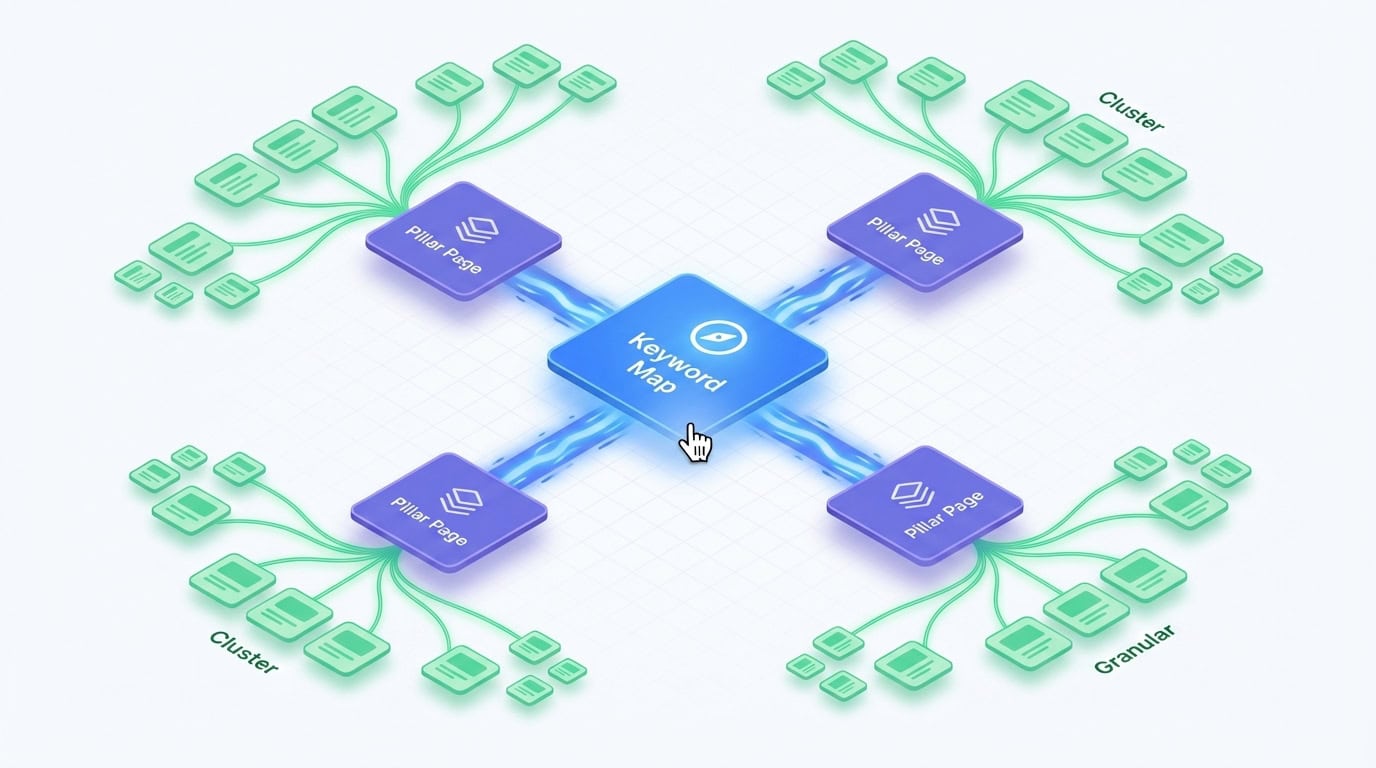
Keyword mapping is a systematic process of assigning target keywords to specific URLs across your entire domain. Your internal keyword map serves as the master blueprint for all internal linking decisions. When you understand the explicit purpose of every page, you can identify natural relationships between topics. It ensures that every link you place has a defined strategic purpose.
A granular keyword map transitions from broad, high-volume terms to specific long-tail variations. Each node in this map requires tailored internal link support to signal its relevance to the search engine. A one-size-fits-all approach to linking often fails because it ignores the unique thematic requirements of deep-level content. Mapping keywords allows you to identify missing links that could otherwise bridge gaps in topical authority.
Gaining this clarity prevents internal competition and ensures that search engines know exactly which page to rank for a specific query. It provides a framework for scaling content without creating redundant pages that fight for the same traffic. You can use your map to audit current link paths and ensure they align with your ranking priorities.
A Step-by-Step Workflow for Keyword-to-URL Mapping
Orchestrating a map starts with a comprehensive spreadsheet that lists every primary URL on your website. You should assign one primary keyword to each URL to follow the one-to-one optimization rule. This rule prevents keyword cannibalization by ensuring that no two pages are competing for the same search intent. If you find multiple pages targeting the same term, you must consolidate them or differentiate their focus.
Once your primary targets are assigned, you can identify secondary LSI keywords and related entities for each page. Your internal linking strategy should then focus on connecting pages with related keywords to build a web of relevance. For example, a page about "SEO audits" should naturally link to a more specific article about "technical crawl errors." This mapping creates a logical progression for both search bots and users.
Core Structural Models for Orchestrating Internal Links
Selecting a site architecture model is a foundational step in organizing your content for search engines. The choice of structure influences how easily crawlers can navigate the site and interpret the connections between different subjects. A clear model ensures that link equity is distributed logically rather than randomly. It serves as the skeleton that supports your entire content body.
A structured architecture helps prevent the loss of authority as your site grows in complexity. Without a model, links are often placed haphazardly, leading to orphaned pages and crawl traps. By adhering to a proven method for establishing authority, you create a sustainable environment for long-term growth. This organization allows you to scale your content library without diluting your search performance.
The Pillar-Cluster Model: Establishing Topical Dominance
The pillar-cluster model, or hub-and-spoke structure, uses a central pillar page to cover a broad topic in depth. The central pillar page then links out to various cluster pages that explore specific sub-topics or long-tail keywords. Applying a pillar cluster linking strategy creates a dense network of relevance that signals comprehensive expertise to search engines. It's a proven method for establishing authority in competitive markets.
A bidirectional linking requirement is a hallmark of this structural model. Cluster pages must link back to the pillar to reinforce its status as the primary authority source. Simultaneously, the pillar links to each cluster page, ensuring they are easily discoverable and receive a share of the main page's equity. Implementing pillar cluster linking requires a rigorous audit of existing content to ensure every spoke page remains contextually relevant to the central hub.
Creating a closed loop of relevance prevents users and crawlers from hitting dead ends within a topic. It organizes content into manageable buckets that are easy to navigate and understand. Search engines reward this organization because it clearly demonstrates a website's knowledge on a subject. By maintaining this structure, you ensure that every new piece of cluster content strengthens the entire group.
Implementing Silo Structures to Prevent Authority Leakage
Siloing is a structural technique that keeps internal links within specific categories or directories. Siloing can be achieved physically through the URL structure or virtually through strict linking patterns.
Silo structures prevent thematic dilution and authority leakage by restricting the flow of equity to unrelated topics.
Large websites with diverse product offerings or service lines benefit the most from this approach. By restricting links between unrelated silos, you reinforce the keyword map and prevent authority from leaking into irrelevant areas. It creates a clear boundary that helps search engines categorize each section of the site accurately. This method ensures that your "software" silo doesn't accidentally pass power to your "lifestyle blog" section.
Flat vs. Hierarchical Architectures: Choosing the Right Depth
Flat architectures attempt to keep all pages within a few clicks of the homepage to improve crawlability. Hierarchical structures use multiple layers of subdirectories to organize content by importance and category. Choosing the right depth involves balancing a clean user experience with the need for granular keyword-specific pages. Each approach has distinct advantages depending on your total page count.
The three-click rule is a common guideline suggesting that no page should be more than three clicks away from the homepage. Internal links can be used to bring deep-seated pages closer to the surface without cluttering the main navigation. Shortening click depth ensures that even the most specific long-tail content is accessible to search engine crawlers. A hierarchical approach provides a logical progression for users but can lead to excessive click depth if not managed properly.
Mastering Link Equity Distribution to Support Long-Tail Keywords
A successful strategist recognizes that not all pages on a website carry the same amount of weight. Identifying your high-authority assets is the first step in fueling the rest of your keyword map. These pages serve as the engine for your entire internal linking strategy. By managing your link equity distribution, you can support niche pages that would otherwise struggle to rank.
Managing link equity requires a balance between supporting existing winners and elevating new opportunities. You don't want to drain too much power from your top pages, but they must contribute to the site's overall growth. Strategic link equity distribution ensures that deep-level conversion pages receive the ranking power necessary to compete for high-intent queries. It's a precise way to leverage your existing successes to foster new growth.
Identifying and Leveraging High-Authority Power Pages
Power pages are those that have earned significant authority through external backlinks or high traffic volumes. You can identify these pages using SEO tools that measure internal link counts and external referring domains. These assets act as equity reservoirs that can be tapped to support newer or more granular articles. They are the most effective tools for improving rankings for difficult keywords.
Periodic audits of these power pages are necessary to ensure they are pointing to current priority targets. If a power page is linking to outdated content, it's wasting valuable equity that could be redirected. Updating these links can provide an immediate boost to your most important new pages. You must ensure that every link from a power page points to a live, indexable, and relevant destination.
Directing Flow: Funneling Authority to Deep-Level Content
Moving authority from top-level pages to the bottom of the funnel is known as the trickle-down effect. Strategic link placement in high-traffic sections can improve the discovery of long-tail content. Logical link placement ensures that the search engine sees a clear path from your most popular pages to your most specific ones.
An SEO A/B testing case study by SearchPilot involving geographic regional pages showed that adding links from high-authority sources resulted in a 7% uplift in organic traffic. While this shows the growth potential, it also highlights the need for contextual alignment. If the link isn't relevant to the user's intent, the search engine may discount the link's value. While this helps the donor page, the benefit to the recipient page varies based on topical relevance. Using your keyword map ensures that every page has a clear entry point and is integrated into the site's equity flow.
Internal Linking for Bottom-of-Funnel Conversion Pages
Bottom-of-funnel (BOFU) pages often lack the natural link-earning potential of informational blog posts. These product or service pages require intentional internal linking to maintain their visibility and authority. You should link from high-traffic informational posts to these conversion pages using commercial-intent anchor text. Phrases like "view our solutions" or "get a quote" help guide users toward the final stage of their journey.
Executing this strategy allows your informational content to act as a bridge to your transactional offerings. By placing these links strategically within the body copy, you pass ranking power directly to the pages that drive revenue. It's important to monitor the performance of these links to ensure they are actually driving conversions. A well-placed link on a high-performing blog post can significantly lower your customer acquisition costs.
Advanced Anchor Text Optimization for Keyword Relevance
Anchor text plays a dual role by providing context to users and signals to search engine crawlers. It's the clickable text in a hyperlink that tells both people and algorithms what the target page is about. Effective anchor text optimization is a delicate balance between clarity and variety. It requires a deep understanding of your target keyword landscape.
Keyword-rich anchors establish topical context by defining the relationship between two pages. When search engines see a specific phrase used to link to a page, they use that information to categorize the destination. Using a mix of exact-match and partial-match anchors provides a more natural profile. Maintaining anchor variety ensures you provide context without appearing manipulative to search algorithms.
Balancing Exact Match with Semantic Variations
Overusing exact-match anchor text can sometimes lead to search engine filters for over-optimization. It's better to use variations that incorporate synonyms and LSI keywords to build a more natural profile. Research suggests that keyword-rich anchors make up roughly 81% of internal links on high-performing sites. Generic phrases like "click here" or "read more" typically account for only about 15% of the total.
Mapping specific anchor texts to specific target pages helps avoid internal keyword cannibalization. You should aim for a ratio that prioritizes descriptive, keyword-focused text while maintaining a small percentage of branded and generic links. For instance, if you link to a page ten times, you might use the exact keyword three times and variations for the remaining seven. Using this approach helps a single page rank for a wider variety of related terms.
Avoiding Over-Optimization and Maintaining Natural Link Profiles
Search engines look for signals that suggest a link profile has been artificially inflated. To avoid these triggers, you should incorporate natural phrasing into your anchor text strategy. The text surrounding the link, often called the link neighborhood, provides additional context that search engines use to understand the page. Descriptive sentences that lead into a link are often more effective than isolated keywords.
Varying your anchor text across hundreds of links is important for maintaining a healthy profile. You don't want every link pointing to a page to use the same four-word phrase. Instead, describe the target content in ways that fit naturally into the flow of different articles. A natural link profile looks like it was created for the user rather than the search engine.
Technical Execution: Auditing for Broken Paths and Wasted Crawl Budget
Technical execution is the foundation upon which your keyword map and linking strategy are built. Even the most perfectly optimized content will fail if search engines cannot access it efficiently. An internal link audit identifies technical debt, such as 404 errors and redirect loops, that drain equity. Fixing these issues preserves the flow of link equity throughout your site.
Links to non-indexable pages, such as those with a noindex tag, should also be reviewed. Linking to these pages wastes crawl budget and doesn't contribute to your ranking goals. Ensuring that every link points to a live, indexable, and relevant page is a core part of site maintenance. Regular audits help you stay on top of changes that occur as your site grows and content is updated.
You might find that old links point to pages that no longer exist or have been merged into other content. Maintaining a clean linking structure ensures that search engines always focus on your most current and valuable work. It's better to proactively fix these issues before they result in a drop in rankings. A clean site architecture is a prerequisite for any advanced SEO strategy.
Reducing Click Depth to Accelerate Ranking
There is a strong correlation between click depth and a page's potential to rank well in search results. You can reduce click depth by using shortcut links, such as featured post widgets or recent article sections. These elements provide direct paths to deep-seated content from the homepage or other high-level pages. Improving crawl depth ensures that your entire site is indexed and understood by crawlers.
Prioritizing which pages deserve the shortest paths should be based on their position in your keyword map. Your most valuable conversion pages or high-intent articles should never be more than two or three clicks away. Improved accessibility signals to search engines that these pages are important. Internal links also help manage your crawl budget, which is the number of pages a search engine will crawl in a given period.
By creating a shallow architecture, you ensure that crawlers spend their time on your most valuable pages. This efficiency is necessary for large sites with thousands of URLs. If a page is too deep, Google may never discover it, regardless of how good the content is. Managing your architecture to support visibility is a key part of technical SEO success.
Enhancing the User Experience Through Contextual Linking
While SEO is a primary driver for internal linking, the user experience must always remain a priority. A site that is easy to navigate will have higher engagement rates and lower bounce rates. Contextual linking helps users find the information they need while they are already engaged with your content. Contextual links turn a static page into an interactive knowledge path.
Contextual links often carry more weight in terms of topical relevance because they are surrounded by related text. Integrating these links naturally into the flow of an article is better than simply listing them at the end. A content-first approach involves placing the most important keyword-targeted links early in the copy. Early placement ensures that they are seen by both users and crawlers as soon as the page is accessed.
The Role of Breadcrumbs in Reinforcing Hierarchy
Breadcrumbs are a type of navigation that shows the user's location within the site hierarchy. They provide a consistent, keyword-rich linking path back up to the homepage or category pages. This helps users understand how the page they are on relates to the rest of the site. They reduce the friction of navigating deep site structures and improve overall session duration.
Implementing Schema markup for breadcrumbs is a professional way to improve your search engine appearance. Using the BreadcrumbList schema type allows Google to generate rich snippets, which directly impacts click-through rates. These snippets provide additional context to potential visitors before they even click on your link. It's a technical nuance that bridges the gap between on-site structure and search engine visibility.
Navigational vs. Contextual Links: Finding the Balance
Navigational links are found in a website's header, footer, and sidebar to help users find major sections. Contextual links are those placed within the body copy of an article or page. Finding the right balance between these two types of links is necessary for a functional site. Too many navigational links can clutter the interface, while too few contextual links can make the content feel isolated.
A well-rounded strategy uses both to create a seamless experience for every visitor. Navigational links provide the "big picture" of your site, while contextual links provide the "deep dive." You should audit your footer and sidebar to ensure they aren't diluting your equity with too many irrelevant links. Focus your internal power on the paths that lead to your most valuable business outcomes.
Measuring and Iterating on Your Linking Strategy
An internal linking strategy is not something you set and forget. It requires constant monitoring and adjustment as your site grows and search trends change. SEO tools allow you to visualize your internal link graph and identify pages that might be starved of authority. Analyzing this data is necessary for making informed decisions about where to add new links. Staying proactive ensures that your site architecture remains a competitive advantage.
Ranking data can help you decide when a struggling page needs more internal link support. If a page is stuck on the second page of search results, a few well-placed links from high-authority pages might move it up. Conversely, if a page is already ranking well, you might shift your focus to other areas of the keyword map. Constant iteration is the only way to stay ahead in a dynamic search landscape.
Leveraging Search Console Data to Identify Underperforming Pages
Google Search Console is an invaluable resource for identifying pages that aren't reaching their full potential. You should look for pages that have a high number of impressions but a low click-through rate or poor average position. Often, these pages are contextually relevant but lack the internal link support needed to compete. By cross-referencing this data with your internal link counts, you can find obvious gaps in your equity flow.
If a page has high impressions but few internal links, it's a prime candidate for a linking boost. You should find related articles and add targeted links back to this underperforming page. Making this simple adjustment can often lead to a rapid improvement in rankings as Google's bots re-evaluate the page's importance. Using real-world data to guide your linking decisions is far more effective than guessing where links should go.
The 82 Percent Opportunity: Finding Missed Connections
A study of over 5,000 websites found that 82% of internal linking opportunities are being missed. This highlights the massive potential for growth that exists within your current content library. Most sites have hundreds of potential connections that go unmade because the team lacks a systematic approach. By performing regular reviews, you can uncover these "missing links" and strengthen your site's topical authority.
You should use a combination of automated tools and manual reviews to find these opportunities. Look for keywords within your articles that could naturally link to other existing pages on your site. Following this process builds a denser network of relevance that search engines find much easier to index. Don't leave your ranking potential to chance when you have the data to build a superior structure.
Evaluating Link Health and Entity Relationships
Regularly evaluating the health of your internal links involves more than checking for 404 errors. You should analyze how links strengthen relationships among entities on your site. For example, linking a 'content marketing' entity to a 'conversion rate optimization' entity helps search engines map the user journey through your expertise. Tools that provide a visual link graph can help you identify clusters with low entity density or relationships that are not clearly defined.
Automated vs. Manual Internal Linking
Many SEOs are tempted to use automated plugins to handle their internal linking tasks. While these tools can save time, they often lack the nuance and strategic thinking of a human strategist. Automated links can sometimes create unnatural patterns or link to irrelevant content, which can trigger search engine red flags. A purely automated approach might lead to an over-optimized profile that lacks the "soul" of a hand-vetted structure.
Manual internal linking allows for a level of contextual precision that machines cannot yet replicate. A human can identify the perfect sentence to place a link, ensuring it adds genuine value to the reader's experience. Prioritizing a human-in-the-loop approach is a core part of Brand Voice's value proposition. We provide strategically placed links that fit naturally into high-quality content, ensuring your site's architecture remains both technical and readable.
The best strategy often involves a hybrid approach in which automation helps identify opportunities, while humans make the final decision. This ensures that your link equity distribution is logical and that your anchor text is varied. By combining technical efficiency with editorial oversight, you create a site that search engines trust and users love to browse. It's the most sustainable way to scale your content and your authority simultaneously.
Scaling Your SEO Authority With Strategic Content
The synergy between architectural planning and keyword mapping is the foundation of a successful SEO presence. Internal linking is far more than a technical requirement. It's an ongoing optimization process that requires a deep understanding of how equity flows through your site. By moving from a reactive to an orchestrated internal linking structure, brands can leverage the full value of their keyword maps.
Brand Voice assists this transition by providing ready-to-publish, SEO-optimized articles that integrate these complex structures from day one. We create content that already includes strategic internal linking tailored to your specific brand goals and keyword maps.
Book a demo today or request a free SEO article to see how we can scale your content production and drive real results for your business.