- Manual internal linking processes often miss approximately 82% of potential opportunities, making automated semantic systems a strategic necessity for scaling modern SEO efforts.
- Optimizing site architecture to minimize crawl depth ensures that search engine bots discover important content within three clicks, significantly enhancing indexing speed and technical efficiency.
- Leveraging Natural Language Processing and vector embeddings allows websites to map topical relevance mathematically, creating contextual link placements based on deep semantic understanding rather than simple keyword matching.
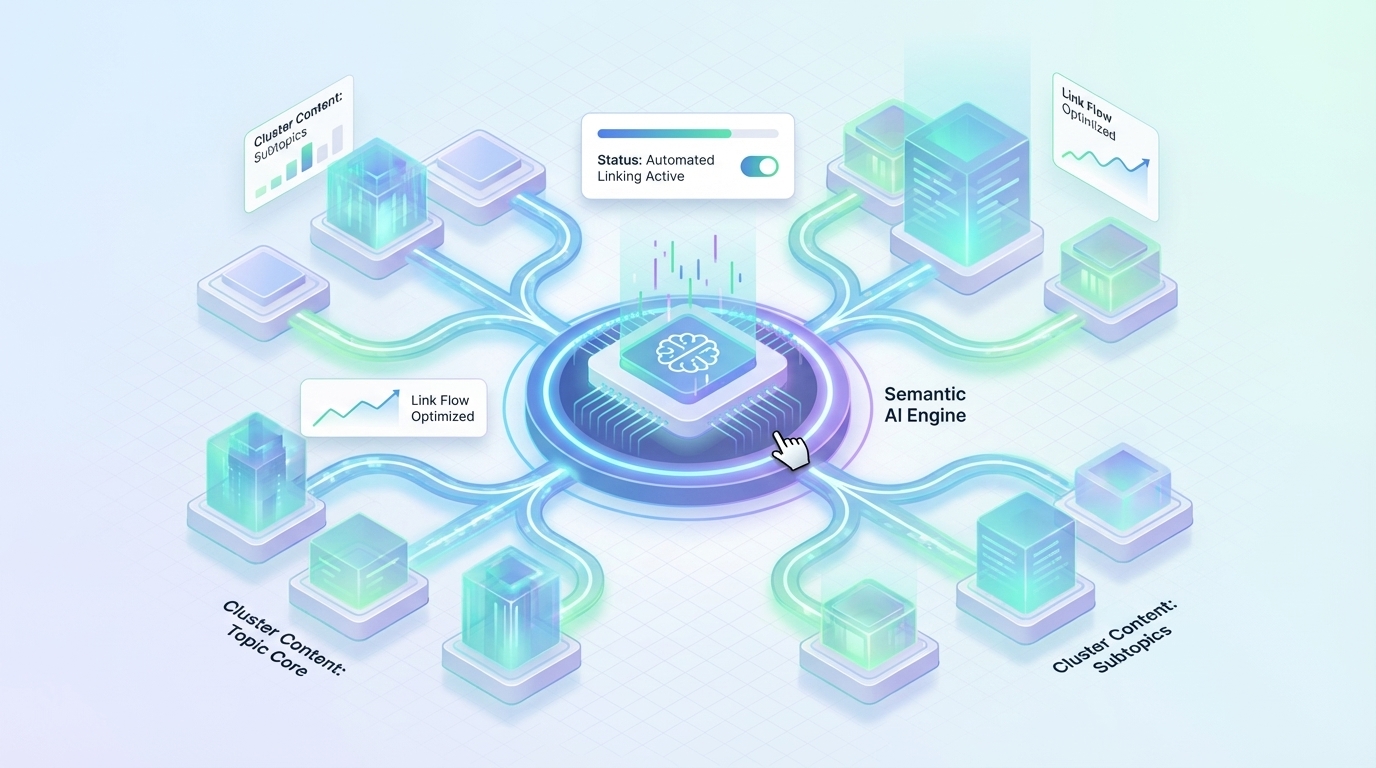
- Implementing automated pillar-and-cluster linking models facilitates a continuous flow of link equity between parent pages and granular subtopics, reinforcing topical authority across the entire domain.
- Regular health audits of automated internal linking structures are essential for identifying broken links and managing anchor text diversity to protect the site's technical integrity and long-term ranking potential.
Internal linking functions as a website's structural backbone, managing authority distribution and directing search engine crawlers through the domain architecture. The evolution of this practice has moved from a manual chore to a strategic, automated necessity in modern technical SEO. Modern SEO teams are moving toward automated internal linking to handle the complexity of massive content libraries that exceed the capacity of human editors.
Logic-based, semantic systems offer a way to move away from labor-intensive manual placement, which slows content production. These automated structures scale with content libraries, ensuring that every new page is instantly integrated into the broader topical framework. Hardening your site architecture against ranking decay requires a deep understanding of the mechanics of automated linking.
Why Manual Internal Linking Fails to Scale in Modern SEO
Manual link insertion is a significant bottleneck for growing websites managing thousands of pages across diverse topics. Human error is inevitable in these environments, often resulting in broken links or inconsistent anchor text that confuses both users and search engines. Research indicates that approximately 82% of all internal linking opportunities are currently being missed by teams relying on manual workflows.
The opportunity cost of managing links by hand is too high for high-growth digital brands. SEO teams often spend hundreds of hours on repetitive tasks instead of focusing on high-level strategy or market analysis. When a site reaches a certain size, it becomes impossible for a human editor to remember every relevant piece of archived content that should link to a new post.
Relying on manual processes also creates a risk of authority bottlenecks, in which certain pages receive too much attention while others remain isolated. Without a systematic overview, the distribution of links becomes uneven and unpredictable. This lack of coordination often leads to keyword cannibalization, in which multiple pages compete for the same intent due to inconsistent internal signaling.
Automating these connections ensures that every piece of content receives the visibility it needs to contribute to the site's overall organic performance. It removes the subjectivity of individual writers and replaces it with a data-driven growth model. Systemic automation allows for the rapid deployment of site-wide changes that would take months to implement by hand.
The Core Principles of Semantic Site Structure
A semantic site structure differs from traditional architectures by organizing content based on underlying meaning and topical relationships. The semantic model ensures that every URL resides within a contextually relevant neighborhood, making it easier for machines to interpret brand expertise.
Optimizing Link Equity Distribution and Page Authority
Link equity represents the value or authority that passes from one page to another through hyperlinks. In an automated system, this equity flows through the architecture based on predefined rules that prioritize high-value pages. Automated rules ensure that new content receives an immediate boost in authority by drawing from established, high-traffic URLs.
Mathematical precision is required to maintain a balanced distribution of authority across a large domain. Automated structures prevent the creation of orphaned pages, which are URLs that have no internal links pointing to them. By spreading equity evenly, you reduce the risk of authority bottlenecks that can trap ranking potential in a few select pages.
Systematic linking also ensures that deeper content remains visible to search engine crawlers over the long term. As authority passes through the site, it reinforces the ranking signals for both parent pages and their supporting subtopics. Constant value flow sustains a site's competitive edge in saturated search results.
Minimizing Crawl Depth for Enhanced Indexing
Crawl depth refers to how many clicks it takes for a search engine bot to reach a specific page from the homepage. Automated linking rules can prevent content from being buried too deep in the site's hierarchy by creating direct paths to important articles. Streamlined technical efficiency serves as a hallmark of a well-optimized semantic site structure.
A shallow crawl depth is essential for fast indexing, especially when publishing large volumes of content simultaneously. Semantic clusters can create shortcuts for crawlers, allowing them to discover related content without navigating through every level of the taxonomy. Crawl depth optimization ensures that your budget is spent on priority pages rather than redundant navigational links.
When you minimize the distance between the homepage and your deepest content, you also improve the user experience. Visitors can find the information they need with fewer clicks, which often leads to higher engagement metrics. Automated systems manage this complexity by dynamically generating links that keep the crawl path short and efficient.
Comparing the Total Cost of Ownership: Manual vs. Automated Systems
Understanding the financial implications of your SEO strategy is necessary for securing executive buy-in for automation tools. While manual linking may appear free because it relies on existing staff, the hidden costs in labor hours and missed opportunities are substantial. A true internal linking efficiency audit often reveals that manual efforts cost $5,000 to $10,000 more annually than an automated software license.
A manual system requires a writer or editor to spend roughly 15 minutes per article researching and inserting relevant links. For a site publishing 100 articles a month, this totals 25 hours of high-level talent time dedicated to a clerical task. Automated systems eliminate this drain, allowing that same talent to focus on producing high-intent content that drives revenue.
The ROI of automation also includes the value of the 82% of missed links that a human editor cannot identify. These missed connections represent dormant ranking power that could be driving thousands of additional sessions per month. When you factor in the increased indexation speed and ranking stability, the case for automation becomes a clear business necessity.
Automated systems also reduce the cost of technical debt and site maintenance. Fixing broken links across a 5,000-page site manually is an expensive, multi-week project for a developer or SEO specialist. An automated system identifies and resolves these issues in real-time, protecting your domain authority without requiring a dedicated maintenance budget.
Transitioning to Logic-Based Linking Rules
Logic-based linking involves using parameters to govern how connections are generated across a domain. Once the principles of equity and crawl depth are understood, they must be codified into systematic rules. Codifying these principles allows a site to grow exponentially while maintaining a consistent and logical internal structure.
Implementing Category-Based and Taxonomy-Driven Automations
Existing site taxonomies, such as categories and tags, provide a natural foundation for automated link blocks. You can set up rules that automatically link new articles to their parent category page and sibling articles within the same silo. This creates a related reading section that is always semantically relevant to the reader's current interest.
Strict taxonomy hygiene is required to ensure these automated links remain useful and accurate. If a site's categories are too broad or poorly defined, the automated links may connect unrelated topics. Maintaining a clean organizational structure ensures that the system's logic always produces high-quality, relevant connections.
These taxonomy-driven links also help search engines understand the topical boundaries of different sections of your site. By consistently linking within a specific category, you reinforce the topical authority of that section. It makes the relationship between individual articles and the broader category clear to any crawler.
Utilizing Breadcrumbs for Hierarchy and Context
Breadcrumb links display the path from the homepage to the current page, typically appearing near the top of the content. They often follow a format like Home, Blog, Technical SEO, and then Internal Linking to show the user's exact location. The breadcrumb trail provides a clear path for both users and search engines to follow back to core pillar pages.
Breadcrumb schemas help search engines display rich snippets in search results, which can improve your click-through rate. These automated links reinforce the site's semantic hierarchy by constantly pointing back to the parent and category pages. It's a simple but effective way to automate a significant portion of your site's internal link equity distribution.
Implementing these paths ensures that no page is ever a dead end for a crawler or a user. By automating breadcrumbs, you create a permanent link from every sub-topic back to its parent authority. This consistent signaling helps Google understand the relationship between broad concepts and specific details.
Leveraging Pillar and Cluster Models for Automated Success
The pillar-and-cluster model acts as a perfect framework for automated linking systems because it relies on predictable patterns. By implementing a pillar-and-cluster linking strategy, brands can ensure that authority flows from high-level overview pages to specific, granular subtopics without manual oversight. Leveraging topic clusters allows a brand to own the entire search landscape rather than just individual keywords.
Automating the Parent-Child Link Relationship
Automating the links between a pillar page and its supporting clusters ensures that every new piece of content is immediately recognized. Scripts or plugins can detect when a new cluster piece is published and automatically update the main pillar page with a new link. Real-time updates keep the pillar page dynamic and signal to search engines that the hub is regularly refreshed.
The two-way relationship between the pillar and its clusters is vital for reinforcing topical signals. The pillar page provides authority to the clusters, while the clusters provide specialized context back to the pillar. Automated systems handle these updates instantly, removing the need for an editor to manually edit the pillar page every time a subtopic is covered.
The automated parent-child relationship prevents cluster articles from becoming disconnected from their primary topic over time. As you add more depth to a subject, the system maintains the silo's integrity by ensuring that all new children are linked to the parent. It creates a robust information network that is difficult for competitors to replicate manually.
Facilitating Horizontal Linking Between Clusters
Horizontal linking involves connecting cluster articles rather than just back to the central pillar. This creates a web of relevance that keeps users engaged with a specific topic for longer periods. It helps search engines map the entire topical neighborhood by showing how different sub-points relate to one another.
You can automate these links using shared keywords or subcategory tags in your content management system. For example, if two cluster articles share the same secondary tag, the system can suggest a link between them. Tag-based automation ensures that related content suggestions remain accurate and contextually appropriate.
Connecting clusters horizontally also helps to distribute link equity across the entire subtopic rather than concentrating it only at the top. When one cluster article gains external backlinks, it can pass that value to its neighbors through these automated connections. This rising tide of authority benefits every page within the semantic cluster.
Incorporating the Reasonable Surfer Model into Link Weighting
Automated systems should account for the Reasonable Surfer Model to ensure that links placed in high-visibility areas receive more weight. By prioritizing links within the main body copy over those in the footer or sidebar, you align your automation with how Google actually distributes equity. This logic ensures that the most prominent links drive the highest ranking value for your target clusters.
Developing an Internal Link Policy for AI Agents
As brands begin to use AI-driven internal link management, they must establish a clear policy to guide the algorithm. An unguided AI can easily over-optimize a site, creating unnatural link patterns that might trigger search engine filters. You need to define specific boundaries for link density and relevance before letting an automated agent take control.
A successful policy starts by setting a maximum number of links per thousand words of content. Too many links can distract the reader and dilute the value of each connection. Most high-performing sites aim for three to five contextual links per article to maintain a balance between SEO and readability.
Relevance scores should serve as the gatekeeper for every automated link placement. You can program your system only to place a link if the semantic similarity between two pages exceeds a certain threshold, such as 85%. Mathematical proximity ensures that your site's internal network is built on deep relevance rather than just linguistic coincidence.
Finally, your policy should include rules for anchor text diversity to avoid over-optimization. An AI agent should be instructed to cycle through a list of branded, exact-match, and partial-match anchors. By codifying these best practices into the system's logic, you ensure that your automated linking remains safe and effective for the long term.
The Role of Natural Language Processing (NLP) in Semantic Linking
Advanced automation moves beyond simple keyword matching to embrace true semantic understanding through Natural Language Processing (NLP). This technology enables much more sophisticated link placement, identifying semantically relevant anchor text positions with high relevance scores. Natural Language Processing identifies topical entities within your content to find the most logical connection points.
Identifying Entities for Contextual Link Placement
NLP models identify specific entities, such as people, places, or technical concepts, within your text to find linking opportunities. Instead of just searching for a specific phrase, the model understands that related terms are entities that deserve a link. Entity identification moves your strategy toward a sophisticated user experience where links appear in the most logical sentences.
Linking based on entities ensures that your internal links are always relevant to the reader's intent. If a paragraph discusses a specific technical concept, the NLP model can link to a source-of-truth page that defines the term. It provides immediate value to the reader without requiring the content creator to conduct manual research.
Semantic linking also protects content from looking like a list of repetitive keywords. Because the system understands entities, it can vary the anchor text while still maintaining a strong topical connection. It allows for a more natural writing style that isn't dictated by the needs of a manual linking spreadsheet.
Mapping Content Relevance via Vector Embeddings
Vector embeddings and cosine similarity scores allow a system to understand the mathematical proximity between two pieces of content. Vectorization represents text as numerical coordinates in a multi-dimensional space, where similar topics are grouped closely together. Vector embeddings compute semantic similarity, helping to ignore surface-level vocabulary differences during the linking process.
A system using vector embeddings can recommend links to conceptually similar content, even if the words used differ. For instance, an article about site speed might be linked to one about image optimization because they share a mathematical proximity. Mathematical proximity ensures that your site's internal network is built on deep relevance rather than just linguistic coincidence.
The Significance of Site-Wide Knowledge Graphs
A site-wide knowledge graph acts as the centralized brain for your automated internal linking system. It stores every entity, category, and relationship found across your thousands of pages in a machine-readable format. The knowledge graph serves as the single source of truth, enabling the NLP model to make informed linking decisions.
By building a knowledge graph, you can map out complex relationships that simple taxonomies might miss. For example, the graph can recognize that a specific product is related to a specific problem mentioned in a blog post. Graph mapping allows for transactional links that feel natural and helpful to the user's journey.
Knowledge graphs also help search engines like Google understand your site's topical authority more quickly. When your internal links mirror a well-structured graph, you're speaking the same language as modern search algorithms. This alignment can lead to faster indexation and better rankings for your core pillar pages.
Updating your knowledge graph is an automated process that occurs every time you publish new content. The system crawls the new text, identifies new entities, and instantly updates the relationships within the graph. This dynamic foundation ensures that your internal linking strategy is always based on the most current version of your website.
Case Study: Moving a 5,000-Page SaaS Blog to Vector-Based Linking
Consider a hypothetical 5,000-page SaaS blog that struggled with a flat site structure and thousands of orphaned pages. Their editorial team was unable to keep up with internal linking, leading to a significant drop in organic visibility for older content. They decided to implement a vector-based, automated internal linking system to restore their architectural health.
The first phase involved generating vector embeddings for every article in their library to map out conceptual relationships. Once the map was built, they set logic-based rules to identify the top three most relevant pages for every URL. The system then automatically inserted these links into the body copy of every page, instantly removing all orphaned URLs.
Within three months of implementation, the site saw a 20% lift in indexation speed for new content. The crawl depth for their most important conversion pages was reduced from 6 clicks to 2. The resulting improvement in technical accessibility led to a measurable increase in organic sessions for deep-level cluster articles.
The team also saved approximately 40 hours of editorial time per month that was previously spent on manual link audits. By automating the process, they ensured that every new post was perfectly integrated into their topical authority from the moment it went live. This case study demonstrates the power of shifting from a reactive manual process to a proactive automated one.
Strategies for Automated Anchor Text Optimization
Anchor text requires careful management within an automated system to avoid the appearance of over-optimization. While automation is highly efficient, it must be programmed to use natural, varied language that accurately describes the target page. Balancing SEO signals with readability ensures that your links remain helpful to users while still passing the necessary ranking data.
Avoiding Exact-Match Over-Optimization
Using the same anchor text for every automated link can look manipulative to search engine algorithms. You should build variation lists that the automation tool can cycle through when placing links across the site. Anchor text variation prevents a single keyword from appearing dozens of times as the only entry point to a specific page.
NLP can also be used to extract diverse phrases from the surrounding text to serve as natural anchors. By analyzing the sentence structure, the system can select a descriptive phrase that fits the paragraph's tone. This results in a much more natural distribution of branded, generic, and keyword-rich anchors.
A diverse anchor text profile is more resilient to algorithm updates that target aggressive SEO tactics. By automating variety, you ensure your site stays within the bounds of natural link building. It provides a safer long-term strategy for maintaining rankings across high-competition keywords.
Using Descriptive Phrases and Contextual Anchors
Programming automation tools to select longer, more descriptive phrases improves the user's understanding of the destination. Instead of linking just a single word, a tool might link a descriptive phrase about enterprise SEO workflows. Descriptive phrasing provides more context to search engines and often results in a higher click-through rate for visitors.
Sentence-level context can inform the selection of these automated anchors by leveraging surrounding information. If the paragraph is discussing cost-efficiency, the anchor might focus on the time-saving benefits of the linked page. This level of detail makes the automated link feel like a deliberate choice made by the author.
Descriptive anchors also improve accessibility by giving screen readers a clearer idea of where a link leads. When your automated system prioritizes clarity, it improves the overall quality of the site's architecture. It ensures that every link serves both a technical purpose and a practical one for the reader.
Technical Solutions for Building Automated Systems
Automating internal linking involves leveraging AI-powered tools and algorithms to streamline the creation, management, and optimization of internal links on a website. Choosing the right technical solution depends on your site's architecture and your team's technical skill level. Regardless of the tool, the goal is to create a system that reduces manual intervention while increasing accuracy.
Smaller sites using WordPress can start with ready-made plugins like LinkWhisper or Interlinks Manager that handle basic logic-based linking and taxonomy rules. These tools allow you to set keywords that automatically trigger a link to a specific URL. While simple, they provide a significant efficiency boost for blogs and small e-commerce stores with limited technical resources.
Advanced teams may prefer Python-based automation with libraries such as BeautifulSoup and Hugging Face Transformers. These scripts can crawl your site, generate vector embeddings, and suggest links based on true semantic similarity. Using custom Python scripts offers much more control and can be integrated into your existing SEO articles production workflow.
Enterprise organizations often require API-driven knowledge graph integration for maximum scalability. These systems connect your content management system directly to a vector database like Pinecone or Milvus. API-driven integration with vector databases like Pinecone represents the gold standard for internal linking, providing real-time, mathematically accurate connections across sites with tens of thousands of pages.
Link Health Auditing and Maintaining Automated Integrity
Even the most advanced automated system requires regular health audits to ensure it remains a positive asset for your domain. Automation can occasionally create link loops or point to redirected pages, which can waste crawl budget. You should implement weekly automated cron jobs to scan your internal link network for technical errors.
A thorough audit of your internal links will identify 404 errors or 301 redirects used as link targets. Your system should be programmed to update these links to the final destination URL automatically. Fixing technical errors ensures a clean experience for both users and search crawlers while maximizing the flow of link equity.
Monitoring link density is another critical part of maintaining system integrity. If your automated rules are too aggressive, they might clutter your most important pages with dozens of irrelevant links. Your auditing tool should flag pages that exceed your predefined link-to-word ratio, allowing you to refine your logic.
Finally, you should review a sample of automated links each month to ensure the anchor text fits the surrounding context. While NLP is powerful, it can occasionally make awkward choices that a human editor would catch. Regular sampling ensures that your automation continues to feel like a high-quality human product.
Protecting Your Site Architecture from Common Pitfalls
Automation isn't without its risks, such as creating spider traps that confuse crawlers. You must set strict exclusion rules to prevent certain pages from being flooded with irrelevant automated links. Pages such as Contact Us, Privacy Policy, and Terms of Service should generally be excluded from semantic linking algorithms.
It's also important to ensure that the automation doesn't create a noisy environment by placing too many links on a single page. If every second sentence contains a link, the value of each connection is diluted, and the user experience suffers. Setting a maximum number of links per paragraph rule can keep the content readable and the link equity focused.
Regular audits are necessary to ensure the system behaves as expected and does not create irrelevant connections. Even the best NLP models can occasionally misinterpret context or link to outdated pages. By reviewing a monthly sample of automated links, you can refine your rules and maintain a high standard of quality.
Monitoring and Iterating on Automated Systems
Automation is not a set-it-and-forget-it solution and requires ongoing monitoring to remain effective. You should track key metrics, such as changes in crawl frequency and improvements in keyword rankings, for heavily linked pages. If certain pages aren't seeing the expected ranking boost, you may need to adjust your equity distribution rules.
User engagement metrics like pages per session and bounce rate can also indicate whether your automated links are actually helpful. If users are clicking through and spending time on the linked content, your semantic structure is working well. According to industry data, pages accessible within 2-3 clicks receive more frequent crawl attention than deeper pages.
A framework for iteration allows you to refine your linking logic as you collect data over time. As search engine algorithms evolve, your automated rules may need to be updated to reflect new best practices. Staying proactive ensures that your site's internal structure remains a powerful asset for your organic growth.
According to research from InLinks, 82% of all internal linking opportunities are currently being missed by webmasters. This highlights the massive potential for brands that embrace semantic internal linking as a core part of their technical strategy. By identifying these gaps, you can secure a significant competitive advantage in even the most saturated markets.
Automate Your SEO Success with High-Performance Content
Transitioning from manual linking to automated, semantic structures is a prerequisite for any brand looking to scale its organic search presence. By implementing logic-based linking and NLP integration, you create a site that is easy for search engines to understand and for users to navigate. Adopting a systematic approach ensures that every piece of content you produce instantly contributes to your overall topical authority.
Achieving this level of technical sophistication requires a content strategy that is built for automation from the ground up. We understand that manual workflows are the primary barrier to growth for most modern marketing teams. Our platform not only creates high-quality, ready-to-publish articles, but also includes internal links built in.
We specialize in creating content that drives traffic, engages audiences, and generates real results for your business. Book a demo with Brand Voice today to learn how we can help you drive measurable organic growth.