- Strategic CTA placement across long-form content is essential because relying solely on a bottom-of-the-post call to action misses readers who exit before the final paragraph.
- Aligning primary conversion elements with the F-Pattern and Z-Pattern visual scanning behaviors ensures visibility for the 68 percent of users who skim digital text.
- Contextual CTA insertion that provides hyper-focused offers related to specific sub-topics reduces user friction and increases the likelihood of a successful signup.
- Utilizing heatmaps and scroll depth analytics allows marketers to identify the conversion sweet spot and adjust placement based on actual user engagement data.
- Combining text-based anchor links with graphical buttons helps overcome banner blindness and maintains reader focus by making promotional elements feel like a natural part of the editorial content.
Most content marketers eventually run into the same problem: long-form articles that rank on page one and pull thousands of monthly visitors still produce disappointing signup rates. While articles exceeding 1,500 words generate substantially more organic traffic, capturing that attention doesn't always translate into immediate conversions.
Closing the gap between high traffic and tangible signups requires a strategic approach to integrating calls to action.
The Evolution of Engagement: Why Traditional CTA Placement Fails
Modern strategies treat long-form content as a tool to satisfy both search engines and human readers. These comprehensive guides are excellent for ranking on the first page because they provide deep value, yet many brands struggle with low conversion rates. Even though long-form guides can meaningfully increase email opt-in rates, this potential is frequently lost when marketers rely on outdated placement techniques.
Traditional strategies often assume that a single call to action at the end of an article is sufficient for driving signups. This approach overlooks the fact that many users never reach the end of a 2,000-word article. If the primary conversion point is buried thousands of words deep, a significant portion of the audience will exit the page before they ever see the offer. This mismatch between content length and user persistence creates a missed opportunity for lead generation.
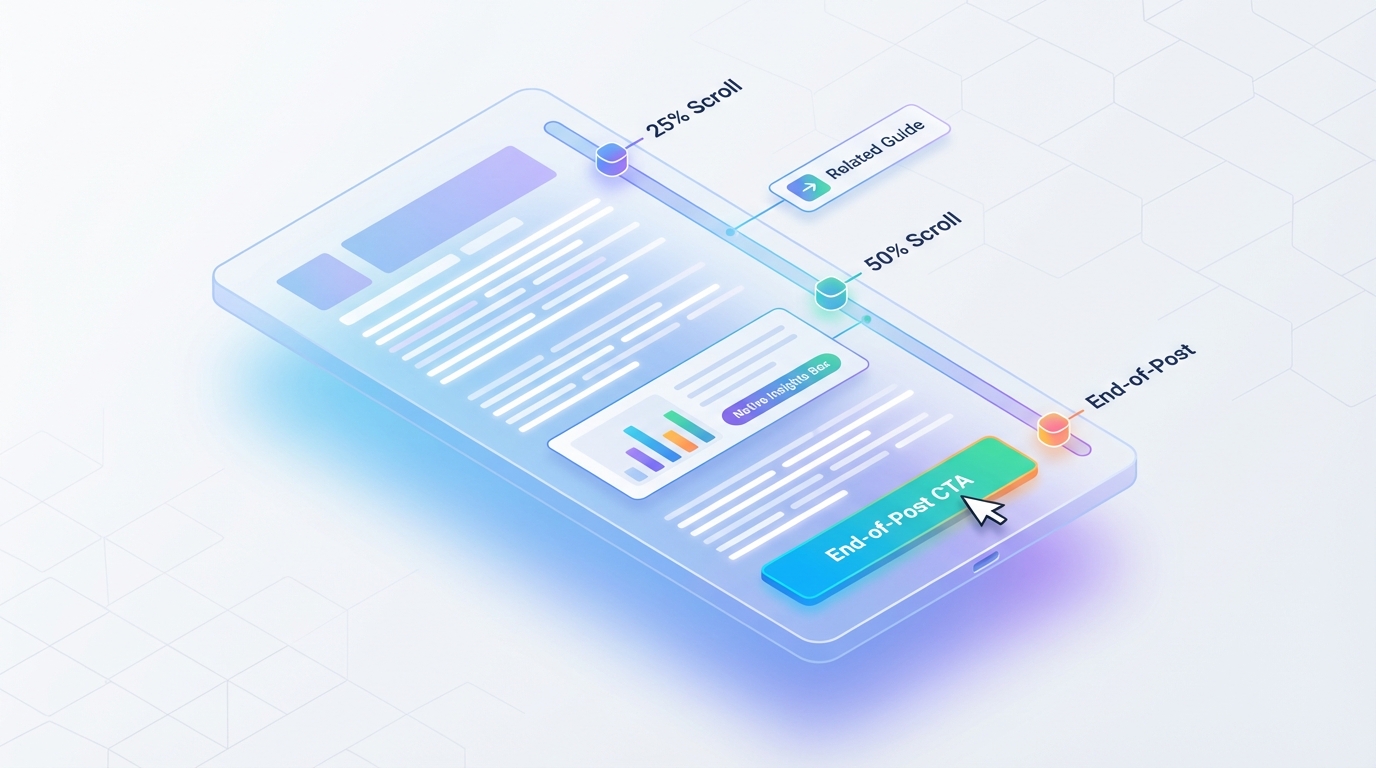
Strategic CTA placement improves lead generation efficiency by ensuring that offers appear where users actually spend their time. Content that exceeds 1,500 words requires multiple touchpoints that respect the reader's time and level of interest. Relying on a "bottom of the post" CTA is no longer a viable strategy for maintaining high conversion rates in a digital landscape where attention is scarce.
Understanding Reader Psychology and Digital Consumption Patterns
Creating an effective strategy for distributing CTAs begins with understanding how people actually read online. Most users don't engage with a blog post the same way they would a physical book. Instead, they navigate through digital text with a focus on efficiency, which means a more distributed approach to CTAs is necessary to capture their attention.
Research on digital reading behavior consistently finds that the majority of users skim content before committing to a full read. If your content doesn't accommodate this habit, you'll likely see high bounce rates and low engagement on your primary offers.
The F-Pattern and Z-Pattern: How Readers Scan Your Content
The F-Pattern is one of the most common visual scanning behaviors for text-heavy articles. Users typically start by reading across the top of the page, then move down and scan across a second horizontal line, and finally scan the left side of the content vertically. This pattern means that the most valuable real estate for a call to action is often in the top-left or along the initial horizontal paths where eyes naturally land.
For pages that feature more visual breaks, headers, and images, readers often adopt the Z-Pattern. In this case, the eye moves from the top left to the top right, then cuts diagonally down to the bottom left, and finally across to the bottom right. Understanding these paths allows you to place conversion elements where they are most likely to be seen during a quick skim. Aligning your CTAs with these natural eye movements ensures that your message isn't overlooked as the reader moves through the page.
To maximize visibility, you should place CTAs at the intersection points of these patterns. For instance, a small text link in the first few paragraphs or a button near a prominent header can catch a skimmer's eye.
The Relationship Between Scroll Depth and Reader Intent
Visual scanning patterns change as a user commits to deeper scrolling. A reader's intent and level of commitment change significantly as they move deeper into a long-form article. Above the fold, a user is usually looking for a quick answer or deciding if the content is worth their time. As they scroll further, their interest shifts to deeper engagement, but they also encounter "the dip," the point where many readers lose focus and drop off.
The type of CTA you offer should evolve based on how far the reader has scrolled down the page. Early in the piece, a low-friction offer, such as a newsletter signup, might be appropriate for someone testing the waters. Once they reach the middle sections, they have demonstrated greater investment, making them better candidates for more detailed resources.
By the time a user reaches the final third of a long-form piece, they've proven themselves to be highly engaged and interested in your expertise. At this stage, you can present more significant offers that require a higher level of commitment.
Using Format Variety to Bypass Selective Attention
Reducing banner blindness is a primary challenge for any digital marketer. This occurs when experienced internet users subconsciously ignore anything that looks like an advertisement, such as standard sidebar banners or header graphics. Selective attention allows readers to focus on the informational content while completely filtering out the surrounding promotional elements.
One of the most effective methods for reducing banner blindness is to match the CTA typography to the article's primary body text. By alternating between different styles, such as text-based links and slide-in conversion elements, you keep the experience fresh and prevent the reader from tuning out. This variety forces the brain to process the information anew rather than filtering it as an advertisement.
Technical Implementation Tools and Platforms
Executing this strategy requires software to manage triggers and track performance. Many brands use platforms like OptinMonster to deploy non-intrusive slide-in conversion elements that appear at specific scroll percentages. These tools allow you to test different designs and copy without needing a developer for every change.
HubSpot provides powerful features for managing dynamic CTAs that adapt to user data. If a visitor is already a subscriber, the system can display a different offer to keep them moving through the sales funnel. This level of automation is necessary for maintaining a personalized experience across thousands of long-form articles.
Using Hotjar for heatmap data informs conversion element positioning by showing where users actually click and hover. These visualizations reveal if your current buttons are being ignored or if users are clicking on non-linked elements. Adjusting your layout based on this data can significantly improve your B2B SaaS blog's conversion rate optimization.
WordPress users can also leverage plugins that offer granular control over CTA placement within the post body. Knowing how to track CTA performance in WordPress is integral for understanding which specific paragraphs drive the most leads. These tools provide the technical foundation needed to move from guesswork to a data-backed conversion strategy.
Anatomy of a High-Converting Call-to-Action in Informational Content
Effective placement is only half of the equation for a successful conversion strategy. The structure and style of the CTA itself must align perfectly with the surrounding informational content to feel natural and persuasive. When the call to action matches the tone and depth of the article, it transforms from a disruption into a helpful next step for the reader.
Contextual offers reduce user friction by providing a solution that is directly relevant to the reader's current problem. This relevance is the primary factor in whether a user chooses to engage or continue scrolling. If the offer feels like an interruption, it will likely be ignored regardless of how well it is placed.
Text-Based Anchor Links vs. Graphical Buttons
Text-based anchor links often have a native feel that allows them to bypass a user's mental filter for advertisements. Because they look like standard editorial links, they don't trigger the same skepticism that a bright, flashing button might. These subtle links are excellent for mid-article insertions when you want to maintain the narrative flow without being overly aggressive.
Graphical buttons provide a strong visual punch that is difficult to miss. They typically use high-contrast hex codes and CSS-based hover effects to differentiate themselves from editorial text. The bold nature of a button signals a definitive action, making it clear to the reader exactly what the next step should be.
Using a combination of both styles is often the most effective way to drive signups. You can use text links to plant seeds of interest throughout the informational sections and then use a prominent button to harvest those leads at the end. This balanced approach ensures you're capturing both the subtle interest of skimmers and the directed intent of deep readers.
The Power of Contextual CTA Insertion
Contextual CTA insertion involves aligning the call to action with the specific sub-topic being discussed in that section. Instead of using a generic "sign up now" prompt, you might offer a checklist that helps the reader implement the specific advice you just provided. A highly relevant, hyper-focused offer will almost always convert better than a broad, one-size-fits-all message.
For example, if you're writing a section about SEO keyword research, a contextual CTA would offer a free template for tracking keywords. This approach leverages the immediate value the reader has just received and provides a logical tool to help them continue their progress. When the offer feels like a natural extension of the paragraph, the friction of signing up is greatly reduced.
Matching your offers to the informational value provided in each section also builds trust with your audience. It shows that you understand their specific needs and are providing solutions tailored to their current context.
High-Intent Copywriting Frameworks
Your CTA copy must connect the problem the reader faces and the solution you provide. Effective transitions often use the "Problem-Agitate-Solve" framework to create urgency. For instance, after describing a technical hurdle, you can introduce a lead magnet that specifically solves that pain point.
Consider the best lead magnet ideas for long-form content, such as spreadsheets, calculators, or PDF summaries. These assets provide immediate utility and serve as a tangible reward for the reader's time. Your copy should clearly state the asset's benefit rather than describe its format.
Transitions should be smooth and conversational to avoid jarring the reader. Instead of "Download now," try "You can use this template to simplify your audit process." This subtle shift in tone makes the call to action feel like a helpful recommendation from an expert.
Anchor Text Optimization for Direct Response
Anchor text optimization is about moving beyond generic phrases like "Click Here" or "Learn More." Effective anchor text should use benefit-driven, action-oriented language that tells the reader exactly what they will gain by clicking. Instead of a vague instruction, try using descriptive phrases such as "Download Your Free Content Audit Template" or "Get the Complete Guide to Conversion Optimization."
Using descriptive anchor text also improves the overall user experience by providing clarity and setting expectations. Readers are more likely to click when they know exactly where the link will take them and what they will receive in return. This transparency reduces the perceived risk of the interaction and encourages more signups.
Optimized anchor text also provides a slight boost to your SEO relevance by signaling to search engines what the linked page is about. While the primary goal is direct response, the secondary benefit of improved topical authority is valuable. Clear, descriptive, and benefit-focused language remains the standard for high-performing conversion links.
Optimal Positioning Strategies Throughout the Content Journey
Viewing your long-form article as a journey for the reader allows you to place CTAs at different stages of readiness. A well-distributed placement strategy ensures you reach users, whether they want to convert now or need more information first. By mapping your conversion points to the reader's progress, you create a cohesive and persuasive experience.
This wasteland model also helps in building a content moat that keeps users engaged within your ecosystem. When users see multiple relevant offers, they are more likely to perceive your brand as the primary authority. Proper positioning ensures that no matter where a reader stops, they have a clear path to follow.
The Lead-In CTA: Capturing Early Interest Above the Fold
Placing a CTA very early in the article is often referred to as "above the fold" positioning. This strategy is particularly effective for high-intent keywords where users may already be looking for a solution and are ready to convert without reading the full piece. If a reader arrives on your page with the specific goal of finding a tool or service, providing an early signup option saves them time.
The risk of a lead-in CTA is that it might distract from the introduction or appear too aggressive if not handled carefully. To mitigate this, the early offer should be subtle and integrated into the introductory paragraphs. A simple text link that says "Short on time? Download the summary here" can capture early leads without frustrating those who want to read the full article.
Implementing a lead-in CTA also provides a safety net for users who may only stay on the page for a few seconds. If they see a relevant offer immediately, they might convert even if they don't have time to engage with the rest of the content. This early touchpoint ensures that you don't lose potential signups from the significant portion of traffic that bounces early.
Mid-Content Breaks: Providing Value-Driven Bridges
The middle of a long-form article is often where readers are most likely to lose focus or become overwhelmed by information. You can use this space to offer interruptive but valuable CTAs that serve as bridges to keep the reader engaged. Well-placed CTAs can increase revenue by an average of 83 percent, according to data from Sender, especially when they appear after high-value sections.
You should place CTAs after key sections like benefits, testimonials, pricing, or case studies. Using "in-feed" boxes or highlighted pull-quotes allows you to create conversion points that stand out without breaking the narrative flow. These boxes can feature a different background color or a simple border to distinguish them from the main text.
Ideally, these mid-content breaks should follow sections that have established your authority or provided significant insight. After you've shared a success story or a complex technical explanation, the reader's trust in your brand is at a peak. This is the perfect moment to offer a resource that builds on that momentum and encourages a signup.
The "Deep Dive" CTA: Targeting Highly Engaged Readers
Readers who reach the 75 percent mark of a long-form article are your most qualified and interested leads. They have demonstrated a high level of persistence and are clearly finding significant value in your content. This is the time to capitalize on their engagement with more substantial offers, such as whitepapers, comprehensive guides, or specialized webinars.
Long-form landing pages and deep-dive offers can produce significantly higher conversion rates than standard blog CTAs. Since these readers are already invested in the topic, they are much more likely to provide their contact information in exchange for deeper insights. This section of the article should reward the reader's persistence with an offer that matches the depth of the content they've just consumed.
The messaging for a deep-dive CTA should acknowledge the reader's commitment and offer a logical "next step" in their learning process. Phrases like "Now that you've mastered the basics, download our advanced strategy guide" can be very effective here. By aligning the offer with the user's progress, you maximize the conversion potential of your most engaged audience members.
Slide-In Conversion Elements and Exit-Intent Overlays
Slide-in conversion elements are a more technical placement strategy that can be triggered at specific scroll depths. These elements typically appear in the bottom corner of the screen once a user has scrolled halfway through the article. They provide a non-intrusive way to keep an offer visible and accessible as the reader moves through the content.
Unlike static banners that can be easily scrolled past, a slide-in element moves with the user, maintaining its visibility without blocking the text. This persistent presence makes it easy for the reader to convert the moment they feel ready, rather than having to search for a link. You can set these to trigger after the reader has spent a certain amount of time on the page or reached a key section.
Exit-intent overlays are another technical tool that can capture signups just as a user is about to leave the site. While these should be used sparingly to avoid being annoying, they can be highly effective for offering a last-chance discount or a lead magnet. When combined with slide-ins, these tools create a comprehensive system for capturing leads at every possible exit point.
Measuring Success with Scroll Depth Analytics and Heatmaps
The most effective placement strategies are never based on guesswork, but on actual user behavior data. By analyzing how people interact with your website, you can refine your CTA positioning to match your audience's habits. Using data-driven insights ensures that your conversion points are located where they will have the most significant impact.
Heatmap data informs the positioning of conversion elements by identifying the exact sections where users lose interest. If you find that a specific subheading consistently causes users to leave, you should move your CTA higher on the page. This iterative approach lets you continually improve results based on real-world usage.
Identifying the "Conversion Sweet Spot" via Heatmaps
Heatmapping tools provide a visual representation of where users spend the most time and where their cursors hover. These maps reveal hot spots where readers are most engaged and dead zones where they are likely to ignore content. If your primary CTA is located in a dead zone, it doesn't matter how compelling the copy is because nobody will see it.
By studying these heatmaps, you can identify the exact points in your article where a CTA would be most effective. For example, if you see a high concentration of activity around a specific sub-heading, that's a prime location for a contextual link. Conversely, if users are quickly scrolling past a certain section, you should avoid placing important conversion elements there.
Practical interpretation of heatmap data involves looking for patterns across multiple long-form articles. If you notice that readers consistently drop off after the 2,000-word mark, you should ensure your most generous offers are placed well before that point. This iterative process of observation and adjustment allows you to optimize your content for maximum signup potential over time.
Tracking Micro-Conversions Across the Content Journey
Micro-conversions are small but significant actions that lead a user closer to a final goal, such as newsletter signups or resource downloads. Digital marketers should use scroll depth analytics to identify the exact paragraph where 50 percent of the audience stops reading. This data is necessary for understanding the effectiveness of your distributed CTA strategy.
Setting up scroll-depth analytics triggers lets you see how many users reach certain benchmarks in the article. You can then correlate this data with your conversion rates to see which CTAs are performing the best. If you find that a slide-in at 50 percent scroll depth is driving more leads than a button at 90 percent, you can adjust your strategy accordingly.
This data-driven approach informs future content updates and CTA adjustments by highlighting what actually works for your audience. You can double down on the types of offers and placements that deliver the highest conversion rates while phasing out those that are being ignored. Continuous monitoring of these micro-conversions is the key to maintaining a high-performing conversion engine.
Advanced Tactics to Minimize Friction and Maximize Signups
For teams that have already mastered the basics of CTA placement, advanced tactics can offer deeper technical integration and personalization. These high-level strategies involve using technology to make the conversion experience as seamless and relevant as possible for every individual reader.
Implementing these advanced tactics is easier when you have a library of monthly content that follows a consistent format. This allows you to apply triggers and personalization rules across multiple pages simultaneously.
Reducing Banner Blindness with Dynamic and Personalized CTAs
Dynamic content allows you to change the call to action based on the user's source, past behavior, or demographic data. For example, a returning visitor might see a different offer than a first-time reader, or someone arriving from a social media ad might see a CTA that matches the ad's messaging. Personalizing the experience in this way makes the reader feel seen and increases the value of the offer.
A report from HubSpot shows that personalized CTAs convert at 202% higher rates than non-personalized ones. This massive increase in performance is due to the offer being much more likely to be relevant to the user's specific needs at that moment. By using dynamic insertion, you can ensure that the right message reaches the right person.
The logic behind dynamic insertion is to reduce the cognitive load on the reader by showing only what they are likely to care about. If a user has already subscribed to your newsletter, the dynamic CTA can instead offer a free trial of your software. This constant evolution of the conversion path keeps the reader moving forward through the sales funnel.
Frequency and Spacing: Finding the Balance Between Persuasion and Annoyance
One of the most common questions regarding long-form content is how many CTAs are appropriate in a 3,000-word article. There is a fine line between being persuasive and being annoying, and finding the right balance is integral for maintaining a positive user experience. Generally, you want to space your conversion elements so that they feel like natural extensions of the content rather than interruptions.
A good rule of thumb is to have a conversion point every 500 to 800 words, depending on the topic's complexity. This frequency ensures that a call to action is always nearby without overwhelming the reader. The rhythm of the piece should allow for several paragraphs of pure informational value between each offer.
Maintaining this spacing helps preserve the article's editorial integrity and ensures the reader doesn't feel bombarded. If the content starts to feel like a series of sales pitches rather than a helpful guide, you will likely see a spike in bounce rates. Strategic spacing allows the reader to absorb your expertise before being asked to take the next step.
Industry-Specific CTA Strategies
The goals and behaviors of your audience will vary significantly depending on whether you operate in a B2B or B2C environment. For B2B SaaS brands, the primary objective is often lead qualification and nurturing through long sales cycles. In this context, CTAs should focus on high-value resources like industry reports or invitations to SaaS content marketing webinars.
Placement in B2B content should prioritize authority building and demonstrating technical competence. You might place a CTA after a complex case study or a detailed breakdown of a technical feature. For example, a technical integration guide, paired with a CTA offering a deployment checklist, can convert at a noticeably higher rate than a generic newsletter prompt placed at the end. This ensures that the user is presented with a conversion opportunity the moment they are convinced of your brand's expertise.
In contrast, B2C e-commerce strategies often focus on immediate transactions or low-friction engagement. These articles might include CTAs offering limited-time discounts or direct links to product pages mentioned in the text. The placement should be more frequent and visually prominent to capitalize on impulsive buying behaviors.
B2C readers often respond well to social proof elements integrated into the CTA itself. Including a small testimonial or a "join 10,000 others" tag near the button can reduce anxiety and increase click-through rates. Understanding these nuances allows you to tailor your placement strategy to the specific psychology of your target market.
Common Pitfalls to Avoid in CTA Placement
Even with a well-researched strategy, certain placement mistakes can actively hurt your conversion rates and even your SEO rankings. Avoid common errors that cause cognitive friction or make your brand appear untrustworthy. Staying mindful of these pitfalls will help you maintain a high standard of quality while you optimize for signups.
You should review your strategic CTA placement regularly to ensure that links haven't become broken or outdated. A poor user experience can quickly erode the authority you've worked so hard to build. Consistency and quality control are necessary for long-term success in content marketing.
Disrupting the Narrative Flow and User Experience
Placing a large, intrusive CTA in the middle of a critical explanation or a compelling story can be very damaging to the user experience. This type of disruption causes cognitive friction, forcing the reader to stop their train of thought to process the advertisement. If the interruption is too jarring, the reader may become frustrated and leave the site entirely before they even finish the section.
Flow and editorial integrity are paramount for keeping readers engaged with long-form content. You should always look for natural breaks in the conversation, such as the end of a sub-section or a transition between topics, to place your CTAs. By respecting the narrative flow, you ensure your offers are seen when the reader is most receptive.
A well-placed offer should feel like a reward for reading rather than a tax on the reader's attention. If you provide immense value in the preceding paragraphs, the reader will be much more open to your request. Focus on creating a symbiotic relationship between your information and your conversion points.
Overwhelming the Reader with Competing Offers
The paradox of choice suggests that offering too many types of CTAs in a single article can lead to decision paralysis. If you ask the reader to sign up for a newsletter, download a whitepaper, and book a consultation all on the same page, they may end up doing none of those things. It is better to pick a primary goal for the article and ensure that most of your CTAs point toward that single objective.
Clarity is essential for guiding the reader toward a conversion. Every element on the page should work together to lead the user down a single, clear path. While you can use different CTA styles, they should all support the same overarching offer. This focus reduces confusion and makes it much easier for the reader to say "yes" to your primary request.
If you must include multiple offers, ensure they are secondary and visually distinct from your main CTA. For example, a primary button could be used for your main lead magnet, while a small footer link could be used for the newsletter. This hierarchy ensures that your most important message is always the most prominent.
Maximize Your Signups with Brand Voice Expertise
Strategic CTA placement is a complex blend of psychology, data analysis, and editorial tact. Long-form content is one of the most powerful assets in your marketing arsenal, but its true value is only realized when it is optimized to guide readers toward specific actions. By distributing your conversion points, personalizing your offers, and using data to refine your approach, you can transform your blog into a high-performing lead generation engine.
Achieving this level of comprehensive optimization requires significant expertise and a deep understanding of digital reader behavior. If you have the strategy but lack the time to produce the 3,000-word articles required to execute these placement tactics, we can help. Our team specializes in creating ready-to-publish, SEO-optimized articles that already incorporate these conversion best practices, so you don't have to worry about the technical details. Book a demo today to see how Brand Voice can deliver high-quality content that drives traffic and generates real results for your business.