- Product-led content accelerates user activation by integrating real-time software experiences into educational material, effectively reducing friction before the signup process.
- Interactive demos and sandbox environments leverage the endowment effect to build psychological ownership, leading to a 30 percent increase in click-to-signup conversion rates.
- Incorporating pre-signup aha moments into SEO articles helps lower the average Time to Value (TTV), addressing the high abandonment rates seen in traditional SaaS trial models.
- High-fidelity GIFs and narrative walkthroughs demonstrate core product value immediately, increasing engagement by 20 percent compared to static marketing content.
SaaS marketing is shifting rapidly as buyers demand immediate proof of value. The traditional funnel often forces users to sign up before they can see a product's true capabilities.
Forward-thinking brands are now moving the aha moment directly into their educational content to satisfy this need. Understanding the mechanics of product-led content is the first step toward reducing user friction and accelerating adoption.
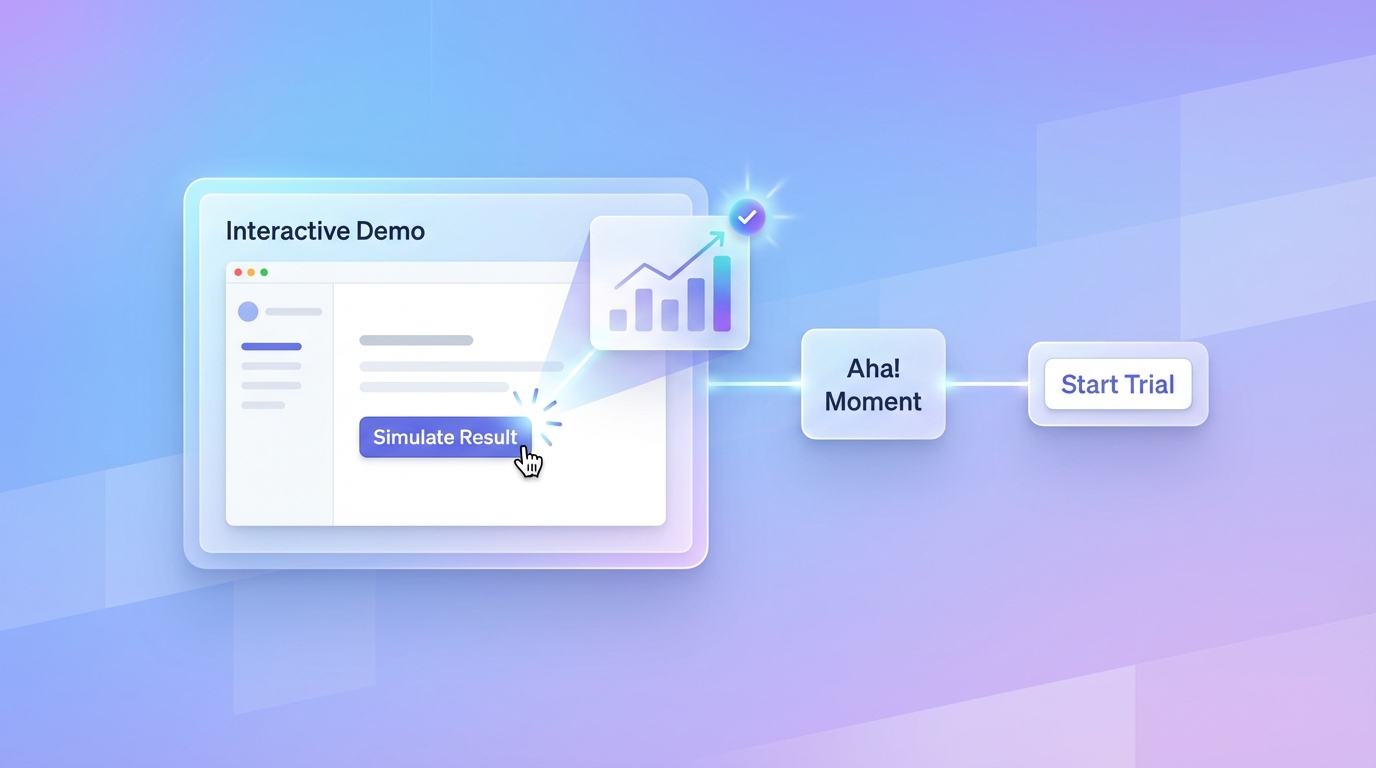
Redefining the User Journey: The Shift Toward the Pre-Signup Aha Moment
The user journey is no longer a straight line that ends at a signup form. It has evolved into a fluid experience where value must be demonstrated long before a user considers sharing their contact information.
The Rise of Product-Led Content
This shift has given rise to product-led content, which integrates the actual software experience into the educational process. Product-led content facilitates user activation by showing functionality in real-time environments. It differs from traditional top-of-funnel material by moving beyond basic education.
The content not only explains a concept but also allows the reader to visualize or interact with the solution immediately. Brief, intuitive interactions are essential for maintaining engagement throughout these digital experiences. Data shows that three-step tours have a 72% completion rate, while seven-step tours see engagement drop to 16%.
Integrating and leveraging topic clusters to dominate search results for core industry terms helps place these interactive moments within a broader authority-building framework. By simulating the user experience in the blog post, brands can mitigate the skepticism typical among technical buyers. This approach transforms a passive reader into an active evaluator.
The Problem with the Gated Value Model
Forcing users to sign up before they see any real value creates high friction that modern buyers often will not tolerate. Most people are naturally skeptical of marketing claims and prefer to see proof of capability before they commit their data or time. When you gate the most valuable parts of your product, you risk losing prospects who are not yet convinced of your solution's relevance.
Industry data highlights this challenge across the software sector. A healthy activation rate typically ranges from 25% to 30% for SaaS organizations. This means that a significant majority of people who sign up never actually realize the product's value. Product-led growth requires a focus on early value delivery to prevent user abandonment.
The consequences of high friction are even more apparent when looking at initial trial behavior. Between 40% and 60% of free-trial users log in once and never return to the platform. This occurs when the gap between signup and value discovery is too wide to sustain interest. High-friction entry points often lead to bounce rates exceeding 80 percent for first-time visitors.
Moving Value Discovery to the Discovery Phase
Bringing the discovery of value into the initial research phase helps you build authority much faster than your competitors. When a user finds your content during a search, they are looking for an immediate answer to a specific problem. By providing a simulated experience right then, you become the first solution they actually feel and understand.
The concept of "show, don't tell" is effective in the context of SEO content. You are not just telling the reader that your software is easy to use or powerful. You are giving them a chance to witness that power without the commitment of a trial. This transparency builds a level of trust that simple text and stock imagery cannot match.
A pre-signup aha moment gives you a distinct competitive advantage in a crowded market. Most brands still rely on high-level blog posts that lead to a generic call to action. If your content allows a user to experience a win while they are still in the research phase, you have already won the most difficult part of the battle. This strategy results in a 30 percent increase in click-to-signup conversion rates.
The Psychological Principles Behind Pre-Signup Value Delivery
There is a strong psychological basis for why experiencing a product within content is more effective than reading about it. When a person interacts with a tool, their brain processes the experience differently than it would process a static advertisement.
The Endowment Effect and Content Possession
The endowment effect is a psychological phenomenon where people place a higher value on things they feel they own or have worked on. When a user interacts with a product simulation or walkthrough, they begin to feel a sense of psychological ownership. They have invested time and effort into the demo, which makes the solution feel like it already belongs to them.
Moving from passive reading to active participation marks a critical shift in the user journey. By allowing users to experiment with a demo, you foster an emotional attachment to the outcomes they achieve. They are no longer just looking at a tool, but they are seeing the results of their own input. Personalizing content at scale for SaaS content marketing requires these interactive anchors.
This sense of possession makes it harder for the user to walk away from the solution. When they eventually reach the signup page, they are not starting from scratch. They are continuing an experience they have already begun to value, which lowers the psychological barrier to entry. Product-led content facilitates user activation by establishing this early bond.
Reducing Cognitive Load and Friction to Adoption
One of the biggest reasons people hesitate to sign up for new software is the fear of the unknown. They do not know whether the interface will be confusing or whether the learning curve will be too steep for their team. Content that mimics the UI/UX of the actual product helps remove this fear by providing a preview of the environment.
When the reader sees the product in action, their cognitive load is reduced because they are already learning the layout. They are becoming familiar with the buttons, navigation, and the software's general flow. This preparation makes the actual interface feel intuitive when they finally log in. Offering a sandbox environment is the most direct way to lower the barrier to adopting complex enterprise platforms.
Simulating the user experience acts as a mental bridge between the problem and the solution. It eliminates the guesswork and allows the user to see exactly how they will navigate the tool. This familiarity is a key driver of user adoption and long-term authority goals because it removes the initial frustration of a new environment. Interactive demos reduce time to value by familiarizing users with core features early on.
Identifying Your Product's 'North Star' Aha Moment for Content
Not every feature in your software is appropriate for a pre-signup demonstration. You need to identify the specific actions or outcomes that represent the most powerful realization of value for your audience.
Mapping Product Features to User Pain Points
The first step is to audit your product features and identify the ones that deliver the fastest solutions to common search queries. Every piece of SEO content is designed to answer a specific intent, so your aha moment must align with that intent. If a user is searching for how to automate invoice processing, your content should show them exactly how your tool does that in seconds.
You do not need to show the entire complexity of your SaaS platform in a single blog post. Focusing on a single, high-impact feature that solves a specific pain point is often more effective than showing the entire platform. For a complex project management tool, this might be as simple as showing how to create a new task using a voice command or a shortcut. Interactive content marketing relies on providing immediate feedback to the user.
To hold a reader's attention, the content-led aha moment must be both direct and immediate. If you try to explain too much at once, you will overwhelm the user and lose the impact of the demonstration. Focus on the one thing that will make the reader think that they need this tool right now. Use high-velocity content sprints to jump-start domain authority and quickly distribute these interactive moments.
Distinguishing Between 'Cool Features' and 'Core Value'
It is easy to fall into the trap of showing off flashy features that do not actually solve a core problem for the user. While these cool features might look good in a video, they do not always lead to a conversion. The true aha moment is always about the user's success rather than the software's complexity. A technical feature comparison should detail your capabilities and the underlying architecture that makes your solution superior.
A high-conversion feature for content leads to a measurable outcome for the reader. It should be something that they can immediately see themselves using to improve their own work or life. If the feature is impressive but lacks a clear application, it will not elicit the psychological response you are looking for. Focus on the core value that defines your product's purpose and makes it indispensable to your customers.
When evaluating which features to include, ask yourself whether each feature addresses the primary reason the user is on the page. If the answer is no, it is probably not the right choice for a pre-signup demo. This discipline ensures that your product walkthroughs in content remain relevant to the user's immediate search intent. High-quality visuals are necessary to maintain trust throughout this evaluation process.
Content Formats That Effectively Simulate the Product Experience
Once you have identified your North Star moment, you need to choose the best format for delivering it in your content. The choice of format depends on how complex the product is and how much depth the topic requires.
Using High-Fidelity GIFs to Show Immediate Outcomes
Using high-fidelity GIFs or short video snippets is excellent for showing immediate outcomes in seconds. These looped visuals act as micro-aha moments that keep the reader engaged as they scroll through your text. They are particularly effective for features that have a clear before-and-after state or a very fast execution time. Using these assets correctly results in 20 percent higher engagement rates.
When creating these visuals, it's important to focus on framing and the speed of the action. You should crop the recording to focus only on the relevant part of the UI so the user is not distracted by extraneous details. The speed should be fast enough to show efficiency but slow enough for the user to follow the steps. These visuals provide a quick hit of proof that reinforces the claims you are making in your writing.
Annotations can be very helpful for guiding the reader's eye to the most important parts of the GIF. Using small arrows or highlight boxes can clarify what is happening without the need for extensive captioning. This allows the visual to tell the story on its own while the reader continues to consume the article's text. By scattering these throughout an article, you maintain interest and keep the user moving toward the final call to action.
The Power of Interactive Demos and Sandbox Environments
For more complex products, interactive demos and sandbox environments are the gold standard for triggering a pre-signup aha moment. Tools like Navattic or Walnut allow you to embed clickable, interactive product tours directly into your blog posts. This lets the user drive the software themselves without ever leaving the article or creating an account. These ready-to-publish SEO articles should focus on these high-impact technical embeds.
The technical advantage of this approach is that it provides a sandbox where users can explore without the risk of breaking functionality. You guide them through a specific workflow, but they are the ones who click the buttons and see the results. This active engagement is more powerful than a static screenshot or a passive video. Psychologically, this format is effective because it mimics the actual feeling of using the software.
The user is getting a taste of the tool's UI and logic in a low-stakes environment. It builds a sense of competence and confidence that makes the eventual signup feel like a natural next step. Including an interactive tour can also provide you with valuable data on how users are engaging with your product. You can see where they are clicking and where they might be getting confused, which helps refine your content strategy.
Creating Step-by-Step Narrative Walkthroughs
In some cases, interactivity might be too complex, or the user might prefer a slower, more guided pace. Narrative walkthroughs use a mix of high-quality screenshots and detailed instructional text to lead the reader through a workflow. This format is ideal for products whose value lies in a series of logical steps rather than a single fast action.
The key to a successful narrative walkthrough is to maintain a conversational tone while providing technical instructions. You are not just writing a manual; you are telling a story of how a user solves a problem. Each screenshot should be clearly labeled and directly related to the preceding paragraph. This approach is useful for users who like to digest information at their own speed.
They can look closely at the interface, read the explanation of why a certain step is important, and then move on when they are ready. It is a highly effective way to build pre-signup competency using tools with a steeper learning curve. These narrative structures should be grounded in real-world scenarios to increase their impact. A well-executed walkthrough reduces the friction between the problem and the solution.
Resource Allocation: Build vs. Buy for Interactive Content
Deciding how to produce interactive content requires a careful analysis of your internal resources and technical capabilities. Many marketing teams struggle to build custom demos because they lack dedicated engineering support for non-product tasks.
The Internal Build Model
Building interactive elements in-house allows for complete control over the user experience and design aesthetics. This model is often best for brands with highly specialized software that generic demo tools cannot accurately replicate. However, the internal build approach often creates significant overhead and can distract your product team from core development goals. You must account for the code's long-term authority and the need for regular updates as your product evolves.
Internal builds also require a robust technical architecture to ensure the interactive elements do not negatively impact page performance. If your custom code is heavy, it can lead to high bounce rates and lower search rankings. Marketing teams must work closely with DevOps to ensure that scripts are optimized and lazy-loaded. This collaboration ensures that your high-tech content remains accessible to both users and search engine crawlers.
Utilizing Third-Party Interactive Platforms
Third-party platforms like Navattic or Walnut offer a more scalable solution for companies that want to move quickly. These tools provide a no-code interface that allows marketers to capture product screens and arrange them into interactive workflows. This significantly reduces implementation costs and allows you to publish multiple demos across different articles. These platforms also provide built-in analytics to track user engagement and completion rates.
Using these tools allows your team to focus on the narrative and strategy rather than the technical plumbing. Most of these platforms use lightweight script wrappers that minimize the impact on Core Web Vitals. They also handle the hosting and responsive design requirements, ensuring your demos work on all devices. For most B2B SaaS brands, the buy model offers a faster path to achieving a positive ROI on their interactive content investments.
Lowering Time to Value (TTV) Through Educational Content
Time to value (TTV) is a critical metric for any SaaS business, as it measures how long it takes for a new user to realize the product's worth. A well-designed article can complete the first half of the onboarding process before the user even logs in.
Setting Industry Benchmarks for TTV
The average TTV for SaaS companies is currently 1 day, 12 hours, and 23 minutes. Organizations that maintain the highest retention rates typically deliver first value within 24 hours for B2C products and within seven days for B2B tools. Using content to lower this metric is a highly efficient marketing approach that increases customer lifetime value.
When you use your content to teach the product, you shorten the distance between signup and the first win. The user is starting their trial with a high level of confidence because they have already seen the solution in action. This early momentum is often the difference between a successful customer and a churned lead. Establishing early competence helps users feel successful from their very first login.
Teaching the Solution, Not Just the Tool
A common pitfall is over-emphasizing the interface at the expense of the user's ultimate goal. Your content should always be centered on the problem the user is trying to solve. The tool is simply the vehicle that gets them to that destination. Effective time-to-value relies on providing unique insights that high-authority aggregators cannot easily scrape.
The true aha moment occurs when the user realizes they can achieve their specific goal using your method. They are not just learning how to use a feature, but they are learning a new way to be successful in their job. When education is focused on outcomes, the value of the tool becomes much more obvious. By teaching the solution, you are positioning your brand as a partner in the user's success.
Higher levels of pre-signup competency lead directly to better retention rates and lower churn. A user who knows how to get results from day one is more likely to become a long-term customer. They do not have to spend their first few hours in the product feeling lost or overwhelmed by the interface. This confidence also makes the user more likely to explore the product's advanced features later on.
Aha Moments in FinTech and Developer Tooling
Triggering a pre-signup aha moment requires different strategies depending on the complexity and technical nature of your software. The goal is always to move from theory to tangible proof as quickly as possible within the content.
Aha Moments in FinTech Content
In the FinTech space, the aha moment often centers on financial clarity or cost savings. Content that includes tax-savings calculators or investment-return estimators allows users to see the tool's direct financial impact. Showing a user their own data in a secure, pre-signup environment creates an immediate sense of trust. For example, a budget management app could show a user exactly where they are overspending through a simple data input field.
This financial transparency serves as a powerful motivator for users tired of vague marketing claims. When a user sees a specific number representing their potential savings, their motivation to sign up increases significantly. These tools should be paired with expert advice on how to optimize those savings further. This combination of utility and expertise establishes your brand as a financial authority before a single transaction occurs.
Triggering Value in Developer Tooling Articles
Developer tooling (DevTools) requires a more technical approach to triggering value. Developers are often skeptical of marketing copy and prefer to see the code or a CLI in action. Browser-based sandboxes that allow a user to run a real command or view an API response are excellent for this audience. Seeing a terminal window return a successful result within a blog post provides the immediate proof of capability that developers crave.
These interactive code blocks should be pre-loaded with sample data to minimize the work required from the reader. The goal is to demonstrate the solution's speed and elegance without requiring the user to configure an entire environment. Providing a taste of the developer experience (DX) within the content builds a bridge to a full product trial. This hands-on approach respects the developer's preference for functional evidence over stylistic flourishes.
Technical Architecture for Interactive SEO Content
Designing interactive content that performs well in search results requires a technical strategy that balances user experience with indexability. If search engines cannot crawl your content because it is buried in complex scripts, your growth will be limited.
Ensuring Indexability with Headless CMS and Iframe Wrappers
Using a headless CMS allows you to decouple your interactive elements from the main page structure. This ensures that your text-based content remains crawlable while your demos are delivered through specialized components. You should also consider using iframe wrappers for complex demos to prevent script bloat from slowing down the main document. This setup ensures pages remain fast and SEO-friendly without sacrificing interactivity.
Proper script management is necessary to prevent these embeds from destroying your page speed. Use techniques like Intersection Observer to load interactive scripts only when the user reaches that section of the page. This lazy-loading approach keeps your initial page load fast and improves your Core Web Vitals. Fast load times signal professional engineering to both users and search engine crawlers.
Utilizing Schema.org Markup for Better Visibility
Schema markup helps search engines understand the specific nature of your interactive content. You should use "SoftwareApplication" or "HowTo" schema to tell Google that the page contains a specific tool or tutorial. This can lead to enhanced search results, such as rich snippets or knowledge panels, which increase your click-through rate. Proper markup ensures that your content is categorized correctly in Google's knowledge graph.
Technical implementation checklists for SEOs should always include these structured data requirements. You can also use the "Video" schema for your high-fidelity GIFs to help them appear in video search results. By making your interactive elements more visible, you increase the likelihood of reaching users seeking immediate solutions. This holistic approach to technical SEO ensures that your product-led content reaches the right audience at the right time.
Measuring the Success of Your Aha-Triggering Content
Marketers need to track specific KPIs to determine if their interactive content is actually driving results. Traditional metrics like time on page are a good starting point, but they tell only half the story.
Tracking Assisted Conversions and Product Signups
Multi-touch attribution is the best way to see how a specific article contributed to a later signup. A user may experience an aha moment on your blog, yet delay signing up for several days or weeks. Tracking assisted conversions allows you to credit the content that first convinced them of your value. Custom conversion events should be set up for your interactive elements to track specific user behaviors.
By connecting your content engagement data with your CRM, you can see the long-term value of these leads. Users who engage with interactive content often have a higher lifetime value because they enter the product with a better understanding of its worth. This ROI is much easier to prove when you have the data to back it up. High-intent content drives significantly higher quality leads for your sales team to pursue.
Analyzing Engagement Metrics for Interactive Elements
Depth of engagement is a key metric for evaluating the effectiveness of a product tour or demo. You should look at how many steps of a tour a user completes before they move on. If you see a large drop-off at a specific point, it indicates that the simulation is too complex or confusing at that stage. Data show that users who reach their aha moment retain at a rate 3-5x higher than those who do not.
Correlating these engagement metrics with signup intent is also very powerful. You can find out if people who complete your interactive tours are more likely to convert than those who just read the text. This information helps you refine your content strategy and focus on the formats that drive the most real business results. Tracking the completion of these moments is one of the most important metrics for product-led growth.
Scaling Interactive Content Across the Customer Lifecycle
The value of interactive content extends beyond the initial pre-signup phase. Demos and simulations created for the blog can be reused across sales enablement and customer success workflows to maintain consistency.
Interactive Content in Sales Enablement
Sales teams can use the same interactive walkthroughs to provide prospects with a consistent experience during the evaluation phase. Instead of a standard slide deck, a salesperson can walk a lead through an interactive demo that was originally featured in a blog post. This reinforces the aha moment and ensures that the marketing and sales narratives are perfectly aligned. This consistency builds trust and shortens the sales cycle for complex B2B platforms.
By using tracked demos in sales outreach, representatives can see exactly how a prospect is interacting with the tool. This data allows for more personalized follow-up conversations that address the prospect's specific areas of interest. Interactive content serves as a 24/7 sales tool that continues to educate the buyer between meetings. Scaling these assets across the sales organization improves your revenue team's efficiency.
Enhancing Customer Success and Onboarding
Customer success teams can use interactive guides to accelerate the onboarding process for new users. Since the user has already experienced the aha moment through marketing content, the transition to active use is much smoother. These guides can be embedded into the product's help center or sent in welcome emails to reinforce core workflows. This early engagement is the foundation of sustainable organic growth and high customer retention.
Using interactive content for troubleshooting also reduces the burden on your support team. Users can follow a simulated path to resolve common issues without speaking to a representative. This self-service model improves the user experience and allows your team to focus on more complex customer needs. Interactive content is a versatile asset that provides value at every stage of the customer journey.
Common Pitfalls to Avoid When Designing Interactive Content
One of the biggest mistakes you can make is over-complicating the demonstration. If the user feels forced to learn a whole new language to see a demo, they will leave your page frustrated. The simulation should be as intuitive as possible so the aha moment happens naturally. Simplicity is the primary requirement for successful top-of-funnel engagement.
Poor-quality visuals can also undermine the trust you are trying to build with your audience. If your screenshots are blurry or your GIFs are choppy, it makes your product look unpolished and unprofessional. Invest the time to create high-quality assets that accurately represent the beauty and functionality of your software. A professional aesthetic reflects the quality of the underlying code and engineering.
Avoid burying the aha moment deep within your content. If readers must scroll through three thousand words of generic text to see the product in action, they will likely bounce before reaching it. Place your most important demonstrations early in the article where they will have the most impact. This placement respects the reader's time and satisfies their search intent faster.
Finally, ensure that your simulation actually works across all devices and browsers. A broken demo is worse than no demo at all because it creates a negative first impression of your technical capabilities. If the experience is frustrating for the user, it will have the opposite of the intended effect and drive them away from your brand. Regular testing and updates are necessary to maintain a high standard of interactive content.
The Danger of Over-Simulated Environments
If the demo is too far removed from the actual software, it creates a false aha moment that leads to churn immediately after signup. The simulation must accurately reflect what the user will experience once they have an account. Overpromising with a highly polished yet unrealistic demo will only damage your brand's credibility in the long run. Accuracy is the most important trust signal you can provide to a prospective buyer.
Maintain a balance between a guided experience and an honest preview of the product's interface. You want the user to feel successful, but you also want them to be prepared for the reality of using the tool. This transparency ensures that the leads you generate are qualified and ready for a long-term relationship with your brand. Authentic product-led content is the most sustainable way to grow your SaaS business.
Transforming Your Content into a Product Experience
Triggering an aha moment within your content is the most effective way to turn casual readers into committed users. Throughout this article, we have discussed how simulating the user experience and providing immediate value can shorten your sales cycles. By prioritizing early activation and reducing technical friction, you can build a more resilient and efficient marketing engine. These strategies prepare your audience for long-term success and high retention rates.
Implementing this experiential model requires a deep understanding of user psychology and technical SEO requirements. At Brand Voice, we specialize in building these value-driven narratives into every piece of content we produce. Our team understands how to weave the nuances of the user journey into ready-to-publish SEO articles that drive real results. We help your brand demonstrate its worth before the user ever hits the signup button.
We are dedicated to helping SaaS companies accelerate their growth through high-caliber, product-led content. Our expertise enables us to create articles that not only rank well but also drive user activation and retention. Book a demo to see how our solutions can help you transform your content strategy and reach your business goals.