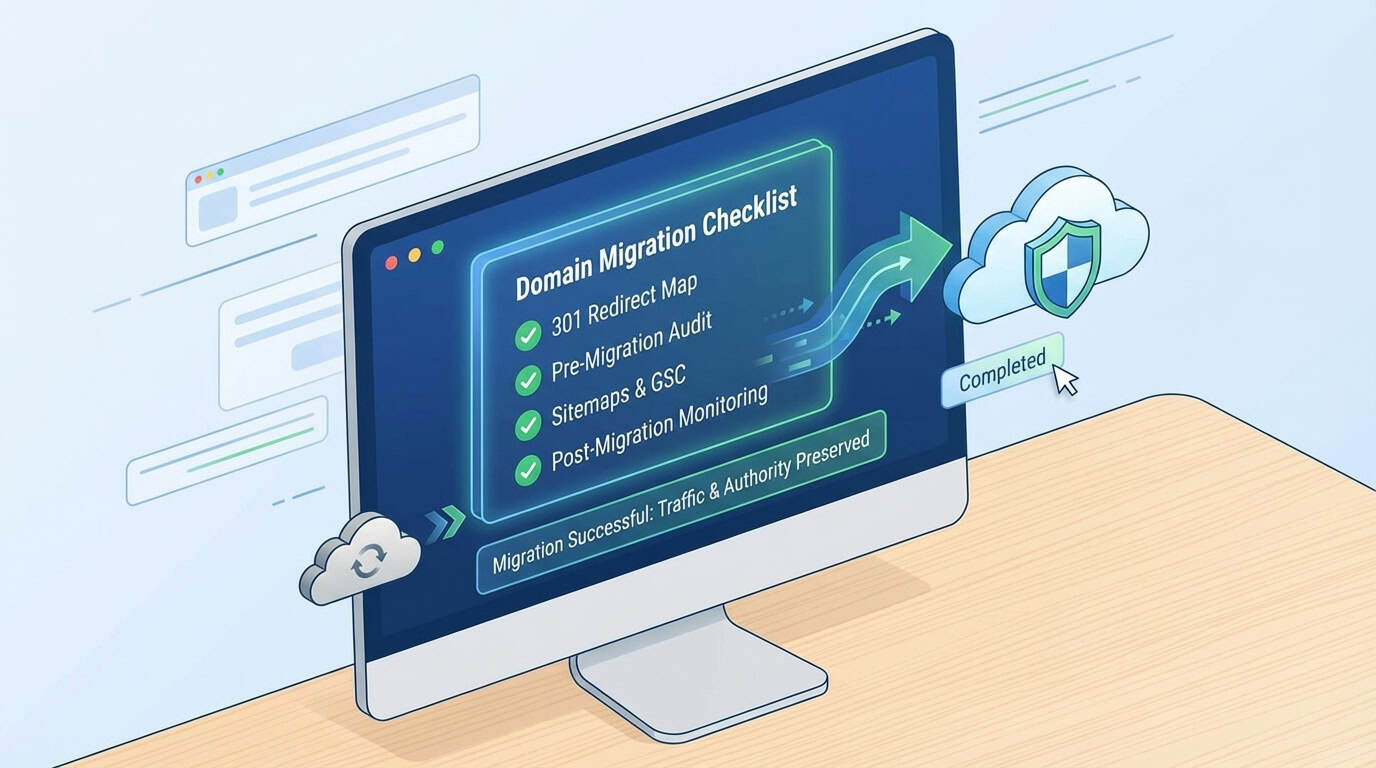
- Implementing a precise 1:1 301 redirect map for all legacy URLs is critical to preserving search equity and transferring ranking authority to the new domain.
- A comprehensive pre-migration audit allows startups to identify high-value Power Pages and establish performance benchmarks to measure success after a domain change.
- Leveraging the Google Search Console Change of Address tool alongside a dual XML sitemap strategy accelerates the re-indexing of new URLs and signals an intentional brand transition.
- Continuous post-migration monitoring through log file analysis and indexation reports is essential for identifying technical crawl errors and mitigating the impact of search volatility on organic traffic.
Rebranding represents a structural evolution of a brand for any startup and marks a time of growth and expansion. Whether the transition involves moving from a temporary .io domain to a more established .com domain or changing the brand name entirely, the transition phase carries a 40% to 60% risk of losing organic sessions. The move is a high-growth phase that also marks a moment of extreme vulnerability for your existing organic visibility.
Organic traffic is often the lifeblood of a growing business, built through months or even years of consistent effort. Failing to follow a strategic protocol during a move can cause this search equity to vanish overnight.
Why Startups Must Prioritize SEO During a Rebrand or Migration
A startup's transition to a new domain is frequently viewed as a purely creative or marketing exercise. However, the technical underpinnings of this move determine whether your new brand is visible to potential customers. Growing from a specialized or temporary domain is a sign of maturity, but search engines require clear signals to understand that your authority should transfer to the new site.
Search equity is fragile and relies on a complex web of established URLs and historical data. When you are changing a website's domain name, you're essentially asking search engines to relearn your entire site structure. Without a disciplined strategy, the rankings you've earned for competitive keywords can disappear, leaving your new domain in a state of digital obscurity.
A loss of organic traffic can stall the momentum of a successful rebrand and force your team to spend months recovering lost ground. Prioritizing SEO ensures that your growth is supported by a stable foundation of organic traffic that continues to drive results.
Startups must realize that changing domain names involves more than just updating a logo. It requires a deep audit of every incoming link and internal connection. Maintaining this focus prevents the technical debt that often accumulates during rapid corporate shifts.
The High Cost of Migration Mistakes: What Is at Stake?
The risks associated with a poorly managed migration extend far beyond a temporary dip in traffic. One of the most significant dangers is the Google Sandbox effect, in which a new domain is treated skeptically until it proves its relevance. If the transition isn't handled correctly, your new site could be ignored for weeks while your old rankings plummet.
Recent benchmarks indicate that even well-executed migrations can see traffic fluctuations of 10% to 30% during the first 2-8 weeks. While some volatility is normal, improper implementation can turn this temporary dip into a permanent decline. Our team once prevented a seven-figure revenue loss for a major e-commerce client by identifying critical technical vulnerabilities just days before their migration.
User experience is also heavily impacted when visitors encounter 404 errors instead of the content they expect. For a startup, organic traffic is usually the most cost-effective acquisition channel available. Protecting this channel is a business-critical objective that requires a focus on preserving SEO authority during migration and ensuring a direct 1:1 mapping of legacy URLs to new architecture.
Ignoring the risks of rebranding to organic traffic can lead to a loss of investor confidence. Stakeholders expect a seamless transition that preserves the valuation built through digital authority. A meticulous approach protects your organic rankings from improper redirect implementation and ensures long-term stability.
Phase 1: Pre-Migration Strategy and Comprehensive Auditing
The pre-migration phase focuses on gathering the comprehensive data that will serve as the primary guide for your entire technical process. You must document every asset on your current site to ensure nothing is left behind during the move.
Managing Subdomains and International Folders
Startups with complex site structures must decide how to handle existing subdomains and international folders before any mapping begins. For example, you might need to determine whether a blog subdomain should be moved to a subfolder or remain separate. The choice between a subdomain and a subfolder has significant implications for how search engines attribute authority to your content.
Moving subdomains into subfolders often helps consolidate domain authority and makes it easier for the main site to rank for competitive terms. However, if your subdomain serves a completely different function or audience, keeping it separate might be the better choice. You must weigh the SEO benefits of consolidation against your business's organizational needs.
International folders, such as those for the UK or EU markets, require careful handling to maintain local search relevance. Ensure that your hreflang tags are updated to reflect the new domain structure so users are still directed to the correct regional version of your site. Correctly managing these complex elements prevents a fragmented search presence that could confuse both users and search engines.
Conducting a Full URL and Content Inventory
The first step in your startup rebranding seo checklist is to perform a deep crawl of your current website. You can use a crawler such as Screaming Frog or Ahrefs to export all live URLs, including images and PDFs. The technical crawl provides a complete picture of your site's current architecture and identifies any existing redirects that might complicate the migration.
Once you have the full list, you must identify your Power Pages within the inventory. These are the specific URLs that have the most backlinks or drive the majority of your conversions. It's important to flag these high-value pages, so they receive extra attention during the mapping phase of the project.
Organize all this data into a master spreadsheet that tracks the URL, its current traffic levels, and its importance to the brand. The master spreadsheet will become the primary reference for your technical team throughout the migration. Maintaining a clean and organized inventory prevents the accidental deletion of pages that are important to your organic health.
Benchmarking Current Performance and Rankings
You cannot measure the success of a migration without a clear snapshot of your starting point. You'll need to export historical data from Google Search Console and GA4 to establish a baseline for your SEO health. Focus on capturing current click-through rates, impressions, and the specific keyword rankings for your top-performing pages.
Deciding between a Domain Property or a URL-prefix Property in Search Console is a critical step for data accuracy. Domain properties provide a more aggregated view across subdomains, while URL-prefix properties offer more granular control over specific directories. You should ideally have both verified to ensure you don't miss any data during the transition.
Keep these reports accessible so you can compare them against new data in the months following the move. If a specific keyword cluster begins to drop, you can refer back to your benchmark data to identify exactly which page is underperforming. Detailed reporting is necessary for rapid remediation if the migration doesn't go as planned.
Auditing the Backlink Profile for High-Value Targets
Backlinks are a fundamental component of your site's authority, accounting for approximately 13% of the total weight in SEO efforts. You must identify the most influential external sites currently pointing to your old domain. While server-side redirects help transfer equity, the most powerful signal comes from updating these links at their source.
Prioritize your outreach efforts based on the Domain Rating and the amount of referral traffic each link provides. A link from a high-authority news site or an industry-specific publication is much more valuable than a small directory link. By focusing on your highest-value targets, you can ensure the most significant portion of your SEO authority is preserved.
Create a list of these high-priority external links and the contact information for the site owners. You'll use this list later in the process to request link updates to your new domain. Proactively managing your backlink profile reduces your reliance on redirects and strengthens the authority of your new brand.
Phase 2: Technical Architecture and 301 Redirect Strategy for Domain Change
Your redirection strategy acts as the bridge between your old brand and your new digital identity. The goal of this phase is to create a direct 1:1 mapping of legacy URLs to the new architecture that guides both human users and search engine crawlers to the correct location. A well-designed technical architecture prevents the loss of historical signals that Google uses to rank your content.
Mapping the 301 Redirect Strategy
You must create a 1:1 redirect map in which every URL from the old site maps to a specific, relevant page on the new domain. Avoid the common but damaging practice of redirecting all old pages to the new homepage. This lazy approach destroys keyword relevance and signals to search engines that your content no longer exists, leading to a loss of rankings.
According to Google's Search Central guidelines, these permanent redirects serve as a robust mechanism to transfer PageRank, link equity, and crawl signals to the new domain. When implemented correctly, these redirects ensure that Google consolidates signals for the target URL without flagging your content as a manipulative duplicate.
It's important to keep these redirects active for at least one year to ensure all users and bots have fully migrated. For high-brand legacy sites, it may even be beneficial to maintain these redirects indefinitely to capture long-tail traffic. Maintaining redirects for an extended period protects the 15% to 25% of post-migration visits that often stem from direct queries for the old domain.
Google imposes no penalties for well-executed 301 redirects, even if you have duplicate content across domains during the transition. The 301 status code serves as a definitive canonical directive instructing crawlers to attribute all historical signals to the new URL. Consistently monitoring these signals ensures your search authority remains intact.
Managing Internal Link Equity
While redirects handle external traffic, you must also address the internal linking structure within your new site. Relying solely on the redirect layer for internal links can slow down your site and dilute your link equity over time. It is best to update these links directly in your database to point to the new destination URLs.
A global search-and-replace function within your database can update thousands of internal links simultaneously. Updating the database ensures that every internal connection is direct, which improves crawl efficiency and user experience. By removing the middleman redirect, you ensure that link equity flows as cleanly as possible through your new architecture.
Updating internal links also reduces the load on your server during the critical post-migration period. When Googlebot crawls your site, it should find a web of direct connections rather than a series of redirects. This technical cleanliness signals to search engines that your new site is well-maintained and authoritative.
Preparing the New Domain's Technical Foundation
Before the new domain goes live, you must ensure its technical foundation is optimized for search engines. The technical setup includes installing a valid SSL certificate to protect user data and maintain trust. You should also create a clean robots.txt file that allows search engines to crawl your new content while blocking any staging or private directories.
The site structure of the new domain should be intuitive and easy for both users and bots to navigate. Whenever possible, keep your URL slugs consistent with the old site to minimize the complexity of your redirect map. Consistency in your URL structure reduces the chance of technical errors and makes the migration process much more manageable.
Testing the new site in a staging environment is a necessary step before the final launch. You should check for broken links, slow loading times, and mobile responsiveness issues that could hinder your performance. A clean technical foundation ensures that your new brand starts its digital life with the best possible chance of success.
Phase 3: The Launch Day Protocol and Execution
Launch day should be treated as a highly coordinated event rather than a series of random updates. Timing is critical for minimizing downtime and crawl errors when moving to a new domain. A clear protocol ensures that every team member knows their role and that the technical transition happens as smoothly as possible.
Using the Google Search Console Change of Address Tool
The Change of Address tool notifies Google of a domain transition. To use this tool, you must have your property verified on both the old and new domains. Once verified, you can select your old site and follow the prompts to point Google toward your new digital home.
The Change of Address tool helps Google prioritize the crawling and re-indexing of your new URLs, which can accelerate the migration process. The Change of Address tool does not replace 301 redirects, but it serves as an additional signal that confirms the transition is intentional. Using the tool is a simple yet effective way to ensure that the search engine's records align with your new brand identity.
Updating DNS Settings and Verifying Header Responses
Managing your DNS settings is a technical requirement for pointing your old domain to the new server. For global audiences, you must ensure that your DNS propagation is handled correctly across different regions. You should adjust your TTL settings to a shorter duration before the launch to ensure the changes propagate quickly across the internet.
Once the DNS changes are in place, you should use cURL to verify that your headers return the correct status codes. A command like "curl -I https://oldsite.com" should return a 301 status, while the new URL should return a 200 OK. Verifying these responses manually ensures that your server configuration is exactly as it should be.
Test your site from multiple locations to confirm that the DNS changes have been recognized globally. You can use online propagation tools to verify that your new IP address is being returned correctly by servers worldwide. Monitoring this process closely allows you to catch any regional access issues before they impact your traffic.
Submitting New XML Sitemaps for Accelerated Crawling
A dual-sitemap strategy is an effective way to help search engine bots discover your new URLs more quickly. First, you should submit a fresh XML sitemap to your new Google Search Console property. This sitemap should contain only the final, live URLs you want Google to index and rank.
At the same time, you should keep your old XML sitemap active on the old domain for a period of time. This helps Googlebot find the 301 redirects on the old pages, which signals it to transfer authority to the new URLs. This two-pronged approach ensures that every part of your site is accounted for during the re-indexing process.
Monitor the sitemap reports in Search Console to see how many of your new URLs are being discovered and indexed. If you notice that some pages are being ignored, you may need to check for internal linking issues or crawl blocks. Using sitemaps strategically can significantly shorten the migration dip.
Phase 4: Technical Performance Monitoring
The weeks following a domain migration are the most critical period for your startup's long-term organic health. While the launch is a single event, the technical tail of a migration lasts for months. Constant monitoring is required to identify and fix technical errors before they can have a lasting negative impact on your revenue.
Leveraging Log File Analysis
Log file analysis allows you to see exactly when Googlebot begins crawling the new domain versus the old one. By reviewing your server logs, you can track the transition of bot activity in real-time. Log files provide a more granular view than Search Console, showing you every single hit from a search engine crawler.
If you notice that Googlebot is still heavily crawling the old domain after several weeks, it may indicate a redirect issue. It could also suggest that your internal links weren't updated correctly, causing the bot to keep following redirects. Log files provide the raw data you need to troubleshoot these deep-seated technical hurdles.
Monitoring these logs also helps you identify crawl budget issues early. If a large portion of your bot activity targets non-essential pages, you can adjust your robots.txt file or your internal linking. Using server logs ensures that search engines spend their time on the pages that drive your business value.
Monitoring Indexation and Search Volatility
The Indexing report in Google Search Console is your best resource for tracking your migration's progress. You should see a steady increase in the number of indexed pages on your new domain and a corresponding decrease on the old one. If the transition seems to be stalling, it may indicate a crawl budget issue or redirect loops.
Tracking 404 Errors and Redirect Failures
After the migration, you must monitor your crawl error reports to identify any unexpected 404 errors. These errors often occur when a legacy URL was missed in the mapping phase or when a redirect rule fails to execute properly. Resolving these issues quickly prevents a negative user experience and ensures that search engine bots can navigate your new structure without hitting dead ends.
It is also important to distinguish between the natural settling period and a genuine technical failure. If your rankings continue to slide after several weeks, it's time to investigate deeper technical issues or content mismatches. Analyzing your benchmark data against current performance can help you identify which specific areas are failing to recover.
Communicate clearly with your stakeholders about this expected volatility to prevent unnecessary panic. Focus on the long-term trend rather than daily fluctuations in keyword positions. A patient but data-driven approach will help you navigate this period of search volatility with confidence.
Phase 5: Reclaiming Brand Authority and Off-Page Equity
A domain migration doesn't end on your website; it extends across your entire digital footprint. Once your technical foundation is secure, you must work to reclaim your authority in the broader digital landscape. This phase involves updating your presence on third-party platforms to ensure brand consistency and trust.
Executing a Backlink Outreach Campaign
Backlink outreach (subject) updates (predicate) external link targets (object) to reflect new branding. Reaching out to the owners of websites that link to your old domain is a proactive way to solidify your new authority. You should ask them to update their existing links to point directly to your new URL.
Use a polite and value-driven outreach template that explains the reason for the change. Most site owners are happy to update links if doing so ensures their readers are directed to a current and functional resource. Outreach helps you maintain the strength of your backlink profile and speeds up the transfer of authority.
Focus your outreach on the most important referring domains first, as they provide the greatest SEO benefit. Even a small number of updated high-authority links can make a noticeable difference in how quickly your new domain ranks. Updating your link profile is a necessary step in rebuilding your startup's organic reputation.
Updating Social Profiles and Business Directories
Maintaining NAP consistency is important for startups that rely on local or industry-specific search visibility. You must update your profiles on LinkedIn, Twitter, and any relevant business directories, such as Crunchbase. These updates help search engines confirm your new identity and prevent confusion among potential customers or investors.
Updating your profile on third-party software review sites such as G2 and Capterra is also critical to building your startup's authority. These sites often rank well for branded searches and provide important social proof for potential customers. Ensuring your new brand name is represented correctly across these platforms reinforces your new digital identity.
Don't forget to manage your Knowledge Graph updates so that the old brand name continues to show the new company's information. You can use schema markup and consistent social profiles to signal this change to Google. This ensures that your brand sidebar remains accurate and helpful for users searching for your old name.
Strategic Content Alignment for the New Brand Identity
A rebrand often involves a shift in your company's messaging and target audience. Your content strategy must evolve to align with your new voice while retaining the keyword foundations that have historically driven traffic. Content consistency ensures that your new brand identity is reflected in every piece of content you publish.
You may need to re-optimize some of your high-performing articles to align with your new brand's value proposition. Updating content might involve changing the tone of voice or adding new sections that address your expanded service offerings. Balancing these updates with the preservation of SEO juice during migration is a delicate but necessary task.
Analyze your competitors' content to see if they're targeting terms that your new brand should now own. Competitor research can reveal new growth opportunities that were previously outside of your scope. Adapting your content strategy to the new brand identity ensures that your organic traffic remains high-quality and conversion-focused.
It's also common for users to continue searching for your old startup name long after the rebrand is complete. You should create a dedicated landing page to capture this navigational traffic and educate your audience about the change. The dedicated landing page should be optimized to rank for your old brand terms so it appears at the top of the search results.
Why SaaS Startups Need an SEO Migration Specialist
The complexity of a domain migration often exceeds the internal resources of a lean startup team. Hiring an SEO migration specialist provides the technical oversight needed to prevent the rebranding risks for organic traffic that affect many young companies. These experts bring a wealth of experience in managing high-stakes transitions without losing search equity.
A specialist can handle the intricate mapping, DNS configurations, and log file analysis that your internal developers may not have time for. They act as a safety net, identifying potential crawl traps or redirect loops before they go live. This proactive approach saves your team time and prevents the revenue loss associated with a botched launch.
For SaaS companies, organic traffic is often a primary driver of demo signups and trial starts. Losing this visibility during a rebrand can stall your customer acquisition pipeline for months. An SEO specialist ensures that your migration is a growth catalyst rather than a technical setback for your business.
Common Startup Migration Pitfalls to Avoid
Fast-moving startups often overlook the smaller details that can have a large impact on SEO success. One of the most frequent mistakes is forgetting to update canonical tags to point to the new domain. If these tags still point to the old site, search engines may continue to prioritize the old URLs, causing significant indexing delays.
Auditing JavaScript-heavy frameworks is another critical step that many startups miss. If your site relies on client-side rendering, you must ensure that search engines can still see your content after the move. A technical audit ensures that your new architecture remains as crawlable as the old one.
Startups often fail to account for their paid search landing pages during a migration. If you don't update your ad URLs, your paid traffic will hit redirects or 404 errors, wasting your marketing budget. Ensure your PPC team is fully integrated into the migration plan to avoid these costly errors.
Finally, ignoring the impact of rebranding risks on organic traffic can lead to insufficient preparation for the migration dip. Don't assume that search engines will automatically understand a name change without clear technical signals.
Scale Your Organic Authority with a Post-Migration Content Strategy
Executing a successful domain migration is a complex technical challenge, but it's only the beginning of your startup's new growth phase. By following a strategic checklist, you've secured your foundation and protected the search equity you worked so hard to build. Now that your technical house is in order, you must shift your focus to aggressive content production to capitalize on your new brand's potential.
The most effective way to build authority on a new domain is through the consistent publishing of high-quality, SEO-optimized content. Our expertise at Brand Voice is designed to help you dominate your niche by delivering content that drives real results. We understand that startups often lack the internal resources to scale content production while managing the many other demands of a high-growth period.
Brand Voice helps you take the content burden off your team so you can focus on product development and market expansion. We provide the expertise and scale you need to ensure your new domain reaches its full potential in the search results. Schedule a demo with us today to learn how we can help you accelerate your organic growth and turn your new brand into a market leader.