- Consolidating redundant SEO tools helps digital marketing agencies improve operating margins by eliminating toxic SaaS sprawl and reducing significant administrative overhead.
- Conducting a comprehensive software stack audit allows agencies to identify feature overlap and decommission underutilized platforms while maintaining core technical capabilities.
- Transitioning to all-in-one SEO platforms minimizes employee context switching and can accelerate campaign delivery by approximately 30% through standardized workflows.
- Implementing an API-first strategy for tool consolidation ensures data integrity across the organization and allows strategists to focus on high-value long-term strategic planning.
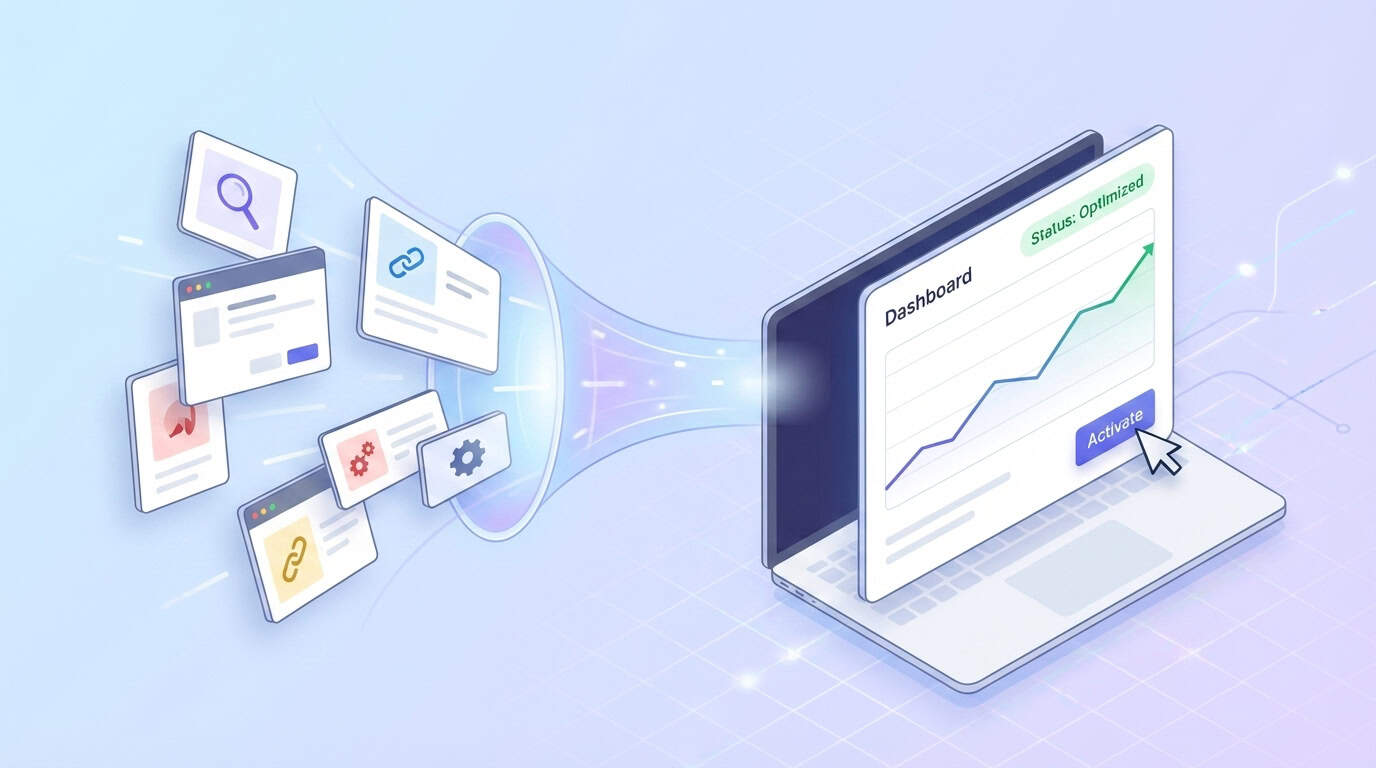
Rapid expansion often forces digital marketing agencies into operational clutter, where software accumulation outpaces necessity. SaaS sprawl occurs when teams adopt specialized platforms for every new client requirement without evaluating existing capabilities. Agencies must prioritize reducing overhead by eliminating software redundancies to maintain healthy profit margins as they scale.
Managing a bloated technology stack requires more than just paying monthly invoices. Effective oversight requires significant time from operations managers who must manage permissions, billing, and technical integrations across disparate systems. Understanding the mechanics of software consolidation is the first step toward building a leaner, more profitable agency environment.
The Growing Challenge of SEO Tool Proliferation in the Modern Agency
The digital marketing landscape has shifted toward extreme specialization. Many firms adopt a best-of-breed approach for each micro-task, resulting in a fragmented ecosystem. As an agency scales its service offerings, it often adds new team members who bring their own preferred platforms into the organizational workflow.
Initial excitement for a new tool usually stems from a specific feature or a user-centric dashboard layout that promises to solve a temporary bottleneck. Over time, the novelty fades, and the realization of overlapping costs begins to set in for the leadership team. Instead of having a single source of intelligence, the agency ends up with multiple keyword research tools and separate site crawlers that staff don't fully use.
Modern operations managers are moving away from the more is better philosophy that defined the previous decade of agency growth. Intense market competition forces firms to prioritize operational efficiency over the sheer volume of software they use. Focusing on a refined stack allows an agency to reclaim its focus and ensure that every dollar spent on software contributes directly to client success.
The Hidden Financial Drain: How Overlapping Subscriptions Erode Margins
The cost of maintaining redundant SEO tools extends far beyond the surface-level monthly subscription fees listed on a credit card statement. Agencies often focus on the visible price tag while ignoring the deeper financial and operational costs that quietly erode their net profit margins. Software consolidation increases agency profit margins by streamlining the accounts payable process and lowering administrative burden.
Consistently auditing your technology stack is the most effective way to identify how to reduce SEO agency overhead and improve your bottom line. When workflows are simplified, teams spend less time on administration and more on long-term strategic planning and roadmap development. Reallocating software spend allows an agency to remain competitive even as overhead costs rise.
Understanding the True Cost of Subscription Fatigue
Gartner estimates that organizations lose an average of 25% of their SaaS budgets to unused entitlements and overlapping tools. Even more concerning is the finding that roughly 30% of total SaaS spend is toxic, meaning it's spent on licenses and features that provide no actual value. When multiple platforms perform the same primary functions, these micro-leaks in the budget add up and significantly reduce the overall profit margin.
The waste scales directly alongside agency spending as the firm adds more seats to accommodate a growing headcount. By 2025, the average SaaS spend per employee is projected to reach $4,830, representing a 21.9% increase year-on-year. The rising SaaS tax on growth often prevents agencies from reaching the elite profitability tier where margins exceed 21%.
High-tier pro subscriptions often include duplicate data processing fees, with the agency paying twice for the same set of client URLs. License redundancy is a primary driver of subscription fatigue among leadership teams. Eliminating software waste is a strategic move to preserve the agency's ability to reinvest in core talent.
The Opportunity Cost of Tool Complexity and Context Switching
Managing an excessive number of tools creates a heavy cognitive load that directly impacts the productivity of SEO strategists and account managers. When an employee must jump between five different platforms to complete a single technical audit, they lose focus and waste valuable billable time. All-in-one SEO platforms reduce employee context switching by providing a unified interface for complex tasks.
Agencies that use more than five separate SEO tools often spend over 20 hours per month on manual reporting and data consolidation. These reclaimed hours can be devoted to client communication or to refining campaign tactics to drive better results. The complexity of a fragmented stack also slows down the onboarding process for new hires as they must learn multiple conflicting workflows.
Operating with a leaner and more integrated stack allows teams to deliver campaigns approximately 30% faster on average. Those who use all-in-one solutions report up to a 50% reduction in time spent on tool management and administrative tasks. Streamlining the software environment ensures that the agency can scale its operations efficiently without being bogged down by technical friction.
A Step-by-Step Framework for Conducting a Software Stack Audit
A software stack audit should be viewed as a strategic necessity rather than a tedious administrative chore. The audit process serves as an operational reset, empowering managers to reclaim control over overhead.
Step 1: Inventory Management and Utilization Tracking
The first step in any audit is to document all active subscriptions currently billed to the agency. You should collect the total number of active seats, the monthly or annual cost, and the specific login frequency for every team member. Effective SaaS subscription management requires more than just tracking costs; it also involves auditing user access to ensure licenses are not wasted on former employees.
Identifying ghost subscriptions that are still active but no longer utilized by any department is a quick way to generate immediate savings. Track which specific client projects use each tool to determine its actual return on investment. Tracking utilization data provides the objective evidence needed to make difficult decisions about which platforms to keep and which to cut.
Managers should look for discrepancies between the number of seats paid for and the number of people actually using the software. Many agencies pay for enterprise tiers that include features or seat counts they'll never realistically need. Consolidating these accounts can often lead to a lower billing tier without sacrificing any of the core functionality the team relies on daily.
Step 2: Mapping Feature Sets to Agency Services
After inventorying the tools, the next phase involves cross-referencing their feature sets with the agency's core service offerings. Creating a matrix helps visualize which platforms handle keyword research, backlink analysis, rank tracking, and technical auditing. Technical audits identify software redundancies by highlighting where multiple platforms are being used for the same technical check.
Conducting a formal feature overlap analysis helps leadership identify which redundant platforms can be safely decommissioned without losing core technical capabilities. You may discover that your primary intelligence platform already has a robust site crawler, making your secondary crawling subscription unnecessary.
Focusing on feature sets rather than brand names helps remove emotional bias from the decision-making process. The goal is to ensure that every task in the SEO workflow has a designated tool, but more than two separate platforms cover no task. Purposeful tool selection reduces confusion and ensures that the team uses the most effective platform for each job.
Step 3: Assessing Data Quality and Reporting Consistency
A successful audit must also evaluate the technical quality and accuracy of the data provided by each platform. Having multiple tools for the same task often leads to data silos where different platforms report conflicting metrics for the same website. These inconsistencies can confuse account managers and make it difficult to provide a clear, authoritative narrative to clients.
Prioritize tools that offer the most accurate data and the best integration capabilities with your agency's reporting dashboard. If two tools provide similar Search Engine Results Page (SERP) analytics but only one integrates seamlessly with your project management system, the choice becomes clear. High-quality data that can be easily moved and visualized is always more valuable than isolated data points in a standalone platform.
Technical evaluation should also consider the depth of historical data and the frequency of updates. Some tools may be cheaper but offer less reliable uptime or slower data refreshes, which can hinder your team's performance. By choosing a primary source of truth, you ensure that all client recommendations are based on a consistent and verified dataset.
Identifying and Eliminating Feature Overlap in SEO Software
Major SEO platforms like Ahrefs, Semrush, and Moz have achieved a high level of feature parity over the last few years. While each of these industry leaders has unique strengths or proprietary metrics, the middle 80% of their functionality overlaps significantly.
Consolidating Keyword Research and Competitive Intelligence
Agencies frequently find themselves paying for multiple high-tier subscriptions to gain access to keyword databases. While it might seem beneficial to have multiple sources, this often leads to inconsistent volume estimates and difficulty in setting clear KPIs. Choosing one primary intelligence platform and training the entire team to master it creates a more cohesive strategic environment.
Consolidation ensures that every SEO strategist in the building is working from the same baseline of data. Uniform data improves the quality of client recommendations because every report follows the same logic. When a team is unified on one platform, they can share insights and shortcuts more effectively, raising the agency's collective expertise.
By focusing your budget on an intelligence tool with a database of over 20 billion keywords, you can often afford a higher subscription tier. Upgrading to an enterprise tier is usually more beneficial than maintaining three middle-tier subscriptions that lack deep competitive insights.
Streamlining Technical Auditing and Site Crawling
Tool redundancy is especially common in technical SEO when agencies mix cloud-based crawlers with desktop-based solutions. A Screaming Frog enterprise license costs around $1,800 per year, while platforms like Ahrefs and SEMrush charge between $4,000 and $4,500 annually. Many agencies pay for all three even though the suite-based tools have significantly improved their crawling capabilities.
Deciding between a versatile all-in-one platform and a specialized point solution requires analyzing your typical client's needs. For websites with over 100,000 indexed pages, a dedicated crawler like Screaming Frog is often necessary for its depth and speed. However, for the majority of small to mid-sized clients, the built-in crawlers in your primary SEO suite are usually more than sufficient.
Consider the trade-offs between the speed of a local crawl and the accessibility of a cloud-based audit that the whole team can view. Maintaining separate licenses for different team tiers adds administrative complexity that rarely translates into better client outcomes. Streamlining your technical toolkit ensures that your audits are standardized and that your technical debt remains manageable.
Rank Tracking and Client Reporting Redundancies
Rank tracking is one of the most expensive recurring costs for any agency, especially as the number of tracked keywords grows. It's common to see an agency pay for tracking within their main SEO suite while also maintaining a separate subscription for a dedicated reporting tool. Relying on multiple tracking sources is inherently inefficient and leads to a fractured understanding of client performance.
Migrating all rank tracking to a single, scalable platform provides immediate financial benefits by reducing the cost per keyword. It also creates an operational benefit by establishing a single source of truth for all performance data. When data lives in one place, it's easier to automate the reporting process and ensure that clients always see the most up-to-date information.
Dedicated white-label reporting tools often offer superior visualization, but they must be fed with high-quality data from your primary SEO tool. If your reporting tool includes its own tracking, you should evaluate if it's accurate enough to replace your other trackers entirely. Eliminating the middleman in data collection reduces the chance of errors and simplifies the technical architecture of your reports.
Evaluating AI-Native Overlap in Modern SEO Suites
The rapid integration of generative AI into SEO workflows has created a new category of redundant costs. Many legacy platforms, such as Ahrefs and Semrush, have introduced AI-powered content analysis and automated meta-tag generation that may replace standalone AI writing tools. Agencies should audit their primary suites for these native AI capabilities before renewing separate subscriptions for AI content assistants. Consolidating AI tasks into your primary SEO platform ensures that data processing remains consistent across both technical and creative workflows.
The API-First Approach to Stack Consolidation
Modern agencies are increasingly turning to an API-first philosophy to manage their software environment. The API-first strategy focuses on connecting best-in-class tools through application programming interfaces rather than standalone logins. By centralizing data flow, agencies can maintain a high-performance stack without the traditional friction of tool sprawl.
Using tools with robust APIs allows agencies to pull data into a single custom dashboard, eliminating the need for five different reporting platform logins. You can consolidate backlink data, organic traffic, and keyword rankings into a single internal tool for better oversight. Centralized data creates a bespoke ecosystem that matches specific reporting needs without the overhead of disparate subscriptions.
API-driven consolidation also ensures better data integrity across the organization. When data is automatically pulled from a primary source, the risk of manual entry errors is eliminated. Strategists can spend their time on long-term strategic planning and roadmap development instead of wrestling with CSV exports from multiple sources.
Vendor Negotiation Strategies for Agency Scaling
Consolidation provides a unique opportunity for agencies to renegotiate their terms with software vendors. When you commit to a single platform for your entire organization, you gain significant leverage to lower your per-seat costs. Software companies often prioritize long-term agency partnerships and are willing to provide custom pricing to secure an exclusive relationship.
Provide actionable evidence of your agency's growth to use consolidation as leverage for better enterprise pricing. Many vendors are willing to offer bridge discounts when they know you are moving away from a competitor to use their platform exclusively. These savings can be substantial, especially when moving dozens of team members onto a single high-tier license with enhanced capabilities.
Agencies should also push for custom feature sets or increased API limits as part of their consolidation negotiations. By bundling services, you can often unlock features that are typically reserved for much larger enterprise accounts. This strategic approach to procurement ensures that your software stack scales alongside your revenue without eating into your monthly margins.
A Tool Evaluation Scorecard for Objective Auditing
Making objective decisions about which software to cut requires a standardized evaluation framework. A scorecard approach removes the emotional attachment team members might have to specific interfaces and focuses on the tool's actual utility. Standardized scoring ensures that the final stack is chosen based on performance rather than habit.
Grade each tool based on four pillars: Data Accuracy, Integration Support, Team Utilization, and Cost Per Seat. Assign a numerical value to each category to calculate a total score for every platform in your current stack. Scorecard results make it easy to identify which tools provide value and which underperform relative to their cost.
Data Accuracy should always be the most heavily weighted category in your scorecard. A tool with a user-centric dashboard layout is useless if its keyword volume estimates or backlink data are consistently unreliable. Integration Support is also vital, as it determines how much manual labor is required to move data between disparate systems.
The Operational Benefits of a Leaner Tool Stack
Shifting focus from cost-cutting to operational excellence reveals that a leaner stack is about more than just the bottom line. Reducing software friction helps build a more agile and focused agency environment, better equipped to handle a sustainable growth model. Managers can spend less time on vendor management and more time refining the firm's core service offerings.
Simplified Onboarding and Professional Development
A consolidated tool stack significantly accelerates the training and integration of new employees. When there is only one way to perform a keyword audit or a backlink review, the learning curve is flattened for every new hire. Standardizing detailed briefs and technical workflows reduces the time it takes for a new team member to start contributing to client projects.
Standardized workflows lead to higher employee satisfaction because the team spends less time troubleshooting tools and more time doing meaningful work. When everyone uses the same platform, senior members can mentor juniors more effectively because they are speaking the same technical language. Standardized training creates a culture of mastery rather than fragmented knowledge across multiple tools.
Professional development becomes more focused when employees can aim for certifications or advanced mastery in a select few platforms. Deep expertise in a single comprehensive tool is often more valuable than a passing familiarity with five different ones. A lean stack encourages your staff to become power users who can extract every ounce of value from the agency's investment.
Improved Integration and Workflow Automation
Fewer tools typically mean better integration because modern APIs and automation platforms like Zapier are easier to manage when sources are consolidated. Building automated workflows is much simpler when you only have to connect one SEO platform to your project management system. Automated connectivity allows data to move from the initial audit stage to the final client report without manual intervention.
Operations managers can build robust systems that trigger tasks in platforms like Asana or ClickUp based on data changes in the SEO tool. For example, a significant drop in a client's ranking could automatically generate a high-priority ticket for the account manager to investigate. Automated event triggers are difficult to maintain when data is scattered across multiple disconnected subscriptions.
Consolidation also makes it easier to maintain data security and manage user permissions across the organization. With fewer platforms to monitor, the risk of a former employee retaining access to sensitive client data is greatly reduced. A secure environment provides the technical foundation needed to scale the agency's operations without increasing the administrative burden on the leadership team.
Implementing the Consolidation: Managing the Transition Without Disruption
Removing tools from a team's daily workflow carries inherent risks that must be carefully managed to avoid performance dips. A successful change management strategy ensures that client deliverables remain consistent and that the team feels supported throughout the transition. Strategic communication is required to keep the agency unified during these technical shifts.
Developing a Phased Decommissioning Strategy
It's rarely wise to cut all redundant tools at once without a plan for data continuity. A phased approach allows you to implement a shadow period where the new primary tool is used alongside the outgoing one to ensure data parity. The overlap period gives the team time to adjust workflows and confirm the new system meets all technical requirements.
Managing the expiration of annual contracts is a critical part of the financial planning for this transition. You should map out when each subscription ends and plan your migration to coincide with these dates to avoid paying for unused time. Transitioning from one platform to another must also prioritize data portability to ensure historical rankings and audits are not lost.
A phased rollout also allows you to test the new workflow with a small group of internal champions before rolling it out to the entire agency. These early adopters can help identify potential bottlenecks and create training documentation for the rest of the staff. Phased rollouts minimize the shock to the system that often accompanies major technical changes.
Internal Communication and Team Buy-In
Tool consolidation involves a human element that is often more challenging than the technical migration itself. Some team members may have emotional attachments to specific platforms because they are comfortable with the interface or have used them for years. It's important to explain the "why" behind the consolidation, focusing on the agency's health and the improvement of internal processes.
Framing the change as a way to reduce administrative busywork helps gain buy-in from the staff most affected by the sprawl. When employees understand that a leaner stack will make their lives easier and their work more impactful, they're more likely to embrace the new system. Transparent communication prevents the feeling that management is simply cutting costs at the expense of the team's tools.
Encourage feedback during the transition, and be willing to make small adjustments if a specific team finds it is truly missing a critical feature. However, maintain a firm stance on the overall consolidation goal to prevent the stack from bloating again. Strong leadership and clear communication are the most effective ways to ensure long-term adoption of the new, streamlined workflow.
Measuring Success: The Impact of Consolidation on Agency Profitability
Tracking the right key performance indicators is essential for evaluating the success of your consolidation efforts. Operations managers should monitor both financial metrics and team utilization rates to ensure the agency remains lean and profitable over the long term. Data-driven oversight prevents the gradual creep of new software subscriptions.
Calculating Direct Savings and Margin Expansion
Financial metrics provide the most immediate evidence of a successful software audit. You should calculate the Tooling Cost Per Client both before and after the consolidation to see exactly how much margin has been reclaimed. Even a modest $1,000 monthly reduction in software spending can translate into $12,000 in pure annual profit that can be reinvested in the business.
Organizations typically have an average of 125 SaaS platforms, costing roughly $1,040 per employee per year. Reducing this volume is an aggressive but necessary step for agencies looking to move from a survival mindset to one of sustainable growth. Agencies should strive to maintain total software overhead between 5% and 10% of gross revenue to ensure long-term stability.
Reinvesting these savings into higher-quality talent or better marketing for the agency creates a sustainable growth model. A leaner stack doesn't just save money; it reallocates resources to the areas of the business that drive the most value.
Monitoring Utilization Rates and Tool Efficiency
Long-term governance of the agency stack requires ongoing vigilance to prevent the slow return of SaaS sprawl. Conducting quarterly usage reviews ensures that every active subscription continues to provide value and that seats are properly allocated. If a tool's utilization rate drops below a certain threshold, it should be flagged for review or potential removal.
Setting up a formal new tool request process is an effective way to control the intake of new software. This process should require team members to demonstrate that the requested feature does not already exist in the current consolidated stack. By forcing a thorough evaluation before any new purchase, you create a culture of intentionality regarding technology.
Efficiency can also be measured by tracking the average time required to complete standard tasks, such as monthly reporting or site audits. If these times decrease after consolidation, it's a clear sign that the team is benefiting from a more streamlined environment. Continuous monitoring of these metrics helps maintain a lean operation that is always optimized for performance and profit.
Maximize Your Agency Efficiency and Improve Your Margins Today
Consolidating your SEO tool stack is one of the most effective strategic levers available for improving agency operating margins. By conducting a thorough software stack audit and implementing a phased transition, you can eliminate toxic spend and reclaim lost billable hours. A leaner technology stack not only saves money but also fosters a more professional, focused environment for your team to thrive.
Brand Voice helps agencies maintain this high level of efficiency by providing ready-to-publish SEO article content that drives real results. We help you reduce the management overhead of content creation by offering a single source for professional writing, further consolidating your external vendor list. Book a demo to see how we can help you streamline your operations and grow your agency's margins with high-quality content.