- Aligning SaaS pricing page copy with bottom-of-funnel transactional search intent captures and converts users who are ready for financial evaluation.
- Strategic price anchoring and decoy pricing within tiered layouts guide buyers toward a preferred option by increasing the perceived value of standard plans.
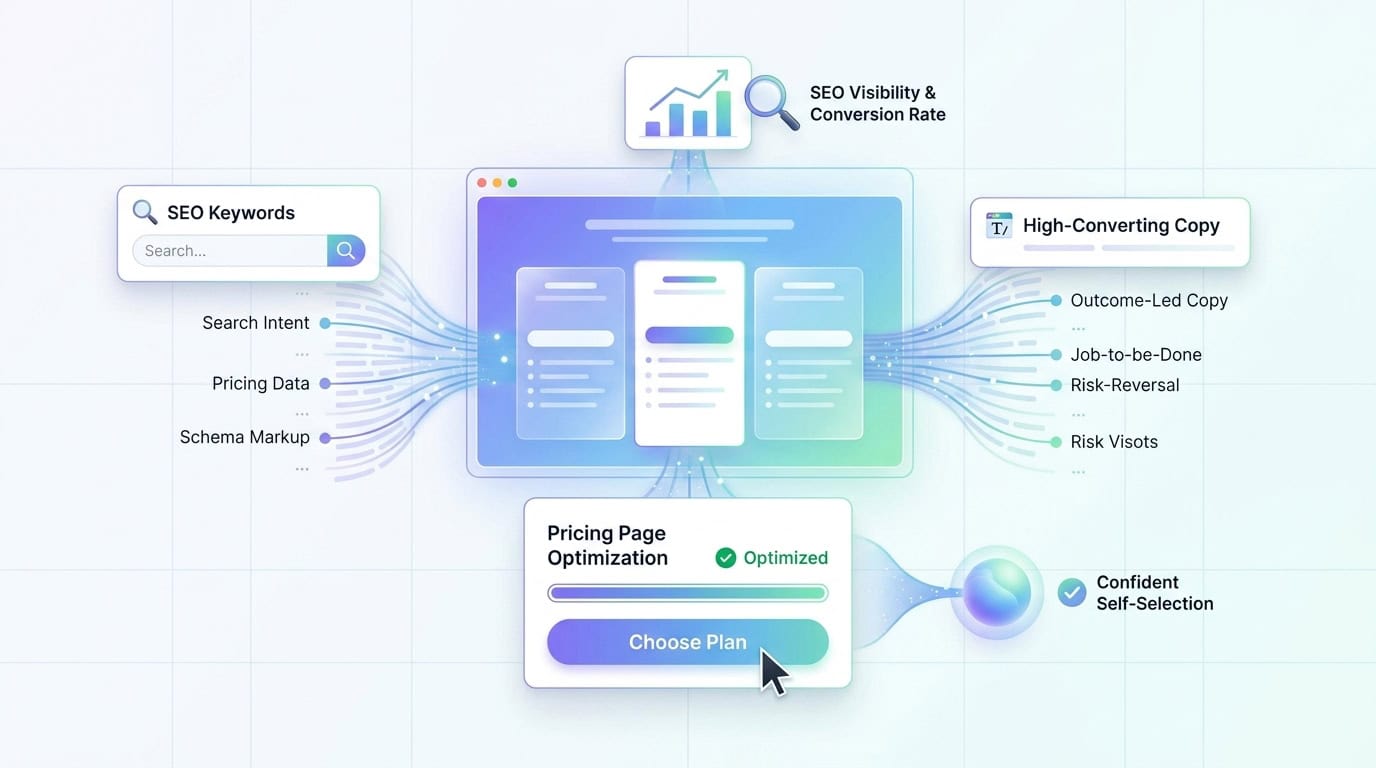
- Replacing technical feature-dumping with outcome-led copy and Job-to-be-Done tier names helps software buyers confidently self-select their ideal plan.
- Implementing interactive tooltips and structured JSON-LD Schema markup optimizes your pricing data for both human decision-makers and AI search crawlers.
- Proactively placing risk-reversal microcopy and transparent objection-handling text near primary call-to-action buttons significantly reduces financial and technical friction.
- Balancing conversion rate optimization with SEO visibility is effectively achieved by naturally weaving target keywords into collapsible accordion sections and dedicated FAQ blocks.
Every dollar spent on top-of-funnel SEO is wasted if your pricing page fails to convert high-intent traffic. The pricing page is where software buyers make their final, hardest decision, transitioning from educational exploration to financial commitment. If your pricing copy is a dry, uninspiring list of technical features, you are leaking revenue at the exact moment buyers are ready to buy.
To maximize trial signups and demo requests, you must blend direct-response copywriting formulas with strategic search engine optimization. Here is how to transform static feature lists into high-converting, search-optimized pricing pages.
Psychological Principles of High-Converting SaaS Pricing Pages
SaaS pricing pages facilitate purchasing decisions by aligning product value with the buyer's financial expectations. The pricing stage of the buyer journey requires a shift from educational exploration to hard financial evaluation. Understanding the buyer's mental state is the first step toward reducing friction in the sales process. To achieve this, you must analyze the psychological drivers that motivate enterprise and small business buyers alike.
Strategies for Mapping Bottom-of-Funnel Search Intent
Every bottom-of-funnel software search represents a user who is ready to commit if the price and value align. Optimizing for these high-intent queries lowers customer acquisition cost while naturally improving long-term lifetime value. They skip the educational blog posts entirely. Instead, they land straight on your pricing cards from the search results. They already know their problem. Now, they are hunting for a specific financial and operational fit.
Your copy must validate this intent by providing accessible information that mirrors their specific search query. If the messaging feels disconnected from the transactional intent that brought them there, the bounce rate will rise. For example, if a prospect searches for "collaborative design tool enterprise pricing," your page headline or Enterprise card should explicitly use similar phrasing, such as "Enterprise Pricing for Collaborative Design Teams," rather than a vague tier name like "Tier 4."
Writing Copy for Usage-Based vs. User-Based Models
The billing model you choose dictates how you must frame the value of your software. In a user-based model (like Slack's seat-based pricing), the copy should emphasize team collaboration and frictionless onboarding. For example, instead of writing "$15 per user, month," frame it as "$15, month to bring your entire product team into a single, real-time feedback loop."Usage-based models (like Snowflake's compute-based pricing) require a different approach that focuses on scaling with value. Your copy should explain how the price grows alongside the utility the customer receives. Frame this proportionally: "Only pay for the data you query, with zero platform overhead when your systems are idle," transforming a variable cost into a highly efficient investment.
Clarity regarding these billing metrics is the best way to ensure that prospective customers feel comfortable. You should use clear examples to show how costs fluctuate based on specific activity levels. This transparency prevents billing surprises and builds a foundation of long-term trust with your audience.
Price Anchoring and Decoy Pricing Strategies for SaaS
Buyers do not evaluate costs in a vacuum. We rely on relative comparisons to determine if a price is fair or expensive. Strategic price anchoring allows you to influence this perception by controlling the context in which your prices are viewed.
The Power of Price Anchoring in Tiered Pricing
Placing an expensive enterprise tier next to a standard tier makes the standard option feel like a bargain. This psychological effect occurs because the brain uses the first number it sees as a reference point for all subsequent evaluations. Even if the enterprise plan isn't the primary goal, its presence increases the perceived value of other plans.
You can also use decoy pricing to nudge buyers toward a specific preferred option. By making the middle tier only slightly more expensive than the basic tier while offering significantly more value, you create a clear choice. Decoy pricing simplifies the decision-making process for the user and improves your average contract value.
Effective pricing table copy highlights these differences using clear, benefit-led language. Don't just list the features; explain why the mid-tier is the best fit for a growing business. This guidance helps the user feel confident that they're making a smart financial choice.
Competitor Price Benchmarking in Copy
Enterprise buyers actively compare tools in multiple browser tabs before reaching a decision. Highlighting how your total cost of ownership undercuts an industry giant immediately establishes a compelling value proposition. For instance, Basecamp famously uses direct competitor benchmarking by showcasing a side-by-side comparison of their flat $299/month pricing against Slack, Asana, and Dropbox's per-user pricing, instantly demonstrating thousands of dollars in annual savings for growing teams. Include similar factual comparisons that demonstrate why your pricing model delivers higher operational efficiency than legacy alternatives.
Strategic Layout and Structural Anatomy of a Conversion-Focused Pricing Page
The relationship between layout design and copywriting is inseparable on a high-performing pricing page. While the visual hierarchy guides the eye to the most important elements, the actual messaging secures the final click. You must understand the physical constraints of the layout to ensure every word supports the movement toward the call to action.
Five Essential Elements of a High-Converting Pricing Page
| Page Element | Core Purpose & Psychological Driver | Copywriting Example |
| Outcome-Driven Headline | Validates purchase intent by highlighting the ultimate business outcome rather than the cost. | "Scale your support operations without doubling your headcount." |
| Descriptive Plan Tiers | Enables instant self-selection based on organizational size, needs, or role. | "Growth Tier (For scaling teams of 5 to 25)" vs. "Enterprise Compliance" |
| Transparent Pricing | Removes buying friction and establishes immediate brand trust by eliminating hidden costs. | "$49, month (Billed annually. No hidden setup fees or overage surprises.)" |
| Risk-Reversal Microcopy | Defuses final, high-friction anxieties immediately adjacent to the primary conversion button. | "No credit card required. Cancel in two clicks." or "Free 14-day trial." |
| Primary & Secondary CTAs | Captures two distinct buying paths: those ready for self-serve vs. those needing a customized trial. | Primary: "Start Free Trial" | Secondary: "Book a 15-Min Demo" |
Above-the-Fold Messaging: Transforming Weak Headlines into Value Propositions
Generic headlines like "Simple Pricing" or "Choose Your Plan" act as placeholders rather than persuasive tools that reinforce your value proposition. A high-converting headline should restate the core benefit of the software while acknowledging the visitor's readiness to buy.
Compare these before-and-after copywriting transformations:
- Weak: "Simple, Predictable Pricing Plans"
- Strong (Outcome-Led): "Predictable Pricing for High-Volume Developers"
- Weak: "Our Plans & Features"
- Strong (Value-Led): "Choose the Plan That Drives Your Team's Productivity"
Pair your main headline with a clarifying subheadline that validates the reader's decision, such as: "Start free on any plan. Upgrade, downgrade, or cancel whenever your roadmap changes." This structural pairing builds immediate confidence and encourages the user to engage with the detailed plan cards.
Mastering SaaS Pricing Page Copywriting Formulas
Direct-response copywriting formulas provide a reliable framework for building trust and clarity in B2B software sales. By relying on tested structures, you can remove the guesswork from the writing process. These formulas help you organize complex information into a narrative that speaks directly to the modern software buyer.
Job-to-be-Done Framing for Plan Names
Naming your pricing tiers based on outcomes or specific personas is more effective than using abstract terms. When you use names like 'For Scaling Teams' or 'For Enterprise Compliance', you help users self-select the correct tier. Role-based naming reduces the mental load on the visitor and makes the transition to buying much smoother.
Framing these names around the visitor's specific Job-to-be-Done ensures that the value of each tier is apparent. When founders spot a plan built precisely for their growth stage, they know you understand their business. This psychological alignment builds early trust and reduces the friction of choosing between multiple options.
Outcome-Led Copy vs. Feature-Dumping in SaaS Pricing Tables
Traditional pricing comparison matrices often resemble an incomprehensible checklist of technical engineering terms. While engineers might appreciate this level of detail, most decision-makers look for the business benefits behind those features. You must translate every technical spec into a tangible result that resonates with the reader's goals.
Instead of listing a generic feature like "AES-256 Encryption," write: "Bank-grade encryption to secure client financial data automatically." High-quality pricing table copy uses action-oriented verbs to describe what the user can achieve rather than just listing static product components. This shift ensures the pricing table feels highly relevant to the buyer's bottom line.
Weaving results like hours saved or pipeline created into the bullet points makes the value concrete. This strategy prevents the reader from having to guess how a feature helps their business. Clear, outcome-focused language is a hallmark of professional SaaS copywriting that drives real results.
How to Optimize Feature Tables for Humans and AI Agents
The behavior of software buyers has evolved to include both human decision-makers and automated AI assistants. Modern pricing pages must serve as a source of truth for people doing research and for search engine bots. Building a structure that satisfies both audiences ensures your information is accessible across all discovery platforms.
Writing Microcopy for Feature Definitions and Interactive Tooltips
Hoverable tooltips and info-icons provide a secondary layer of information that resolves user confusion without cluttering the page. These small boxes are excellent places for simplified explanations of complex features. If a user is unsure what a specific term means, a well-written tooltip provides instant clarity and keeps them moving.
These interactive elements also allow you to include more persuasive copy without overwhelming the visual design. You can use them to provide clarifying examples of how a feature works in a real-world scenario. By addressing potential questions in real-time, you prevent the user from leaving the page to search elsewhere.
Optimizing Schema and Layout for LLMs and AI Search Crawlers
Technical copywriting now involves ensuring that large language models and AI agents can accurately parse your pricing data. Schema markup informs AI search agents about the specific structure of your plans and their costs. Using proper JSON-LD properties helps these bots extract data accurately and present it in search summaries.
Here is a practical JSON-LD code example incorporating PriceSpecification and Offer schemas for a standard SaaS plan:{ "@context": "https://schema.org", "@type": "Product", "name": "SaaS Growth Plan", "offers": { "@type": "Offer", "priceCurrency": "USD", "price": "49.00", "priceSpecification": { "@type": "PriceSpecification", "price": "49.00", "priceCurrency": "USD", "valueAddedTaxIncluded": "false" } }}Using proper markup ensures your brand remains highly visible and accurately represented in the emerging landscape of AI-driven search engines.
When AI engines can easily read your page, they're more likely to present your software as a top contender. This visibility is fundamental for capturing traffic from users who ask AI tools for software recommendations. Technical diligence in your pricing models documentation pays dividends in long-term search authority.
The Psychology of Objection Handling on the Pricing Page
Conversion copywriting is essentially a form of objection handling that happens in real-time as the user reads. The moment a buyer reaches the pricing page is often the moment their internal doubts are at their highest. Proactively addressing these concerns within your copy can prevent a prospect from abandoning the process out of fear.
Addressing Financial and Commitment Objections
Financial anxiety often centers on billing terms, long-term contracts, and the fear of hidden overage fees. You can eliminate this fear by placing transparent objection-handling microcopy directly beneath your pricing cards or CTAs.Use these high-converting microcopy formulas:
- For contract anxiety: "Cancel, upgrade, or downgrade anytime. No long-term commitments."
- For trial anxiety: "14-day free trial. No credit card required to start."
- For usage anxiety: "No sudden overage fees. We'll alert you when you reach 80% of your plan limit."
Placing risk-reversal copy near the primary action buttons serves as a final reassurance at the most critical moment. If a user is worried about usage-based pricing, a short sentence explaining how overages are calculated provides peace of mind. Clarity in these areas prevents the user from feeling trapped, which makes them much more likely to click.
Resolving Technical and Setup Hurdles
Non-financial objections often revolve around the perceived difficulty of implementing a new tool. Prospects worry about the time it takes to migrate data or the steep learning curves their teams might face. Your copy should offer explicit guarantees about short implementation timelines and seamless integration with existing tech stacks.
Showcasing these technical reassurances near the pricing table prevents the fear of setup hassle from stopping a sale. You can mention that expert migration support is included or that the interface is designed for immediate use. When you resolve these hurdles through clear writing, you remove the last few reasons for a buyer to say no.
Leveraging Trust Signals, Social Proof, and High-Intent CTAs
Social proof and clear calls to action are the final elements needed to push a motivated buyer toward a conversion. Placing these elements generically across the page reduces their impact because they might not feel relevant. Hyper-targeted copy that links trust signals to the user's chosen path can boost conversion rates dramatically.
Dynamic Social Proof Placement That Complements Specific Tiers
A generic carousel of reviews at the bottom of the page is often ignored by savvy software buyers. A more effective copy strategy involves placing specific customer testimonials directly below, or alongside the pricing tiers they actually use. For example:
- Next to the Starter Plan: Position a quote from a founder talking about rapid setup and immediate ROI.
- Next to the Enterprise Plan: Position a quote from a CTO or VP of Engineering highlighting SOC2 security, custom integrations, and seamless data migration.
Targeted social proof answers specific concerns before they arise, building immediate trust for each audience segment. When social proof is contextually relevant, it acts as a powerful validator of the price and features listed above it.
Direct Response Calls to Action: Moving Beyond Sign Up
Users typically read the copy on your pricing card button last before making a decision. Passive button copy like 'Submit' or 'Click Here' lacks the persuasive energy needed to drive action. Direct-response formulas suggest linking the button copy to an immediate benefit or the specific next step in the process.
Phrases like "Start Your Free 14-Day Trial" are much more compelling because they describe exactly what happens next. Instead of standard button text, try these high-intent, benefit-driven variations:
- Standard: "Sign Up"
- Benefit-Driven: "Start Building Free"
- Action-Oriented: "Automate Your Workflows Now"
- Friction-Free: "Get Started in 60 Seconds"
This clarity reduces the user's uncertainty and makes the action feel like an immediate gain rather than an administrative task.
Maximizing SEO Visibility for SaaS Pricing Pages
Finding a balance between search engine optimization and user experience is a common challenge on transactional pages. A pricing page must remain uncluttered to facilitate fast decision-making, yet it needs quality content to rank. Strategic placement of text ensures that both search algorithms and human readers get what they need.
Balancing Search Optimization with Conversion Rate Optimization
You can naturally weave target keywords into a designed pricing page without resorting to visual clutter. For example, instead of stuffing keywords into your main plan cards, place secondary and long-tail keywords (like "enterprise SaaS billing platform" or "unlimited users team plan") inside collapsible FAQ accordion sections. This keeps the primary UI clean while providing the semantic depth that search engines require for ranking.
Using section intro copy blocks is another way to build deep contextual relevance for your target keywords. These short paragraphs allow you to explain the value of your pricing structure while incorporating LSI terms. This dual-purpose approach ensures your page remains highly functional for buyers while dominating the search results.
Structuring the Dedicated Pricing FAQ Section
An interactive FAQ block serves as both a search engine optimization tool and a conversion aid. You can structure this section to answer the long-tail questions that frequently appear in search results. By addressing these queries directly on your pricing page, you increase your chances of claiming valuable rich snippet real estate.
Using proper schema markup for these FAQs is necessary for ensuring that search engines understand the content correctly. This technical step helps your page stand out by providing direct answers to prospective buyers. A well-organized FAQ section resolves final doubts and captures traffic that might otherwise go to a competitor's resource.
Drive More Conversions with High-Intent SEO Content
Optimizing your SaaS pricing page is a scientific process that combines strategic framing, objection resolution, and conversion-focused design. By focusing on the psychology of high-intent buyers and the technical requirements of search engines, you can turn a simple table into a powerful sales tool. The transition from feature-dumping to outcome-led messaging is the most effective way to ensure your traffic results in growth.
Leveraging professional SaaS copywriting is the fastest way to turn a stagnant pricing page into a revenue engine. Brand Voice allows you to help you scale high-converting SEO content without the typical overhead of traditional agencies. We specialize in creating ready-to-publish articles and landing page copy that transforms casual browsers into paid trials or demos.
Book a demo with Brand Voice today to see how our hybrid human-AI content strategies can transform your website into a lead-generation machine. We are ready to help you refine your messaging and capture the full potential of your high-intent search traffic. Let us help you dominate your niche with content that speaks directly to your ideal customer's needs.