- Replacing copy-pasted manufacturer descriptions with unique product description copywriting prevents search engine algorithms from filtering your e-commerce pages as low-value duplicate content.
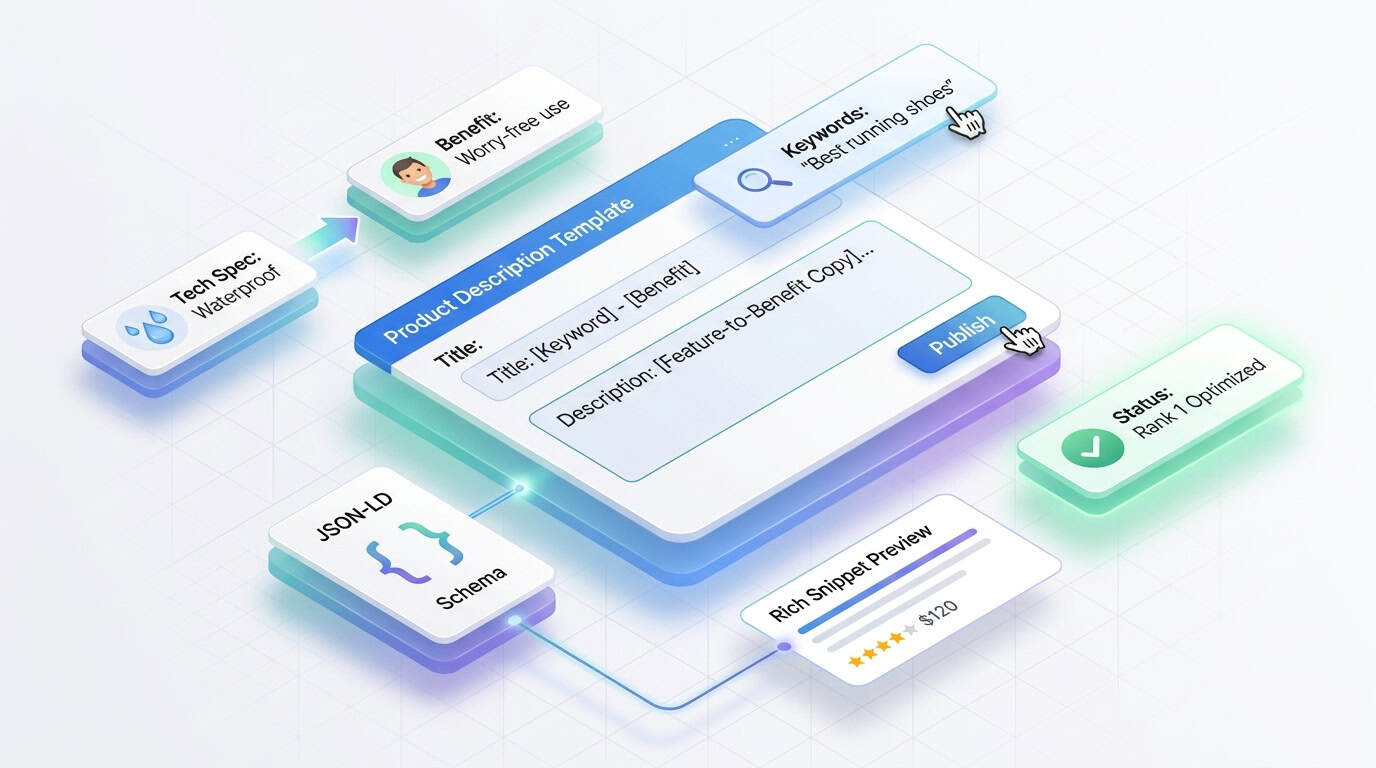
- Utilizing feature-to-benefit mapping templates transforms technical specifications into psychological transaction triggers that improve conversion rates by emphasizing how the product enriches the customer's daily life.
- Strategically integrating high-intent, long-tail keywords into product titles, H2 subheadings, and above-the-fold bullet points naturally captures ready-to-buy shoppers without resorting to outdated keyword stuffing.
- Optimizing e-commerce product imagery with descriptive filenames and structured alt-text formulas enhances visual search visibility and ensures page accessibility for screen readers.
- Implementing JSON-LD structured data and product schema markup maximizes organic search visibility and click-through rates by displaying rich snippets like pricing, availability, and reviews directly on the results page.
Many online retailers unknowingly sabotage growth by relying on generic, copy-pasted manufacturer descriptions. However, effective product description copywriting functions as a digital salesperson that works around the clock to educate and convert visitors. By moving away from stock text, store owners turn product pages into high-performing assets that capture and hold attention.
Our comprehensive guide provides five ready-to-use templates designed to bridge the gap between technical search visibility and persuasive sales copy. You will learn how to structure content that satisfies both search algorithms and human shoppers while mastering the nuances of retail search optimization to stay ahead in a competitive marketplace. Understanding the mechanics of these systems is the first step toward building a dominant e-commerce presence. It's that simple.
What is Product Description Copywriting?
Product description copywriting is the specialized practice of writing marketing text that explains a product's value and features to potential customers. It serves to inform shoppers while simultaneously optimizing the page for search engines to drive organic traffic. The practice focuses on three primary functions:
- Search Discovery: Helping crawlers index the page for relevant buyer queries.
- Customer Education: Providing enough technical and functional detail to resolve buyer doubts.
- Conversion: Using psychological triggers to encourage an immediate purchase action.
Why Duplicate Manufacturer Copy Destroys E-commerce Product Page SEO and Rankings
Using stock supplier spreadsheets is a common practice that creates significant technical and visibility hurdles for e-commerce platforms. Many store owners believe they're saving time by importing these descriptions, but they often end up rendering their entire product catalog invisible to major search engines. When multiple websites use the exact same text, search algorithms struggle to determine which page is the original or most relevant source for a shopper.
The Penalty of Repetitive Content and Omitted Results
Search engine algorithms utilizing natural language processing (NLP) prioritize unique product content to improve the user experience. If your product detail pages consist only of recycled specifications, they fail to meet the unique content requirements necessary for competitive ranking. Algorithms are designed to filter out repetitive information, which means your store could be omitted from organic results entirely.
Search engine filters are efficient at identifying non-unique copy across different domains. When a crawler encounters text that exists on hundreds of other sites, it classifies that content as a low-value duplicate. This often results in the page being suppressed from the main index or hidden in the section reserved for omitted results. Creating unique product descriptions is a foundational step in establishing a healthy and visible digital presence.
Managing Crawl Budgets: Efficiency for Large Catalogs
Writers must also consider the role of crawl budgets, which are the processing limits search engines set for a website. Crawlers allocate their time based on site speed, popularity, and the perceived uniqueness of the information they find. When thousands of unoriginal pages bloat a site's catalog, a search engine may stop crawling it as frequently.
Wasting these resources on manufacturer text prevents new or updated products from being indexed quickly. Such delays cause a significant lag between when you launch a product and when it appears in search results. Focusing on unique content ensures that search engines prioritize your store and re-index your pages with higher frequency.
The Art and Science of Product Description Copywriting for Conversions
Quality copywriting serves as a psychological bridge between the physical utility of a product and the emotional desires of the customer. While technical measurements provide a logical justification for a purchase, people generally buy based on how they perceive a product will improve their lives. Professional writers must learn to balance these two elements to create a page that converts well.
Using Benefit Mapping Templates to Convert Technical Features into Sales
To execute a deep feature-to-benefit mapping process, you must first list every technical component of the item. You then ask yourself what each specific feature actually allows the user to do or feel. For instance, a water-resistant material on a backpack is not just a product feature. It represents peace of mind for a student walking home during a sudden morning commute in the rain.
Moving from a feature-led description to a benefit-led one shifts the entire perspective of the shopper. Instead of reading about the grade of aluminum used in a bicycle frame, the customer learns about the effortless speed and durability they will experience on long weekend rides. Shifting your focus simplifies the decision-making process by highlighting how the product enriches their daily life. Using benefit mapping templates helps your team maintain this focus across a massive inventory of products.
Activating Psychological Transaction Triggers and Self-Qualification Anchors
Persuasion triggers are subtle cues integrated into the copy to guide the visitor toward a transaction. Self-qualification sentences are particularly useful for signaling exactly who the product is designed for. By stating who should use the item and who might not find it suitable, you reduce bounce rates and set realistic expectations for your customers.
The placement of micro-copy elements like risk-reversal reassurances can significantly lower the friction of a purchase. Mentioning a simple return policy or a long-term warranty near the buy button builds confidence at a critical moment. Sensory descriptions and gentle calls to action act as organic triggers that nudge the shopper forward without being aggressive. After optimizing the psychological elements of your copy, you must tune the technical components to ensure maximum search visibility.
Incorporating User-Generated Content for Enhanced Trust
Beyond professional copywriting, integrating user-generated content directly into the product page builds an additional layer of trust. Showcasing real customer reviews, unboxing photos, and community Q&A sections provides authentic social proof that validates your product claims. Search engines also value this dynamic content because it continually refreshes the page with organic keywords and relevant entities.
Integrating Long-Tail Keywords Naturally Without Keyword Stuffing
Optimizing product pages for long-tail search terms is a powerful way to capture buyers who are ready to make a purchase. Search engines look at the semantic relationships between words on a page to understand its true context. Forcing keywords into sentences where they do not fit naturally will only ruin the user experience and drive shoppers away.
Identifying Search Terms With High Commercial & Transactional Intent
Identifying long-tail keywords requires focusing on the specific modifiers shoppers use when they are close to buying. You can research these terms by looking at e-commerce search suggest bars and category filter options. Common patterns often include combinations of size, material, color, and specific use cases that solve a problem.
E-commerce brands should also target localized search variations and precise technical specifications that have lower competition. While these terms may have a lower overall search volume, they typically yield much higher conversion rates because they match exact needs. Teaching your team to prioritize these high-intent phrases will improve the overall efficiency of your marketing efforts. A data-driven approach ensures that your content is always relevant to what the audience is actively searching for.
Optimizing Product Imagery for Visual Search
Visual search is an increasingly significant component of e-commerce product page SEO. Search engines can't see images the way humans do, so they rely on text-based metadata to understand the content of a photo. Descriptive filenames and specific alt-text structures are essential for appearing in image-based search results.
Your alt-text should follow a logical formula such as [Product Name] + [Color] + [Material] + [Use Case]. For example, instead of naming an image "IMG_123.jpg," use "ergonomic-blue-mesh-office-chair-for-back-support.jpg." Providing such specific details adds valuable information that generic descriptions often lack. It also ensures that your products are accessible to users who rely on screen readers.
Keyword Placement Best Practices: Titles, Feature Bullets, and Body Text
A strategic anatomical blueprint for keyword placement is necessary for every product detail page. Your primary keywords must appear in the product title and at least one H2 subheading to signal relevance to search engines. Above-the-fold bullet points should also contain these terms while remaining focused on the benefits to the user.
Product metadata contains long-tail keywords to signal relevance to search crawlers. You should weave keywords into the story of the product without resorting to the outdated practice of keyword stuffing. Modern algorithms are sophisticated enough to recognize the theme of a page based on synonyms and related concepts. By maintaining a readable and flowing sentence structure, you keep both the search bot and the human reader engaged.
Five Reusable Copywriting Templates for E-commerce Retailers
These five templates serve as versatile frameworks adaptable for various retail niches. Each framework uses placeholder fields so you can immediately customize them for your own inventory.
Template 1: The Problem-Agitate-Solve (PAS) Framework for High-Utility Products
The PAS framework is ideal for functional items, which are products that solve a specific pain point. You begin with a hook that identifies a common problem, then use an agitating sentence to explain why that problem is frustrating. Finally, you present your product as the benefit-led solution that resolves the issue once and for all.
To use this template, follow this structure: [Product Name], followed by the [Key Pain Point], the [Agitation], the [Core Benefit], and the [Transactional Trigger]. If you sell ergonomic office chairs, start by mentioning the back pain caused by long hours at a desk. You then describe how a lack of support ruins productivity before introducing your chair as the ultimate ergonomic relief. This structure works because it validates the shopper's frustration before offering a clear way out.
Template 2: The Lifestyle and Sensory Storytelling Framework for Premium Goods
This template is designed for brands where emotional connection and imagery are the primary drivers of sales. It focuses on sensory vocabulary and aspirational scenarios rather than just technical specifications. You want to paint a vivid picture that allows the potential buyer to mentally experience the ownership of the item.
Start by setting a scene: [Product Name], followed by the [Sensory Detail], the [Aspirational Scenario], the [Brand Story Element], and the [Final Image]. If you are selling a luxury candle, describe the soft glow of the flame and the scent of sandalwood filling a quiet room. You aren't just selling wax and a wick. You're selling a moment of relaxation. Sensory language helps to bridge the gap between a digital screen and the physical product.
Template 3: The Spec-to-Benefit Technical Transformer for Complex Hardware
Technical gear and industrial products often come with dense data tables that can be overwhelming for shoppers. This template converts those engineering specifications into highly readable and benefit-driven bullet lists. You list a physical dimension or material grade side-by-side with its real-world functional value.
Structure the copy as follows: [Product Name], followed by the [Technical Spec], the [Functional Value], and the [User Advantage]. If a power tool has a specific battery capacity, explain that this means the user can finish an entire project without stopping to recharge. Transforming raw data into clear benefits provides compelling reasons to buy the product. It allows non-technical buyers to make informed decisions without feeling intimidated by the jargon.
Template 4: The Business-to-Business (B2B) Wholesale and Bulk Purchasing Framework
B2B buyers have different priorities than retail consumers, focusing on logistics, reliability, and unit economics. This template emphasizes durability, lead times, and case pack specifications. You must show the professional buyer that your product can withstand high-volume use in a commercial environment.
The structure should lead with: [Product Name], followed by [Commercial Durability Rating], [Bulk Ordering Savings], [Logistics Assurance], and [Compliance Standards]. Highlight the specific certifications or industrial grades that matter to a procurement officer. Speaking the language of business operations builds professional trust. It focuses on the return on investment (ROI) of the purchase rather than personal emotional satisfaction.
Template 5: The Subscription Box and Curation Framework
Subscription models rely on the promise of recurring value, discovery, and the expertise of the curator. This template focuses on the "surprise and delight" factor while justifying the monthly cost. You want to highlight the exclusivity of the items and the convenience of the delivery service.
Follow this flow: [Subscription Name], followed by the [Curation Theme], the [Exclusive Item Reveal], the [Convenience Value], and the [Subscriber Milestone]. Explain how each box is selected by experts to solve the customer's need for variety or specialized gear. You are selling the excitement of the unboxing experience as much as the items themselves. The curation framework works exceptionally well for beauty, snack, and niche hobby subscriptions.
Implementing Technical Schema and JSON-LD for Search Visibility
Persuasive writing gets the user to click, but technical data ensures that search engines show your product in the first place. Modern retail search optimization requires a deep integration of structured data to help crawlers extract specific details about your offer. Schema information appears in the search results as rich snippets, which can significantly improve your click-through rates.
The Architecture of Product Schema Markup
You should leverage structured data to help search engines understand the specific details of your offer. This includes marking up prices, availability, and review scores so they can appear directly on the search engine results page (SERP). Using JavaScript Object Notation for Linked Data (JSON-LD) format is the preferred method for most major search engines because it is easy to maintain and parse.
Key properties within your JSON-LD should include the "name," "image," "description," and "brand" of the item. You must also include the "offers" property to specify the "price," "priceCurrency," and "availability" status. Search engine algorithms use this data to populate comparison tools and shopping tabs. Without this technical layer, your persuasive copy remains partially hidden from the systems that drive traffic.
Improving Information Gain with Structured Data Attributes
Search engines favor pages that provide comprehensive and verifiable data points that are not found on other sites. By including specific attributes like "sku," "gtin13," and "mpn," you provide a unique footprint for your product page. Technical precision helps search engines distinguish your page from competitors who might be using the same manufacturer name.
You can also use the "aggregateRating" property to show star ratings directly in the search results. Visible social proof acts as a transaction trigger before the user even lands on your website. Structured list items should mirror the long-tail keywords you used in your main description. Aligning these assets maximizes your overall search visibility and transactional trust.
Step-by-Step Guide: How to Customize These Templates for Your Retail Niche
Scaling these templates across a large catalog requires a systematic approach to maintain brand uniqueness. Customization is the key to avoiding a generic feel while still benefiting from a structured writing process. This methodology helps you transition from basic theory into a high-velocity publishing workflow.
Step 1: Execute Your Feature-to-Benefit Mapping Worksheet
Setting up an internal product sheet is the first step in the customization process. This document should list every physical component of your product next to its corresponding human advantage. The resulting worksheet serves as the raw material that you will feed into your benefit mapping templates.
You can extract the initial specifications from manufacturer data sheets or technical manuals. Once you have the data, spend time translating those points into clear value propositions for the end user. Having this information organized beforehand makes the actual writing process much faster and more accurate. Focusing on high-value points ensures that your copy is always impactful.
Step 2: Establish Your Core Brand Voice Parameters
Adapting the tone and style of the templates to match your brand identity is essential for consistency. You should define specific rules for sentence length, the use of humor, and the level of formality you want to project. Maintaining a defined tone ensures that a shopper has the same experience whether they are looking at a socks listing or a luxury watch page.
Avoid using overly generic adjectives like "high-quality" or "amazing" because these do not provide real information. Instead, encourage your writers to use precise and brand-aligned vocabulary that resonates with your specific target audience. A clear style guide prevents your product descriptions from sounding like they were written by many different people. Such attention to detail separates professional retailers from amateur sellers.
Measuring the Impact of Unique Product Descriptions
The transition to unique content is an investment that should produce a demonstrable ROI. You cannot simply write the copy and forget about it; you must track how these changes influence your bottom line. Monitoring specific performance metrics allows you to refine your strategy based on actual user behavior.
Tracking Key Performance Indicators in Search Console
You should use Google Search Console to monitor the organic keyword movements of your updated product pages. Look for increases in impressions and clicks for the long-tail terms you targeted in your descriptions. A successful update will typically result in a wider variety of search queries driving traffic to the page. You should also watch for the appearance of rich snippets in your performance reports.
If your impressions are rising but clicks are stagnant, your meta titles or descriptions may need further refinement. The relationship between your search engine results page appearance and your on-page copy must be seamless. Consistent monitoring ensures that you stay ahead of algorithm updates and shifting competitor strategies. These insights help you decide which templates are performing best for your specific catalog.
Analyzing Conversion Rates and Time on Page
Unique content should lead to a measurable increase in your "Add to Cart" rates and a reduction in bounce rates. When a description is informative and persuasive, shoppers spend more time engaged with the page. You can track "Time on Page" in your analytics suite to see if the new copy is holding attention longer than the previous stock text. Higher engagement is a strong signal to search engines that your content is valuable.
You should also perform A/B testing on your most popular products to see which framework drives the most revenue. For instance, try the PAS framework against the Lifestyle framework to see which one resonates more with your audience. Analyzing A/B test data allows you to optimize your production workflow for maximum profitability. Effective descriptions reduce buyer hesitation and lead to a more efficient sales cycle.
Scale Your Organic Website Traffic with Optimized Product Content
Unique and persuasive product descriptions are a source of organic revenue that typically accounts for 15% to 30% of e-commerce site traffic. Moving away from copy-and-paste manufacturer data requires a dedicated, systematic approach to content production. When you invest in high-quality writing, you transform your product catalog into a powerful engine for growth and customer loyalty. High-quality writing investments pay off through higher search rankings and improved conversion rates.
Don't let generic manufacturer text stall your e-commerce growth. Partner with Brand Voice to deploy high-converting, ready-to-publish website content that will make your store stand out in search. Book a demo today to discuss a custom content strategy that can turn your product pages into high-ranking revenue drivers.