- Strategic middle-of-funnel (MOFU) content bridges the gap between initial brand awareness and final purchasing decisions by providing B2B buyers with practical tools, product comparisons, and evidence-based frameworks.
- Implementing a defined sales funnel structure with intermediate educational assets can increase your overall conversion rate by four to ten times by improving the quality of leads handed off to sales.
- Marketers must utilize intent-based mapping to align contextual blog topics with high-value MOFU assets, ensuring offers match the exact semantic search signals of users in the active evaluation phase.
- High-converting B2B lead generation relies on deploying targeted middle-of-funnel formats like interactive ROI calculators, original research reports, step-by-step playbooks, and strategic competitor matrices.
- To accurately prove the business value of mid-funnel content, marketing teams must move beyond vanity metrics to track leading indicators like content velocity and lagging indicators such as MQL-to-SQL pipeline conversion rates.
Many B2B companies experience the frustration of watching organic traffic climb while sales pipeline revenue remains flat. Resolving this disconnect requires strategic middle-of-funnel (MOFU) assets that guide buyers from initial awareness to active commercial consideration. While top-of-funnel content builds broad interest, MOFU resources target prospects in the evaluation stage. By providing empirical proof, technical validation, and practical tools, mid-funnel assets address the specific implementation questions and risk factors that influence B2B purchase decisions.
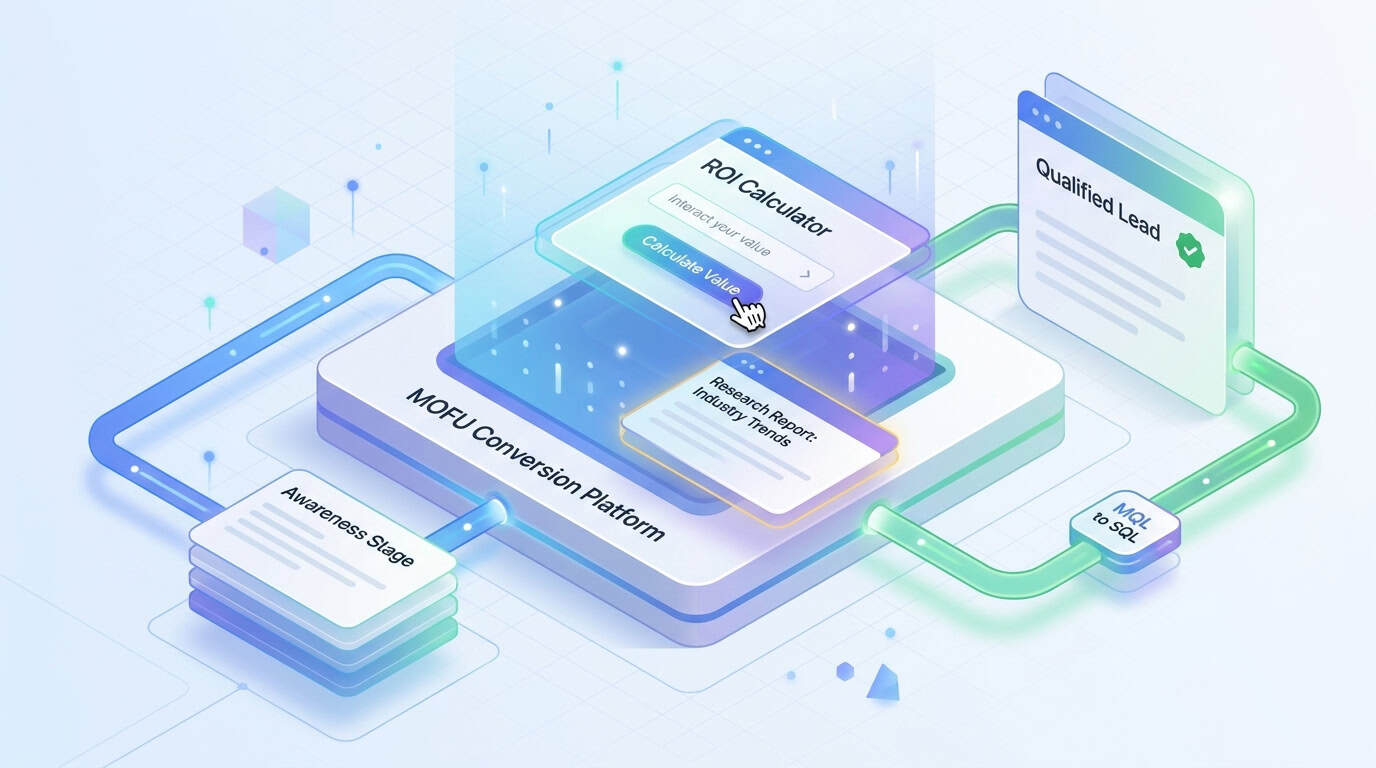
Understanding the Middle of the Funnel: Why MOFU Drives B2B Conversions
Middle-of-funnel (MOFU) content targets buyers during the evaluation stage of their journey. By providing evidence-based resources like comparison matrices, case studies, and interactive calculators, you help prospects confidently analyze and select the right solution for their business needs.
Marketing teams often prioritize top-of-funnel traffic or bottom-of-funnel sales pitches, leaving a gap in the middle. Without structured mid-funnel assets, potential buyers drop off the journey because they lack the depth of information needed to trust a solution. By mapping original data, expert frameworks, and practical tools directly to user search intent, you can transition broad curiosity into purchasing confidence.
The Strategic Mindset Shift: How B2B Buyers Evaluate Solutions
According to Google's "messy middle" research, buyers in the consideration phase constantly loop between two distinct cognitive modes: exploration (an expansive activity where they search for options) and evaluation (a reductive activity where they narrow their choices).
Moving a prospect through this phase requires adopting the mindset of an expert consultant who addresses specific business challenges. You should move beyond explaining what a problem is and start providing clear blueprints for how to resolve it using your unique methodology. Effective B2B mid-funnel content must highlight how your product is better than others while featuring social proof from those who already trust it.
Marketers can influence this evaluation loop by leveraging behavioral biases identified in the research, such as social proof, authority bias, and the "power of free." Offering high-value templates or tools provides immediate utility without financial commitment, which builds frictionless goodwill and reduces buyer friction.
Integrating customer reviews and peer recommendations directly within middle-of-funnel resources provides the validation prospects seek during the reductive evaluation phase. When buyers see evidence of successful peer outcomes, they can comfortably shortlist your brand.
The Cost of the Leaky Funnel: What Happens When You Skip the Mid-Funnel
Skipping the mid-funnel creates a leaky funnel, where high traffic volumes fail to convert into meaningful sales meetings. Research indicates that only about 17% of marketers currently maintain a fully functioning funnel structure. Additionally, a benchmark study by MarketingSherpa shows that 68% of B2B organizations have not identified their marketing-sales funnel, leading to a disconnect that wastes sales development resources on unqualified leads.
A structured sales funnel provides prospects with the information they need to self-qualify before reaching a sales demo. This systematic approach improves lead-to-sales hand-offs, boosting average funnel conversion rates. Ultimately, organizations with a formalized funnel process achieve significantly higher revenue growth by ensuring that organic traffic investments convert into bottom-line revenue.
Preventing Mid-Funnel Content Decay
Even high-performing lead-generation assets lose effectiveness over time. Competitors publish updated data, and software interfaces evolve, making static playbooks and comparison matrices feel obsolete. Auditing your mid-funnel resources biannually ensures that all statistics, screenshots, and product references remain accurate, preserving your brand's editorial integrity.
Mapping Intent: Aligning Organic Traffic with Middle-of-Funnel Assets
Successful lead generation relies on delivering the right offer at the exact moment a user signals commercial readiness. Intent-based mapping ensures that your conversion strategy feels like a natural extension of the buyer's search journey rather than an intrusive interruption. Every page visited signals a prospect's position in the buying process. A visitor reading an introductory guide requires different resources than someone comparing specific features. Tailoring your calls to action to these search signals dramatically increases lead quality and conversion rates.
Deciphering Mid-Funnel Search Intent Signals
Identifying search intent that signals a mid-funnel mindset involves looking for specific semantic modifiers in keyword research. Search queries containing "versus," "best practices," "framework," or "templates" indicate that a prospect has graduated from awareness to active evaluation.
Google's search trends show that global search volume for the word "best" has far outpaced "cheap" for over a decade. This indicates that buyers actively prioritize quality, utility, and fit over low cost during the reductive evaluation phase. When analyzing search engine results, identify whether users seek deep guides or comparison tools for your niche.
The search intent of a user in this phase is often reductive and focused on narrowing down a list of potential vendors. They are looking for reasons to exclude options that do not meet their specific technical or operational requirements. Your content must address these specific evaluation criteria directly to remain on their shortlist and move them toward a purchase.
Creating the Perfect Match: Pairing Specific Blog Topics with High-Value Offers
A practical framework for mapping blog topics to specific offers begins by identifying the natural pivot points in your existing content. If you have a high-traffic post about onboarding strategies, the next logical step for the reader is likely a downloadable checklist. Matching the offer to the specific context of the article drives significantly higher conversion rates than using generic pop-ups.
Map your top-performing top-of-funnel posts to the specific product features or business outcomes they address. This allows you to introduce your solution as a logical next step in the reader's education, creating a seamless bridge to conversion without resorting to a hard sales pitch.
Consider a blog post that explains the theory of inventory management for small businesses. A high-value offer for this page might be a pre-formatted Microsoft Excel calculator that allows the user to input their own stock levels. This transition feels helpful and provides the reader with a tangible tool they can use immediately in their daily operations.
Nine High-Converting Middle-of-Funnel Assets Every B2B Strategy Needs
Several specific formats consistently outperform others when it comes to developing B2B mid-funnel content that converts. These tools help prospects bridge the gap between understanding a problem and executing a practical solution.
1. Interactive return on investment (ROI) and cost-savings calculators
Interactive return on investment (ROI) and cost-savings calculators turn vague marketing promises into personalized, quantifiable value. By inputting their own metrics, prospects can instantly calculate potential savings or revenue lift, generating a concrete internal business case they can present directly to executive decision-makers. These tools also capture high-intent zero-party data. When a user inputs their company size, current software spend, or manual processing hours, they hand your sales team a tailored roadmap of their exact operational pain points. To maximize conversion, ensure the calculator features a clean user interface, minimal input friction, and a downloadable, shareable PDF report of the results.
2. Tailored Industry Benchmarks and Original Research Reports
Original research and benchmark reports establish proprietary authority by offering industry-specific insights that cannot be found anywhere else. When you conduct proprietary surveys or analyze aggregated platform data, you become the primary source for your niche, which earns both authoritative editorial backlinks and the trust of risk-averse B2B buyers. Benchmark reports are highly effective because they let readers compare their own performance metrics against industry averages. Discovering an operational deficit compared to peers triggers immediate urgency, positioning your product or service as the logical mechanism to close that performance gap.
3. Step-by-Step Playbooks, Checklists, and Airtable Templates
Playbooks, checklists, and interactive templates (such as Notion boards, Google Sheets, or Airtable bases) act as actionable shortcuts for readers who are ready to execute a strategy. While B2B buyers find educational articles useful, packaging that advice into a downloadable, pre-formatted framework bridges the gap between theory and execution. Providing a ready-to-use tool embeds your brand directly into the prospect's daily workflow. Whether it is a marketing budget calculator or a project roadmap template, matching the format to their actual working stack proves you understand their real-world operational challenges, building deep trust before they ever speak to sales.
4. Video Walkthroughs and Interactive Software Demos
Self-guided interactive software demos and video walkthroughs address the modern buyer's preference for independent product exploration. B2B buyers increasingly avoid high-friction live sales calls during early evaluation. Instead, they prefer to interact with the interface on their own terms. Incorporating self-paced demos or short walkthrough videos can raise landing page conversion rates significantly. By showing the software in action, you resolve complex feature questions without heavy text blocks. Product-led blog content, exemplified by Hotjar's contextual feature highlights, serves as an organic, self-guided demo. Showing real-world applications of specific features helps prospects validate technical requirements before requesting a personalized sales demonstration.
5. "Versus" Comparison Pages and Strategic Competitor Matrices
Comparison pages and competitor matrices are essential for controlling the narrative during the final evaluation stage. Rather than avoiding direct comparisons, presenting an honest, feature-by-feature matrix helps prospects justify their choice to internal stakeholders.
| Evaluation Metric | Our Platform (Product-Led) | Legacy Competitors | Point Solutions | |
| Self-Guided Demo | Interactive, ungated sandbox experience | Requires a sales contact | Limited video walkthrough only | |
| Zero-Party Data Collection | Built-in custom calculators & templates | Manual PDF forms | Basic contact forms only | |
| Implementation Time | Under 2 weeks (automated setup) | 3 to 6 months (custom services) | Varies by integration complexity | |
| Pricing Transparency | Tiered public pricing with clear ROI | Hidden behind "Request a Quote" | Flat rate with limited scalability |
Framing these differences around specific customer needs, such as implementation speed or self-service options, demonstrates maturity. Including validated social proof, like verified customer reviews, on these comparison pages further validates your claims during the buyer's reductive evaluation phase.
6. On-Demand Webinars and Expert Masterclasses
On-demand webinars and expert-led masterclasses deliver high-value training without the scheduling friction of live events. Structured around resolving advanced, real-world operational challenges rather than pitching product features, they establish authority bias by positioning your brand as a trusted industry advisor. To maximize lead nurturing efficiency, embed subtle, context-specific calls to action within the presentation at moments when your software or service naturally resolves the bottleneck under discussion. This educational-first approach maintains engagement while guiding high-intent viewers toward the next stage of the funnel.
7. Case Studies and Customer Success Stories
Case studies provide the empirical validation risk-averse B2B buyers need to finalize their selection. Unlike generic marketing collateral, success stories demonstrate real-world utility by showing exactly how a peer organization resolved a familiar friction point. A prime example is Calendly's HackerOne customer story, which details a 169% ROI and 73 business days saved by standardizing customer-facing scheduling templates.To drive conversions, structure your case studies around the classic challenge-solution-results narrative. Highlighting quantified outcomes (like percentage reductions in cost or time saved) gives internal champions the exact metrics they need to justify the purchase. These assets also serve as critical sales enablement material, helping representatives handle active objections with real-world proof.
8. White Papers and Technical Briefs
White papers and technical briefs satisfy the information needs of analytical decision-makers and technical buyers who require deep, architectural insights. Because they offer high-density analysis of complex industry standards or system integrations, they carry high perceived value as gated resources. A good white paper addresses macro-level industry shifts, whereas a technical brief focuses on a specific feature, security compliance standard, or integration. Providing these briefs freely, or through a low-friction single-field form, helps prospects verify that your platform checks all technical boxes, removing late-stage friction from the evaluation loop.
9. Product-Led Newsletters and Drip Campaigns
Product-led newsletters and automated drip campaigns nurture captured leads by continuously delivering contextual value to their inboxes. Instead of blasting generic company updates, focus on sharing advanced use cases, optimization tips, and industry trends that help prospects improve their existing processes today.Automating these sequences based on user behavior, such as sending a specialized playbook three days after a checklist download, shortens sales cycles. Segmenting your email cohorts by role or industry vertical ensures that every follow-up aligns with the recipient's specific operational needs, significantly increasing overall pipeline velocity.
How to Craft Compelling Call-to-Action (CTA) Triggers That Convert
An exceptional middle-of-funnel asset will still fail to capture leads if the conversion path is poorly designed. The transition from reading an educational article to clicking an offer must feel like a natural, frictionless progression. High-converting CTAs act as helpful suggestions, appearing exactly when the prospect requires a tool or deeper documentation to resolve their immediate challenge.
Contextual Placement: Going Beyond the Sidebar and Generic Banners
To combat "banner blindness," where readers reflexively ignore sidebar ads and header banners, integrate your offers directly into the body text using inline, contextual CTAs. Mid-paragraph callout boxes and scroll-triggered slide-ins capture attention while the user is actively engaged, driving significantly higher click-through rates. The key to non-intrusive conversion is strict thematic relevance. If a section explains how to audit a database, your inline CTA should offer a downloadable database audit checklist, not a generic product demo. This alignment transforms the CTA from an ad into a helpful, next-step resource.
Copywriting for CTAs: Shifting From "Submit" to Value-Oriented Action Verbs
Button copywriting heavily influences final conversion rates. Industry data shows that personalized calls to action perform 202% better than standard, generic buttons. Replace passive, high-friction verbs like "Submit" or "Download" (which focus on what the reader must give up) with active, value-centric phrases like "Get My Free Audit" or "Access the Template Now."This shift in framing emphasizes immediate benefit. Given that the vast majority of visitors scan pages rather than reading every word, your CTA copy must stand out with clear, benefit-driven value. Continuous A/B testing of button copy and page layout can increase overall landing page conversion rates by up to 300%, ensuring you capture high-quality leads.
Aligning Offer Depth with Content Consumption Signals
A reader who scrolls through 80% of an article signals significantly higher intent than a casual bounce. Use scroll-depth or time-on-page rules to display your offers at the exact moment of maximum engagement, avoiding the common mistake of gating content before the visitor has seen its value. Aligning CTA intensity with consumer engagement directly impacts lead quality. Nurtured leads produce 20% more sales opportunities and yield 47% higher average order values than non-nurtured prospects. While MOFU content can look underpowered on a direct-attribution model, measuring its impact via assisted conversions reveals its true role in driving pipeline revenue.
The Strategic Gating Decision: To Gate or Not to Gate?
Deciding whether to gate middle-of-funnel content requires balancing search engine visibility against the need for structured lead capture. While ungated resources maximize reach and SEO value, gating is essential for collecting high-intent prospect data. Designing a flexible strategy that matches access requirements to the asset's production value ensures a healthy, high-converting pipeline.
When to Keep MOFU Assets Open for SEO and Brand Equity
Keeping middle-of-funnel resources ungated allows search engine crawlers to index the entire asset, boosting keyword rankings and organic acquisition. Ungated tools and guides also acquire links more naturally, expanding your brand's authority. Furthermore, providing high-value assets without form friction establishes immediate goodwill, positioning your business as a trusted resource when the prospect enters active commercial buying mode. This open approach is equally valuable for nurturing existing pipeline leads. Sending deep-dive guides via email without demanding a form login respects the prospect's time and builds long-term authority. This positions your product as a natural solution when they are ready to purchase.
When to Restrict Access to Capture High-Quality Leads
Gating is reserved for high-production-value assets that offer deep, exclusive utility, such as proprietary calculators or original industry benchmarks. Because these resources cannot be found elsewhere online, B2B buyers perceive the value exchange as fair and are willing to provide their contact information. This captures high-intent leads who are ready to enter a targeted nurture stream. To optimize gated conversions, design a high-converting landing page that highlights the specific outcomes the asset delivers. Providing a brief, interactive preview of the content or an executive summary reduces user skepticism. This ensures that the perceived value of the asset outweighs the friction of the lead capture form.
The Middle Ground: Semi-Gating and Smart Lead Captures
Hybrid alternatives, such as semi-gating and progressive profiling, capture lead data without compromising user experience. Semi-gating allows users to read a portion of a research report or watch a segment of a video before prompting for registration, letting prospects verify the asset's quality beforehand. Progressive profiling keeps initial forms short (demanding only an email address) to maximize conversions. As the returning prospect consumes more resources over time, your marketing automation dynamically asks for additional qualifiers (like team size or industry). This smart capture strategy keeps friction low while building rich, sales-ready lead profiles.
Measuring MOFU Success: Key Metrics Beyond Simple Conversion Rates
Measuring mid-funnel performance requires shifting focus from top-of-funnel vanity metrics (such as pageviews or social shares) to pipeline velocity and conversion indicators. Tracking how prospects interact with multiple MOFU resources reveals where buyers stall, enabling you to optimize the journey and demonstrate content's direct influence on revenue.
Leading Indicators: Resource Consumed per Session and Content Velocity
Leading indicators such as "content velocity" (the rate at which a prospect consumes resources) and "assets per session" signal how effectively your material is educating the buyer. When a visitor reads an article, immediately downloads a checklist, and then reviews a competitor comparison page in a single visit, they demonstrate exceptional purchase intent. In parallel, measure average session duration on individual assets and engagement metrics (open and click-through rates) within your automated nurture sequences. A sudden drop in engagement at a specific nurture stage signals a content mismatch, indicating that the asset is outdated or misaligned with the buyer's current evaluation criteria.
Lagging Indicators: Pipeline Contribution and MQL-to-SQL Conversion
Lagging indicators validate the bottom-line ROI of your middle-of-funnel content investments. Tracing closed-won revenue back to specific asset interactions provides hard pipeline contribution data. Specifically, monitoring the conversion rate from Marketing Qualified Lead (MQL) to Sales Qualified Lead (SQL) is the most reliable way to assess mid-funnel lead quality. While the average conversion rate for standard sales funnels hovers around 2.35%, companies with structured funnels report deal sizes that are 102% larger due to better-educated buyers. Furthermore, organizations that prioritize lead nurturing experience 23% shorter sales cycles, proving that high-quality MOFU assets directly accelerate pipeline velocity and sales efficiency.
Create Expert Middle-of-Funnel Content With Brand Voice
A robust B2B marketing strategy depends on high-quality middle-of-funnel assets that turn passive readers into pipeline opportunities. However, consistently producing search-optimized, expert-level resources like calculators, playbooks, and competitor matrices requires significant time and editorial expertise that internal teams often struggle to sustain at scale.
Brand Voice helps you scale your content operations and build a high-converting middle-of-funnel library. We provide a full-service content marketing solution that manages everything from strategic search intent mapping to ready-to-publish technical articles and interactive assets. Book a demo with Brand Voice today to discover how we can help convert your organic traffic into sustainable sales revenue.