
- The topic cluster model improves search visibility by organizing content into a strategic framework consisting of a central pillar page, supporting cluster content, and a robust internal linking structure.
- A comprehensive pillar page serves as the high-authority hub for core industry terms, typically ranging from 2,500 to 4,000 words to provide a broad overview of a subject.
- Detailed cluster content pieces target specific long-tail keywords and niche sub-topics to demonstrate exhaustive topical authority and mastery of the subject matter.
- Establishing a hub-and-spoke internal linking architecture is essential for distributing page equity and signaling semantic relevance to search engine crawlers.
- Implementing structured topic clusters makes content 3.2 times more likely to receive citations in AI-powered search results while satisfying Google’s E-E-A-T guidelines for expertise and trustworthiness.
Many marketers feel frustrated when their long articles fail to rank for competitive keywords. They often publish content in isolation and see it buried on the second or third page of search results. This struggle usually stems from a reliance on unlinked, siloed blog posts that lack a parent-child URL structure needed to challenge established industry leaders.
Modern search engines now look at how different topics relate to each other, rather than just counting keywords. Search algorithms now prioritize entity relationships and the context surrounding a specific subject rather than just counting keyword instances. Understanding the mechanics of these systems is the first step toward building a sustainable online presence that withstands algorithm updates.
Understanding the Topic Cluster Model and Its Components
The topic cluster model serves as a framework for organizing a website's content to maximize its search visibility. HubSpot pioneered this approach around 2016 and 2017 in direct response to evolving search engine behavior. Recent data indicates that topic clusters can drive 30% more organic traffic than standalone posts and are 3.2 times more likely to receive AI citations.
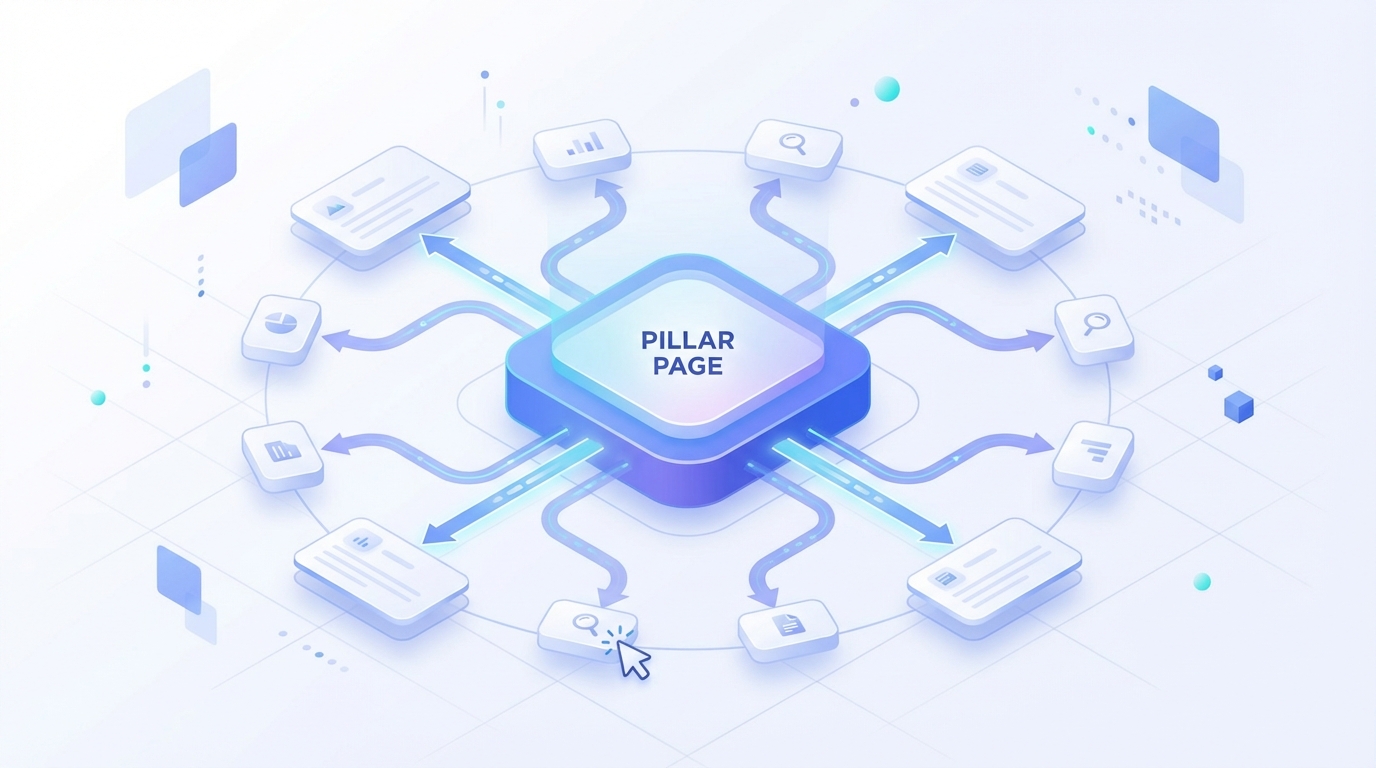
This model relies on three interconnected elements: the pillar page, cluster content, and internal linking structure. These components work together to create a network of information that proves the site's semantic relevance to both users and search bots. By establishing this cohesive system, a brand can effectively communicate its depth of knowledge on a broad subject.
Identifying Your Core Industry Head Terms
Selecting the right topic for a pillar page is a foundational step in the planning process. You need to identify terms that are broad enough to support at least eight to twelve sub-topics. However, the topic must also remain specific enough to be relevant to your business's core products or services.
Use tools like Ahrefs or Semrush to identify head terms with high monthly search volume and difficulty scores that make ranking with standalone posts difficult. These are often the terms that are the hardest to rank for using traditional, isolated blog posts. You should prioritize topics that your brand truly wants to be known for, as these will become the pillars of your digital identity.
The chosen head term should represent a primary category of your business. For example, a project management software company might choose workplace productivity or agile methodology as a pillar. The topic must have sufficient depth to support multiple how-to guides, case studies, and FAQ-style cluster articles.
Identifying high-intent B2B search terms during this phase is essential to a successful SaaS SEO content strategy. You must look for phrases that signal a user is moving from the research phase to the evaluation phase. This foresight ensures your pillar page attracts visitors who have the potential to become long-term customers.
The Pillar Page: Your Content's North Star
A pillar page serves as the central hub for a core industry term, providing a broad yet comprehensive overview of the topic. It functions as the structural foundation for your topic by covering all aspects of a subject on a single page. This setup ensures that every piece of supporting content has a high-authority hub to link back to.
Pillar pages define core industry concepts for both users and crawlers. The ideal length for a pillar page typically ranges between 2,500 and 4,000 words to ensure it covers the breadth of the topic. While the content is expansive, it should avoid getting bogged down in extreme technicalities that are better suited for niche sub-topic pages.
User experience is a primary consideration for any successful pillar page design. It must be easy to navigate and serve as a reliable one-stop shop for anyone looking to understand a subject from start to finish. A well-organized hub encourages visitors to spend more time on the site, which signals to search engines that the content is valuable.
Cluster Content: Deep Dives into Niche Sub-topics
Cluster content pieces represent the individual spokes of the wheel that support the central pillar. These articles are typically individual blog posts of 1,000-2,000 words that explore specific long-tail keywords in great detail. They provide the granular information that the pillar page only mentions briefly in its high-level summaries.
Each cluster article must answer a specific search query or a specific problem related to the broader theme. By addressing every niche question, you move from simple keyword targeting to comprehensive topic authority building. Together, they form an exhaustive library of content that demonstrates the brand's complete mastery of the subject matter.
Search engines interpret this collection of related articles as a signal of high authority. When a site covers ten to twelve specific sub-topics related to a head term, it becomes much harder for competitors with only one or two articles to rank higher. This exhaustive coverage ensures that the brand's ecosystem addresses every potential search query within a topic.
The Hyperlink: The Glue of Your SEO Architecture
Internal links are the connective tissue of the cluster model. Every piece of cluster content must include a link back to the pillar page to pass equity and establish a clear relationship between the pages. Place the link to the pillar page within the first two paragraphs to maximize click-through potential and crawler discovery.
The pillar page also needs to link out to each supporting cluster piece to create a closed loop of information. Internal links distribute page equity across the entire cluster. This structure ensures that both users and search engine crawlers can navigate through the entire topical ecosystem without hitting dead ends.
Strategically placed links help search engine bots understand the site's hierarchy and the relevance of each page. When bots can easily follow a path from a broad topic to a niche sub-topic, they can index the entire group of pages more efficiently. A site that uses this hub-and-spoke model effectively will see much better distribution of authority across all its pages.
Technical SEO for Topic Clusters
Maintaining a clean technical environment is just as important as writing the content itself. You must ensure that your URL structure reflects the hierarchy of your clusters so search engines can understand the relationships among them. Adopt a sub-directory URL structure (e.g., domain.com/topic/sub-topic) to signal a clear content hierarchy to search engine crawlers.
Canonicalization is a primary technical consideration for clusters that cover similar keywords. You should use canonical tags to point toward the pillar page when cluster articles have high overlap in their subject matter. This prevents keyword cannibalization and ensures that the search engine knows which page is the primary authority for the broad term.
Your XML sitemap should also be organized to reflect your cluster strategy. Grouping your pillar and cluster URLs in the sitemap can help search bots discover the entire content network in a single crawl. This technical organization supports the overall visibility of your enterprise topic cluster implementation.
Topic Clusters Versus Traditional SILO Architectures
Traditional SILO structures organize content into strict, isolated categories that often prevent cross-departmental discovery. In a SILO model, a blog post about one topic rarely links to a related post in another category. This creates a rigid hierarchy that can feel restrictive for both users and search engine crawlers. While it keeps things neat, it doesn't always reflect how humans naturally search for information.
The topic cluster model is more fluid and focuses on semantic relationships rather than on technical categories alone. It enables more comprehensive content ROI through topic modeling by emphasizing how different subjects overlap. This approach is particularly effective for scalable content architecture for SaaS brands. These companies often have complex features that need to be explained in relation to one another.
Choosing a cluster model over a SILO structure allows for better enterprise SEO content mapping. It provides a flexible framework that allows new subtopics to be integrated without rebuilding the entire site's navigation. This ensures that your domain remains agile as your industry evolves and new trends emerge. It's the preferred method for modern brands that want to build deep, interconnected authority.
The Strategic Power of Topical Authority and Semantic Relevance
Search engines like Google use advanced natural language processing to understand the underlying context of a piece of content. They no longer look at keywords in isolation but instead evaluate how words and phrases relate to one another across an entire website. This shift means that the site's overall semantic relevance is now a primary factor in determining its ranking for competitive terms.
When a brand covers every angle of a topic through a cluster, it builds a network of interconnected entities that increases domain-level topical relevance. This depth makes it significantly more difficult for competitors to displace the site from the top of the search results. Topic clusters demonstrate subject expertise by providing a more stable foundation for long-term rankings.
The transition from the theory of semantic relevance to the physical design of a website requires a focus on structure. You must translate these abstract concepts into a navigable interface that users can easily explore. This process begins with a clear understanding of how search engines categorize different entities.
Moving Beyond Keywords to Semantic Entities
Search has shifted from matching keyword strings to mapping conceptual entities. Search engines now look for co-occurring related terms to verify a webpage's quality and accuracy. If an article about email marketing doesn't mention segmentation or open rates, the algorithm may perceive it as less authoritative.
A topic cluster naturally incorporates these related terms through its various supporting articles. This methodology satisfies the requirements of modern algorithms like Hummingbird and RankBrain, which prioritize the intent behind a search query. By focusing on a concept rather than a single word, content becomes more resilient to changes in search behavior.
Building content around entities also helps future-proof a website against major algorithm updates. When you optimize for a topic, you're providing the comprehensive value that search engines are designed to find. This approach ensures that your content remains relevant even as the specific keywords people use to find it continue to change.
Designing Your Pillar Page Architecture for Maximum Impact
Building a successful central hub requires a balance between high-level summaries and actionable insights. A pillar page must function as a guided roadmap for the reader. It serves as the gateway to the rest of your content, so the information provided should be valuable enough to encourage further exploration.
A pillar page must be designed differently from a standard blog post to handle its significant length and complexity. It requires a more robust user interface and clear navigation elements to prevent the reader from feeling overwhelmed. Thoughtful UI/UX choices ensure that the vast amount of information remains accessible for every visitor.
Structuring the Page for Scannability and Depth
Formatting is a primary factor in keeping users engaged with a long-form pillar page. Using descriptive H2 and H3 headings allows readers to scan the page and find the specific information they're looking for. Bulleted lists and numbered sections are also effective for breaking up large blocks of text.
An anchor-linked table of contents is an effective addition to any pillar page over 2,500 words. These jump links allow users to bypass sections that aren't relevant to them and get straight to the answers they need. This feature improves the user experience and can lead to site links appearing in the search engine results pages.
Including multimedia elements like videos, infographics, or downloadable assets can significantly increase the time a user spends on the page. These elements provide different ways for the audience to consume information and reinforce the text's key points. Increased dwell time is a positive signal indicating that your content satisfies user intent.
Developing a High-Value Cluster Content Map
A content map is a strategic plan that outlines how every piece of content fits into the larger topical structure. Cluster content shouldn't be created in a vacuum or in response to trending news. Instead, it should be mapped out in advance to ensure you fill every informational gap identified during your initial research phase.
Most successful topic clusters contain 8 to 12 supporting cluster pages per pillar. This range provides enough variety to cover the topic comprehensively without diluting the authority of the central hub. By following a map, you can ensure that each piece of content has a clear purpose and a specific keyword target.
Mapping Sub-topics to the Modern Buyer's Journey
A dominant topic cluster must address every stage of the marketing funnel to be truly effective. Top-of-funnel clusters should focus on broad awareness questions that help users define their problems. These articles often answer what-is or why questions and introduce readers to the industry's basic concepts.
Middle-of-Funnel content should compare specific software solutions or methodologies to help users narrow their options. These pieces are intended for users who have already identified their needs and are now looking for the best way to address them. By providing helpful comparisons, you position your brand as a helpful advisor rather than just a vendor.
Bottom-of-funnel cluster articles help users make a final purchasing decision by highlighting your specific expertise. These pieces might include case studies, product walkthroughs, or detailed pricing comparisons. This full-funnel approach is a key part of any SaaS content marketing strategy.
Using People Also Ask and Related Searches for Content Ideas
One of the most effective ways to identify cluster topics is to mine the People Also Ask section of Google search results. This area reveals the real questions users type into the search bar every day. Each of these questions could serve as the primary focus of a 1,000-word cluster article. Google's Related Searches and Autocomplete features are also excellent for finding long-tail keywords that competitors might have overlooked. These suggestions reflect real search patterns and can help you identify niche subtopics that are gaining popularity. Using these tools ensures that your content is aligned with real-world search demand.
Forums like Quora or Reddit can provide deeper insight into the specific pain points and frustrations of your target audience. People often visit these communities to seek advice they can't find in standard search results. Addressing these specific concerns in your cluster content can help you build a more authentic connection with your readers.
Content Refreshing Strategies for Established Clusters
Topic clusters are not static assets and require regular maintenance to maintain their ranking positions. As competitors publish new content and industry standards evolve, your existing pages may lose relevance. A regular content refresh ensures that your cluster continues to provide the most accurate and up-to-date information.
You should prioritize refreshing your pillar pages at least once a year to reflect changes in the search landscape. This might involve updating statistics, adding new multimedia elements, or expanding on sub-topics that have gained importance. Keeping the central hub fresh signals to search engines that the entire topical cluster is still authoritative.
Refreshing cluster content involves identifying pages that have seen a decline in traffic or rankings. You can use a strategic competitor gap analysis to identify where your supporting articles fall short. Often, adding a few hundred words of new insight or updating broken links can restore a page's performance.
Pruning Underperforming Spokes and Content Decay
Not every spoke in your cluster will be a high-performer, and that's okay. Some articles may fail to gain traction or might become outdated due to industry shifts. Pruning involves identifying these underperforming pages and deciding whether to update, merge, or remove them. If two spokes are competing for the same keywords, merging them can create a single, more powerful resource.
Updating your pillar page is also necessary to maintain its fresh factor in the eyes of search engines. Adding new data, recent case studies, or even a new subtopic can breathe life into an older pillar. This signals to Google that you're still actively maintaining your position as a topical expert. Consistent updates help you defend your rankings against newer pieces of content.
As your cluster grows, you may find that a specific subtopic has become large enough to become its own pillar. Recognizing these opportunities allows you to expand your topical authority into new, related niches. This scalable approach ensures that your content strategy never hits a ceiling. It allows you to build a massive web of authority that dominates your entire industry.
Masterclass in Internal Linking Architecture
A poorly executed linking strategy can undermine even the most well-written topic cluster. Links are both navigation aids for users and the primary way search engine bots understand a site's hierarchy. Without a logical structure, the authority generated by your cluster content may never reach your pillar page.
Proper internal linking can boost rankings by up to 40% when implemented correctly. It's the mechanism that turns a group of individual pages into a powerful, unified topical ecosystem. Ensuring that every link serves a strategic purpose is fundamental to dominating the search results for competitive industry terms.
The "Hub and Spoke" Linking Logic
The directionality of your links is the most important part of the cluster model's success. Every cluster article must include a link back to the pillar page, ideally placed in the first or second paragraph. This link passes authority upward to the central hub and signals its importance to the search engine.
The pillar page must also link down to every cluster article to ensure there are no orphan pages on your site. The hub-and-spoke model serves as a visual and technical map of your site's topical hierarchy. By linking out from the pillar, you ensure that search engines can easily discover every niche deep dive you've created.
Cross-linking between related cluster articles is another effective way to encourage users to explore your site more deeply. If a reader is looking at an article about email automation, they might also be interested in lead scoring. Providing these related paths reinforces the depth of your content and keeps visitors engaged with your brand.
Using Descriptive Anchor Text for Contextual Clarity
Anchor text selection is a nuanced part of building a successful topic cluster. You should avoid using generic phrases like "click here" or "read more" because they provide no context for search engines. Instead, the anchor text should clearly describe the destination page's content to help bots understand its relevance.
Use the target page's primary keyword as the anchor text to pass maximum relevance to the cluster piece. For example, if you're linking to a cluster piece about B2B lead generation, that exact phrase should be your anchor text. This practice helps the destination page rank for its specific long-tail keyword while supporting the overall cluster. It's important to vary your anchor text slightly to keep the linking structure looking natural.
You might use "generating B2B leads" or "B2B lead generation strategies" instead of using the same phrase every single time. This variation prevents your site from appearing over-optimized while still maintaining high relevance.
How Clusters Satisfy Google's E-E-A-T Guidelines
Google's quality rater guidelines prioritize Experience, Expertise, Authoritativeness, and Trustworthiness (E-E-A-T). The topic cluster model aligns directly with these requirements by showcasing the brand's deep knowledge of a subject. Exhaustive coverage of a topic demonstrates the company's expertise and shows it understands industry nuances.
Experience is demonstrated through cluster articles that provide unique case studies or hands-on tutorials. When a brand shares original data or proprietary insights, they provide the real-world perspective that search engines demand. High-quality pillar pages that summarize complex subjects are a clear indicator of a professional and knowledgeable source.
Authoritativeness grows over time through consistent internal linking and traffic distribution. When multiple related pages all link to a central hub, it signals that the hub is a definitive resource. This collective strength helps the entire site gain a reputation as a leader in its niche or industry.
Trustworthiness is built by providing comprehensive and accurate answers to user queries. When users find everything they need on one site, they're more likely to return and engage with the brand. These positive user engagement metrics indirectly signal quality to search engines and further cement the brand's position in results.
Measuring the Success and ROI of Your Topic Clusters
Measuring the success of a topic cluster requires looking beyond individual keyword rankings for a single page. The goal of this strategy is to increase the total number of ranking keywords and domain authority of the entire site across a broad subject area. You should expect to see initial ranking improvements within 60 to 90 days after publishing a complete, fully linked cluster.
A successful cluster should lead to increased total organic traffic and a better distribution of that traffic. By tracking the cluster's aggregate performance, you can see how different pieces of content support one another. This holistic view of SEO performance is much more accurate than focusing on the fluctuations of a single head term.
Case Study: How Viral Loops Scaled to 1,000 plus Keywords
As seen in the Viral Loops case study, a structured topic cluster helped them rank for more than 1,000 keywords. This aggregate visibility clearly indicates that the search engine recognizes the site's topical authority and technical structure. The project focused on building a high-authority hub and connecting it to niche cluster articles.
The results of this strategy were significant and led to a consistent increase in daily engagement. This Viral Loops cluster brings in more than 100 clicks per day by focusing on specific user intent. By covering every aspect of their core industry terms, they were able to displace larger competitors in the search results.
This success highlights the power of building a content moat through structured content. You can achieve similar results by identifying the terms your audience is searching for and providing the most comprehensive answers. Scalable content production for B2B is the key to maintaining this level of dominance over time.
Future-Proofing Your SEO with AI-Driven Content Creation
Artificial intelligence is changing the landscape of content creation by accelerating the research and drafting phases of cluster development. AI tools can quickly identify related sub-topics and help outline comprehensive pillar pages in a fraction of the time. This efficiency allows brands to scale their content production and cover more ground in less time.
The 'Expertise' component of E-E-A-T requires original data and unique industry insights that AI cannot synthesize independently. Using AI to create generic, low-quality content can actually hurt your authority if the information isn't accurate. High-quality content must always include the professional perspective that an AI cannot replicate.
Preparing for AI-Powered Search Results
The strategic structure of a topic cluster is something that AI-generated search results, like Search Generative Experience (SGE), will look for. SGE prioritizes sites with a clear internal linking architecture because it enables the model to verify relationships between entities efficiently. By building robust clusters, you're positioning your brand to be a primary source for next-generation search.
LLMs are designed to source answers from authoritative, well-organized sites that provide comprehensive information. Clustered content is 3.2 times more likely to receive citations in AI Overviews. This data confirms that structured content is the most effective way to maintain visibility as search technology continues to evolve.
Dominate Your Industry Terms with Scalable Topic Clusters
Implementing a topic cluster model is the most effective way to build long-term search authority for competitive industry terms. By moving away from isolated blog posts and toward a structured architecture of pillar pages and cluster content, you can demonstrate the expertise search engines demand. Consistency in your internal linking and exhaustive coverage of your core subjects are the keys to outranking even your largest competitors.
Building and maintaining these complex content structures at scale requires significant time and technical SEO expertise. Manually building a cluster of 20 to 30 articles is a bottleneck that prevents many companies from reaching their full potential. Our team at Brand Voice understands these challenges and provides the professional support you need to succeed.
Use the Brand Voice SaaS platform to generate high-quality, ready-to-publish cluster content that bridges the gap between your pillar pages and your audience's search intent. We specialize in creating SEO-optimized articles that fit perfectly into your larger strategic framework and drive measurable growth. Schedule a demo today to see how we can help you achieve your content goals and dominate your industry's search results.
