
- Shifting from generic newsletters to a narrative email marketing strategy allows high-trust brands to provide expert-level guidance through automated individualism.
- Utilizing plain-text formatting and minimal HTML increases deliverability and engagement by making automated sequences appear as authentic, one-on-one professional communications.
- Establishing authority through "Value Bombs" and vulnerability activates the principle of reciprocity, turning a standard drip campaign into a high-value consultant relationship.
- Implementing behavioral segmentation and intent-based triggers enables a CRM to deliver highly relevant content that mimics active listening during the lead nurturing process.
- Effective B2B email automation uses lead scoring to determine the optimal moment for transitioning from automated advice to manual outreach and high-ticket sales conversations.
Traditional email marketing often relies on flashy graphics and aggressive sales pitches that no longer resonate with sophisticated audiences. High-trust industries require a different approach because high-value leads have developed a natural resistance to standard commercial broadcasts. When a message looks like a mass marketing blast, it's immediately filtered out or deleted before the recipient even reads the first sentence.
Creating an automated consultant requires shifting the focus from broad reach to deep, individual connection. A well-engineered drip campaign should feel like a bespoke interaction where the expert provides direct value to the recipient. Mastering the structural nuances of these sequences is the first step toward building expert-level authority and trust at a significant scale.
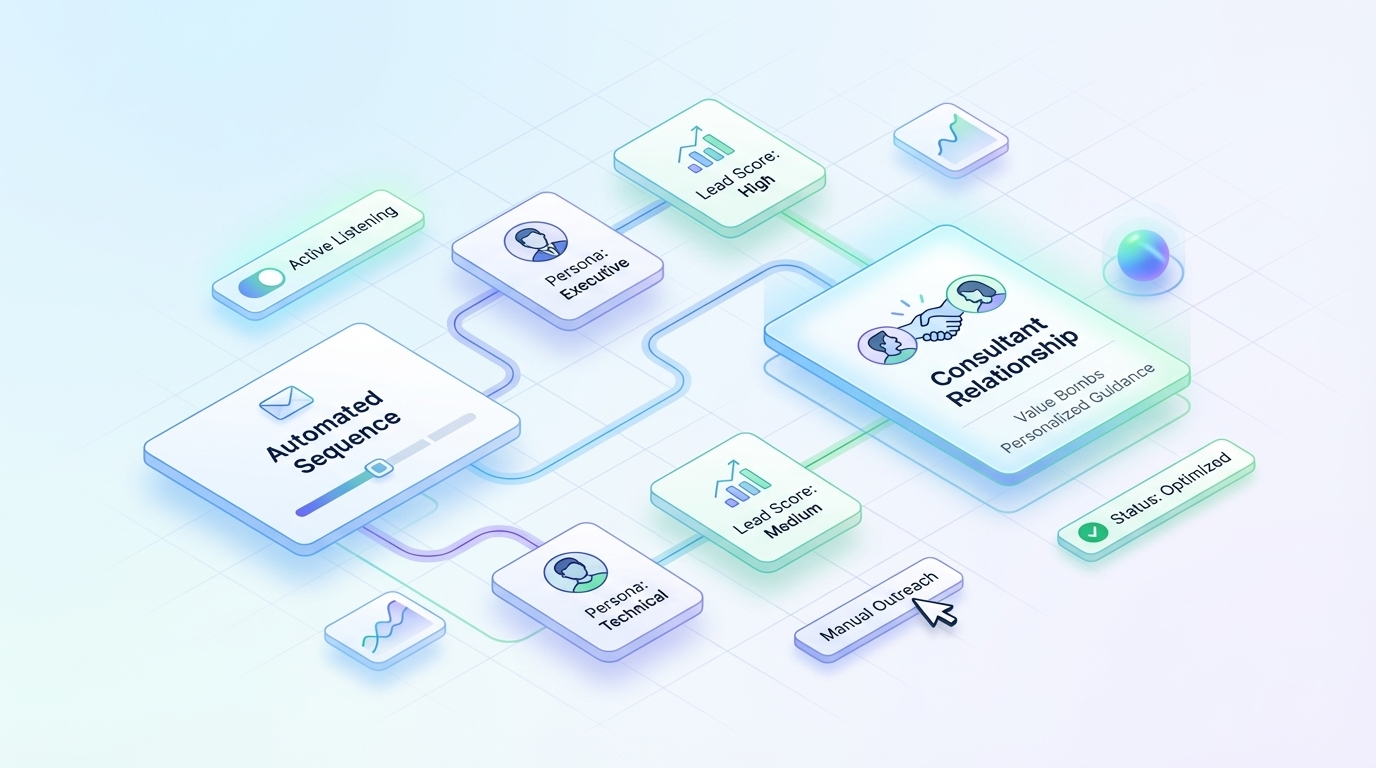
The Shift From Mass Marketing to Automated Individualism
Automated individualism represents a significant departure from standard lead nurturing because it prioritizes the recipient's personal experience over the brand's broad messaging. Instead of sending the same content to thousands of people, this strategy uses data to create a unique path for every subscriber. High-trust brands use automated consulting to provide expert-level guidance at scale.
Why Generic Newsletters Fail the Professional Standard
Most highly produced newsletters create an immediate psychological barrier between the brand and the lead. When a recipient opens an email filled with banners and complex layouts, their commercial filter kicks in instantly. They recognize the content as a marketing asset rather than a personal communication from a peer. This visual noise signals that the brand is shouting at a crowd instead of talking to an individual.
Trust is often lost when automation feels too obvious or impersonal. In professional services and consulting, leads are looking for authentic expertise and direct guidance. They want to know that the person on the other side understands their industry and their specific pain points. A generic newsletter lacks the intimacy required to establish this level of professional rapport.
Bypassing the marketing filter requires a consultant-style approach that appears in the inbox as a peer-to-peer note. When an email appears to come from a colleague or trusted advisor, the recipient is far more likely to engage with the content. This shift in presentation allows the expert's message to reach the reader without the baggage of traditional advertising. It allows the information to land in a space reserved for meaningful professional dialogue.
Defining the Personal Consultant Framework
The relationship between a consultant and a client is built on authority, empathy, and proactive problem-solving. In an email format, these traits translate into content that addresses the reader's needs before ever asking for a transaction. The goal isn't just to keep the brand's name in the inbox, but to provide actionable insights that help the lead solve a problem today.
There's a fundamental difference between selling and guiding within an automated sequence. Selling often feels like an interruption, with the brand's goals placed above the reader's interests. Guiding focuses on the narrative email marketing strategy by leading the recipient through a logical progression of ideas. This approach positions the sender as a partner who's invested in the lead's success.
Authority is established by showing, not just telling, what the expert knows. A consultant doesn't need to brag about their credentials if they're consistently providing high-level advice that works. By maintaining this posture, the brand builds a foundation of trust that makes future business conversations much easier. It's a strategy that values the long-term relationship over the immediate click-through rate.
Implementing B2B email automation for consultants means mapping out the client's internal journey before they ever talk to a human. You must identify the common roadblocks that prevent a lead from moving forward. Once those are identified, you can build a sequence that systematically removes those obstacles. This proactive guidance mimics the early stages of a high-ticket sales drip sequence.
The Psychology of Perceived Expertise in Email
Psychology serves as the backbone of any successful drip campaign aimed at building a deep connection. The objective is to trigger the same mental shortcuts that lead people to trust a human expert during an in-person meeting. By understanding how the human brain processes authority and familiarity, brands can design sequences that feel incredibly personal.
Establishing Authority Through Vulnerability and Insight
Sharing insider knowledge is one of the most effective ways to build rapport in a professional context. When an expert reveals the secrets of their trade or discusses past failures, they become more relatable to the reader. This transparency demonstrates that the sender is a real person who has faced and overcome actual challenges. It breaks down the wall of corporate perfection and creates a sense of shared experience.
The concept of a "Value Bomb" is central to this consultant-style approach. This involves sharing a piece of advice or a strategy so useful that it could easily be a paid product. When a lead receives this level of insight for free, it cements the sender's status as a top-tier expert. It proves that the sender has an abundance of knowledge and isn't afraid to share it to help others.
Finding the balance between professional distance and relatable transparency is a delicate task. While the content should be personal, it also needs to maintain a level of authority that commands respect. The expert should be seen as someone who's in the trenches but also has the high-level perspective needed to lead. This combination of vulnerability and insight makes the automated consulting experience feel genuine.
The Reciprocity Effect in Long-Form Sequences
The psychological principle of reciprocity suggests that when someone does something nice for us, we feel a natural urge to return the favor. In automated consulting, this principle is activated by providing consistent, high-level advice over several weeks or months. By the time the brand makes a formal ask, the lead has already received immense value. This creates a sense of professional gratitude that often leads to higher engagement rates.
This long-game strategy focuses on relationship building rather than short-term sales goals. Each email in the sequence should be viewed as a deposit into a trust bank that the brand can draw on eventually. If every message is helpful and insightful, the lead will look forward to hearing from the expert. They won't see the eventual pitch as an intrusion but as a natural extension of the help they've already received.
Patience is required to execute this strategy effectively because it requires delaying the gratification of a sale. However, the leads generated through this method are usually of much higher quality and are more prepared to buy. They've already been trained to see the brand as a source of solutions. This reduces the friction in the sales process and leads to more meaningful professional partnerships.
Technical Execution: Designing the "Non-Design" Email
Executing this strategy involves a technical paradox where advanced automation tools are used to create something that looks manual. The goal is to strip away the elements that scream "marketing automation" while preserving the efficiency of a scalable system. It's about using conditional logic triggers within the CRM to deliver a front-end experience that feels like a personal note from a Gmail account.
The Power of Plain-Text Formatting
Plain-text or minimal HTML formatting is the best aesthetic for a consultant-style campaign. Research indicates that plain-text emails consistently achieve higher open rates than their HTML-heavy counterparts. A highly targeted, well-written drip email campaign template can achieve up to 70 percent higher open rates and 30 percent higher click-through rates. These statistics highlight how a simple appearance can lead to much better engagement results.
Avoiding banners, buttons, and complex layouts ensures the email lands in the Primary tab of the recipient's inbox. When an email looks like it was typed in a standard mail client, it avoids the Promotions tab filter. This technical choice signals to the recipient that the message is a personal communication. It feels like the expert took five minutes out of their day to send a quick note specifically to them.
A plain-text format signals personal communication to both the reader and the inbox provider. Subtle cues in plain-text formatting can mimic a one-on-one interaction very effectively. For instance, including a simple signature with a title and a link feels more authentic than a large graphic footer. Simpler HTML emails perform better than HTML-rich ones because they don't look like advertisements.
Avoiding the Promotions Tab via SPF and DKIM
Ensuring that your consultant-style emails actually reach the primary inbox requires a solid technical foundation. You must configure your Sender Policy Framework (SPF) and DomainKeys Identified Mail (DKIM) records correctly to verify your identity. These server-side settings tell the recipient's email provider that your automation platform has permission to send on behalf of your domain. Without these, even the best-written content might be flagged as spam or untrustworthy.
Maintaining a high sender reputation is essential for bypassing the automated filters of major providers like Gmail and Outlook. You should regularly monitor your bounce rates and ensure that you're only sending content to engaged leads. High-velocity content sprints can help jump-start domain authority, which in turn positively impacts your email deliverability over time. Technical health is the prerequisite for building an intimate connection through automation.
Mastering the Tone and Voice of a Human Expert
The linguistic choices in a drip campaign are just as important as the visual design. Using "I" and "you" frequently creates a conversational bridge between the expert and the reader. It's important to avoid corporate jargon that makes the sender sound like a faceless organization. Narrative email marketing transforms a standard sequence into a cohesive professional story that stays consistent across every touchpoint.
The stats show that personalized emails lead to nearly 50 percent higher open rates and roughly 22 percent higher reply rates when the tone is right. Writing in staccato sentences and using white space can mimic the rhythm of a real person's typing style. Real people don't usually write long, dense blocks of text in a casual email; they use short paragraphs and clear breaks. This formatting makes the content easier to read on mobile devices and feels more spontaneous.
The difference between consultant-speak and marketing-speak is often found in the directness of the language. Marketing-speak uses superlative adjectives and hype to grab attention, which often backfires in high-trust industries. Consultant-speak uses clear, authoritative language to describe problems and offer strategic solutions. This tone conveys confidence and knowledge without resorting to aggressive sales tactics.
Narrative Email Marketing: Crafting the Arc
A successful drip campaign shouldn't be a collection of random tips, but a narrative arc that moves the lead forward. This sequence should tell a story that mirrors the journey a client takes when they first hire a professional consultant. It starts with an introduction to a problem, moves through various layers of discovery, and ends with a clear path to a solution.
The Hook: Initiating the Conversation
The first email in the sequence must break the fourth wall of automation by acknowledging the lead's current situation. It shouldn't feel like a standard welcome message that confirms a subscription. Instead, it should immediately address a specific problem the lead is likely facing and offer a quick win. This sets the stage for the value-driven relationship that's about to follow.
Setting clear expectations is essential during this initial interaction. The expert should explain what the recipient will receive in the coming days and why it's worth their time to keep reading. This isn't about promising the world, but about establishing a cadence of useful information. By telling the lead what's coming, the expert creates a sense of anticipation and professional commitment.
The art of the Welcome email that doesn't feel like a welcome email lies in its directness. It should feel like a follow-up to a recent conversation or an answer to a question the lead recently had. By focusing on the recipient's needs from minute one, the brand distinguishes itself from the noise. This approach establishes the consultant's role as a proactive problem solver from the very beginning.
The Bridge: Connecting Problems to Strategic Solutions
During the middle phase of the campaign, the narrative should deepen to address more complex challenges. This is where case-study storytelling becomes a powerful tool for demonstrating the expert's methodology in action. Instead of listing features or services, the email describes how a similar problem was solved for another client. This allows the lead to visualize themselves achieving similar results through the expert's guidance.
Maintaining engagement during the messy middle of a long-term drip sequence requires constant variety in the content. The expert can share different perspectives, answer common industry questions, or debunk popular myths. Each message should build on the last, creating a comprehensive picture of the expert's unique approach. This phase is about reinforcing the authority established at the beginning.
These emails mustn't feel repetitive or stale. If the lead feels like they're learning something new every time they open an email, they'll stay subscribed. This constant delivery of value keeps the relationship warm even if the lead isn't ready to buy just yet. You can also use content marketing services to ensure your narrative remains fresh and relevant to evolving market trends.
The Transition: From Advice to Engagement
Moving from providing pure information to proposing a formal partnership requires a soft-ask technique. This means the call to action should feel like a natural next step in the ongoing conversation. For example, the expert might say, "If you're struggling with this specific issue, I'd be happy to jump on a quick call to help you map it out." This feels much more personal than a button labeled "Buy Now".
The timing of this transition should be based on the lead's previous engagement with the sequence. If someone has opened every email and clicked on several links, they're likely ready for a more direct conversation. Automation tools can track these behaviors and trigger the ask email at the perfect moment. This ensures the offer is relevant to the person's current level of interest.
A successful transition acknowledges the progress the lead has already made through the automated advice. The expert can refer to the topics covered in previous emails and explain how a one-on-one consultation would go into greater depth. This maintains the consultant-client rapport even as the relationship moves into a more commercial phase. It's about offering more help, not just asking for a sale.
Behavioral Segmentation: Mimicking Active Listening
Behavioral segmentation is the digital equivalent of listening to a client during a real-world consultation. In a face-to-face meeting, a consultant adjusts their advice based on the client's responses and questions. Sophisticated behavioral segmentation enables a brand to deliver content that mirrors real-time conversations and optimizes lead relevance.
Using Intent-Based Triggers to Alter the Narrative
Click-based or view-based triggers allow the sequence to branch off into different sub-sequences. If a lead clicks on a link about scaling operations, the automation can move them into a track focused specifically on that topic. This mimics a consultant saying, "Since you mentioned your interest in scaling, let's dive deeper into that strategy." It shows the recipient that the brand is paying attention to their preferences.
Personalized emails were six times more likely to drive conversions and delivered a sixfold increase in transaction rate. These statistics prove that responding to user intent is incredibly effective at moving leads toward a purchase. When the content matches the reader's immediate needs, the perceived value of the relationship skyrockets. The lead starts to see the automation as a responsive tool rather than a static sequence.
Implementing these triggers requires a well-planned logic map that accounts for various user actions. The brand needs to decide which behaviors signal a change in interest or a move to a new stage of the funnel. For instance, a lead who views a pricing page might receive a more direct check-in email. This level of responsiveness is what makes automated consulting feel like a true one-on-one relationship.
This strategy significantly increases the one-on-one feeling because the content is no longer generic. Every link clicked and every page visited provides more data that the automation uses to refine the message. It's a continuous feedback loop that ensures the lead is always receiving the most pertinent advice. This high level of relevance is what keeps people engaged with long-term sequences.
A Logic Map for Behavioral Automation
To truly mimic a consultant, your automation must account for diverging interests in real time. Imagine a lead signs up for your general strategy newsletter and receives an email with two distinct resources. One resource is a guide on Return on Investment (ROI), while the other is an Implementation Checklist. If the lead clicks the ROI guide, your CRM should tag them as a Business Value persona and move them to a sequence focused on financial outcomes.
Conversely, if they click the Implementation Checklist, the automation should tag them as a Technical Operations persona. The next three emails for this lead should focus on technical hurdles, team onboarding, and operational efficiency. This ensures the content is always meeting the lead where they are. You are no longer guessing what they want; you are responding to their demonstrated behavior.
Personalized Email Sequencing for Different Lead Stages
Tailoring the cadence and content based on the lead's stage in their journey is a fundamental part of automated consulting. A cold awareness lead needs a different narrative than a warm consideration lead who has been following the brand for months. Effective personalized email sequencing depends on data-driven triggers rather than simple name tags. Awareness leads might get broader industry insights, while consideration leads get deep-dive tactical guides.
Personalized emails have an average open rate of 18.8 percent, while non-personalized emails have an average open rate of 13.7 percent. This gap shows that recipients can sense when a message has been tailored to their specific context. By using branching campaigns, a brand can maintain the illusion of a personal relationship with thousands of leads simultaneously. Each branch of the campaign represents a different conversation happening at a different pace.
The logic of branching campaigns also helps prevent lead fatigue. If someone isn't engaging with a certain topic, the automation can switch them to a different track or slow down the frequency. This flexibility mimics the empathy of a human consultant who knows when to push and when to give the client space. It's about respecting the lead's time while remaining available to provide help when it's needed most.
The Role of Lead Scoring in Automated Consulting
A sophisticated consultant knows exactly when a client is ready to sign a contract and when they need more education. In an automated system, this is managed through lead scoring based on CRM behavioral triggers for lead nurturing. You assign point values to specific actions, such as opening three consecutive emails or visiting your solutions page multiple times. Once a lead hits a specific threshold, they're no longer just a reader; they are a high-intent prospect.
This data allows you to determine the perfect moment to transition from automated advice to manual outreach. If a lead has a high engagement score but hasn't responded to a soft ask, they might need a direct, human peer-to-peer note. This ensures your sales team spends time only on the most qualified opportunities. Content marketing for SaaS thrives on this marriage of automation and human intuition.
Lead scoring also helps you identify leads who have gone cold. If a previously engaged lead stops opening emails, their score will drop, triggering a re-engagement sequence. This allows the system to work in the background to revive interest without your manual intervention. It keeps the consultant-client relationship active even during periods of silence.
Lead Nurturing Cadence: The Pacing of a Real Relationship
The timing of communications is just as important as the content itself when building a professional relationship. A consultant who shouts every day becomes a nuisance, but one who disappears for months is easily forgotten. Finding the right pace means being present enough to stay top of mind without overwhelming the recipient's inbox. Establishing a consistent lead nurturing cadence prevents the brand from appearing intrusive or desperate.
Finding the "Goldilocks" Frequency
The ideal spacing between emails often depends on the topic's complexity and the lead's stage in the journey. Many experts find success by front-loading value in the first week, sending two or three high-impact emails to build immediate rapport. After the initial period, the sequence can transition to a more relaxed expert-in-residence cadence. This might involve one insightful message every week or two.
A sample 30-day consultant sequence could start with three emails in the first seven days to establish the Value Bomb concept. The second and third weeks might each feature one in-depth case study to illustrate the expert's methodology. By the fourth week, the sequence could move to a soft ask or a direct check-in to gauge interest. This schedule provides a steady stream of value while allowing the lead time to process the information.
Consistency is more important than sheer volume when it comes to long-term relationship building. If the lead knows they can expect high-quality insights every Tuesday, they'll start looking for them. This predictability builds trust and reinforces the expert's reliability. It creates a habit of engagement, making the brand a permanent fixture in the lead's professional life.
The "Check-In" Email: Re-engaging the Silent Lead
The checking-in email is a specific tactic that mimics a consultant following up on a previous piece of advice. These messages are often short and don't include any links or graphics, making them appear entirely manual. They often have the highest response rates because they feel genuinely helpful and personal. The sender might ask if the lead had a chance to try a specific strategy or if they have any questions.
The "Short, Personal, and Pointed" (SPP) framework is the best way to write these re-engagement notes. They should be no more than three or four sentences long and focus on one single point or question. For example, "Hi [Name], I was thinking about our conversation on X and wondered if you'd made any progress on Y. Let me know if I can help." This doesn't feel like marketing; it feels like one person reaching out to another.
These emails are effective because they break the pattern of the longer, advice-heavy messages. They provide an easy way for the lead to re-engage without committing to a major project or purchase. When a lead replies to an SPP email, it creates a perfect opportunity to transition into a real one-on-one conversation. It's the ultimate tool for turning a passive reader into an active prospect.
Subject Line Psychology for Peer-to-Peer Communication
Your subject line is the gatekeeper of your entire consultant relationship. In a professional context, you want to avoid anything that looks like a headline from a magazine or an advertisement. The goal is to make the email appear to have been sent manually from your personal account to theirs. This psychological approach ensures your message isn't ignored among a sea of corporate updates.
Subject lines like "quick question" or "re: [Specific Problem Name]" are incredibly effective because they imply an ongoing conversation. They lack the capitalization and punctuation that usually signal a marketing broadcast. This simple adjustment can significantly increase your open rates by bypassing the mental filters of high-value prospects. You want to pique their curiosity without triggering their skepticism.
Avoid using numbers or over-the-top promises in your subject lines. Instead of "5 Tips for Growth," try something like "a few thoughts on your growth strategy." The second option feels more like a peer sharing an observation than a marketer delivering a list. This subtle shift in tone sets the stage for the intimate, expert-level content inside the email.
Measuring Success Beyond the Open Rate
When the goal of a drip campaign is to build a relationship, traditional metrics like open rates don't tell the whole story. While it's good to know people are seeing the emails, visibility doesn't always equal trust or authority. Success should be measured by how well the sequence prepares a lead for a professional partnership. You can use strategic CTA placement to better understand which points in the sequence drive the most engagement.
The Metric of Meaningful Replies
The Reply Rate is the North Star metric for any consultant-style drip campaign. A reply indicates that the reader was so moved or intrigued by the content that they took the time to write back. This is the highest form of engagement because it breaks the one-way nature of traditional marketing. According to some research, personalized emails achieve about a 29 percent open rate and a 41 percent click-through rate, highlighting the potential for deeper interaction.
Handling these replies correctly is what keeps the 1:1 illusion alive for the recipient. If someone writes back, a real human should respond to them to continue the conversation. This transition from automated consulting to actual consulting is where the real value is created. It proves to the lead that there's a real person behind the insights they've been receiving.
Tracking these interactions over time allows a brand to see which topics are generating the most interest. If a specific Value Bomb email gets a high number of replies, it signals that the topic is a major pain point for the audience. This data can then be used to refine the entire sequence and create even more relevant content. The reply rate is a qualitative measure of the brand's authority and resonance.
Tracking Conversion Through Qualitative Engagement
Measuring the warmth of a lead involves examining how much of the narrative they've consumed before they convert. A lead who has read ten emails over two months is likely much more sold on the expert's authority than someone who just signed up. Drip campaigns can generate 50 percent more sales-ready leads at a 33 percent lower cost than other methods. This shows the long-term financial benefits of relationship-driven automation.
The concept of assisted conversions is important for understanding the ROI of long-form content. A lead might not click a link in the drip campaign to make a purchase, but they might call the sales team as a result. The trust built through the sequence makes the final closing process much smoother and faster. The drip campaign does the heavy lifting of education and authority building before the sales conversation even begins.
A strategic view of ROI considers the lifetime value of the clients acquired through this method. Relationships built on trust and expertise tend to be more stable and profitable over the long term. While it might take longer to get the first sale, the quality of the client is often much higher. This makes the effort of structuring a narrative, consultant-style sequence well worth the investment for any high-trust brand.
Common Pitfalls: When Automation Breaks the Illusion
There are several ways that marketers can accidentally reveal the man behind the curtain and destroy the carefully built rapport. When the recipient realizes they're just another record in a database, the trust evaporates instantly. Avoiding these common mistakes is essential for maintaining the professional authority required for a successful consultant relationship.
Avoiding the "Template" Trap
Using recognizable marketing templates is one of the fastest ways to trigger a lead's commercial filter. If an email has a View in Browser link or an obvious unsubscribe block at the top, it's immediately identified as a blast. These elements signal that the message is part of a mass campaign rather than a personal note. Consultant-style emails should be as clean and simple as possible to avoid this trap.
Failed dynamic fields, such as "Hello [FIRSTNAME]," are a catastrophic error in this strategy. There's nothing that screams automation louder than a broken tag that shows the recipient exactly how they're being tracked. Auditing every sequence for these technical glitches is a mandatory part of the process. It's better to use a generic greeting like "Hi there" than to risk a failed personalization tag.
Bot-like behavior also includes sending emails at the same time every week or using overly formal language. Real people don't usually send their emails at exactly 9:00 AM on the dot every Tuesday. Varying send times and keeping the tone conversational help maintain a human feel. Every email should pass a simple test: "Does this look like something I would actually send to a client manually?"
The Danger of Over-Automation and Rigidity
A sequence that's too rigid can feel robotic if a lead's circumstances change during the campaign. For example, if someone has already booked a call, they shouldn't receive an email the next day asking them to book a call. These overlaps create a jarring experience that reminds the lead they're in an automated loop. Flexibility is required to ensure the automation stays in sync with human reality.
Ensuring that exit triggers are in place is a critical part of the technical setup. Once a person takes a desired action, like buying a product or scheduling a demo, the nurture sequence must stop or change. They should be moved to a customer or active prospect sequence that reflects their new status. This prevents the awkwardness of receiving salesy advice after they've already committed to the building of a content moat with your team.
Over-automation can also lead to a lack of human oversight, causing the brand to lose track of what's being sent. It's important to periodically review the entire narrative arc to ensure the advice is still relevant and accurate. The world moves fast, and an automated sequence that worked last year might be outdated today. Maintaining the consultant illusion requires a constant commitment to quality and relevance.
Scale Your Authority with Brand Voice Content
The success of a modern drip campaign depends on its ability to mimic human expertise, and it requires genuine empathy. True automation isn't about replacing the human element, but about scaling it so that every lead feels the impact of your authority. By moving away from generic marketing and toward automated consulting, you build a bridge of trust that leads to long-term professional relationships. The goal of every email should be to provide enough value for the recipient to see you as an indispensable advisor.
Achieving this level of sophisticated, narrative-driven content requires a deep understanding of your audience and a commitment to high-quality writing. By partnering with Brand Voice, you can deploy automated consulting sequences that turn cold leads into long-term clients. Our expertise allows you to scale your authority without losing the personal touch that high-value leads demand. We specialize in the exact type of high-level expert content that sounds like a human professional wrote it.
We can help you design and execute sequences that drive real engagement and meaningful results for your business. Transitioning from traditional newsletters to automated consulting is the most effective way to improve your lead nurturing results. Schedule a demo today to learn how we can help you build high-trust relationships with your audience through ready-to-publish, expert-led content.
