
- Standard how-to headlines are losing effectiveness due to information saturation and headline fatigue, requiring a shift toward benefit-driven copywriting that promises a specific transformation.
- High-converting headlines follow a transformation formula that combines an action verb, a specific result, and a timeframe or condition to provide the certainty modern readers demand before clicking.
- The Result-Metric-Constraint framework helps writers create tangible value propositions by defining a quantifiable goal within a realistic set of parameters to address reader objections.
- Shifting to outcome-focused titles can generate a measurable increase in click-through rates by appealing to the reader's psychological desire for a guaranteed result rather than general education.
The digital landscape is currently saturated with over 4.6 billion pieces of content produced daily. Standard how-to headlines once served as the primary gateway to engagement, but their effectiveness has steadily declined as audiences become accustomed to generic instructional formats. Readers are no longer looking for broad education that requires significant time investments without a clear payoff. They're seeking a specific transformation that promises to move them from their current state to a desired outcome with minimal friction.
Modern consumers have shifted their expectations from simply receiving information to achieving a tangible result. While educational content still holds significant value, the way it's presented must evolve to meet the needs of a result-oriented audience. This shift requires writers to rethink their headline strategies and move away from traditional manuals toward benefit-driven copywriting. Refining your approach to title construction is a fundamental step toward building a more effective digital marketing presence.
Why Traditional 'How-To' Headlines Are Losing Their Edge
The evolution of digital content consumption has fundamentally changed how people interact with titles and meta descriptions in search results. In the early days of the web, a simple instructional guide was enough to capture interest, but today's users view these formats as a commodity. When every search result promises to teach the same basic steps, the perceived value of each article diminishes significantly.
The Problem with Information Saturation
The internet is currently flooded with basic educational content that often repeats the same fundamental concepts across various platforms. This massive volume of similar information leads to a phenomenon known as headline fatigue among target audiences. When a reader sees a list of search results all starting with the same generic phrasing, they're likely to experience a sense of boredom. The content's unique value proposition becomes buried under a structure that feels repetitive and uninspired.
Readers have developed a subconscious tendency to filter out content that feels like a standard manual or a list of basic steps. They're searching for a solution to a specific pain point rather than a general overview of a topic. If a headline doesn't immediately signal that it contains the exact answer they need, they'll likely skip it. This filtering process happens in milliseconds, making it difficult for standard educational titles to compete for attention.
Generic headlines fail to differentiate the depth or quality of the underlying article from its competitors. A reader cannot tell if a guide is a surface-level summary or a deep dive into expert strategies if the title remains vague. This lack of distinction creates a barrier to engagement, often resulting in high bounce rates or low initial click-through rates. Shifting the focus toward a result helps to break through this noise by offering something more substantial than mere information.
The Shift from Curiosity to Certainty
There's a significant psychological shift occurring in how audiences navigate the web, moving from curiosity-driven clicking to certainty-driven clicking. In the past, a clever or mysterious headline might have been enough to entice a user to see what's on the other side. Today, people value their time far too much to gamble it on content that might not deliver immediate value. They want a guaranteed result before they commit to spending several minutes reading a blog post or technical guide.
Data suggests that headlines focused on providing solutions generally outperform those that don't promise a specific fix. For example, solutions-oriented headlines garnered more clicks in 56 percent of the tests in a study involving 50 A/B tests on The Huffington Post website. While many factors influence click-through rates, the preference for certainty is a clear trend in modern user behavior. Readers are actively seeking the path of least resistance toward their goals.
There's a fundamental difference between a reader who wants to learn a complex process and one who wants to solve a pressing problem. The latter group is far more likely to convert into leads or customers because they're looking for an outcome. By targeting the desire for certainty, writers can attract users who are further along in their journey and ready to take action. This approach builds trust by demonstrating that the content creator understands the reader's ultimate objective.
Anatomy of a High-Converting Outcome Headline
Moving from the theory of psychological triggers to the practical application requires a clear understanding of headline construction. A high-converting title isn't created by accident; it's built using a specific structure that prioritizes results. The literal arrangement of words plays a significant role in how the reader perceives the promise. By following a proven formula, writers can consistently produce headlines that grab attention and drive action.
The Transformation Formula
A repeatable and highly effective formula for writing outcome headlines is [Action] + [Specific Result] + [Timeframe or Condition]. This structure ensures that all the necessary components of a successful headline are present and organized logically. The action verb starts the momentum, the specific result provides the value, and the timeframe adds urgency or feasibility. For example, skyrocket your sales in 60 days with this simple email template that follows this pattern perfectly.
The order of these elements matters significantly for reader retention and impact. Starting with an action verb immediately places the reader in a proactive mindset, making the result feel attainable. The specific result is placed in the center of the headline, where it's most likely to be noticed during a quick scan. Adding a timeframe or a condition at the end provides the final push needed to convince the reader to click.
Writers should use power words that emphasize the transformation, such as master, unlock, or eliminate. These words carry more emotional weight than generic verbs like learn or understand. They suggest a level of mastery or a significant change that's highly attractive to an ambitious audience. Choosing the right power words can make the difference between a headline that's ignored and one that's clicked.
Negative Framing for Risk Mitigation
While positive transformations are attractive, highlighting a potential failure that can be avoided can create a sense of urgency. Research indicates that the presence of negative-emotion words is positively associated with headline success. By framing the outcome as a means of escaping a negative state, the writer increases the perceived value of the information. This balance of clarity and emotional resonance is a key factor in driving higher engagement levels.
Negative framing works because it addresses the reader's fear of loss or failure. A headline like "Stop losing 20 percent of your leads to slow response times" speaks to a specific pain point. It promises a result, which is the retention of leads, by correcting a specific mistake. This approach often outperforms positive versions because the risk of loss is a more immediate motivator than the hope of gain.
Using Action Verbs to Drive Momentum
The choice of verbs in a headline is one of the most critical factors in determining its success. Because an outcome implies action, passive language must be avoided at all costs in headline construction. Active verbs create a sense of movement and agency, making the reader feel like the result is within their immediate grasp. They transform the reader from a passive consumer of information into an active participant in their own transformation.
Starting a headline with a strong, result-oriented verb immediately communicates the benefit of clicking. Verbs like double, slash, build, or create are much more effective than words that describe the content itself. They focus on the reader's potential actions rather than the writer's words. This shift in perspective is subtle but powerful in its influence on user behavior.
Writers should also avoid overused or weak verbs that have lost their impact through constant repetition. Instead of saying how to get more followers, a headline could say accelerate your audience growth. The second version feels more professional and promises a more significant level of success. Using precise and vigorous language helps to establish authority and build excitement for the content.
The Result-Metric-Constraint (RMC) Framework
The RMC framework provides writers with a structured method for injecting specificity into every headline they create. By breaking down the headline into the result, the Metric, and the Constraint, you ensure the promise is tangible. This framework moves beyond the vague "how-to" and into the realm of professional copywriting. It allows you to create titles that act as a definitive value proposition for the reader.
The first step is identifying the result, which is the broad outcome the reader wants. For example, the result might be better search engine rankings. The next step is adding a Metric to make the result quantifiable. Instead of just better rankings, the headline becomes "reaching the first page of Google." This provides a clear goal that the reader can visualize and measure after they've implemented your advice.
The final component is the Constraint, which typically involves a timeframe or a resource limit. Adding "in under 30 days" or "without a massive backlink budget" makes the promise feel grounded in reality. It addresses the reader's potential objections about the time or effort required to achieve the goal. A complete RMC headline might read, "Reach the first page of Google in 30 days without building a single new backlink."
The Psychological Bridge: Moving Readers from Features to Outcomes
Benefit-driven copywriting is the practice of translating technical features into human advantages. Human beings are naturally wired to respond more favorably to results and personal transformations than to abstract concepts or general instructions. Understanding internal drivers allows writers to craft headlines that resonate on an emotional and logical level. This psychological bridge is what turns a casual browser into a committed reader.
Headline writing can be directly connected to the higher levels of Maslow's Hierarchy of Needs, particularly the desires for esteem and self-actualization. Outcome-focused headlines work because they appeal to the reader's vision of their future self, who has already achieved a specific goal. When a title promises a transformation, it speaks to the person the reader wants to become. This connection creates a much stronger pull than a simple offer to teach a basic skill.
The concept of cognitive ease also plays a role in how headlines are processed. Outcome-focused headlines trigger cognitive ease by removing the ambiguity of what the reader will learn. Research shows that headline length is positively associated with success because longer titles provide more context. When a headline tells a reader exactly what they'll get, it reduces the mental load required to evaluate the content's relevance.
Writers like Claude Hopkins and Eugene Schwartz popularized these principles by focusing on the audience's underlying desires. They understood that the reader isn't just looking for words on a page; they're looking for the feeling of success. By highlighting the after-state, the headline bypasses the logical resistance to the effort of learning. It centers the conversation on the reward rather than the work involved in the process.
Outcome-Based Marketing Strategies for Modern Content
Outcome-based marketing is a key part of a broader strategy designed to move users efficiently through the sales funnel. This approach aligns content with the specific goals of the target audience. When headlines promise results, they attract higher-quality traffic that's already looking for solutions. This alignment makes it easier to guide a reader from an informational article to a lead-generation form or a product page.
The Jobs-to-be-Done Framework in Headline Construction
The Jobs-to-be-Done theory suggests that people don't buy products or read articles because of their inherent qualities. Instead, they hire them to do a specific job in their lives or businesses. For a content marketer, this means that a reader is hiring every article to solve a problem or achieve a goal. If the headline doesn't clearly state which job the article is about, the reader is unlikely to hire it.
To apply this framework, a writer must identify the specific task or progress the reader is trying to make. The headline should then be constructed to reflect that job directly, ensuring maximum relevance to the user's intent. For instance, if the reader's job is to get a promotion, a headline promising to master executive communication is very effective. It targets the underlying motivation rather than just the surface-level topic of public speaking.
By focusing on the job, the headline becomes a functional tool for the reader's success. It shifts the perspective from what the writer wants to say to what the reader needs to accomplish. This customer-centric approach is much more effective at building a loyal audience than a standard educational focus. It demonstrates that the brand is committed to helping the user reach their specific milestones.
Outcome-Focused Headlines for Complex B2B Services
For professional services, the desired outcome often involves risk reduction, compliance, or stakeholder buy-in. These readers have longer sales cycles and require a high level of technical authority. Headlines in this niche must promise outcomes that align with institutional goals rather than just individual preferences. For example, "Reduce your audit risk by 40 percent with this compliance automation framework" targets a specific professional outcome.
Outcome-focused headlines for professional services should focus on stability and efficiency. A consultant might use a title like "Scale your firm without increasing your overhead" to attract growth-minded leaders. This focus on the business result makes the content feel more like a strategic investment. It ensures the content is viewed as a solution to a corporate challenge rather than just another educational blog post.
Bridging the Curiosity Gap Without Using Clickbait
There's a fine line between a compelling, result-oriented headline and deceptive clickbait that leaves readers feeling frustrated. Ethical copywriting is built on the principle of making big promises and then delivering on them completely. Benefit-driven copywriting reduces the curiosity gap by providing enough information to be authoritative but leaving the "how" as the primary reason to click. A headline should entice the reader without resorting to misleading tactics or vague, sensationalized claims.
The curiosity gap is the space between what a reader currently knows and what they want to know. An effective headline uses this gap by providing enough information to be authoritative but leaving out just enough to require a click. A traditional how-to headline is often too transparent, telling the reader exactly what they'll learn and leaving little reason to explore further. An outcome-focused headline provides the what, which is the result, but keeps the how as the primary reason to read.
Writers should avoid being overly vague in an attempt to create a curiosity gap. If a headline says you won't believe what happens next, it's classic clickbait that provides no value or authority. Instead, a headline like " Reduce your cloud costs by 40 percent with these three infrastructure tweaks is far more effective. It tells the reader exactly what they'll gain while keeping the specific tweaks as the missing piece of the puzzle.
Value Proposition Testing and Headline CTR Optimization
Mastering the art of outcome-focused headlines also involves a technical side that relies on data and continuous optimization. Even the most experienced writers can't always predict which specific phrasing will resonate most with a particular audience. A/B testing and performance analysis are essential for refining a headline strategy and ensuring maximum click-through rates. By treating headline writing as a science, brands can achieve more consistent and predictable results.
A/B Testing Methodologies for Headlines
A/B testing is a critical process for determining which headline variations are most effective for a specific target audience. Testing involves creating two or more versions of a headline and showing them to different segments of the audience to see which one performs better. Brands can test different headline versions through social media ads, email subject lines, or specialized SEO plugins. This data-driven approach removes the guesswork from the creative process and provides clear evidence of what works.
When analyzing the results of a headline test, it's important to look beyond just the raw number of clicks. Metrics like time-on-page and scroll depth are essential for ensuring that the headline is attracting the right audience. A headline might get a lot of clicks but lead to very low engagement if it's attracting people who aren't truly interested in the topic. The goal is to find the headline that drives both high volume and high-quality engagement.
Analyzing User Intent Through Click Patterns
Understanding the difference between search intent and result intent is key to adjusting a headline strategy. Search intent refers to what the user is looking for, while result intent refers to what they hope to achieve once they find it. By analyzing user behavior data, writers can understand why certain headlines perform better than others in specific search contexts. This analysis allows for a more nuanced approach to headline construction that goes beyond basic keywords.
Writers should adjust their headline strategy based on where the reader is in their journey. A reader in the awareness stage might respond better to a headline that promises a broad but significant transformation. A reader in the decision stage might need a more specific and quantified result to convince them to click. Tailoring the outcome to the user's current mindset increases the headline's relevance and effectiveness.
Case Studies: Education vs. Result-Oriented Headlines
Real-world examples provide the strongest evidence of the effectiveness of shifting from educational to results-oriented headlines. Across various industries, brands that have made this pivot have seen significant improvements in their content performance and conversion rates. By examining these case studies, writers can see how to apply these principles to their own work and achieve similar success.
SaaS Industry Transformations
In the SaaS industry, leading with the benefit sells for you by telling your customers exactly why to use your product. Software companies often fall into the trap of writing headlines that describe their features or explain how to use their tools. However, the most successful SaaS headlines focus on the efficiency or the results that the software provides. This approach shows visitors exactly what they can achieve, which is much more motivating than a list of functions.
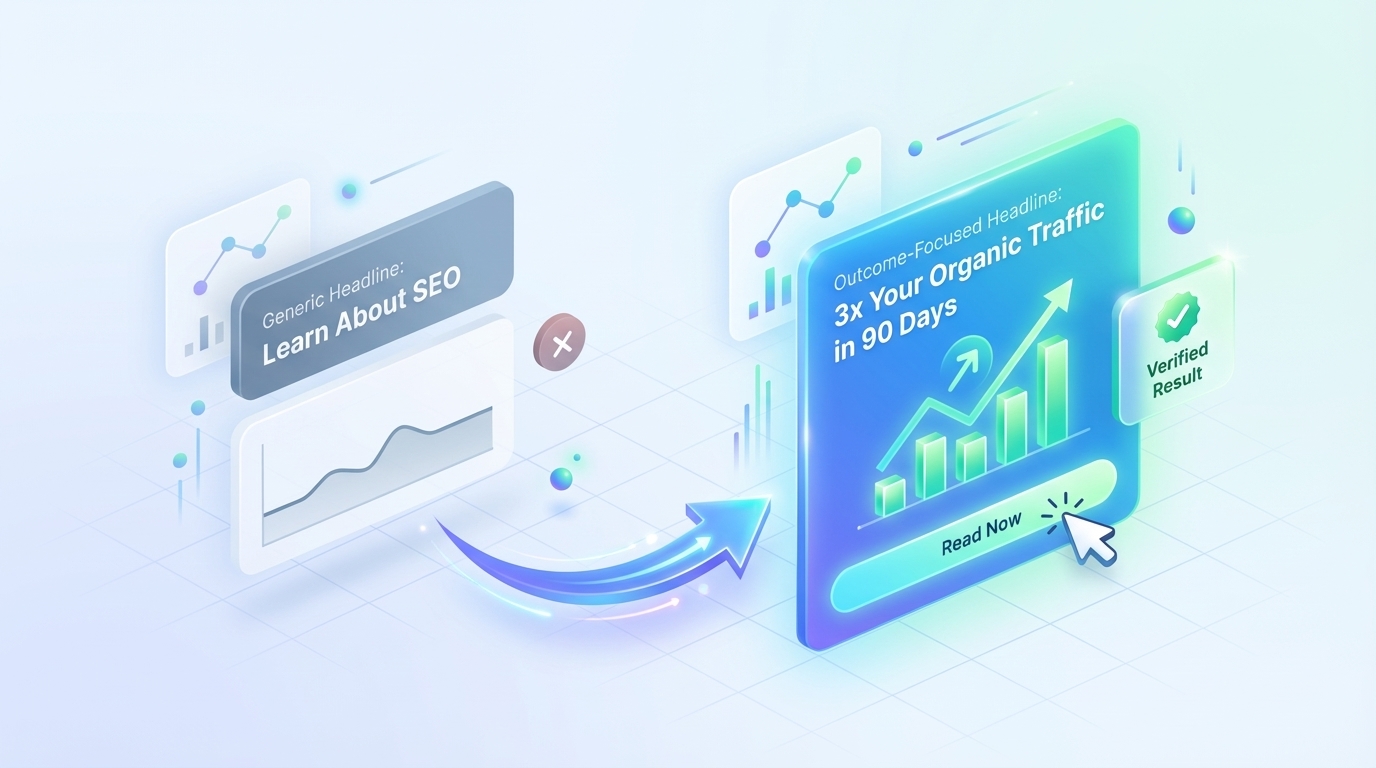
For example, a title like " How to Write SEO Articles " is a generic educational headline that many brands use. A more result-oriented alternative would be to generate 10 ready-to-publish SEO articles in 5 minutes. The second headline promises a specific volume and timeframe, directly addressing the reader's need for efficiency. It transforms the task of writing from a time-consuming chore into a streamlined and manageable process.
SaaS Headline Templates for High Conversion
High-converting SaaS templates often follow the "Unlock [Benefit] by [Action]" structure. For example, "Unlock 20 percent more revenue by automating your lead follow-up" is a powerful promise. This template works because it connects a high-value business metric to a specific software function. It allows the visitor to see the direct value of the offer before they even reach the landing page.
Another effective template is the "The Only Way to [Result] Without [Pain Point]" model. A headline like "The only way to track your expenses without manual data entry" speaks directly to a user's frustration. By positioning the software as the unique solution to a specific pain, the brand creates a strong competitive advantage. This template is particularly effective for SaaS companies in crowded markets where efficiency is the primary differentiator.
B2B Headline Formulas for Lead Generation
Effective B2B headline formulas for lead generation often incorporate the RMC framework to provide professional certainty. A common formula is "[Number] Strategies to [Result] for [Target Audience] in [Timeframe]." For example, "5 strategies to double your email open rates for mid-market SaaS companies in 30 days" is highly targeted. It defines exactly who the content is for and what measurable success looks like.
These formulas help create content that resonates with decision-makers. B2B buyers are looking for proven systems and repeatable processes rather than vague advice. Quantifying the promise with specific data points, such as "10 proven strategies to double your email open rates in 30 days," consistently outperforms generic alternatives. Specificity builds the authority needed to capture high-quality leads in the professional services sector.
Accelerate Your Revenue Growth with Outcome-Focused Headlines
Transitioning from general-education promises to outcome-focused ones is essential for any brand looking to capture attention in today's saturated digital market. The headline remains the most critical element of any content strategy because it dictates whether the rest of your work ever gets seen. By focusing on transformation and specific results, you can break through the noise of standard how-to guides and connect more deeply with your audience's core motivations. This approach not only increases click-through rates but also builds the authority and trust needed for long-term growth.
Achieving this level of sophisticated copywriting and SEO alignment across all your content requires significant time and specialized expertise. We understand the challenges of consistently producing high-performing, result-oriented articles while managing other core business functions. Our team specializes in creating ready-to-publish, SEO-optimized content that's designed to drive traffic and engage your audience instantly. Brand Voice uses these outcome-focused frameworks to deliver professional content that generates a measurable 15-20% increase in click-through rates.
Our expertise allows you to automate your content creation process while maintaining a strict focus on high-impact, outcome-driven results. We take the guesswork out of headline construction and content strategy so you can focus on scaling your business. Visit our website today to learn how our automated content creation platform can transform your marketing performance. If you are ready to see how these strategies can work for your brand, schedule a demo with us today to get started.
