
- High content velocity creates a compounding effect where older authoritative pages help newer content rank faster and attract natural citations.
- A robust internal linking strategy distributes link equity from established high-authority pages to fresh content, accelerating its visibility in search results.
- Increasing your content footprint expands the surface area for passive link acquisition, especially when targeting high link-intent keywords like original industry data and statistics.
- Developing comprehensive topic clusters signals deep expertise to search engines, allowing brands to build topical authority that transcends individual keyword rankings.
- Since domain rating is a lagging metric, businesses should monitor leading indicators such as organic impressions and share of voice to track the effectiveness of a high-velocity publishing strategy.
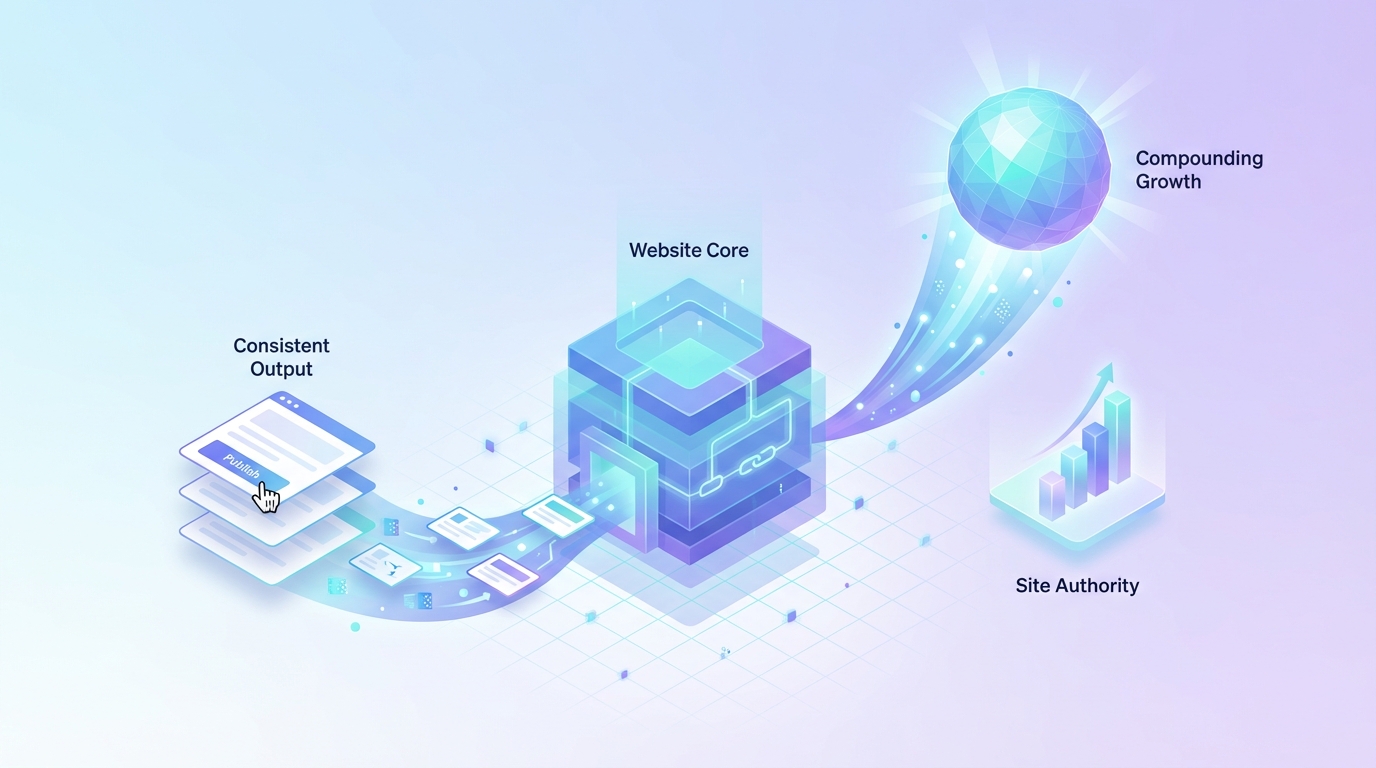
The compound effect in search engine optimization describes how small, consistent actions produce significant results over time. Unlike linear growth, where every effort yields a fixed and predictable return, compounding allows your previous successes to magnify the impact of your current work. This momentum eventually leads to a point where your organic growth becomes self-sustaining and increasingly efficient for your brand as your library of information expands.
This relationship between your publishing velocity and your overall domain authority creates a self-reinforcing cycle for long-term organic growth. A larger content footprint increases the surface area for passive link acquisition, which eventually drives higher domain rating growth through natural citations and social shares. Keep reading to learn more about how consistent output drives domain rating growth.
Understanding the Core Concept: Content Velocity and Compounding SEO
Success in search rankings depends on more than just high-quality writing or technical optimization. It relies on the interplay between the speed of your production and the way those pages build authority over time. This section breaks down the fundamental components of content velocity and explains the mathematics behind compounding growth in the search landscape.
Defining Content Velocity vs. Quality
Content velocity refers to how often you publish content on your website over a specific period. High velocity means you're consistently putting out valuable material, which Google favors because it shows your site is active and sharing knowledge with its audience. It's not just about the number of pages you create, but the frequency with which you provide new and relevant insights to your users.
Inconsistent or low-quality volume can dilute the authority of a new website by sending mixed signals to search engine algorithms. You must distinguish between simply publishing more pages and consistently publishing relevant, high-quality content that satisfies user intent. Consistent quality is the actual driver of long-term results because it establishes a reliable pattern of helpful information that users and search engines can trust.
Your team should focus on a professional seo content production schedule to maintain this balance. If you publish ten great articles one month and zero the next, you disrupt the momentum that search bots expect. Steady output signals to crawlers that your domain is a living resource that deserves frequent re-indexing.
The Mathematics of Compounding SEO
You can think of search engine optimization as a form of digital compound interest. Initially, a single piece of content might attract only a few links and rank for a small handful of keywords. This linear phase of growth is where most brands start their journey, and it often requires the most effort for the smallest visible return.
The first six months of a compounding strategy typically follow a specific growth trajectory. Month one focuses on technical foundation and indexing, while month two sees a rise in long-tail impressions. By month three, topical clusters begin to mature, and internal links start passing equity more effectively through the site structure.
Months four through six are where the exponential shift typically occurs for most established domains. During this phase, your older and more authoritative content helps your newer content rank much faster. Even a single piece of content can rank for hundreds of important keywords as it accrues more authority on Google, creating a self-reinforcing flywheel effect.
This mathematical advantage is why established sites can dominate search results even when they're entering new topic areas. The cumulative weight of your existing library starts to work in your favor, meaning your past efforts continue to generate value long after publication. It's a system where the input remains steady, but the output grows at an accelerating rate.
Site Structure Scaling and Internal Linking
A high publishing velocity requires a robust site structure scaling strategy to keep your library organized and accessible for both users and bots. Without a proper foundation, a high volume of content can become a liability that confuses search engines rather than helping them. This structural framework ensures that every new page contributes to the overall strength of your domain.
Internal Linking for Authority Distribution
A consistent stream of new content provides continuous opportunities for building a strong web of internal links between your pages. Internal links help Google find your most important pages and understand how your website is structured for the best user experience. This intentional linking process allows you to distribute link equity from your older, high-authority pages to your newer, less authoritative pages.
This distribution is important for accelerating the ranking of fresh content and ensuring that your new work doesn't sit in isolation for months. By passing authority down through your site's hierarchy, you give every new article a head start in the search results. This process is especially effective when using a strategic content-mapping approach to link related topics.
Well-organized internal linking also encourages users to stay on your site longer, which signals engagement to search engines. When you provide clear paths to related information, you can better satisfy the user's intent. This creates a better experience and reinforces the topical relevance of your entire domain in the eyes of the algorithm.
Crawl Budget and Indexation Efficiency
Maintaining a consistent publishing schedule trains search engine bots to crawl a site more frequently and deeply. When Googlebot discovers that your site regularly adds new, high-quality information, it prioritizes your domain in its crawl queue. This provides a technical reason why consistency matters beyond just the quality of the individual pages themselves.
Effective crawl budget management ensures that your most valuable pages are indexed and updated as quickly as possible. If your site structure is messy or your publishing is erratic, bots might waste time on low-value pages or stop crawling before reaching your new content. High-velocity publishing, supported by a clean site hierarchy, maximizes the efficiency of every search bot visit.
This technical efficiency is a prerequisite for rapid growth in a competitive niche. If your pages take weeks to get indexed, you lose the opportunity to gain early traction and passive backlinks. By training the bots to be consistent, you ensure that your latest insights are available to searchers almost immediately after you hit publish.
The Role of Search Intent in High-Velocity Publishing
Successful scaling involves more than just filling a calendar with titles and keywords. You must align your high-volume output with the different stages of the buyer journey to capture the most valuable traffic. Understanding why a user is searching for a specific term allows you to create assets that actually drive business results.
High-Intent vs. Informational Scaling
Scaling content enables you to target long-tail, high-intent keywords that are often overlooked in broad strategies. While informational articles build top-of-funnel awareness, high-intent pages focus on users who are ready to make a purchasing decision. This might include terms related to specific tool comparisons or service-based solutions for niche industries.
A balanced strategy targets high-intent keywords alongside broad educational topics to capture users at every touchpoint. This approach ensures that your content library isn't just a collection of facts, but a functional sales tool. High-velocity SEO content production enables coverage of these specific, lower-volume terms, which collectively drive significant conversion volume.
When you address specific pain points through targeted content, you build a level of trust that generalist sites cannot match. Users are more likely to engage with a brand that demonstrates a deep understanding of their specific technical challenges. This relationship between intent and volume is what separates a high-performing content engine from a simple blog.
Entity-Based SEO and the Knowledge Graph
Consistent output helps a brand become an entity in Google's Knowledge Graph, which is an important concept for sophisticated SEO strategies. Instead of just ranking for keywords, your brand begins to be associated with specific topics, people, and other recognized entities. This helps search engines understand the context of your site and its relationship to the broader web.
By publishing a high volume of related content, you provide the data points Google needs to accurately categorize your domain. This entity-based approach increases your site's likelihood of appearing in AI-driven search results and knowledge panels. It moves your strategy from simple matching to a deeper level of semantic understanding, making it harder for competitors to replicate.
As you establish your brand as a recognized entity, you gain a level of authority that transcends individual keyword rankings. Search engines start to view your domain as a primary source of information for your entire niche. This broad recognition is a key driver for long-term growth and stability in the search results.
The Engine of Growth: How a Larger Content Footprint Attracts Backlinks
The compounding effect is a mechanical process driven by the expansion of your linkable asset footprint. By increasing the number of pages you have indexed, you create more opportunities for other websites to discover and reference your work. This section explores how content volume directly facilitates the acquisition of passive backlinks.
The Linkable Asset Footprint and Surface Area
A larger content footprint dramatically increases the chance of being cited by others simply because of the sheer volume of keywords you rank for. This increased visibility naturally leads to organic backlink growth without the constant need for manual outreach or expensive PR campaigns. Link velocity refers to how quickly a website gains or loses backlinks over time, and a consistent pace reflects a healthy website.
A diverse range of topics captures a wider variety of long-tail keyword traffic across many different search intents. These varied pages offer multiple entry points for researchers, bloggers, and journalists seeking citation sources to support their own articles. By having more pages available to be found, you maximize the surface area of your domain and increase your odds of being linked to by high-authority peers.
This organic acquisition is the most sustainable way to grow your authority because it's based on the genuine value of your work. When other experts cite your pages, they're providing a signal of trust that search engines weigh heavily. Over time, these natural citations accumulate and move the needle on your domain rating far more effectively than artificial tactics.
Targeting High Link-Intent Keywords
Strategic growth involves creating specific types of content that are designed to act as passive link magnets. Passive link building is creating an asset around a high-link-intent keyword, building a flywheel that helps the post gain links and rank higher. When you target keywords that researchers and writers use to find data, you're positioning your brand as a source of truth.
Linkable assets are high-quality content pieces created to attract backlinks from other websites and can be presented in various formats. These assets include comprehensive guides, original industry data, original statistics, free online tools, and definitive ultimate lists. By providing these resources, you offer unique value that other creators are eager to share with their own audiences through a link.
This strategy creates a self-sustaining cycle where your post gains links, which improves its ranking, leading to more visibility and even more links. Some of these well-positioned posts can potentially gain hundreds or even thousands of links over several years. This massive accumulation of links is what eventually moves the needle on your overall domain rating and authority.
Original Data and Industry Statistics
One of the most powerful ways to attract high-quality backlinks is to publish original data and industry statistics. When you conduct surveys or analyze proprietary information, you create a unique resource that other writers must cite to use. Journalists and researchers are constantly looking for fresh data to support their claims, and your brand can become their primary source.
For example, a brand could use its own internal data to create a detailed annual report on market trends. This report becomes a primary source of citations for news outlets and industry blogs, naturally driving high-authority backlinks. This type of link acquisition is highly efficient because a single well-researched asset can continue to earn links for years after it's published.
Providing original insights also enhances your brand's reputation as a thought leader in your space. It shows that you're not just repeating what others say, but that you're actively contributing to your industry's knowledge. This level of expertise is a key component of the trust signals that search engines use to evaluate the quality of your domain.
Free Online Tools and Interactive Assets
Free online tools, such as calculators or templates, are another highly effective form of linkable asset. These tools provide immediate value to users and are often bookmarked and shared by professional communities. Because they solve a specific problem, they're frequently recommended in forum discussions and resource lists across the web.
Interactive assets like these tend to have a much longer lifespan than standard blog posts. As long as the tool remains functional and relevant, it will continue to attract traffic and links over the long term. This provides a steady baseline of authority that supports the rest of your content production efforts.
Developing these tools requires more initial effort than writing an article, but the long-term payoff is often significantly higher. They serve as permanent magnets for backlinks that are very difficult for competitors to displace. When combined with a high-velocity publishing schedule, these tools accelerate your domain rating's overall growth.
Developing an Editorial Standard at Scale
Moving from a handful of articles a month to dozens requires a sophisticated approach to quality control. You must maintain a consistent brand voice and factual accuracy even as you increase the volume of your output. This section discusses how to build an editorial engine that supports high-velocity publishing without sacrificing the integrity of your brand.
Maintaining Brand Voice Across High Volume
Maintaining a consistent tone and style is one of the biggest challenges when scaling a content team. Without a clear set of guidelines, your content can become disjointed and unprofessional as more writers contribute to the library. A strong editorial standard ensures that every piece of content feels like it came from the same trusted source.
Successful brands use detailed style guides and standardized briefs to keep their production on track. These documents should outline the brand's personality, preferred terminology, and structural requirements for different types of articles. By providing a clear framework, you allow your team to produce a high volume of work that remains cohesive and aligned with your business goals.
Scaling requires a consistent production workflow that includes multiple layers of review. This process ensures that every article is checked for brand alignment before it goes live on your site. When you maintain a high standard at scale, you build a reliable reputation that both users and search engines will trust.
Ensuring Factual Accuracy and Experience
Google's E-E-A-T framework emphasizes the importance of experience and expertise in content evaluation. When you publish at a high velocity, it becomes even more important to ensure that every fact and statistic is verified. Inaccurate information can quickly damage your brand's credibility and lead to a drop in search rankings.
Your editorial process should include a dedicated phase for fact-checking and expert review. Incorporating insights from subject matter experts adds a layer of depth that AI-generated or generalist content often lacks. This first-hand experience provides the credibility that search engines are looking for when determining which sites to rank at the top of the results.
Accuracy is not just about avoiding mistakes; it's about providing the most up-to-date and relevant information available. In fast-moving industries, facts can change quickly, and your content must reflect those shifts. By prioritizing accuracy, you show search engines that your domain is a reliable and authoritative resource for your audience.
Strategic Content Planning: Maximizing the Linkable Asset Footprint
Successful scaling requires moving beyond simple volume toward a strategy that builds deep topical authority. Your output should be organized to demonstrate your expertise rather than being scattered across unrelated topics across the web.
Building Topical Authority Through Volume
Consistent, deep-dive content on a specific topic creates topical authority and signals your expertise to search engines. Sites with strong topical authority tend to rank higher because they help Google deliver better results to searchers that fully answer their search query. Covering a topic comprehensively through a cluster strategy is much more powerful than publishing isolated articles.
A topic cluster is a group of pages focused on a particular topic with one pillar page that covers the main topic and links to cluster pages. This accumulated authority then transfers power to your individual pages, causing them to rank higher and attract more links more quickly. This strategy shows Google that you have extensive knowledge of the subject and deserve to rank as a top result.
This process is closely tied to semantic search, in which search engines look for clusters of related concepts rather than individual keywords. By covering every sub-topic within a cluster, you help Google understand the full context of your site. This makes it more likely that you will rank for broad, high-volume terms even if your site has a lower domain rating than established competitors.
The Long-Term Payout: Measuring and Sustaining Domain Rating Growth
Domain rating growth is a long-term metric that requires significant patience and a commitment to quality over many months. You shouldn't expect immediate results after a few weeks of publishing; instead, look for a gradual shift in your site's overall profile. This section discusses how to measure your success and sustain the momentum you've built.
Patience and the Lagging Metric of DR
Domain Rating is a lagging indicator of SEO success because it's a relative metric based on the quantity and quality of your backlinks. The compounding process often takes many months to yield significant results, with most sites seeing results after 6 to 12 months of consistent work. It can take about 23,000 referring domains to reach mid- to high-80s domain ratings.
While you wait for your DR to move, you should advise your team to track leading indicators of growth. Sites with a DA of 30 or higher typically see results two to four weeks faster than newer domains with lower authority. It's important to remember that DA and DR are merely proxies used by SEOs to measure progress, not direct ranking factors used by Google itself.
You should monitor the total volume of indexed pages, the total number of ranking keywords, and your current link velocity to gauge your progress. These metrics provide a more immediate view of how your high-velocity strategy is performing. If these numbers are trending upward, your domain rating will eventually follow as the authority of your content library continues to grow.
Measuring the Right KPIs
Beyond domain rating, readers should track more actionable KPIs, such as Share of Voice and organic impressions. Share of Voice measures how much of the total search market for your target keywords is occupied by your brand. This provides a clear picture of your competitive position in your niche and how it changes as you publish more content.
Organic impressions show how often your site appears in search results, even if users don't click through immediately. An increase in impressions is often the first sign that your content velocity is starting to pay off. It means Google is finding your content relevant for a wider range of queries and is testing your pages in different positions.
Tracking these metrics helps you justify the investment in a high-velocity strategy during the early stages when revenue impact might be low. You can see the profitability of your campaign by comparing the total value of the traffic you're generating to paid alternatives. This data-driven approach allows you to refine your strategy and focus on the topics that drive the most growth.
The Content Maintenance Multiplier
Maintaining your linkable asset footprint is just as important as growing it through new production. Updating and refreshing existing content helps recover lost traffic, improve rankings, and extend the lifespan of posts that already have established authority. Evergreen content should ideally be reviewed every 6 to 12 months to ensure that all facts and statistics remain accurate for readers.
You should also focus on identifying and fixing broken internal or external links to ensure your link equity is not wasted. When you update your content, you maximize its long-term link attraction power and prevent your older pages from becoming stagnant. This maintenance ensures that your high-performing assets continue to serve as the foundation for your site's authority.
Consistency is also about a commitment to content freshness over time, which sustains the compounding growth cycle. Google uses indicators such as experience, expertise, authoritativeness, and trustworthiness to evaluate a page's overall quality. By keeping your entire library up to date and accurate, you signal to search engines that you're a credible, reliable source of information in your niche.
Build Your Compounding Content Engine with Brand Voice
The compounding effect of consistent output is the most sustainable way to achieve long-term growth in your domain rating and topical authority. By continuously creating high-quality, link-earning assets, you build a digital foundation that grows more valuable every month. This strategy transforms your website from a simple collection of pages into a dominant authority that naturally attracts traffic and backlinks.
Achieving this level of consistent production often requires significant internal resources and a dedicated workflow. Brand Voice addresses the resource challenge of maintaining high content velocity while ensuring that every piece of writing meets the highest standards. We specialize in creating ready-to-publish, technically accurate articles that help brands scale their organic presence with confidence.
Schedule a demo today to see how we can deliver the high-quality content you need to grow your authority at scale.