
- Busy decision makers often follow an F-shaped reading pattern, making it essential to place the most valuable information and key entities in the top and left-hand portions of digital content.
- Adopting a top-down delivery model using the inverted pyramid ensures that critical ROI figures and strategic insights appear within the first 20% of the article to capture peak reader attention.
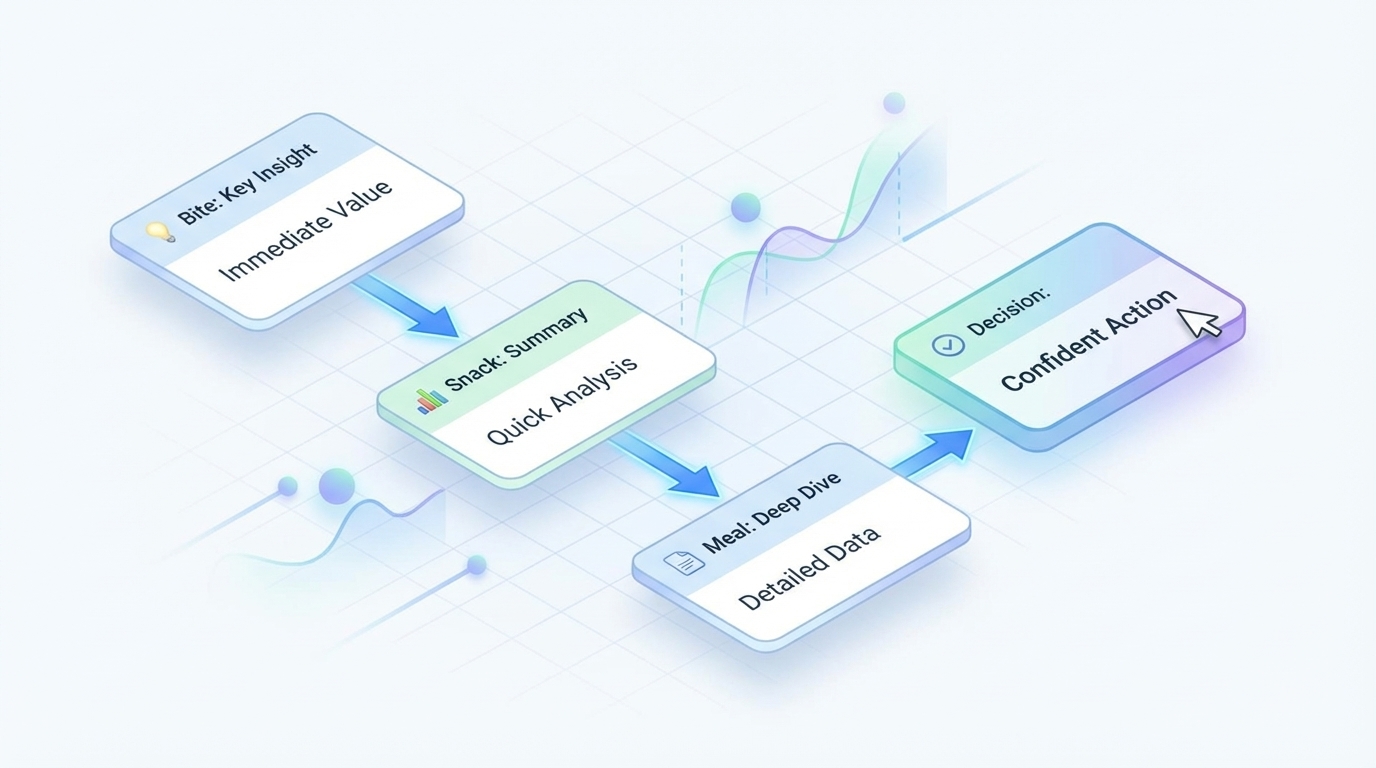
- The Bite-Snack-Meal framework provides multiple levels of depth, ranging from assertion-based subheadings to detailed data analysis, to satisfy varying degrees of executive interest and time availability.
- Using assertion-based subheadings instead of generic topic labels turns every section title into a mini-insight that facilitates immediate decision-making for high-level skimmers.
- Maximizing information density through visual scaffolding, such as bulleted lists and callout boxes, reduces cognitive load and helps leaders quickly extract actionable insights from long-form content.
Capturing the attention of a high-level leader requires more than just technical performance data and accurate charts. It demands a hierarchical content framework that acknowledges the intense time constraints of the modern boardroom. Decision makers often approach a document with a specific goal in mind rather than a desire for a narrative journey. They want to find specific answers without navigating through unnecessary introductory filler.
Successful communication in this environment relies on a writer's ability to provide immediate value while maintaining technical depth. By adopting a strategy that prioritizes scannability and information density, you can ensure your insights aren't lost in a sea of prose. Optimizing content structure for rapid consumption is the first step toward ensuring your high-level insights actually influence the boardroom.
Understanding the Skimmer Mentality of the Modern Executive
Modern leadership roles involve a constant tension between the need for deep strategic insights and the reality of a packed schedule. Executives are expected to stay informed on complex market shifts and technical innovations, yet they rarely have the luxury of uninterrupted reading time. This creates a paradox where long-form prose is both necessary for depth and difficult to consume in its traditional format.
The concept of continuous partial attention plays a significant role in how these professionals interact with digital content. Rather than focusing intently on a single document, many leaders are juggling multiple streams of information and high-stakes responsibilities simultaneously. This mental state leads to a reduced ability to retain information from dense blocks of text that lack clear signposts. It's often helpful to assume your reader is looking for a reason to stop reading and return to their primary tasks.
Research into web usage patterns highlights the severity of this challenge for content creators. On the average web page, users typically have time to read at most 28% of the words during a single visit. In many cases, a reader might consume only 20% of the content before moving on to another task. This reality dictates that scannable content for executives isn't just a preference; it's a requirement for effective communication.
The Cognitive Load of Decision Fatigue
Executives spend their workdays navigating a series of high-stakes choices that slowly deplete their mental energy. This decision fatigue makes it harder for them to process information presented in a dense or unstructured manner. When a document requires excessive effort to decode, the reader's brain may disengage to preserve cognitive resources.
Providing a clear path of least resistance through your content is a tangible form of professional respect. By organizing your thoughts logically and highlighting key takeaways, you reduce the cognitive load on the decision-maker. Strategic formatting reduces cognitive load by making the main points visible at a glance. This approach allows them to focus their energy on the implications of your insights rather than the act of uncovering them.
The Evolution of the F-Shaped Reading Pattern
Specific visual science and ingrained habits govern the way people interact with digital text. Studies show that many readers follow an F-shaped pattern, which involves two horizontal stripes followed by a vertical stripe. This behavior means that the top and left-hand portions of your content receive the most attention, while the middle and bottom sections are often glossed over.
Recent 2022 research continues to confirm that users often read website content in this specific pattern. These behaviors are even more pronounced for busy professionals who are scanning for specific data points or answers. Scanning text is an extremely common behavior for higher-literacy users, as they've developed the ability to filter out background noise quickly. If your most valuable information isn't positioned to catch the eye during this rapid scan, it won't be seen.
High-literacy users, such as executive decision-makers, have trained themselves to ignore decorative language and focus solely on nouns and verbs that signal utility. They'll often skip entire paragraphs if the first sentence doesn't immediately validate their search intent. This makes the placement of your key entities a technical requirement for engagement. You must design your pages to work with these habits rather than trying to change them.
The Top-Down Delivery Model: Prioritizing Insights
Establishing a clear information hierarchy is what separates professional executive communication from standard academic writing. For a decision maker, the strategic why and the actionable what now must always take center stage over the historical how or the methodological background. By flipping the traditional narrative structure, you provide the context leaders need to justify spending more time on the details.
This top-down delivery model ensures that the most valuable takeaways are delivered when the reader's attention is at its peak. You shouldn't save your best point for a conclusion that 80% of your audience will never see. Leading with the core message demonstrates that you respect the reader's schedule and understand their priorities. It creates confidence that the rest of the document will be equally valuable.
Implementing the Modern Inverted Pyramid
Adapting the journalistic inverted pyramid for B2B long-form content means leading with your strongest points. The most critical insights, including ROI figures and strategic takeaways, should appear within the first 20% of your article. This ensures that even the most hurried reader walks away with the core message you intend to deliver.
This structure serves as a filter, allowing the reader to decide how deeply to dive into the supporting evidence. If the initial insights are compelling and clearly articulated, the executive is more likely to commit to the rest of the piece. You're essentially selling the value of the full article within its opening sections. It turns a standard blog post into a high-impact content structure that instantly captures attention.
When you place the conclusion at the beginning, you eliminate the suspense that often frustrates busy readers. They aren't looking for a surprise ending or a slow build-up to a main point. They want to know the bottom line immediately so they can evaluate the relevance of the information to their current strategic goals. This approach also helps search engine crawlers identify the primary purpose of your content much faster.
Front-Loading Value in Every Paragraph
Effective sentence-level structure is a building block of high-retention content. You should aim to place the most important information at the very beginning of every sentence and paragraph. This technique ensures that a cursory glance down the left side of the page captures the essence of your argument. It aligns perfectly with the vertical stripe of the F-shaped reading pattern.
When paragraphs start with a clear assertion, the reader doesn't have to hunt for the point. They can quickly scan the lead sentences to get the gist of the section before deciding to read the supporting sentences. This method of front-loading value respects the reader's time and improves the overall flow of the document. It also prevents the reader's eye from wandering away from the text due to boredom.
Consider how many times you've read a paragraph only to realize the main point was hidden in the final sentence. For a busy decision maker, that paragraph is a failure of communication. Every sentence should contribute to a rapid understanding of the topic at hand. By moving the subject and predicate to the front, you make your prose more punchy and professional.
The Bite-Snack-Meal Approach to Content Design
The Bite-Snack-Meal framework is an effective way to structure insights for different levels of interest and time availability. It acknowledges that some readers have only 10 seconds, while others may have 10 minutes to dedicate to your analysis. By providing all three levels of depth in a single document, you satisfy the broadest possible audience without compromising quality.
This framework is especially useful for a strategic competitor gap analysis guide or other technical resources. It allows a reader to choose their own depth of engagement based on their current needs. It also makes the content more shareable, as people can easily pass along bite-sized or snack-sized portions to their colleagues. You're essentially creating a multi-layered experience within a single URL.
The Bite consists of the headline and the assertion-based subheadings that tell the story. The Snack is the executive summary and callout boxes that provide the TL;DR version of the facts. Finally, the Meal is the full analysis, the data tables, and the detailed logic that justifies your conclusions. This structure ensures that every visitor receives at least some value, regardless of how much they actually read.
Mastering the Executive Summary as a Standalone Asset
The executive summary is arguably the most significant component of any long-form document. A summary at the beginning of the article helps readers quickly determine whether it is relevant to their specific needs. It should be written as a standalone asset that provides all the necessary context for a leader to take action or participate in a high-level discussion.
Proper executive summary formatting ensures that the most critical ROI data is visible within the first three seconds of engagement. A well-crafted summary allows a decision maker to walk into a meeting and speak intelligently about the topic without having to read every page. It bridges the gap between raw data and strategic understanding by distilling complex concepts into their most basic elements. When you treat the summary with the same care as the main body text, you increase the likelihood that your work will make an impact.
Professional executive summary writing services often focus on the balance between brevity and technical accuracy. You don't want to oversimplify the message to the point that it loses its strategic weight. However, you must also avoid the jargon that often clutters academic summaries. The goal is to provide a clear, authoritative overview that demands further investigation.
The Anatomy of a High-Retention TL;DR
An effective Too Long; Didn't Read section must start with a clear and concise problem statement. This identifies the specific challenge or opportunity that the rest of the document addresses. By framing the problem early, you anchor the reader's attention to the relevance of the insights that follow. It's the hook that convinces them the information is worth their mental energy.
The second component of a successful summary is the primary recommendation. This shouldn't be a vague suggestion but a concrete action that the executive can evaluate. Clearly stating what you believe should be done provides a focal point for the reader's cognitive processing. It transforms the content from a simple information dump into a strategic tool for growth.
Finally, the summary must outline the expected outcome or impact of following the recommendation. Executives need to know the potential ROI or the strategic benefits of the path you've laid out. Connecting the action to a specific result completes the logical loop and provides a compelling reason to engage with the deeper analysis. This outcome should be grounded in the data provided in the document's fact-checked sections.
Balancing Brevity with Strategic Depth
Keeping an executive summary concise doesn't mean you have to strip away the nuance that experienced leaders require. You can maintain depth by using power verbs that convey complex ideas in a single word. This approach allows you to pack more meaning into fewer sentences while maintaining a professional and authoritative tone. It's about maximizing the impact of every syllable on the page.
Eliminating introductory fluff phrases like "it's important to note that" or "as we have seen in the past" is another key tactic. These phrases delay the delivery of your core message and add unnecessary length to the summary. By cutting the filler, you ensure that every word on the page works to deliver value and respects the reader's schedule. You're showing the reader that you've done the hard work of editing before they ever saw the draft.
Strategic brevity isn't about leaving things out; it's about putting things in more efficiently. You can use parenthetical data points to provide depth without breaking the flow of a sentence. For example, instead of a whole sentence about market growth, you can add (up 12.3%) after a noun. These small choices add up to a much more professional and readable document.
Restructuring for Impact: A Before and After Example
To understand the power of front-loading value, it's helpful to look at how a typical dense paragraph can be transformed. Most writers start with a long lead-in that provides context before finally making their main point. This forces the reader to spend five seconds searching for the actual insight you're trying to share. By the time they find it, they may have already lost interest in the topic.
The original version of a paragraph might read: In order to understand the complexities of modern marketing, we must first look at how budgets have shifted over the last three years, as Gartner reports that budgets as a percentage of revenue increased from 10.5% to 12.3% because brands need more differentiation. This sentence is technically correct, but puts the most important data at the end. It requires the reader to process 16 words before reaching the actual statistic.
The restructured version would say: Marketing budgets increased to 12.3% of revenue in 2023 to combat market saturation. This version places the subject and the main statistic in the first six words. It also removes the vague lead-in and provides the context afterward. This type of transformation is the hallmark of a summary that facilitates immediate decision-making.
How to Use Assertion-Based Subheadings for Better B2B SEO
Subheadings should never be treated as simple labels or afterthoughts in your writing process. They serve as informative signposts that guide the reader through the logic of your argument. A skimmer should be able to understand the entire progression of your article just by reading the headings in order. Assertion-based headings provide immediate value by turning every label into a mini-insight.
Topic-based headings like "Market Trends" provide very little information to a reader scanning the page. They force the executive to dive into the text to find out what those trends actually are. This creates a barrier to information retrieval, leading to frustration and disengagement. It makes the document feel more like a homework assignment than a strategic resource.
Assertion-based headings, such as Market Trends Indicate a 20% Shift Toward Automation, provide immediate value. Even if the reader never looks at the paragraph below, they have gained a specific and useful piece of information. This heading style transforms your table of contents into a summary that facilitates immediate decision-making. It also helps search engines categorize your brand entities accurately.
Using assertion-based headings also helps the writer maintain a tighter focus on the core message of each section. If you can't summarize a section into a single, proactive statement, it's a sign that your argument isn't yet fully formed. These headings serve as a quality-control mechanism for the logic and flow of your insights. They ensure that every H2 and H3 is pulling its weight in the overall narrative.
Maximizing Information Density Without Sacrificing Clarity
Information density is the gold standard for executive communication because it prioritizes the signal over the noise. It refers to the amount of useful, actionable information contained within a specific word count. High information density ensures that the reader's time is spent on insights rather than unnecessary filler or stylistic flourishes. It's the difference between a high-retention report and a generic blog post.
Achieving high density requires a disciplined approach to editing and a commitment to clarity. You must be willing to scrutinize every sentence to see if it's contributing something unique to the reader's understanding. If a sentence doesn't provide new data, offer a new perspective, or serve as a necessary transition, it should be removed. This maintains the piece's momentum and respects the reader's cognitive limits.
The Art of the Cut in B2B Writing
Auditing your content for wordiness is a practical skill that improves the impact of your writing. One of the first steps is the removal of redundant adjectives that don't add specific value to the noun they modify. For example, describing a strategy as very effective is less powerful than simply showing its results through data. You should always aim for technical specificity rather than marketing fluff.
The importance of the active voice cannot be overstated when writing for busy decision makers. Active voice makes your sentences more direct and easier to process, which helps maintain a high reading velocity. It also clarifies who is responsible for an action, which is vital for providing clear recommendations. For example, our team analyzed the data rather than having it analyzed by our team.
You should also learn to identify sections that provide interesting but not actionable information. While a piece of trivia might be engaging, it can distract the reader from the document's primary strategic goal. If an insight doesn't directly support the main recommendation or provide necessary context, it's often better left on the cutting room floor. This focus on utility is what builds long-term authority with your audience.
Using Data as a Shorthand for Authority
Integrating statistics and data points directly into the flow of your text is an excellent way to build credibility quickly. Specific numbers act as anchor points for skimmers, drawing their eye and providing immediate evidence for your assertions. A well-placed percentage or dollar figure can communicate more than an entire paragraph of descriptive adjectives. It provides the proof that leaders need to justify their choices.
Data acts as a shorthand for authority by showing that your insights are grounded in reality rather than just opinion. When an executive sees a specific figure, they can instantly grasp the scale of a problem or the potential of an opportunity. This allows them to perform mental calculations more quickly and move more quickly toward a decision. It also helps your content rank better for technical search queries that include data points.
When using data, ensure that you provide the proper context so the reader knows why the number matters. A statistic without a baseline or a goal is just noise. For instance, mentioning a 28% reading rate is only useful if you contrast it with the 100% reading rate that most writers assume they have. Context turns raw data into a compelling argument for change.
Leveraging Visual Scaffolding for Rapid Cognition
Visual scaffolding refers to non-textual elements that assist in communicating complex ideas. These elements work alongside the written word to provide a more comprehensive and accessible experience for the reader. By using a mix of text and visuals, you cater to different learning styles and make your content more resilient to skimming. Visual scaffolding includes three primary components: bulleted lists, callout boxes, and data visualizations.
These elements provide natural resting points for the eye and create a sense of progress as the reader moves down the page. They act as visual scaffolding that supports your argument's structure and makes the document feel more approachable. By keeping your sections short and well-labeled, you encourage the reader to continue their journey through the content. It's a way of breaking up the wall of text that often scares away busy readers.
The Power of the Bulleted List for Scanability
Bullet points are one of the most common and effective text-formatting techniques available on the web today. They support scanning, emphasize key points, and reveal clear relationships among different items or ideas. When used correctly, they allow a reader to absorb several related concepts much faster than if they were buried in a paragraph. They are the ultimate tool for the vertical stripe of the F-shaped reading pattern.
To maximize the effectiveness of a list, ensure that each bullet point starts with a consistent part of speech. For instance, if the first bullet starts with a verb, all subsequent bullets in that list should also start with a verb. This parallelism facilitates faster scanning by allowing the reader's brain to predict the structure of each upcoming point. It reduces the mental effort required to process the information.
Lists are particularly useful for comparative analysis or for standardizing detailed briefs to maintain technical accuracy across freelancers. They provide a visual break from standard paragraphs and give the reader a clear sense of organization. Just be careful not to over-rely on lists, as they should be used to highlight the most important groups of information. A document that's 90% bullet points can feel fragmented and lose its narrative authority.
Utilizing Pull-Quotes and Callout Boxes
A callout is a specific paragraph formatted to stand out from the rest of the body text to attract attention. These elements use visual weight to draw the reader's eye to the most significant golden nuggets of information. You can use them to emphasize key quotes from experts, highlight pro-tips, or provide essential warnings. They act as the snack portions of your Bite-Snack-Meal framework.
Callout boxes serve as an additional layer of information that exists outside the main narrative flow. This allows you to include important context without cluttering your primary argument. For a busy executive, these boxes often provide the most memorable and actionable parts of the entire document. They are the perfect place to put your high-intent call to action or a critical ROI figure.
When designing these boxes, ensure they have enough white space to stand out from the surrounding text. If they are too cluttered, they'll blend back into the sea of sameness. Use a subtle background color or a border to define the space and signal its importance to the reader. These visual cues are essential for guiding the reader's eye through a long-form document.
Writing for the Nth Degree of Scannability on Mobile Devices
Many busy decision makers consume long-form insights on their smartphones while traveling or between meetings. The constraints of a small screen necessitate an even greater focus on short paragraphs and frequent visual breaks. If your content isn't optimized for mobile reading, you risk losing your audience at the very moments they're most likely to be seeking information. You must design your documents with a mobile-first mindset from the very beginning.
Reading on a mobile device often happens in short bursts of attention, which makes scannability even more critical. You must ensure that your main points are visible without requiring the reader to scroll through multiple screens of background text. This includes optimizing how content campaign reports show profitability for vertical viewing. A mobile-friendly structure leads to a cleaner, more focused document that benefits all readers.
The One-Thumb Test and Interactive Navigation
The one-thumb test is a simple way to evaluate how easily a reader can navigate your content on a mobile device. It involves checking if the most important information and key links are easily accessible using just a thumb. This focus on white space and vertical scrolling ensures that the reader doesn't feel overwhelmed by the interface. It's a tangible form of user-centric design that respects the reader's physical constraints.
To further assist the mobile skimmer, you should consider implementing interactive navigation elements, such as a sticky table of contents. This allows the reader to jump between sections without having to scroll back to the top of the page. You can also include progress bars that give the reader a visual sense of how much of the document they've completed. These features provide a sense of control and reduce the anxiety of committing to a long read.
Interactive navigation is a technical nuance that appeals to both human readers and search engine crawlers. It signals that your site is modern, well-engineered, and optimized for user experience. When a decision maker finds your site easy to use on their phone, they're more likely to view your brand as a professional and reliable partner. It's a small investment that pays off in higher engagement and lower bounce rates.
Formatting for Low-Bandwidth Attention
Bolding and italics can be used to draw the eye to the most important phrases within a mobile-optimized paragraph. However, these tools must be used sparingly to remain effective for the reader. The highlighted text should make up no more than 30% of an article's total text to avoid visual clutter. When you bold everything, you essentially bold nothing, because the eye no longer has a focal point.
When you overuse bolding, it loses its ability to signal importance and starts to feel like visual noise. Instead, focus on highlighting the specific keywords or phrases that capture the essence of a paragraph's main point. This targeted use of formatting helps the reader's eye jump from one key insight to the next with minimal effort. It's especially useful for technical summaries where specific terms carry significant strategic weight.
Data from recent eye-tracking studies shows that users will often jump directly to bolded text before reading the start of a paragraph. If that bolded text provides a clear takeaway, you've successfully communicated your point even if they skip the rest of the sentence. This technique is a powerful way to ensure your most important entities are always seen. It turns your paragraphs into a series of punchy assertions that the reader can digest at their own pace.
Scaling Executive Insights with B2B SEO Content Writing Services
Producing this level of sophisticated, high-retention content requires a significant investment of time and expertise. Many marketing teams struggle to maintain a high publishing velocity while meeting the technical standards required for executive communication. This is where hiring an SEO agency for executive insights becomes a strategic necessity for growth. External partners can provide the fresh perspective and specialized skills needed to transform raw data into a hierarchical content framework.
Hiring B2B SEO content writing services allows your internal team to focus on high-level strategy and product innovation. You can provide the raw expertise through internal SME interviews, and the agency can handle the structural heavy lifting. This collaboration ensures that every piece of content you publish is optimized for both search engines and busy decision-makers. It's a scalable way to build a content moat that your competitors cannot easily replicate.
External partnerships also provide access to specialized tools and data that can improve the technical accuracy of your articles. Professional writers understand how to balance information density with narrative flow to keep the reader engaged. They can help you implement the Bite-Snack-Meal framework across your entire content library. This consistency reinforces your brand's authority and ensures that every touchpoint delivers undeniable strategic value.
Bridging the Gap: Moving from Skimming to Deep Engagement
While scannability is the priority, you must also reward the reader who decides to slow down and engage with the full text. A layered approach to content design provides a surface layer for skimmers and a deeper layer for those who need proof. By including detailed evidence and logic beneath your scannable headings, you satisfy both types of readers. It demonstrates that you've done the deep thinking necessary to justify your surface-level assertions.
This layered structure ensures that your assertions aren't just empty claims but are backed by rigorous analysis. It builds trust with the decision maker by showing that you've done the heavy lifting necessary to justify your recommendations. When a leader does choose to dive deep, they should find a cohesive and persuasive argument waiting for them. High-quality content establishes a clear relationship between the surface insight and the underlying data.
The Role of Internal SME Interviews for E-E-A-T
To improve your trust signals, you should regularly include insights from internal subject matter expert interviews. Scannable content for executives is most effective when it includes direct quotes or proprietary insights unavailable in generic AI-generated articles. These interviews provide the human element that search engines prioritize through their Experience and Expertise criteria. It proves that your brand is a primary source of knowledge rather than a simple aggregator.
Internal SME verification ensures that your technical claims are accurate and reflect the latest industry developments. It also provides you with unique entities and concepts that can help you rank for high-intent search queries. When an executive sees a quote from a recognized leader in your organization, their trust in your brand increases instantly. It transforms a standard article into a piece of thought leadership that carries weight in the industry.
Integrating these expert voices into your visual scaffolding is a great way to draw attention to them. You can use pull-quotes or dedicated sidebars to highlight the most significant insights from your SMEs. This ensures that even the skimmer walks away with the feeling that your brand is backed by real human expertise. Professional executive summary formatting should always include a reference to these expert sources to boost credibility from the very first paragraph.
Strategic Internal Linking for Further Exploration
Internal links allow you to provide rabbit-holes for interested readers without cluttering the current page with background info. If a reader already knows the basics of a topic, they can skip the link and continue with your main argument. This respects the reader's time by not forcing them to sit through information they've already mastered. It also helps search engines understand the topical authority of your entire website.
For readers who need more context, internal links provide a seamless way to access supporting documents and related insights. This creates a network of information that the executive can navigate at their own pace. It also keeps them within your brand's ecosystem, increasing the total value they receive from your content. You should always use descriptive anchor text that tells the reader exactly what they'll find on the next page.
Strategic internal linking is also a fundamental part of any SEO article strategy. It passes authority between pages and helps your most important resources rank higher in search results. When you link from a high-retention executive summary to a deep-dive analysis, you're signaling to search engines that both pages are highly relevant. It's a technical win-win for both the user experience and your organic visibility.
Secure Your Digital Future with a Defensible Content Strategy
Respecting a reader's time is one of the most effective ways to gain a competitive advantage in B2B marketing. Throughout this article, we have explored how the top-down delivery model and assertion-based headings can transform your long-form insights. By maximizing information density and leveraging visual scaffolding, you ensure that your message reaches the decision makers who matter most. These strategies build long-term resilience and ensure your brand remains a primary source of truth.
Achieving this level of sophisticated content structure requires a deep understanding of both your subject matter and your audience's habits. Our team at Brand Voice understands the challenges of producing high-impact, SEO-optimized content that meets the high standards of the modern executive. We help companies execute primary research and SME-led strategies to ensure their traffic is defensible and authoritative. Our expertise in executive communication enables your brand to deliver real results through articles that are actually read.
We specialize in crafting content that respects the reader's time while delivering undeniable strategic value. Our monthly content subscriptions provide you with a consistent supply of ready-to-publish articles that are tailored to your industry's needs. Schedule a demo with us today to discover how our ready-to-publish articles can help you build a content moat that larger competitors cannot easily replicate. You can contact us to start your journey toward more effective executive communication.
