
- A strategic content gap represents an opportunity to provide a superior user experience and comprehensive value that goes beyond simply matching high-competition keywords.
- Building topical authority through interconnected content clusters can drive 30 percent more organic traffic and maintain search rankings 2.5 times longer than standalone articles.
- Identifying outdated information in competitor content provides a significant ranking opportunity, as the average last update for page-one search results is 730 days.
- Improving qualitative factors like readability and digestible structure can increase user engagement by up to 40 percent compared to text-heavy competitor articles.
- Addressing specific, high-intent niche questions that competitors ignore allows brands to capture more visibility through the 86 percent of search queries that trigger question-based results.
Most search strategies rely heavily on finding words that competitors use, and you don't. This traditional approach often ignores the experience a person has when they click on a result. A strategic content gap represents an opportunity to provide a significantly superior user experience and value rather than just checking a box for a missed phrase.
Modern search engine optimization demands topical authority and comprehensive content that anticipates what a user needs next. You can't displace an established ranking by simply repeating what's already been said. Keep reading to learn more about identifying strategic gaps in competitor content beyond simple keywords.
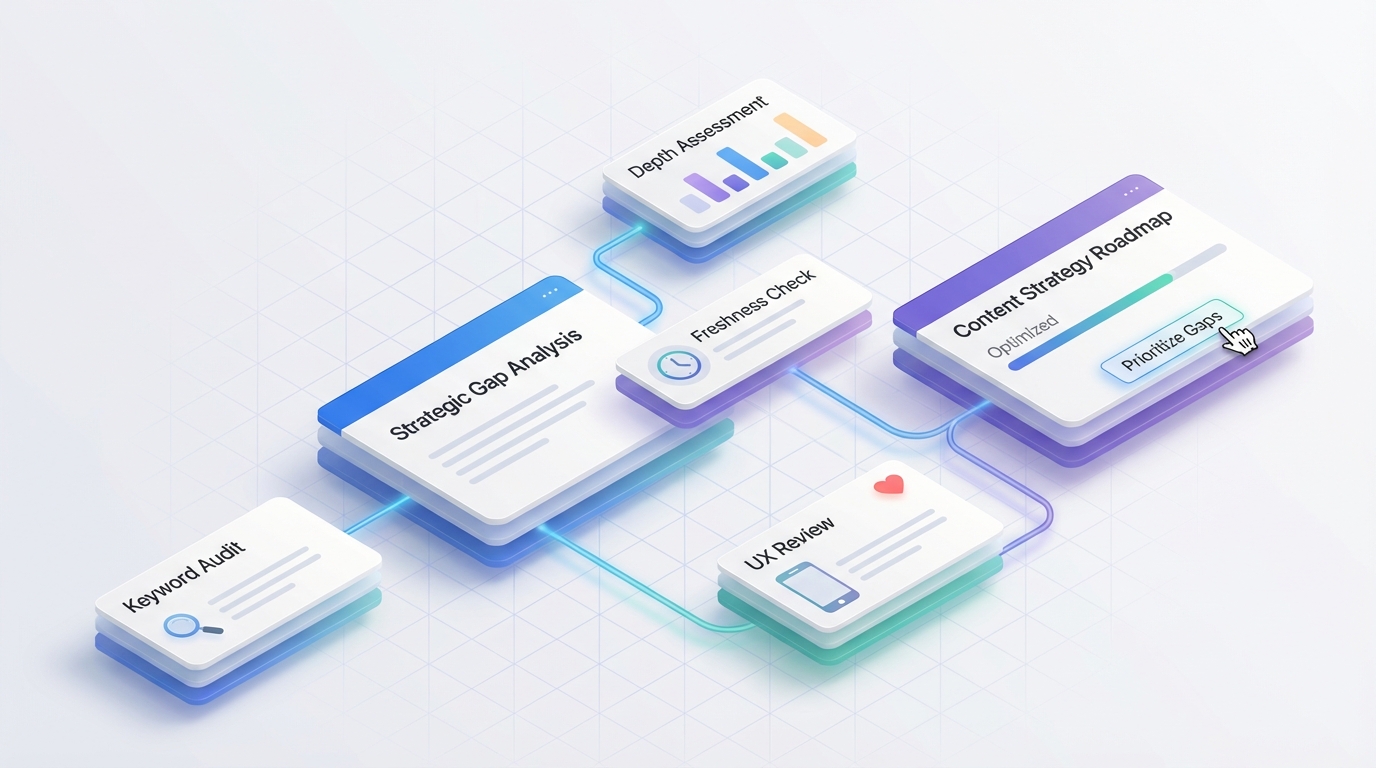
The Limitation of Keyword-Only Content Audits
Focusing solely on keywords during a content audit is no longer enough to secure top rankings in a competitive landscape. High-competition search terms are usually dominated by articles that have already satisfied the basic intent of the query. Simply including the same phrases won't give search engines a reason to rank your page higher than the existing leaders.
Modern search algorithms prioritize a holistic view of topic coverage, authority, and user satisfaction. Google's internal research indicates that user behavior signals and machine learning systems like RankBrain, RankEmbed, and DeepRank are fundamental to how pages are evaluated. If your content merely matches keywords but fails to engage the reader, it won't hold a high position for long.
A narrow focus on keywords often leads to user intent mismatches where a page ranks but fails to convert or satisfy the reader. Strategic gaps occur when an existing piece of content fails to meet the underlying needs of the person searching. Real results come from connecting with the specific need behind the search rather than just the words used to express it.
Algorithm updates over the past few years have shifted the focus toward content relevance and the visitor experience. In the current search environment, these factors are more critical than raw link numbers or keyword density. It's necessary to identify where competitors are leaving readers frustrated or curious to find a true opening in the market.
The Problem with Short-Tail Keyword Focus
Short-tail keywords often have ambiguous search intent because they're broad and general. Top-ranking articles on these terms often try to cover everything at once, leaving specific, high-value questions unanswered. A strategic gap analysis seeks out these hidden questions that the broad guides ignore or treat as afterthoughts.
For example, a competitor might have a high-ranking article on email marketing that covers the basics of software and sending. However, they might barely mention email list segmentation best practices or how to clean a list of inactive users. These specific sub-topics represent high-value opportunities to create a more useful and targeted piece of content.
Filling these gaps with detailed information can help you rank for more specific, high-intent queries, leading to better conversion rates. A high-ranking article on link building was identified as having gaps because it was outdated and lacked specific examples. When a new guide filled those gaps with modern details, it quickly moved into the top three search results.
This approach to high-velocity content sprints helps brands build authority faster than traditional methods. By addressing specific intent rather than broad terms, you build a foundation of trust with your audience. You're no longer just competing on volume but on the actual depth of the answers you provide.
Overlooking Content Quality and Practicality
Traditional keyword tools often overlook the qualitative aspects that determine whether a piece of content is actually helpful. A competitor's article might rank well for a specific term while being overly theoretical or difficult to read. This creates a major strategic gap because users prefer information they can apply immediately to their own problems.
Readability is a major factor in how users interact with a website and whether they choose to stay. Research shows that making content more digestible through shorter sentences can increase user engagement by as much as 40 percent. If a competitor provides a wall of text without a clear structure, you can win by presenting the same information in a more accessible way.
You should analyze the structure and practicality of top-ranking content to see if it's actually useful to the target audience. Content that is a tedious read or lacks actionable steps provides a perfect opportunity for a more practical alternative. Improving a topic's usability is often the fastest way to gain an advantage over established competitors.
The Pillars of Strategic Content Gap Assessment
An effective competitor content audit moves beyond technical data to assess content against critical pillars of superior user value. These pillars serve as the foundation for a complete topical depth assessment and provide a blueprint for creating content that search engines favor. By evaluating how well competitors meet these criteria, you can find specific areas where your brand can offer more value.
Topical Depth and Comprehensiveness (The "Why" Behind E-E-A-T)
Topical depth is a measure of how thoroughly a piece of content addresses an entire topic cluster rather than just a single keyword. A strategic gap exists when a competitor's article is an inch deep and a mile wide. These articles often fail to cover critical related terms and subtopics that readers need to understand the subject fully.
Modern AI search engines map your entire content ecosystem to understand the breadth and depth of your coverage. They look for interconnected information that shows you have a strong authority on the subject. Content grouped into clusters drives about 30 percent more organic traffic and holds rankings 2.5 times longer than standalone pieces, according to HireGrowth's 2025 analysis.
To exploit these gaps, look for missing data points, industry-specific examples, and detailed methodologies that others have skipped. You can use our article brief creator to ensure every subtopic is covered before you begin writing. Providing a comprehensive guide that links related subtopics creates a more satisfying experience for the visitor.
This approach helps search engines understand that your site is a primary source of information for that specific niche. High-quality depth signals Expertise, Experience, Authoritativeness, and Trustworthiness, which are the core components of the E-E-A-T framework. You aren't just writing for a keyword; you're building a knowledge base that serves the user throughout their entire journey.
Identifying Outdated Information and Examples
Content freshness is a significant strategic gap that often goes unnoticed by brands focusing only on new keywords. Many top-ranking articles were published years ago and haven't received a substantial update since their original release. These pages often contain references to old statistics, deprecated technologies, or defunct product names that are no longer relevant.
Google's algorithm emphasizes fresh, relevant content through systems like the Helpful Content System. If a competitor's guide is full of broken links or outdated advice, it's vulnerable to being displaced by a modern version. The average last-update date for page-one ranking content is 730 days, suggesting a refresh is needed every 2 years.
Auditing for freshness involves checking the publication dates and the relevance of the examples used in competitor articles. If the top results for a search term are several years old, you have a clear ranking opportunity. Creating a modern, relevant piece of content ensures users receive the most accurate information available.
You can win by providing the most current data and examples that reflect the current state of the industry. This is especially true for rapidly changing sectors like technology or finance, where yearly data is already old news. By staying updated, you signal to both users and algorithms that your content is the most reliable choice.
Mismatches in Format and Qualitative User Experience
A strategic gap can be purely structural or related to how the information is presented to the user. Many high-ranking pages are difficult to navigate or feature long paragraphs that are hard to scan on mobile devices. Research indicates that 86 percent of users prefer readable websites, with 73 percent acknowledging that design and readability heavily influence their decision to interact.
On the web, users are often looking for specific information and will fixate their attention on summaries and visuals. If a competitor's article is a wall of text without visual aids like charts or graphs, its usability is poor. You can gain an advantage by turning a text-heavy guide into a more interactive or visual experience.
Look for opportunities to use different content formats to make the information more digestible for the reader. This might involve adding video embeds, interactive checklists, or helpful tools that the competitor lacks. A well-formatted piece of content with clear headings and visual support will almost always outperform a poorly structured alternative.
Brand Voice and Tone Gaps
Beyond facts and keywords, competitors often fail to match the tone or level of empathy required for certain topics. Psychological and emotional gaps exist when the current ranking content feels cold, robotic, or disconnected from the reader's actual struggles. A more relatable or authoritative voice can win over an audience even if the factual information is similar to that of a competitor.
You should assess whether your competitors are writing for robots rather than real human beings. If their content is filled with jargon that confuses the reader, there's a strategic opening to adopt a clearer, more empathetic voice. This connection builds long-term loyalty that a dry, keyword-stuffed article can never achieve.
Matching the tone to the audience's emotional state is a powerful way to differentiate your brand. For sensitive topics, a compassionate tone provides comfort that technical guides lack. For professional topics, a senior-level authoritative voice provides the confidence a decision-maker needs to take the next step.
Ignoring Niche Questions and Tangential Audience Needs
Successful content anticipates the reader's next question, which is a strategic gap that many competitors fail to fill. These are the tangential topics or next logical steps a person would search for after finishing an article. For example, a guide about a software feature might miss a section on troubleshooting common errors or advanced use cases.
Addressing these niche questions builds trust and keeps the audience on your site longer. Data shows that 86 percent of queries that trigger People Also Ask boxes are question-based. This indicates that users are looking for specific answers to their problems rather than broad overviews of a topic.
You should look at these question-based queries to find what competitors are ignoring in their main content. Featured answers average 41 words, so providing concise and direct answers can help you steal those positions. Covering the tangential needs of your audience demonstrates a deeper understanding of their journey and challenges.
This strategy is particularly effective for content gap analysis for B2B SaaS, where user needs are often technical and layered. By answering the "what happens next" questions, you position your brand as a helpful partner. This keeps users within your ecosystem and prevents them from returning to the search results to find the rest of the answer.
Identifying Conversion Gaps
A competitor might rank well but fail to provide a clear path to the next stage of the buyer journey. This creates a conversion gap where users find the information they need but aren't encouraged to engage further with the brand. Analyzing a competitor's calls to action and internal linking will help you find where they're losing potential customers.
If the top-ranking page lacks a relevant lead magnet or a logical next step, you can improve on this by integrating your solution naturally. You don't want to just provide information; you want to solve the problem that led to the search. Providing transactional content that bridges the gap between learning and doing is a major competitive advantage.
You should check if the competitor's calls to action are generic or poorly placed within the content. A strategic opening exists when you can offer a specific, high-value resource that directly relates to the topic at hand. This turns a simple informational visit into a measurable lead for your business.
Technical Performance Gaps
While the focus is often on words, the user experience is heavily dictated by page speed and mobile responsiveness. If a competitor has a high-ranking page that's slow or poorly optimized for mobile, that's a significant strategic gap. Google's mobile-first indexing means that poor technical performance will eventually drag down even the best content.
You should use Core Web Vitals as a competitive benchmark to see where you can offer a smoother experience. Metrics like Largest Contentful Paint and Cumulative Layout Shift affect how users perceive your site's quality. A page that loads instantly and functions perfectly on a phone will always have a psychological advantage over a sluggish competitor.
Technical gaps are often the easiest to identify and exploit through professional development and hosting. If you can provide the same information on a faster, more secure platform, you've already improved the user experience. Never underestimate the power of a frictionless interface in winning the battle for search visibility.
A Systematic Framework for Strategic Gap Discovery
Moving from a simple keyword list to a comprehensive competitor audit scorecard requires a systematic process. You need a way to quantify the qualitative gaps you find so you can prioritize your content creation efforts. This framework allows you to see exactly where you can displace competitors by offering a better experience.
Step 1: Defining Your True Content Ecosystem
True content competitors aren't always the companies that sell the same products or services as you. They're the domains that consistently outrank your brand for the specific topics you want to own. You must identify the sites currently attracting your target audience in the search results.
Build a short list of three to five high-authority pages that currently rank for your target keyword cluster. This allows you to focus your deep analysis on the content that's actually winning the battle for visibility. Understanding who you're really competing with is the first step in creating a better alternative.
Focusing on these specific pages helps you see the patterns in what search engines currently reward. You can then look for the strategic gaps within this specific group of top performers. You might find that your biggest competition comes from industry publications or forums rather than direct business rivals.
Step 2: Developing a Strategic Audit Scorecard
Create a strategic competitor content audit template that goes beyond word count and keywords to evaluate qualitative criteria. You should score each competitor's page against the strategic pillars to identify their weakest areas. Use a simple scale for metrics like Topical Depth, Freshness, Intent Alignment, and Usability.
Your scorecard should include at least 10 specific qualitative metrics for each page. These include mobile button spacing, original photography, downloadable assets, sentence length variety, and the presence of expert quotes. You should also look for interactive tools, a clear H-tag hierarchy, video embeds, high-quality sources, and CTA relevance.
This data-driven approach is detailed further in our marketing insights section for those looking to refine their process. By quantifying these elements, you can see which competitors are ranking on reputation alone. This scorecard makes it easier to identify the biggest openings for your own content strategy.
Step 3: Prioritizing Gaps for Maximum Ranking Opportunities
Not all gaps are created equal, and you should prioritize them based on the potential impact of filling them. Content that scores low on multiple strategic pillars represents the highest-value ranking opportunity for your brand. You want to target areas where the user need is high, but the existing coverage is poor or outdated.
The ROI of qualitative content gap identification is significantly higher than just chasing high-volume keywords. When you find a gap, consider how it fits into your broader topic cluster to maximize its effectiveness. A gap is most strategic when it's identified as having content that is hard to understand or lacking modern details.
Focus your resources on creating the superior, in-depth content that these gaps demand. By addressing the weaknesses in your competitors' strategy, you can build a more resilient and authoritative presence. This systematic approach ensures that your content is always providing the most value to your audience.
Dominating Your Market Through Strategic Content Gaps
Success in modern search engine optimization comes from identifying and exploiting strategic, qualitative, and topical gaps rather than just matching keyword lists. By focusing on depth, freshness, and usability, you can create content that genuinely serves the user and displaces established rankings. This approach ensures your brand builds long-term authority and delivers a superior experience that search engines are designed to reward.
Achieving this level of comprehensive analysis and high-quality production across an entire content ecosystem requires significant time and expertise. We understand the challenges of consistently identifying these strategic openings and creating the in-depth content needed to fill them. Our expertise is designed to take the complexity out of this process so you can focus on growing your business.
We specialize in creating ready-to-publish, SEO-optimized, and technically accurate articles that bridge the strategic gaps in your market. Our service provides the superior, gap-filling content your brand needs to drive real results and engage your target audience. Contact us today to learn how we can help you build a dominant search presence through our high-quality content services.