
- Modular content creation solves the scalability crisis in ABM by replacing manual production with reusable blocks, potentially reducing the weekly content burden by 50%.
- High-value account-based marketing campaigns using personalization see up to 99% higher engagement, 80% improved win rates, and 73% larger deal sizes.
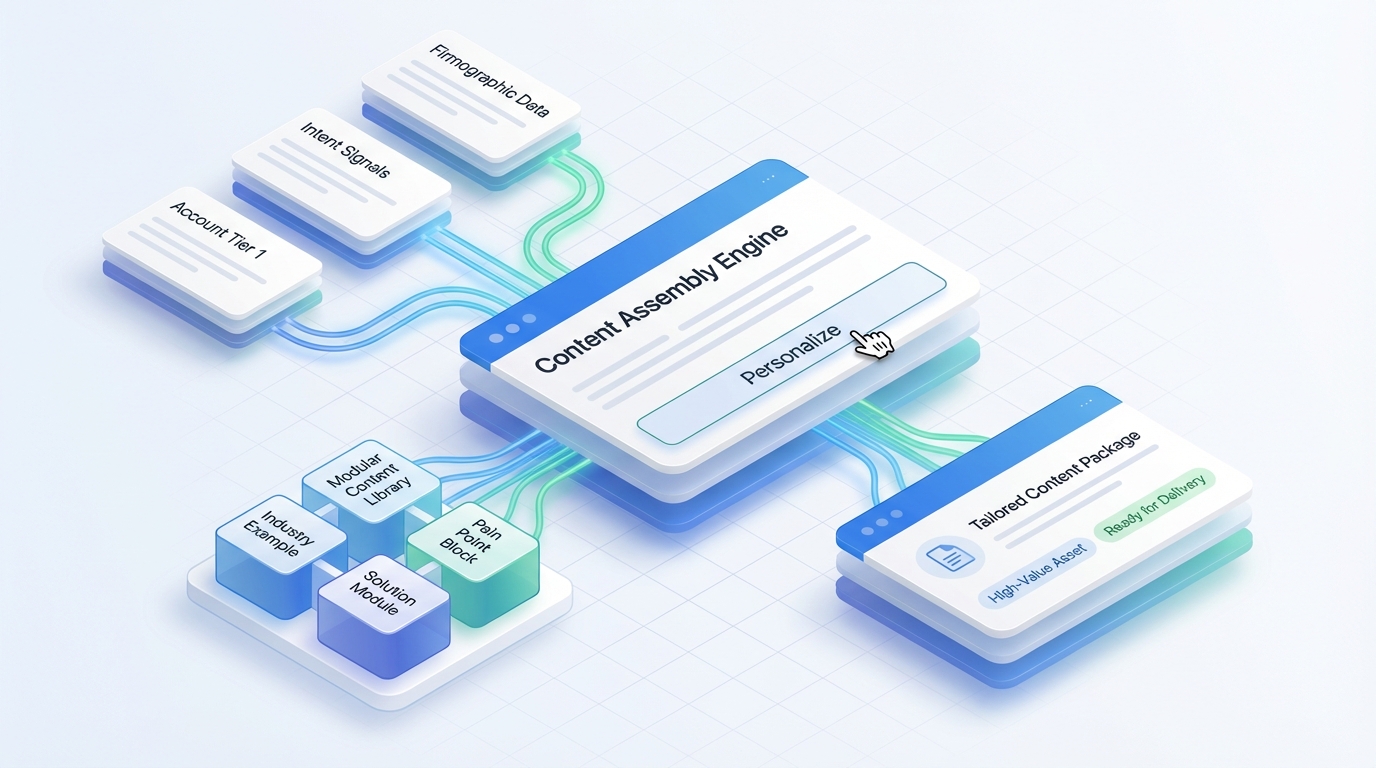
- Scalable personalization utilizes a two-layer structure featuring a static content base for core concepts and a dynamic personalization layer for industry-specific pain points.
- Effective ABM at scale leverages firmographic and intent data to automate real-time content assembly, ensuring messages align with the prospect's industry, company size, and behavioral signals.
- Strong alignment between sales and marketing through a modular content factory can influence 29% of the sales pipeline by streamlining the delivery of relevant, pre-approved assets.
Generic content often fails to capture the attention of high-value targets in sophisticated account-based marketing campaigns. These Tier 1 accounts require a level of relevance that standard marketing materials simply cannot provide. This creates a significant challenge for teams trying to balance depth with production volume.
Modular content creation offers a strategic solution to this efficiency problem while maintaining quality standards. By using small, reusable blocks of information, teams can deliver hyper-personalized experiences without increasing their daily workload. Keep reading to learn how to personalize content at scale for high-value accounts.
The Scalability Crisis: Why Traditional ABM Personalization Fails
Effective account-based marketing requires a tiered approach to address different levels of account value across the organization. These tiers typically include one-to-one, one-to-few, and one-to-many strategies to ensure broad coverage. While one-to-one personalization offers the highest engagement, it presents a mathematical challenge that makes manual scaling nearly impossible for most organizations.
The Pitfall of One-to-One Manual Production
Marketing teams currently spend about 82% of their work week strictly on content creation tasks. This translates to over 32 hours every week dedicated to a process that often feels inefficient and slow. When teams try to craft bespoke white papers or custom presentations for every lead, they quickly reach a point of exhaustion.
The costs in time and labor drain budgets and limit the overall impact of strategic campaigns. This manual approach often leads to significant content gaps, leaving important prospects with generic information rather than tailored insights. It's unsustainable for brands that want to grow their reach while maintaining the quality of their interactions.
The Opportunity Cost of Manual Production
The burden of manual production doesn't just exhaust the team; it prevents them from focusing on high-level strategy. If a team could reduce its 32-hour content burden by 50% through modularity, it would gain 16 hours of strategic planning time. This time could be used to refine seo articles or analyze deeper market trends.
Manual processes also slow time-to-market for time-sensitive campaigns. While writers are busy manually adjusting every sentence, competitors might be reaching the same prospects with automated, relevant insights. Reducing this friction allows the brand to act with more agility and respond to market shifts in real time.
Defining High-Value (Tier 1) Accounts and Their Content Needs
A Tier 1 account has high revenue potential and aligns perfectly with a brand's ideal customer profile. These accounts hold significant strategic value and require a specialized communication approach. Content for these targets must address their specific industry challenges and regulatory environments to be effective.
C-suite priorities differ across organizations, so messaging must be hyper-relevant to be noticed. Decision-makers at this level expect vendors to understand their unique operating constraints and business goals. When a brand demonstrates this level of understanding, it builds trust and positions itself as a partner rather than just a vendor.
Companies that implement these strategies effectively see impressive results in their sales pipelines. Research indicates that ABM can lead to 99% higher engagement with target accounts. It also contributes to 80% improved win rates and 73% larger deal sizes for high-value accounts.
Modular Content: The Architecture for ABM Personalization at Scale
Modular content provides the structural solution needed to solve the scalability crisis in modern marketing. It breaks down large assets into smaller, purpose-driven blocks that can be rearranged for different audiences. This architectural shift serves as the blueprint for creating dynamic assets that adapt to readers' needs.
What is a Content Module? The New Atomic Unit of Content
A content module is a discrete unit of information that functions as the new atomic unit of marketing material. Unlike monolithic content that's fixed in one format, modules are designed to be interchangeable and reusable. This flexibility allows marketers to quickly create personalized pieces without a heavy manual workload.
Common components that work well as modules include introductions, pain point statements, and industry examples. Proof points and calls to action also make excellent candidates for modularization. By breaking content into these parts, a single strategy can generate a significant amount of tailored content from the same original modules.
Effective assembly of these blocks requires a robust tagging and metadata system. Each module must be labeled clearly so the system knows when and where to use it. This organization ensures that the right information reaches the right audience at the right time.
The Content Base and the Personalization Layer
The framework for scalable personalization relies on a two-layer structure that separates static and dynamic elements. This architecture begins with the content base, which serves as the core educational foundation of the asset. It contains the fundamental methodologies or primary concepts that remain constant across all campaigns.
The personalization layer sits on top of this base to provide immediate context and relevance. This layer consists of dynamic modules that swap out based on specific account data. It allows a single core asset to feel unique to different prospects at the same time.
Dynamic modules typically include industry-specific examples and pain points that resonate with a particular vertical. They use terminology that's familiar to the reader's daily work life to build credibility. This approach ensures that the most important parts of the message are tailored to the recipient's reality.
Building a Content Tagging Taxonomy
To make modular content work, you need a sophisticated tagging taxonomy that categorizes every block of text. This taxonomy should include tags for the target persona, industry vertical, and the specific stage of the buyer journey. Without these labels, the automated system won't know which module fits a specific prospect's needs.
Metadata shouldn't be limited to simple categories, but should also include performance indicators. You can tag modules with information regarding their effectiveness in previous monthly content cycles. This data enables the system to prioritize high-converting modules during assembly.
Consistency in tagging is the most important factor for long-term success. If different team members use different labels for the same concept, the system will eventually fail. Establishing clear naming conventions ensures the library remains organized and searchable as it grows.
The Content Audit for Modular Migration
Moving to a modular system starts with a comprehensive audit of your existing monolithic assets. You'll need to go through white papers and ebooks to identify which sections can stand alone. These sections are then extracted and transformed into independent modules within your new library.
During the audit, focus on identifying evergreen concepts that serve as the content base. These are the core principles of your business that don't change regardless of the industry you're targeting. Separating these from industry-specific examples is the first step toward modularity.
You should also look for content gaps that need to be filled with new modules. If you have a strong core base but lack specific pain point modules for the finance sector, that becomes a priority. This audit helps you build a roadmap for future content production that supports the modular model.
Optimizing Content for Reuse: Writing for Modularity
Writing for modularity requires a shift in how authors approach their craft. Each module must use simple and clear language that can stand alone while still fitting into a larger narrative. Writers should focus on a single, clear topic for each block to maintain the block's versatility.
Avoiding complex interdependencies between blocks is essential for a successful modular strategy. If one paragraph relies too heavily on another, it becomes difficult to swap them out. This focus on independence ensures that the assembled content flows naturally, regardless of which modules are chosen.
Personalization is a high priority for modern buyers who expect brands to understand their needs. While 71% of consumers desire personalized offers, only 34% of brands actually provide them. Closing this gap requires a commitment to writing content that's designed for reuse and adaptation.
Leveraging Firmographic Data for Dynamic Content Swapping
Firmographic data powers the modular content system for Tier 1 accounts. It provides the necessary triggers that tell the assembly platform which modules to select. By leveraging this data effectively, brands can automate personalization without losing the human touch.
Identifying the Key Firmographic Data Points
Several firmographic data points are critical for personalizing content for high-value accounts. These include the target business's industry vertical, company size, and geographic location. Each piece of information allows the marketing team to swap modules for maximum impact.
Personalization delivers between five and eight times more ROI on marketing spend than generic messaging. It also has the power to cut customer acquisition costs by up to 50%. These financial incentives make the accurate collection of firmographic data a top priority for sales and marketing teams.
Industry data allows a system to select specific case studies that demonstrate success in a particular field. Company size data helps determine which ROI metrics will be most impressive to the prospect. Regulatory environment data ensures the content remains compliant and relevant to the user's local laws.
Integrating Intent Data for Behavioral Personalization
While firmographic data tells you who the prospect is, intent data tells you what they are doing. High-value ABM relies heavily on behavioral signals to trigger the assembly of specific content modules. If a target account visits your pricing page, the system should trigger a module focused on ROI and implementation.
Behavioral signals can also come from third-party sources where prospects research specific topics. Using a strategic competitor gap analysis guide can help you identify which topics your prospects are searching for. This allows you to serve modules that directly address the gaps in their current knowledge.
Intent-driven assembly ensures that you aren't just sending personalized content, but you're sending it at the perfect time. A prospect in the middle of a research phase needs educational modules, not sales pitches. Aligning the module type with the current behavior increases the likelihood of a positive response.
Mapping Modules to Account Segments (One-to-Few Strategy)
Modular content naturally supports a one-to-few strategy by clustering accounts with similar firmographic characteristics. This approach is often referred to as ABM Lite because it balances personalization with broader reach. A single content base can be combined with modules that are specific to a group of similar companies.
For example, a marketing team can combine a core methodology with a healthcare industry module. They can then add a module for companies with over 1000 employees and another for North American regulations. This results in a highly relevant piece of content for an entire cluster of prospects with minimal effort.
This clustering allows for more efficient production without sacrificing the feeling of individual attention. Prospects in the same segment often face similar regulatory hurdles and competitive pressures. By addressing these shared realities, you can build authority with an entire group of key accounts at once.
Real-Time Assembly: Technology That Powers the Swap
Technology plays a central role in managing the complex task of assembling content in real time. A modern Content Management System or a dedicated ABM platform stores and organizes the modular library. These systems use APIs or cookies to identify the account and pull the corresponding modules from the database.
Headless CMS architectures are particularly effective for this task because they decouple the content from the presentation layer. This allows the same module to be pushed to a website, a mobile app, or a PDF summary simultaneously. It creates a unified experience across all digital touchpoints for the high-value prospect.
AI tools are increasingly important for suggesting or drafting personalized variations of these modules. These tools analyze historical performance to determine which messaging resonates best with specific segments. Large companies have already seen success with this approach to improve their outreach.
Amazon achieved a 25% boost in email-driven revenue by using AI to personalize its communications. Their AI-powered emails achieved open rates of 20% to 25%, well above the industry average. While this is a B2C example, the same AI-driven principles of modularity apply to high-stakes B2B account interactions.
Operationalizing the Shift: From Content Team to Content Factory
Adopting a modular strategy requires an organizational shift in how teams manage their daily workflows. This change tackles the common problem of overwhelming production teams with manual requests. By moving toward a factory model, brands can produce higher volumes of content with better consistency.
Establishing a Content Governance and Tagging System
A robust governance framework is necessary to maintain brand consistency across hundreds of different modules. This system ensures that every piece of content meets the brand's quality standards. Without clear rules, the modular approach can quickly become fragmented and confusing for the audience.
Governance also involves managing the lifecycle of each module within the library. Outdated modules should be archived or updated to ensure that the assembly engine never pulls old information. Regular reviews by subject matter experts keep the modular library accurate and reliable.
Standardized metadata and tagging structures are the backbone of a successful governance strategy. Each module should be tagged with persona, industry, and the buyer's journey stage. This organization ensures the assembly engine pulls the correct block of text every time.
Governance for Global Teams: Master Modules and Localization
For global organizations, modularity simplifies the challenge of regional compliance and localization. You can establish master modules that contain the core global brand messaging. Local teams then create regional variants that address local laws and cultural nuances while following the same structure.
This master-variant workflow ensures that the global brand remains cohesive across different markets. It prevents local teams from having to rewrite entire articles from scratch for every campaign. They can simply swap out the master industry module for a translated and localized version.
This approach also makes it much easier to manage regulatory updates worldwide. If a law changes in Germany, you only need to update the specific German regulatory module. The change will automatically reflect in every piece of content that uses that specific block of text.
Workflow Alignment Between Marketing and Sales
Success in ABM depends on tight alignment between marketing and sales. Marketing teams act as the module owners while sales teams serve as the primary deployers of the content. When these teams work together, they can influence up to 29% of the pipeline through coordinated efforts.
In contrast, brands with broken handoffs and poor alignment only influence about 10% of the pipeline. A modular system simplifies the sales team's job by providing a library of pre-approved assets. Sales reps can quickly find contextually relevant information to share with their prospects.
This alignment ensures the sales team isn't creating unapproved content in a vacuum. They can rely on marketing to provide high-quality modules that are already optimized for conversion. This collaborative environment improves efficiency and delivers a more professional brand experience for customers.
Measuring Module Performance, Not Just Article Performance
The shift to modularity requires a change in how marketers measure the success of their content. Instead of focusing solely on total article views, teams should track the performance of individual modules. This allows them to see which specific messages are driving the most engagement.
Marketers can identify which pain-point statements have the highest click-through rates across industries. This feedback loop is essential for continuous optimization of the modular library. It provides the data needed to refine messaging and improve ROI over time.
ABM campaigns can deliver ROI 21% to 50% higher when they focus on the right ABM metrics for success. Success depends on measuring engagement at the target account level rather than relying on vanity stats. This granular approach ensures every module contributes to your business goals and helps you show the profitability of content campaign efforts.
Scale Your High-Value Outreach With Brand Voice Today
Modular content creation and intelligent data application provide the only sustainable path to hyper-personalization at scale. This strategy allows your team to engage Tier 1 accounts with high-value messaging without causing a resource crisis. By breaking content into reusable parts, you can drive higher engagement and generate better results with your existing team.
Moving from a manual, exhausted content team to a streamlined, automated personalization engine is essential for winning in competitive markets. We understand the challenges of maintaining quality and consistency as you scale your outreach. We specialize in creating ready-to-publish, SEO-optimized articles that fit into your modular strategy and deliver real results. Book a demo today to see how we can help you transform your ABM results.