
- Shifting focus from vanity metrics to pipeline-centric KPIs like influenced pipeline value and velocity allows marketing teams to demonstrate the direct financial impact of content on the revenue funnel.
- Implementing sophisticated multi-touch attribution models, such as the W-shaped framework, helps credit content interactions at key inflection points across complex B2B buyer journeys.
- Organizations using content for sales enablement see win rates increase by 13.7%, while those providing marketing air cover report sales cycles that are up to 40% shorter.
- A healthy LTV to CAC ratio, often targeting 3:1 or higher for SaaS businesses, proves that organic content functions as a scalable, cost-effective asset for long-term company growth.
- Integrating CRM data with standardized UTM strategies is critical for transforming content production from a cost center into a measurable contributor to net revenue retention and business valuation.
In the current economic climate, marketing budgets face more scrutiny than ever before. Marketing departments frequently struggle to demonstrate how early-stage metrics like page views and social shares translate into actual company revenue. This disconnect often leads leadership to view content production as a cost center rather than a primary growth driver.
Executive teams and investors now demand a new generation of pipeline-centric KPIs that reveal the financial impact of every published asset. These specific metrics allow a company to understand how content influences the valuation and long-term growth trajectory of the business. Keep reading to learn more about metrics that prove content contribution to the revenue pipeline.
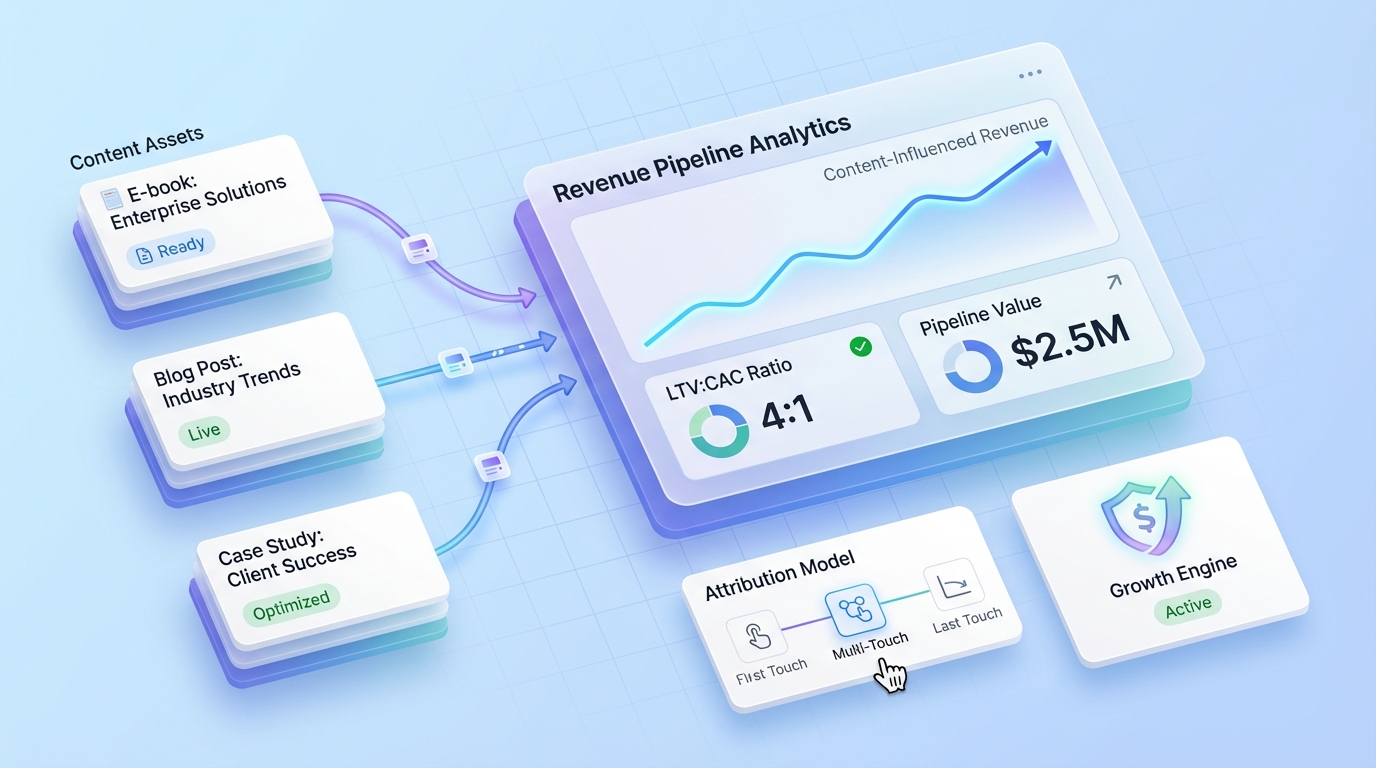
The Foundation: Shifting Focus from Reach to Business Value
Relying solely on vanity metrics like likes, impressions, and follower counts can mislead a marketing strategy. These figures lack the depth needed to reflect actual brand engagement or audience loyalty. They provide a surface-level view of reach but fail to indicate whether a reader has any intent to purchase. Focusing on these numbers often masks the reality that the content isn't moving the needle on the balance sheet.
Actionable KPIs and value metrics provide a much clearer picture of business health. These indicators are explicitly tied to the sales funnel, customer acquisition, and long-term retention. When a team tracks value metrics, they're looking at how content influences a prospect's journey from an anonymous visitor to a loyal customer. This shift in mindset ensures that every piece of content serves a measurable purpose in the company's growth strategy.
Defining Top-Funnel Metrics That Matter
Search visibility for high-intent keywords is a far more reliable indicator of future revenue than general traffic volume. Ranking for commercial terms like best enterprise software allows a company to capture prospects who are actively looking to buy. While informational terms might bring in more people, they don't always lead to a sale. Research indicates that B2B buyers spend about 27 percent of their time researching independently before they ever talk to a salesperson.
Lead quality indicators tell a story that raw traffic numbers cannot. It's more useful to know that 10 decision makers from target industries visited a page than to see 1,000 random visitors. Marketing teams should analyze whether visitors fit the ideal customer profile using firmographic data. An effective audience analysis helps identify if the people consuming the content are actually the ones with the power to sign a contract.
The identity of the reader is always more significant than the total number of clicks. Prioritizing quality over quantity ensures that the sales team receives leads that are actually worth their time. This targeted approach prevents the sales department from wasting resources on prospects that'll never convert. It also helps marketing refine its strategy to speak more directly to the needs of the most profitable customer segments.
Content engagement depth goes beyond simple metrics like time on page to show how much value a reader truly finds. Metrics such as scroll depth and completion rates for whitepapers indicate a high level of interest and knowledge absorption. Tracking sequential consumption patterns helps marketers understand the multi-touch journeys that lead to a conversion. If a user reads three related articles in a single session, they're demonstrating clear progression toward a buying decision.
Content Type Impact Analysis
Different types of content serve different financial purposes within the revenue pipeline. Top-of-funnel blog posts and articles are typically designed to drive brand awareness and generate pipeline. These assets attract new visitors who may not have been aware of the solution previously. They're the initial entry point that brings fresh prospects into the marketing ecosystem.
Mid-funnel assets such as whitepapers, webinars, and detailed guides are better suited for the influenced pipeline. These pieces of content nurture existing leads by providing deep technical insights or solving specific business problems. When a lead engages with these resources, it's a strong indicator of increasing intent. This type of engagement often moves a prospect from a general-interest phase to a concrete evaluation phase.
Late-funnel content, such as case studies and product comparison sheets, directly impacts pipeline velocity. These assets provide the social proof and technical validation required to close a deal. By answering specific objections, this content helps the sales team overcome friction in the final stages of the journey. Understanding these distinctions allows marketing leaders to allocate their budget more effectively across the entire buyer cycle.
Technical Setup: CRM and UTM Strategy
The CRM system is where marketing and sales data finally meet to track an individual lead's journey. It's the central repository that records every interaction from an anonymous visit to a closed deal. For attribution to work, the CRM must be configured to capture and store touchpoint data from the marketing automation platform. This integration allows the team to see which blog posts a specific lead read before they signed a contract.
A well-maintained CRM is the foundation of any credible revenue reporting system. Without this technical link, marketing efforts remain siloed and invisible to the finance team. Managers should ensure that every lead record includes a history of content interactions. This transparency enables the marketing budget to be defended during executive reviews.
A consistent UTM strategy is the backbone of cross-channel and content-specific tracking. Every link shared in an email, social post, or third-party site should have standardized tags. These tags tell the analytics platform exactly where a visitor came from and which specific asset they clicked on.
Without this technical discipline, the data in the CRM will be incomplete and unreliable. Standardized naming conventions ensure that every content touchpoint is correctly logged and ready for attribution analysis. Marketing teams should document their UTM parameters to maintain consistency across different campaigns and time periods. This organization makes it much easier to pull accurate reports on which channels are driving the highest quality traffic.
The Data Gap: Why Most Content Attribution Fails
Most content attribution efforts fail because they rely on a single source of truth that's often incomplete. The buyer's journey is rarely a straight line from an ad to a purchase. It's a complex web of interactions that spans multiple devices and platforms over several months. Technical hurdles, such as cookie expiration and the rise of private browsing, make tracking these journeys incredibly difficult.
Dark social presents another significant challenge for modern marketing attribution. This refers to content sharing and recommendations that occur in private channels like Slack, WhatsApp, or direct email. Since these interactions don't carry UTM parameters, they often appear as direct traffic in analytics tools. This leads to an undercounting of the actual influence that content has on the decision-making process.
Fragmented user journeys further complicate the picture for marketing teams. A prospect might read a blog post on their mobile phone but eventually sign up for a demo on their laptop. Without sophisticated cross-device tracking, these two sessions appear to belong to two different people. This fragmentation makes it hard to give credit to the top-of-funnel content that started the relationship.
To overcome these gaps, companies must adopt a more holistic approach to data collection. This involves combining technical tracking with qualitative measures like customer surveys and sales team feedback. Asking a customer how they first heard about the brand can reveal touchpoints that the digital tools missed. Combining these datasets provides a much more accurate reflection of how content drives business growth.
Establishing Content's Direct Link to Revenue Pipeline
The metrics in this section are tools for showing how content functions in the mid- to late-stages of the funnel. They prove that marketing assets don't just create awareness but actually influence the creation and acceleration of sales opportunities. Since 67 percent of the buyer's journey is now completed digitally, marketing's role in the pipeline is larger than ever before.
Measuring content performance at this level requires a shift from counting visits to counting dollars. This means looking at the pipeline value of accounts that engage with your site. It's about showing that the people reading your articles are the same people who are signing six-figure contracts. This level of reporting is what ultimately captures the C-suite's attention.
Content-Influenced Pipeline Value and Velocity
Content-influenced pipeline value tracks the total monetary value of sales opportunities in which a specific asset played a role. This might include a blog post a prospect read or a case study they downloaded during their research. By documenting these touchpoints, teams can see exactly how many dollars in the pipeline are connected to the content strategy. Organizations that use content for sales enablement see win rates that are 13.7 percent higher than those that don't.
Pipeline velocity measures how quickly a prospect moves through the various stages of the sales cycle. Content accelerates this process by answering questions and removing friction before a prospect even speaks to a representative. Companies that provide marketing air cover through sophisticated programs report 40 percent shorter sales cycles. These programs also see 234 percent faster pipeline progression for ad-influenced accounts compared to those without marketing support.
Measuring the average time from the first content interaction to the creation of an opportunity reveals the true efficiency of the marketing engine. Faster movement through the funnel means the company can close more deals in less time. Marketers should focus on creating transactional content that helps prospects make decisions faster. This efficiency is a powerful narrative to share with investors seeking scalable growth models.
Analyzing content consumption patterns for closed-won versus closed-lost opportunities provides deep qualitative insights. High-performing companies identify specific pieces of content that are consistently present in successful deals. If most winning prospects read a particular comparison guide, that guide is a high-value asset. This analysis allows marketers to double down on the topics and formats that actually drive revenue while retiring those that don't.
Assisted Conversions and Multi-Touch Attribution
Assisted conversions help marketers overcome the heavy limitations of first-touch attribution. This metric credits content that may not have started the journey but played a role in keeping the lead engaged. Many buyers require multiple interactions before they are ready to make a final decision. By tracking these assists, the marketing team can prove the value of mid-funnel assets that nurture leads toward the end of the journey.
Multi-touch attribution models assign weighted credit to various touchpoints across the entire buyer journey. This approach helps leadership understand how top-of-funnel awareness efforts eventually connect with final conversion drivers. It reveals the hidden relationships between different channels and content types. Using these sophisticated models ensures that every part of the content ecosystem receives the credit it deserves.
Without this view, many impactful pieces of content would appear to have no financial value. For instance, a technical whitepaper might never be the first thing a prospect sees, but it might be what convinces them to buy. Recognizing these assist relationships is key to building a balanced content portfolio. It prevents the team from over-investing in just one stage of the funnel.
Tracking these interactions requires a tight integration between your analytics platform and your CRM. Each touchpoint should be logged as a campaign member or a task within the prospect's profile. This data allows you to run reports that show the exact influence of every article. It turns the content library into a verifiable asset that the sales team can rely on daily.
Operationalizing Revenue Attribution Models
Implementing a rigorous operational framework is the only way to transform theoretical metrics into verifiable data. Without the right technical setup, it's impossible to track the customer journey with the level of accuracy finance teams require. This process requires a tight alignment between the marketing and sales departments. It's not just about the tools, it's about the processes that govern how data is entered and analyzed.
Marketing teams must work closely with sales ops to ensure that attribution is a standard part of the reporting workflow. This includes setting up automated triggers that update lead statuses based on content engagement. It also means training sales reps to properly attribute their deals to the right campaigns. When everyone is on the same page, the data becomes a reliable source of truth for the entire company.
Choosing and Implementing an Attribution Model
First touch attribution credits the very first piece of content a prospect encountered with the company. This is useful for understanding which topics are best at generating brand awareness. Last-touch attribution assigns all credit to the content that immediately preceded the conversion event. While these models are simple to set up, they often ignore the complex reality of a modern buyer's journey.
The U-shaped attribution model offers a more balanced view for shorter sales cycles. Under this position-based model, 40 percent of the credit is assigned to the first touchpoint. Another 40 percent goes to the touchpoint immediately preceding the conversion. The remaining 20 percent is split among any other interactions that happened in between. This ensures that the assets that start and end the journey are prioritized.
The W-shaped model is often the most sophisticated choice for organizations with long sales cycles. It assigns 30 percent of the credit to the first touch, the lead creation touch, and the opportunity creation touch. The remaining 10 percent is distributed among all other interactions in the journey. This structure accurately reflects the content's role at the most key inflection points in the sale.
Choosing the right model depends on the typical length and complexity of the company's sales cycle. If most deals happen quickly after a single interaction, a simpler model might suffice. However, enterprise B2B companies usually need the nuance of a multi-touch model. You can learn more about setting up these systems in this guide to a U-shaped attribution model and other common frameworks.
How to Build a Content Revenue Dashboard
Building a content revenue dashboard is the most effective way to socialize marketing's impact with the rest of the company. A good dashboard should start with high-level pipeline figures and then allow users to drill down into specific assets. In a CRM like Salesforce, you'll need to use the 'Primary Campaign Source' and 'Contact Roles' fields to pull this data. This allows you to link specific deals directly to the content that influenced them.
Your dashboard should include a report for 'Content Sourced Revenue'. This is calculated by summing the revenue from deals in which a content asset was the very first touchpoint in the journey. This metric proves that your blog or resources section is actively bringing new business through the door. It's a clear indicator of the ROI for your top-of-funnel SEO efforts.
Another essential report is 'Content Influenced Pipeline Value'. To calculate this, sum the value of all open opportunities that have at least one content touchpoint recorded. This shows the scale of the pipeline that marketing is helping to support. It's often a much larger number than sourced revenue and shows the true reach of your content strategy across the entire database.
Finally, include a section ranking your top-performing assets by their contribution to closed-won deals. This helps the content team prioritize updates for the pieces that are actually closing revenue. It also tells the sales team which resources they should be sharing with their prospects. A live dashboard keeps the focus on revenue rather than vanity metrics during every marketing meeting.
High-Level Business Metrics: The Investor’s View
The following financial KPIs translate content performance into the language used by CEOs and venture capital investors. These metrics directly impact investment decisions and the company's overall valuation. They move the conversation away from marketing tactics and toward the fundamental economics of the business. Investors want to see that the company has a predictable and efficient way to acquire customers.
Marketing leaders who can speak to these numbers are much more likely to secure budget increases. It shows that they understand the business as a whole, not just the marketing channel. By connecting content to the bottom line, you transform your department from a cost center into a growth engine. This perspective is vital for long-term career success and departmental influence.
Customer Lifetime Value (CLV) and LTV:CAC Ratio
Customer lifetime value measures the total revenue a company can expect from a single customer account. Content contributes to a higher CLV by building long-term loyalty and encouraging repeat purchases. When customers find continuous value in a brand's educational resources, they are less likely to churn. High-quality content keeps the brand at the top of their mind throughout their entire lifecycle.
The LTV-to-CAC ratio is the single most important metric for evaluating the profitability of a content-sourced customer. For most SaaS businesses, a 3-to-1 ratio is considered a healthy benchmark for success. Some industries, like B2B SaaS, aim for a 4-to-1 ratio, while EdTech companies often target a 5-to-1 ratio. If the ratio is significantly higher, it might actually indicate that the company is underinvesting in its growth.
A healthy LTV-to-CAC ratio, driven by effective content, supports the company's growth trajectory and investor reporting. It proves that the marketing model is scalable and that the company can grow efficiently. Investors look for this efficiency when deciding where to allocate their capital. When content lowers acquisition costs while increasing customer value, it creates a powerful financial narrative.
Scaling these efforts requires a consistent output of high-quality material. Investing in high-velocity content sprints can help establish this authority quickly. This approach builds a large library of assets that work together to lower your average acquisition cost. Over time, this content becomes a moat that competitors find difficult to cross.
Content’s Role in Net Revenue Retention (NRR)
Net Revenue Retention is a critical metric for SaaS companies that measures how much revenue the company retains over time. Content plays a major role in NRR by providing ongoing value to existing customers. Educational resources, product updates, and advanced use case guides help customers get more value from the software. When customers are successful with the product, they are much more likely to renew and expand their accounts.
Using content for customer marketing can significantly reduce churn rates and drive expansion revenue. For example, a series of emails featuring advanced tips can encourage users to upgrade to a higher tier. This type of content is often overlooked in traditional attribution models, but is essential for long-term health. It turns the marketing department into a partner for the customer success team.
To measure this, marketing teams should track content engagement among existing customer accounts. If high-value accounts are consuming specific educational content, it's a strong signal of retention. You can link this engagement to renewal rates to show a direct financial impact. This helps justify the budget for content that doesn't just acquire new leads but keeps the ones you already have.
Cost of Content-Sourced Acquisition (CAC)
Customer acquisition cost represents the total expense required to gain a new customer. To get an accurate content calculation, teams must include salaries, software costs, and distribution expenses. It's not enough to simply look at the cost of writing a single article. All overhead associated with the content department must be factored into the final CPA to give a realistic view.
Comparing the CAC of content-sourced leads to other channels often reveals a significant advantage. Paid advertising usually becomes more expensive as competition increases, but content provides a more scalable path. Leads generated through organic content often have lower long-term acquisition costs. This efficiency is a strong argument when asking the board for more resources to scale the content program.
To keep CAC low, many brands choose to outsource production to specialized partners. Investing in monthly content production allows you to maintain a steady output without the high overhead of a full in-house team. This flexibility helps you scale your efforts up or down based on your current budget and growth goals. It ensures that you're always producing the volume of content needed to stay competitive.
Reporting Content ROI to the C-Suite and Investors
Data alone is not enough to convince high-level stakeholders to increase a marketing budget. This section focuses on how to transform raw figures into a compelling financial narrative that resonates with the board. Success in the C suite requires speaking the language of valuation and long-term asset growth. You need to show how your work increases the company's value to its owners.
Marketing budgets reached 9.4 percent of company revenues in 2025, and having clear scenarios ready helps justify every dollar. Leaders don't need to see granular details like click-through rates or social shares. Instead, the presentation should focus on how content is driving revenue and pipeline value. This approach ensures your reporting aligns with the marketing budget reality that 84 percent of CMOs now prioritize ROI.
Transforming Content into a Balance Sheet Asset
Digital content should be viewed as a valued asset rather than a transient operational expense. Much like intellectual property, content is a persistent asset that delivers an ongoing return. An article written today can continue to generate leads and revenue for several years. This compounding effect is often a blind spot in traditional company valuations, but it is a key driver of long-term growth.
You can indirectly value this asset by presenting the total value of unearned organic traffic. Calculate what it would cost to buy the same amount of traffic through paid search ads. This figure shows the immediate savings the content program provides to the company every month. Additionally, reporting on the ROI of evergreen content over its lifespan underscores the strategy's long-term efficiency.
Shifting the perception of content from a cost to an asset changes how leadership views the entire marketing department. It moves the discussion from 'how much are we spending' to 'how much are we building'. This perspective encourages long-term thinking and more stable budget allocations. It also helps the company see the strategic value of its internal knowledge and expertise.
Building the Financial Narrative: Three Reporting Scenarios
Presenting three distinct budget scenarios to the board is an effective way to show the content's impact on growth. The first scenario is business as usual, which shows the current trajectory with existing resources. The second scenario outlines a minimum new investment that could accelerate growth and market share. The third scenario is the dream budget, designed for maximum market capture and dominant industry positioning.
A successful investor presentation anticipates objections and connects the content strategy to the core investment thesis. If the company's goal is to reduce churn, show how educational content increases customer retention. If the goal is rapid expansion, highlight how content lowers the CAC and shortens the sales cycle. Connecting every marketing activity to a financial outcome ensures that the department remains a priority.
This narrative should be supported by the revenue dashboard mentioned earlier in this guide. Showing real-time data of how content is influencing current deals builds immediate credibility. It shows that your theories about content value are supported by actual customer behavior. This combination of strategic narrative and hard data is the winning formula for any executive report.
Scale Your Revenue Engine with Proven Content Performance
Proving the financial impact of content is no longer optional for brands seeking to protect their budgets. By moving from vanity metrics to pipeline-centric KPIs like LTV-to-CAC and influenced pipeline value, marketing teams can transform from cost centers into primary growth drivers. This data-driven approach ensures your content strategy is directly aligned with the company's valuation and success.
Our team understands the challenges of producing the high-quality material necessary to feed these high-performance revenue pipelines. We specialize in creating ready-to-publish, SEO-optimized articles engineered to drive traffic and generate real results. Our expertise allows you to scale your production without sacrificing the technical integrity that investors demand.
Our solutions provide the consistent, professional content required to achieve the metrics discussed in this guide and secure the executive buy-in you need. We're dedicated to helping you build a content library that functions as a long-term financial asset. Book a demo with our team today to learn how we can help you scale your organic presence and drive measurable revenue.