
- Comparison pages target high-intent "alternative to" keywords to capture buyers experiencing incumbent fatigue who are searching for modern, agile software solutions.
- Competitor comparison content serves as a high-value bottom-of-funnel asset that typically converts at two to five times the rate of general organic blog articles.
- Establishing radical trust requires a balanced approach that acknowledges competitor strengths while using data-driven benchmarks and third-party evidence to prove product value.
- Adhering to the legal doctrine of nominative fair use and the 4-Point Trust Framework helps challenger brands maintain transparency and compliance while naming established industry giants.
- Optimizing technical SEO through Review and FAQ schema and structured topic clusters enables comparison pages to dominate search engine results pages for branded "vs" queries.
The modern software landscape is often dominated by massive corporations that have held market power for decades. Many buyers now feel frustrated with these legacy systems and actively seek nimble alternatives that solve their specific problems. They're often searching for a tool that's built for modern workflows rather than corporate bloat.
Positioning your brand alongside these industry giants creates a clear path for potential customers to discover your unique value. This approach helps bridge the gap between a relatively unknown startup and a market leader. Understanding the mechanics of these high-intent pages is the first step toward hardening your content moat against larger competitors.
The Strategic Foundation of the David vs. Goliath Comparison Page
The SaaS industry has become a high-stakes environment where startups must battle for visibility against multi-billion-dollar incumbents. These massive companies often possess significant marketing budgets and name recognition that can feel insurmountable. However, these giants frequently suffer from their own size, leading to bloated software and disconnected customer support. This creates an opening for smaller, more agile brands to claim their space in the market.
Modern buyers are increasingly experiencing what experts call incumbent fatigue. They've grown tired of software that feels slow, overpriced, or difficult to navigate without a dedicated consultant. These users aren't just looking for a tool; they're looking for a partner that understands their modern workflow. When a challenger brand identifies these frustrations, it can position itself as the antidote to corporate stagnation.
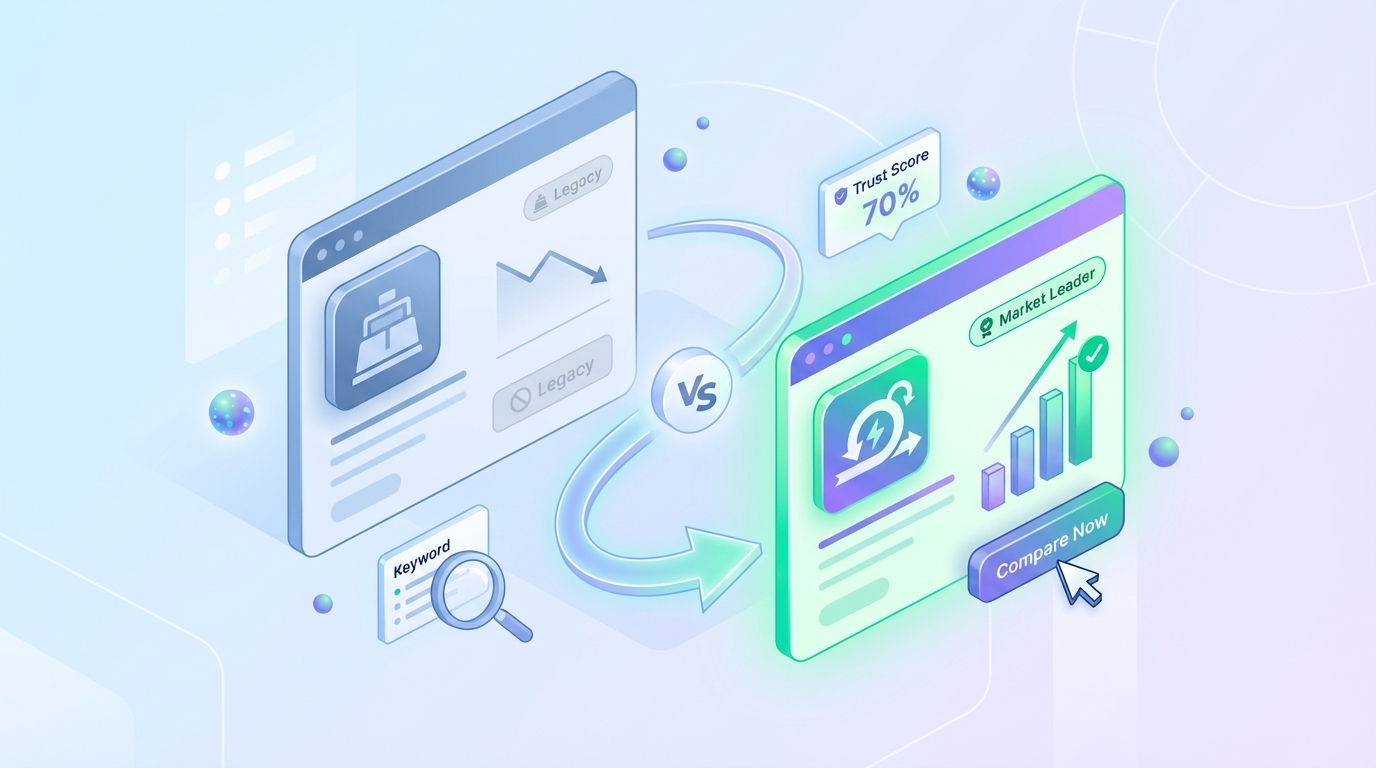
Comparison pages act as a mental shortcut for these tired buyers by placing a newer brand directly alongside a household name. Instead of trying to build authority from scratch, you're placing your solution in the same category as the leader. This positioning signals to the market that your product is a serious contender worthy of evaluation. It changes the conversation from "Who are you?" to "How are you different from the leader?"
Thinking of these pages as simple marketing assets is a mistake. They're actually strategic offensive tools designed for rapid market share acquisition. By targeting a giant's specific weaknesses, you can peel away its most dissatisfied customers. A robust bottom-of-funnel content strategy helps you win over high-value users who are ready to switch immediately.
Why Competitor Comparison Content is the Ultimate Bottom-of-Funnel Asset
Understanding where a buyer is in their journey is the difference between a bounce and a conversion. Users who land on competitor comparison pages aren't just browsing for general information or educational tips. They've already identified their pain points and are actively vetting specific solutions to address them. This placement makes comparison content one of the most powerful tools in a digital marketing arsenal.
Capturing High-Intent Search Traffic with Alternative To Keywords
Traditional high-volume keywords often attract users who are only in the awareness stage of their search. While those terms might look good in a traffic report, they rarely lead to immediate sign-ups or sales. In contrast, an alternative to keywords focuses on users who've already decided they need a specific type of software. These individuals are searching for a way out of their current situation, which makes them highly motivated.
Queries like "[Your Product] vs [Competitor]" or "[Competitor] alternatives" capture high-intent searches from buyers in the evaluation stage. You should also target specific variations, such as "[Competitor] alternatives for non-profits" or "[Competitor] vs [Your Brand] for mid-market teams." These long-tail modifiers signal that the user has specific functional requirements the incumbent isn't meeting. Capturing competitor traffic at this level of granularity ensures you're reaching leads at their highest point of readiness.
Research shows that competitor comparison pages convert at 2 to 5 times the rate of general blog content. This conversion gap exists because the user is already at the finish line of their decision-making process. By focusing on these terms, you're effectively bypassing the long and expensive awareness stage of the funnel. You don't have to explain why the user needs the software category, because the competitor's already done that work.
Your only job is to explain why your specific solution is the better choice for their needs. This efficiency allows challenger brands to see a much faster return on their content investment. It's often easier to rank for these terms because incumbents rarely want to acknowledge their smaller rivals. This lack of defensive content creates a vacuum that you can fill with helpful, comparative data.
Leveraging the Credibility of Established Industry Giants
Newer brands often struggle to gain trust when they first enter a crowded market. Appearing in search results alongside a market leader provides a halo effect of legitimacy that's hard to earn elsewhere. When Google displays your page next to an industry giant, it subtly suggests to the user that you're a comparable option. This immediate boost in perceived authority is one of the most valuable benefits of comparison content.
Borrowing this authority requires a disciplined, professional approach to your challenger-brand messaging. You must ensure your design and tone match or exceed the incumbent's quality. If your page looks amateurish, the halo effect vanishes, and the user returns to the safety of the known brand. A confident and knowledgeable presentation tells the buyer that you belong in the same conversation as the giants.
You aren't trying to be a copycat, but rather a sophisticated alternative that addresses specific gaps. You can ethically leverage a competitor's brand equity by acknowledging their presence in the market while highlighting your unique focus. This strategy allows you to ride the wave of their massive brand recognition to build your own reputation. It's about being seen as a peer in the industry rather than just a noisy newcomer.
Navigating the Legal and Ethical Guardrails of Comparative Marketing
Naming your competitors directly on your website can feel like walking into a legal minefield. However, being transparent about your differences is a standard practice that helps consumers make better decisions. While comparative advertising is legal and encouraged by the FTC in the interest of consumer transparency, it requires a disciplined approach. You must be prepared to defend every claim you make with cold, hard evidence.
Understanding Nominative Fair Use and Trademark Protections
The legal doctrine of nominative fair use is a critical concept for any brand creating comparison content. This doctrine allows a company to use a competitor's trademarked name specifically for the purpose of identifying and comparing them. You don't need their permission to mention them, but you do need to follow strict rules to stay protected. The primary goal is to ensure your content doesn't create consumer confusion about who owns which product.
You must never suggest that the competitor endorses your product or that there's a formal partnership between you. It's generally safer to use text-based names rather than company logos, as logos often carry more stringent copyright protections. Using a competitor's logo can sometimes imply an association that doesn't exist, which could lead to a legal challenge. Stick to clear, descriptive text to maintain a safe distance while still making your point.
Including clear disclaimers is another way to protect your brand from trademark infringement claims. These disclaimers should state that all trademarks belong to their respective owners and that you're an independent entity. Placing this text in the footer or near the top of the comparison table adds an extra layer of security. It shows that you're acting in good faith and following the rules for comparative marketing in the US.
Avoiding Trade Libel, Defamation, and Misleading Claims
There's a very fine line between an objective comparison and disparagement or trade libel. To stay on the right side of the law, every negative claim made about a competitor must be substantiatable with verifiable facts. This could include third-party reviews, publicly available pricing sheets, or technical data from their own documentation. If you claim their software is slow, you should have the performance benchmarks to prove it.
Avoiding vague superlatives like "better" or "best" is a smart way to reduce your legal risk. These words are subjective and hard to prove, which makes them easy targets for a defamation lawsuit. Instead, focus on specific differences in focus or functionality. You might say your product is "optimized for small teams," whereas the competitor "targets enterprise-level infrastructure."
Frame weaknesses as philosophical differences to maintain a professional, neutral tone. If an incumbent lacks a certain feature, explain that they've prioritized other areas while your brand has focused on this specific need. This approach is not only safer from a legal perspective but also more persuasive to the buyer. It shows you're offering a reasoned alternative rather than just hurling insults at a rival.
When Not to Build a Comparison Page
While comparative marketing is effective, there are situations where it's better to abstain. You shouldn't target competitors that are so small they have no search volume, as the effort won't yield a significant ROI. Additionally, some incumbents are notoriously litigious and may pursue legal action even if your claims are technically accurate. If you don't have a robust legal review process, avoid extremely aggressive comparisons against those specific rivals.
Strategic restraint is often as important as strategic aggression in your bottom-of-funnel content strategy. Focus your energy on competitors where the feature-value gap is largest, and the legal risk is manageable. This ensures that every page you publish is a safe and high-performing asset for your brand. It also protects your reputation as a fair and professional player in your industry.
Identifying and Prioritizing Your Competitor Targets
Creating a comparison page for every single player in your industry is a waste of resources. You need to be strategic about which incumbents you choose to target to ensure the highest return on investment. Startups should prioritize incumbents where there's a clear feature-value gap or significant user dissatisfaction. These are the competitors who are most vulnerable to losing customers to a faster, more modern solution.
Mining Public Review Sites for Incumbent Fatigue Signals
Public review sites are a gold mine for identifying the exact pain points that drive customers away from industry leaders. You can use sites like G2, Capterra, and TrustRadius to identify recurring complaints about pricing, clunky user interfaces, or poor customer support. Look for patterns in what users hate, such as long implementation times or a lack of specialized features. These negative experiences are your best opportunities to position your brand as the solution.
Once you've identified these pain points, you can use them as the primary headers for your comparison page. If users are complaining about the competitor's confusing pricing, make "Simple, Transparent Pricing" one of your main sections. This immediately tells the reader that you've built your product to avoid the very things that're making them unhappy. It makes your solution feel like it was designed specifically for their needs.
Mining these reviews helps you develop messaging that resonates on an emotional level. You aren't just guessing what people want, you're using their own words to validate your value proposition. This data-driven approach ensures that your content addresses the real-world struggles of your target audience. It transforms a generic comparison into a powerful, persuasive narrative that speaks directly to the user.
Balancing Search Volume Estimates with Strategic Conversion Value
Keyword research tools can sometimes be misleading when it comes to comparison queries. Even if a keyword tool shows zero volume for a specific comparison, the qualitative value of winning that customer can be immense. Branded comparison queries often exceed tool estimates for actual traffic and conversion potential. Winning one enterprise client from a comparison page can be worth thousands in monthly recurring revenue.
You should also consider whether you're targeting rising stars or dying giants in your industry. A "dying giant" might have huge search volume, but it's a product that's rapidly becoming irrelevant. On the other hand, a "rising star" might have lower volume now but could indicate the market's future direction. Aligning your targets with your long-term product roadmap ensures that your content remains relevant as the industry evolves.
Prioritizing targets based on their proximity to your ideal customer profile is the final step in this selection process. If a competitor serves a very different audience from yours, a comparison page might attract the wrong kind of traffic. You want to focus on the competitors whose customers would benefit most from your specific features. This alignment ensures that the people who find your page are qualified leads who're likely to convert.
The Anatomy of a High-Converting Comparison Page
A successful comparison page must feel like a helpful resource rather than a biased sales pitch. If a user feels they're being lied to or manipulated, they'll leave the page immediately and likely never return. Your goal is to move the user from skepticism to trust through clear, honest communication. The anatomy of your page should reflect this commitment to being an objective guide in their decision-making process.
The 4-Point Trust Framework
To maximize conversions, your page should adopt a structured approach to building trust. First, include a clear "last updated" date to show the information is current. Second, provide a direct link to the competitor's official documentation or pricing page to prove you're not hiding their strengths. Third, use a side-by-side technical specification table to enable an objective, granular comparison of features.
Finally, include a clear link to a migration guide or a "Switching is Easy" section to address concerns about technical debt. This framework provides the reader with a checklist of evidence they can implement or verify immediately. It positions your brand as a transparent advisor rather than just a seller. When you give users the tools to verify your claims, they're much more likely to trust your recommendation.
Moving Beyond the Traditional Feature Checklist
Many brands fall into the trap of using a standard check-mark table in which they list all the features, and the competitor has none. This lacks credibility and often looks like an obvious marketing ploy. Savvy B2B buyers know that no software is perfect and that every tool has its own set of trade-offs. A more nuanced approach that's structured around outcomes and specific use cases is far more effective at building trust.
You can actually build radical trust with the reader by acknowledging where the incumbent is stronger. For example, if the giant has a more robust set of integrations for legacy hardware, you should state that clearly. This honesty makes your claims about your own strengths feel much more believable. It shows the reader that you aren't afraid of the competition and that you're confident in your specific niche.
Structure your comparison around the results the user wants to achieve rather than just a list of buttons and menus. Instead of a feature called "Advanced Reporting," use a section titled "How We Help You Visualize ROI Faster." This shift in focus moves the conversation from technical specifications to real-world value. It makes the page feel like a solution to a problem rather than just a product demonstration.
Establishing Authority with Data-Driven Comparisons
In a market filled with marketing claims, the brand that provides the most objective evidence usually wins the buyer's trust. Savvy B2B buyers are often skeptical of brand-generated content and are looking for data that backs up your promises. Incorporating third-party evidence helps move the conversation from "we say we're better" to "the data shows we're better." This shift is essential for establishing true authority as a challenger brand.
One B2B SaaS company successfully built about 50 comparison pages that drove between 1,000 and 2,000 organic visits per month. These pages didn't just bring in traffic; they converted at a rate of 5 to 10 percent. Comparison searches generally convert at 5 to 10 percent versus 1 to 2 percent for general organic traffic. These comparison pages convert at a significantly higher rate because the audience has high purchase intent.
Incorporating Third-Party Benchmarks and Performance Data
Including independent benchmarks, such as speed tests or security certifications, can serve as a shield against claims of bias. If you can show that your software loads 40% faster than the incumbent's, that's a powerful and objective selling point. You can also use ROI studies from third-party research firms to prove the financial value of your solution. These external proof points are much more persuasive than internal marketing data.
Visualizing this data through charts and infographics makes it much easier for a busy professional to digest. A well-designed chart can communicate a complex performance advantage in seconds. Make sure your visuals are clear, honest, and easy to read on both desktop and mobile devices. High-quality data visualization tells the reader that you've done the work and that you're proud of the results.
For a B2B SaaS with $500 MRR and $7,000 LTV, a well-structured library of 25 comparison pages can yield a 172% ROI over 36 months. This data, provided by market research experts, proves that comparison content is a high-yield investment. When you back up your claims with hard numbers, the market responds with actual revenue. It removes the ambiguity that often prevents a buyer from making a final decision.
The Power of Switching Stories and Migration Case Studies
The biggest hurdle for many users is not the price or the features, but the fear of the move itself. They're worried about technical debt, lost data, and the time it'll take to get their team up to speed. You can address these fears directly by sharing switching stories and migration case studies. These stories should focus on the actual process of moving from the incumbent to your platform.
Detail how you handle data portability and what the time-to-value looks like for a new customer. If you have a dedicated migration team or a tool that automates the process, make that a centerpiece of your comparison page. Showing a step-by-step roadmap of the switch helps the user feel in control of the transition. It transforms a scary technical project into a manageable and exciting upgrade.
Case studies that highlight a successful migration are the ultimate form of social proof for a challenger brand. They show that other companies have faced the same fears and come out stronger on the other side. When a user sees a peer who's successfully ditched the giant, the decision to switch becomes much easier. It's about proving that the grass really is greener on your side of the fence.
Masterful Copywriting Techniques for Challenger Brands
Challenger brands have a unique advantage because they don't have to follow the rigid corporate brand guidelines of a massive giant. You can afford to be bolder, more opinionated, and more empathetic to the user's daily struggles. This freedom allows you to write high-converting technical copy that sounds human. A clear and confident voice is your best weapon against the incumbent's bland copy.
Refining your challenger brand messaging requires a deep understanding of how specific features better solve user frustrations than the market leader's. Comparison pages (subject) improve (predicate) conversion rates (object) by directly addressing these frustrations. When you use technical specifics instead of vague marketing terms, you build immediate trust with a sophisticated audience. This approach anchors your content to specific performance outcomes.
When to Concede a Feature
Admitting that a competitor has a better feature for a specific, non-target use case actually increases your conversion rate. It positions your brand as an expert advisor rather than a biased seller who's desperate for a signup. For instance, if the incumbent is better suited to teams of 10,000+ people, stating that clearly makes your claim to be better for mid-market teams more believable. It builds immense trust by showing you care about the user's actual success.
This honesty filters out leads that aren't a good fit, saving your sales team time and reducing churn. It signals to your ideal customers that your product was built specifically for their unique environment. When you acknowledge the strengths of a giant, your own claims of superiority in your niche carry much more weight. You're no longer just another noisy rival; you're a transparent partner in their decision-making process.
Using Voice of the Customer to Mirror Real-World Pain
Using the exact language found in competitor reviews is a powerful technique for mirroring real-world pain. When you use the same phrases that users use to complain about the incumbent, they feel seen and understood. It creates an immediate connection because it shows you've been listening to their frustrations. This technique is often referred to as "voice of the customer" data, and it's essential for high-converting copy.
Integrate customer quotes and testimonials that specifically mention the transition from the competitor to your solution. Seeing that someone else's already made the move and is happier for it reduces the perceived risk for the new buyer. These testimonials act as social proof that your claims aren't just marketing fluff. They provide a roadmap for the user to follow, showing them that a better experience is possible.
Focus on the "before and after" of the switching process in your copy. Describe the frustration of using the old tool and the relief of using your modern alternative. This emotional arc is much more persuasive than a dry list of features. It helps the reader visualize their own transformation and decide to switch, making it feel like a positive life change.
Technical SEO Strategies for Dominating Alternative To SERPs
Even high-converting, technical copy won't steal market share if it never appears in search results. Technical SEO is the engine that drives your comparison pages to the top of the SERPs for competitive branded searches. You need to ensure that Google understands exactly what your page is about and who it's meant to help. Structured data (subject) defines (predicate) product relationships (object) for search engines, making your site more readable for crawlers.
Building a solid technical foundation allows your competitor comparison pages to compete with established review sites. By leveraging topic clusters to dominate SERPs, you can surround an incumbent's brand name with your own high-value content. This approach ensures that you're present at every stage of the buyer's evaluation process. Without these technical signals, your pages'll remain invisible to your most qualified audience.
URL Structure and On-Page Keyword Optimization
The structure of your URLs plays a significant role in how search engines categorize your content. Using clear, descriptive URL structures such as "/alternatives/competitor-name" or "/compare/you-vs-them/" is highly recommended. This tells both the user and the search engine exactly what to expect before they even click the link. It also helps you organize your site in a way that's easy to manage as your library of pages grows.
You must also optimize your H2 and H3 headings for long-tail "vs" queries and alternative keywords. These headings should reflect the specific questions users type into the search bar. For example, a heading like "Is [Your Product] a better alternative to [Competitor] for small businesses?" directly targets a high-intent query. This helps you capture traffic that might've otherwise gone to a third-party review site.
Manage these pages carefully so they don't accidentally cannibalize your own brand search. You want to make sure that when someone searches for your brand name, they find your homepage or a product page, not a comparison page. Using proper internal linking and canonical tags can help guide search engines to the right content. Your goal is to capture the competitor's traffic without confusing your own existing customers.
Building a Comparison Silo Structure
To improve search performance, you should organize your comparison pages into a logical silo structure. Start with a parent "Comparison Hub" page that links out to every individual "Brand A vs Brand B" article. This efficiently distributes authority from the hub down to specific long-tail pages. It also helps search engines understand the breadth of your market coverage and your status as an industry authority.
This outranking-high-authority topic-cluster strategy is a proven way for challenger brands to win competitive real estate. By interlinking these pages, you pass link equity throughout the silo, helping newer pages rank faster. It also provides a better user experience by allowing researchers to explore multiple alternatives from a single starting point. A well-organized silo signals to Google that your site is a comprehensive resource for buyers in the evaluation stage.
Leveraging Review Schema and Rich Snippets for Higher CTR
Structured data is a powerful way to make your comparison pages stand out in a crowded search result. Implementing the FAQ, Review, and Product schemas can help you earn rich snippets that increase your click-through rate. Review schema (subject) defines (predicate) a clear relationship (object) between user satisfaction and product performance for search engines. This makes your result the one with the highest visual prominence and CTR on the screen.
Seeing a 4.8-star rating next to your brand name provides an immediate boost in credibility compared to a competitor with no rating shown. The FAQ schema can also help you occupy more real estate on the page by listing common questions about the switch. This makes your result appear more authoritative and helpful to the user. It's a small technical step that can lead to a significant increase in organic traffic and conversions.
The technical addition of schema doesn't just improve click-through rates; it also helps search engines understand the context of your data. It defines clear relationships between your product, the competitor, and the reviews you're sharing. This machine-readable data makes it easier for Google to trust the information you're providing. It helps you bypass the dominance of third-party aggregators who often control these valuable search terms.
Common Pitfalls That Can Backfire on Challenger Brands
A poorly executed comparison page can backfire, driving users back to the incumbent. If your content feels desperate, dishonest, or overly aggressive, you'll lose the buyer's trust instantly. One of the most common mistakes is using outdated information about a competitor's features or pricing. If a user sees that you're lying about something they know to be true, they'll assume everything else on the page is a lie as well.
Failing to update your comparison pages when a competitor releases a new feature is another dangerous pitfall. You must treat these pages as living documents that require regular maintenance and fact-checking. An expert strategy for reviving decaying content should include a regular audit of all comparison assets. Keeping your content current shows that you're an active and attentive player in the industry.
An overly aggressive tone can also damage your reputation and make you appear to be a bitter rival rather than a professional alternative. You want to sound confident and knowledgeable, not angry or petty. Focus on the user's needs and how you solve them, rather than just attacking the competitor for its own sake. A neutral and fair tone is much more likely to win over a sophisticated buyer.
Finally, avoid making your comparison pages too long or difficult to navigate. If a user has to scroll for five minutes to find the pricing comparison, they'll likely give up and leave. Use clear headings, concise bullet points, and high-quality visuals to keep the reader engaged. A well-organized page shows that you respect the user's time and that you're confident in your message.
Accelerate Your Market Share Acquisition with Brand Voice
Comparison pages are a fundamental element of a growth strategy for any challenger brand seeking an edge. These pages provide a high-ROI way to capture high-intent traffic and position your brand as a legitimate alternative to industry leaders. Investing in a robust bottom-of-funnel content strategy ensures that you capture users at the exact moment they are ready to switch providers. While the research required is significant, the long-term benefits in terms of authority and revenue are undeniable.
We understand that building a library of high-converting, legally compliant comparison pages can be daunting for busy teams. Our team specializes in creating SEO-optimized content that follows the technical and ethical guidelines required for success in the SaaS market. We take the guesswork out of competitor research and content creation so you can focus on building your product and serving your customers. Our expertise ensures that every "Alternative To" page you publish is designed to build trust and drive conversions.
Achieving a significant ROI requires a consistent and professional approach to content. We can help you identify the right competitor targets and develop the data-driven comparisons that unseat established incumbents. If you're ready to out-think your competition and scale your market presence, we are here to support your growth journey. Book a demo with us today to receive a free audit and see how our content can transform your acquisition strategy.
