
- Capturing Position Zero provides a significant competitive advantage by achieving a 42.9 percent click-through rate and serving as the primary source for 40.7 percent of voice search results.
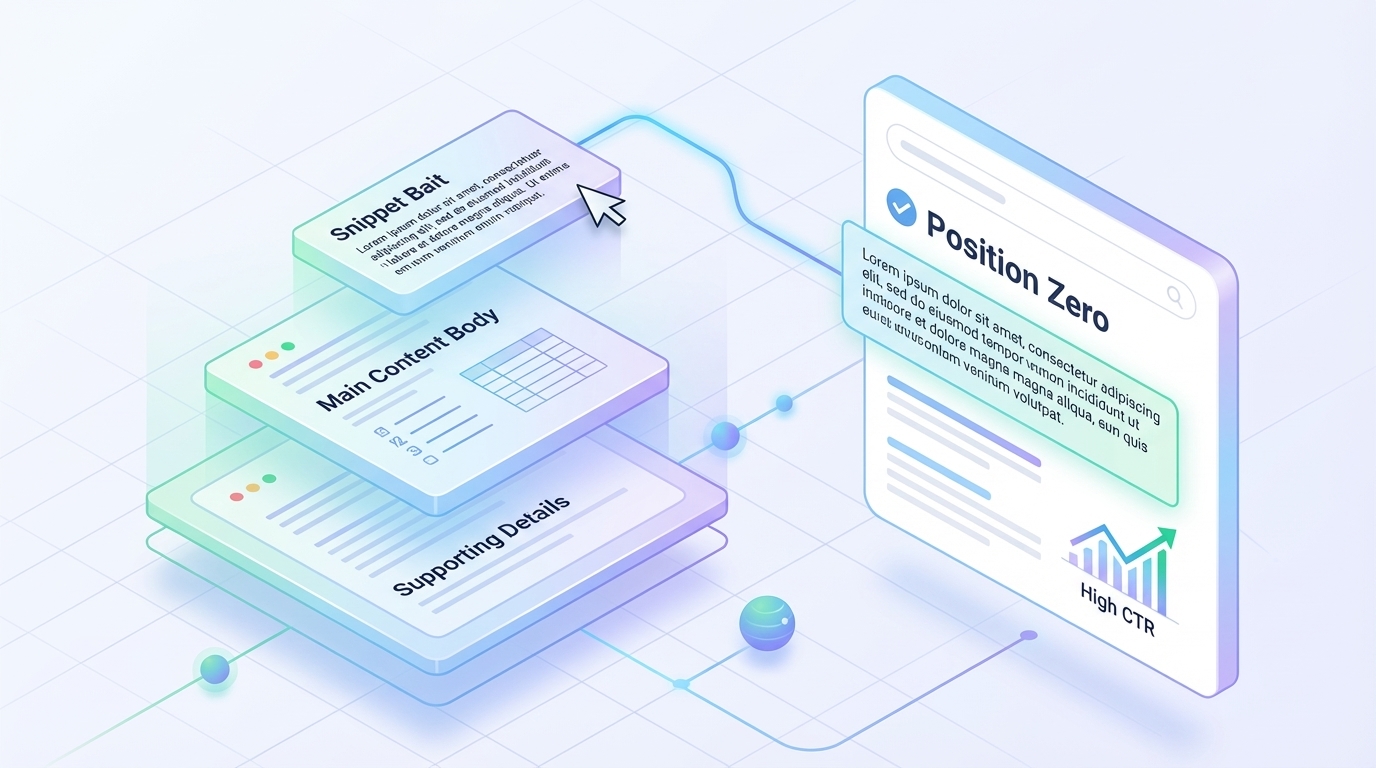
- Effective featured snippet optimization requires engineering concentrated "snippet bait" blocks of 40 to 60 words placed directly beneath relevant, question-based HTML headers.
- Utilizing semantic HTML tags, such as ordered lists for sequential how-to guides and clean tables for data comparisons, helps search engine crawlers identify and extract content for specialized snippet formats.
- Implementing the inverted pyramid model ensures that the most important information satisfies user search intent immediately, which is essential for earning highly visible paragraph-based snippets.
- Regular technical audits and the integration of schema markup like FAQPage or HowTo provide the necessary structured data to enhance semantic understanding and visibility within modern AI-driven search environments.
Modern search landscapes have shifted from simple blue links toward immediate, direct answers provided at the top of the results page. This coveted placement, known as Position Zero, allows brands to capture attention before a user even scrolls past other listings.
Winning these spots requires a deep understanding of how search engines parse and present information to satisfy specific user queries. Understanding the mechanics of these systems is the first step toward hardening your organic search visibility against competitive threats.
Understanding the Power of Position Zero in Modern Search
Position Zero represents the highest point of organic search success by placing content directly above the traditional first result. This evolution in search technology addresses the user's growing demand for instant information without requiring multiple clicks to find an answer. It's a fundamental shift in how brands must approach topic clusters to dominate SERPs in a crowded market.
The visibility benefits of this placement are substantial for any brand looking to increase its organic search visibility. A snippet that replaces the top organic result achieves the highest overall click-through rate, at 42.9 percent. This performance is 42 percent better than regular search listings, making it a priority for competitive industries. When your content satisfies a query so completely that Google highlights it, you gain authority that traditional listings can't match.
Capturing this spot also ensures your brand becomes the primary source across a wide range of modern search methods. Featured snippets appear in 40.7 percent of voice search results, which is increasingly important for mobile-first indexing. When users ask questions through smart speakers or mobile assistants, your structured answer becomes the authoritative voice they hear. You aren't just ranking for a keyword; you're becoming the definitive answer for the user's specific problem.
Displacing high-authority competitors is possible by providing a better-structured answer, even if your domain authority is lower. By focusing on how the information is presented, you gain a significant competitive advantage over older, less structured content. This allows smaller brands to win Position Zero placement by simply outperforming others in clarity and formatting. Technical precision often trumps raw backlink power when it comes to capturing these specialized search features.
The Evolution of Featured Snippets: Why Formatting Matters More Than Ever
Google's algorithm has progressed beyond simple keyword matching to prioritize content that is easily digestible for machine crawlers. While content quality remains a primary factor, the physical layout of your HTML often determines whether a page earns the snippet. Successful featured snippet optimization requires a balance between editorial clarity and technical HTML precision.
Search engines currently display featured snippets in approximately 12-13% of all search queries. This frequency highlights the need for semantic HTML that helps Google identify candidate answers within a long-form article. Proper tags tell the crawler exactly where the most relevant information is located on the page. HTML headers signal topical hierarchy, allowing algorithms to map your arguments with high confidence.
Modern search engines view specific sections of your page as independent units of information called content blocks. By organizing your article into these discrete units, you make it easier for machines to extract and repurpose your text. This modular approach is essential for ranking in an environment where search results are increasingly fragmented. Every block should serve a unique purpose while supporting the page's broader theme.
The rise of AI-driven search environments, such as the Search Generative Experience, makes structured data even more critical for brand visibility. Clear structures allow AI models to cite your content as a primary source for their generated answers. Ensuring your data is well-organized protects your brand's presence as the search interface continues to evolve. You've got to ensure your technical foundation is ready for a future where traditional results might take a backseat.
The Four Major Types of Featured Snippets
Google uses several distinct formats to present information based on the searcher's intent and the query type. Paragraph snippets are the most common, accounting for approximately 70 percent of all featured snippets found on search results pages. Other formats include list snippets for sequences, table snippets for data comparisons, and video snippets for visual demonstrations.
The user's specific needs dictate the format Google chooses at that moment. Your content must match the expected structure of the query to have a chance at winning the top spot. If a searcher is looking for a comparison, a paragraph will rarely beat a well-formatted table. You should analyze the current search landscape to determine which format is dominating your target keywords before you start writing.
The Role of Search Intent in Winning Position Zero
Search intent is the bedrock of any snippet strategy because even perfect formatting won't save irrelevant content. Aligning your answer with the user's specific goal is necessary for maintaining a top spot in the results. If your content doesn't provide what the user is looking for, Google will quickly replace it with a more relevant source. Developing a robust question-based keyword strategy enables a brand to address customers' specific pain points during the research phase.
Informational and commercial investigation queries dominate the featured snippet landscape. Users are typically looking for facts, definitions, or comparisons when these boxes appear. Navigational or transactional queries are less likely to trigger a snippet because the user's goal is to reach a specific site or make a purchase. You've got to tailor your SEO articles to meet these informational needs if you want to capture Position Zero.
You can reverse engineer the intent by looking at the current snippet holder for your target keyword. Identify if they're providing a definition, a list of steps, or a data comparison. This observation tells you exactly what format Google thinks is most helpful for that specific search term. If the current winner is using a list, your attempt to displace them with a paragraph will likely fail regardless of your content quality.
Adjusting your tone and depth based on the searcher's position in the funnel is also important for long-term success. Top-of-funnel searches require broad definitions and easy-to-understand introductory information. Those closer to a decision may need more technical details or specific comparisons to satisfy their intent. Your content must evolve as the user's journey progresses through the various stages of the buying cycle.
Identifying High-Value Opportunities for Featured Snippets
Not every search query is eligible for a featured snippet, so identifying the right targets is the first step toward a successful strategy. Strategic selection involves analyzing current results pages to see where Google already provides an answer box. You should focus your efforts on keywords where a snippet already exists or where the intent clearly calls for a direct answer. This helps you prioritize your resources in ways most likely to yield a return.
Using SEO tools to filter for snippet opportunities allows you to find low-hanging fruit in your niche. You can often identify competitors who hold a snippet with a poorly formatted or outdated answer. If you can provide a more concise or accurate version of that information, the algorithm may swap your content into Position Zero. This is a highly effective way to outrank high-authority content with better-structured topic clusters.
Targeting informational and how-to keywords is highly effective because these categories have the highest snippet density. It's important to remember that pages already ranking in the top 10 organic results win 99.58 percent of all featured snippets. You should prioritize optimizing pages that are already performing well but haven't yet captured the top box. If you're on page two, your focus should be on traditional SEO before you attempt position zero targeting.
Analyzing People Also Ask boxes provides a roadmap for related questions that can be answered within a single pillar page. By addressing these auxiliary questions, you increase the topical depth of your content and create multiple opportunities for snippets. This approach helps you capture a wider range of search traffic from a single asset. It ensures your page remains relevant to a broader range of user queries and search behaviors.
Technical Audit for Snippet Eligibility
Performing a systematic technical audit is the best way to identify where your site is currently missing out on featured snippets. You should start by using Google Search Console to export your top-performing queries for a specific set of pages. Focus on keywords where your average position is between one and five, as these are your strongest candidates for promotion. This data-driven approach removes the guesswork from your optimization efforts.
Once you have your list, manually check the SERP for each query to see who currently holds the featured snippet. Analyze the snippet bait they're using and compare it to your own content on that same page. You're looking for discrepancies in word count, formatting, and directness of the answer. If your content is buried in the middle of a long paragraph, you've found a clear area for improvement.
Check your HTML code to ensure that your headings are properly tagged and that your target keywords appear early in the section. You should also verify that your page is mobile-friendly and that it loads quickly, as performance can influence snippet selection. A page that provides a great user experience is a much safer bet for search engines to feature. Constant auditing ensures that your content marketing for SaaS or other industries remains technically sound.
The "Snippet Bait" Technique: Engineering Answers for Google's Algorithm
Snippet bait involves creating a highly concentrated block of text designed specifically for Google to extract and display in the answer box. This technique creates a bridge between detailed long-form content and the concise answers users expect when they search for specific facts. You're essentially feeding the algorithm the exact snippet you want it to display to users.
The ideal length for a paragraph-based featured snippet is between 40 and 60 words. Statistics show that snippets of approximately 45 words or 293 characters appear most often on search engine results pages. Keeping your bait within this range increases the likelihood that Google will use the entire block without cutting it off. You want to provide enough detail to be helpful but stay concise enough to fit the box.
Placement is another key factor in the success of this engineering technique. You should place this bait directly beneath a relevant heading to give the crawler immediate context for the text. This proximity helps the algorithm associate your concise answer with the section's primary topic. When the heading asks a question and the first paragraph answers it, you've created a perfect snippet candidate.
It's necessary to use clear, objective language that mirrors the searcher's query. Avoid unnecessary fluff, introductory filler, or brand-specific marketing language in this block. The more direct and universal the answer feels, the more likely it is to be chosen as the definitive response. You're writing for a machine to understand and a human to use instantly.
Optimizing Headers and Subheadings for Answer Box Relevance
Headers serve as clear signposts that guide both users and search crawlers through your document's information. When your subheadings mirror the questions searchers ask, you increase the likelihood that a snippet will be included. Google uses these tags to understand the structure of your arguments and the relevance of your data. HTML headers signal the topical hierarchy to search engines and LLMs.
Using question-based headings is a highly effective strategy for capturing Position Zero. Phrases like "What is" followed by your topic or "How to" followed by a task provide a direct signal to the algorithm. These headings align with users' natural language patterns, especially for those using voice search. You're directly aligning your page's structure with the way people actually talk and search.
Maintaining a logical hierarchy with your tags is technically important for crawler efficiency. You should use H2 tags for main themes and H3 tags for specific sub-steps or related details. This structure helps the algorithm understand the context of your answer and its relationship to the broader topic. It ensures the crawler can navigate your page without encountering confusion or technical roadblocks.
The proximity of your target keyword to the header also influences the algorithm's confidence in your content. Placing the primary search term early in the heading reinforces the section's relevance. This clarity makes your content a safer bet for the search engine to display as a featured result. You want to remove any ambiguity about what each section of your page is trying to convey.
Creating a "Logical Flow" for Crawler Efficiency
A clean document outline ensures that search crawlers can navigate your content without encountering confusion or technical roadblocks. Fragmented or disorganized header structures often prevent Google from recognizing a section as a valid candidate for a snippet. You've got to ensure that each section flows naturally from the one before it to maintain topical consistency throughout the asset.
Break complex topics into smaller sections that allow for easy categorization by the search engine. This approach makes it easier for machines to pull specific segments for relevant queries. When your information is bite-sized and logically ordered, you improve both user experience and search visibility. You're building a content asset that is both deep in knowledge and easy to navigate for any visitor.
Strategic Content Structuring for Paragraph-Based Snippets
Paragraph snippets are the most frequent format appearing in search results, particularly for definitions or explanations. The goal is to provide a comprehensive answer that delivers immediate value to the searcher within the first two sentences. You should aim to answer the query within the first 40 to 60 words of your content block to align with Google's preference for conciseness.
Starting your answer with a direct definition is the most reliable way to capture a paragraph snippet. Using sentence structures that include phrases like 'is' or 'refers to' helps the algorithm identify the text as a definitive explanation. This directness removes any ambiguity about what the content is trying to convey. It's the most effective answer box format for informational queries.
Avoid brand-specific jargon and first-person pronouns in the snippet bait to make the content more universal. Google prefers answers that feel like they come from an encyclopedia rather than a marketing brochure. Keeping the tone neutral and authoritative increases the chances that your content will appear to a wide variety of users. You're aiming to be the most objective source of information available on the web.
Including secondary keywords or related concepts within these 50 words can increase your topical depth. This signals expert status to the algorithm and shows that your answer is comprehensive despite its brevity. It also helps you rank for long-tail variations of the primary search query. You can learn more about strategic CTA placement in long-form content to convert the traffic you earn from these snippets.
Formatting Lists and Tables to Capture Complex Featured Snippets
Google favors lists for sequential how-to guides and tables for structured data comparisons. You can influence how your content is displayed by using specific HTML tags that match these formats. "How" questions generate list format featured snippets the most, occurring in 46.91 percent of these results. You should always use proper semantic tags to help crawlers understand the intent of your lists.
When you're breaking down steps or items, it's important to use ordered or unordered lists correctly. Use the <ol> tag for items that must follow a specific sequence, such as a recipe or a technical process. Use the <ul> tag for non-sequential items where the order doesn't change the meaning of the information. For example, a list of product features would look like this:
- Feature 1: Direct description.
- Feature 2: Technical detail.
- Feature 3: User benefit.
You can also use H3 headings as list items to encourage Google to pull a bulleted list snippet from your subheadings. This technique is useful for long-form guides where each step requires several paragraphs of explanation. The crawler will see the headings as a summarized list and present them accordingly in the search results. This allows you to provide deep value while still appearing in a concise list format.
Optimizing HTML tables for data-heavy queries requires a simple, clean structure using standard table tags. Ensure your table headers are descriptive so that Google can understand the relationships among data points. A well-organized table is often the only way to win snippets for queries involving pricing, specifications, or comparisons. You must avoid using images to represent data, as crawlers need the text in the code to understand the values.
Integrating Schema Markup to Enhance Semantic Understanding
While schema markup isn't a strict requirement for winning a snippet, it provides context that helps search engines better understand your content. Think of structured data as a translation layer between human language and machine code. Structured data defines relationships among content, making your content a more reliable choice for Position Zero. Implementing this code reduces the guesswork for search crawlers during indexing.
Specific types of schema, like FAQPage or HowTo, are especially relevant for capturing featured snippets. Adding this schema signals to crawlers that your content is structured for direct answers. This can lead to your content appearing in both the featured snippet and the expandable FAQ section of the results page simultaneously. It increases your real estate on the SERP and improves the likelihood of a click.
Using JSON-LD is the preferred technical method for providing this structured data to search engines. It's a clean way to add metadata without affecting the visual layout of your page for human readers. By providing this extra layer of information, you help the algorithm verify the accuracy and relevance of your content. You're giving the machine a roadmap to your page's most important details.
You should focus your schema efforts on the most important pages of your content library. Adding schema to a pillar page can help Google understand the broader context of your entire site hierarchy. This technical layer supports your editorial efforts and ensures that search engines can accurately map your brand's expertise. It's a high-impact task for any serious content strategy.
The Role of Visual Assets in Position Zero
The role of visual assets in Position Zero has expanded significantly as search engines become better at interpreting imagery. High-quality images with descriptive alt text and relevant captions often appear alongside paragraph snippets. Search engines use image recognition and context to pair an image with a text-based answer, providing another layer of information for the reader. This creates a more engaging and helpful experience for the user.
Optimizing your images for snippet inclusion requires a focus on both technical and contextual factors. You should ensure that your images are placed near the relevant text blocks to provide immediate context for the crawler. Descriptive alt text should include your target keywords without being spammy. This helps the algorithm understand exactly what the image represents and why it's a good fit for the featured result.
Visuals can also help you capture specialized snippets, such as video boxes or image carousels. If you're explaining a complex process, a short video or a detailed infographic can provide more value than text alone. By providing multiple types of content, you increase your chances of appearing in different areas of the search results. It's all about providing the best possible answer in the format the user prefers.
Advanced Formatting: The Inverted Pyramid Model for SEO
The inverted pyramid model places the most important information at the very beginning of your content. This journalistic style aligns with the way search engines scan for immediate answers to satisfy user queries. By serving the answer first, you satisfy the algorithm's desire for efficiency and the user's desire for speed. It's the most effective way to structure an asset for high-CTR SERP features.
The top layer of the pyramid should be the direct answer or lead that immediately satisfies the query. This is where your snippet bait lives, providing a concise summary that works as a standalone piece of information. This structure ensures that even if a user doesn't scroll, they still get value from your page. It's about meeting the searcher's needs as quickly as possible.
The middle layer contains the supporting evidence, context, and secondary details that provide depth for the reader. This section is for users who choose to click through to learn more about the topic. It builds your authority and provides the nuance that a short snippet cannot convey. This is where you can showcase your expertise and build a deeper connection with your audience.
The bottom layer includes the broader background information and related topics that establish your topical authority. This structure is superior to burying the lead because it retains users while also satisfying search bots. It creates a document that is easy to skim but rewards those who stay for a deep dive. You're building a comprehensive resource that serves users at every level of interest.
Advanced Troubleshooting for Lost Snippets
Securing a snippet is a major win, but you must be prepared to troubleshoot if you lose that spot to a competitor. The first step is to analyze the new snippet holder's content and HTML structure. You're looking for what they did differently to win the spot, such as a more concise answer or better use of headers. Sometimes, a competitor might have provided a more updated statistic that Google prefers.
You should also check for recent Google core updates that might have changed the query's intent. Search engines constantly refine how they interpret user goals, and what used to be a good answer might no longer be a good fit. If the intent has shifted from a definition to a process, you may need to reformat your paragraph into a list. Staying flexible and responsive to these shifts is the key to maintaining your position.
Check your technical health to ensure that your page speed or mobile usability hasn't declined. A decrease in performance can sometimes lead to a loss of specialized search features. If everything looks good technically, try tweaking your snippet bait to be more direct or slightly longer to meet the 45-word sweet spot. Constant testing and refinement are necessary to stay at the top of the search results.
Maintaining and Scaling Your Featured Snippet Strategy
Securing a snippet is just the beginning, as competitors will continually attempt to replace your content with better-formatted content. Ongoing monitoring is required to protect your visibility and authority in the search results. Winning a snippet isn't a one-time event but an ongoing process of refinement and optimization. You've got to treat your high-ranking pages as valuable assets that require regular maintenance.
Tracking your snippet share with SEO dashboards lets you see how your visibility changes over time. You should set up alerts for when you lose a Position Zero spot so you can react quickly. Often, a loss indicates that search intent has shifted or that a competitor has provided a more up-to-date answer. Quick reactions can often win the spot back before your traffic takes a significant hit.
You can re-optimize a lost snippet by checking whether your information has become outdated or whether a competitor offers a more concise format. Small tweaks to your word count or heading structure can often win back the spot. Scaling this strategy involves creating a standardized snippet template for every informational article you publish. Consistency is the foundation of any large-scale SEO article strategy.
Using a template ensures that every piece of content has the correct HTML structure and snippet bait from the start. This consistency makes it easier to manage a large volume of content across an entire domain. Over time, this standardized approach builds significant search real estate for your brand. You're creating a repeatable process that drives consistent results across your entire library.
Future-Proofing Your Content for AI-Driven Search Environments
The rise of AI overviews and generative search is changing how results are displayed, but the demand for structured data remains. Even as interfaces evolve, clear and well-formatted content will continue to serve as the foundation for search engines. Featured snippets have seen their visibility drop 64 percent as AI Overviews dominate search results, making technical precision even more important.
Being the source for a featured snippet often makes your content the primary training data or cited source for AI answers. AI models look for the most authoritative and well-structured answers to present to users. If you dominate the snippet landscape, you're more likely to remain relevant as these new technologies take over. You're positioning your brand as the definitive source for the machines that guide human search behavior.
Entity-based SEO is becoming more important as search engines move toward understanding the relationships between concepts. Defining these relationships clearly helps AI understand your brand's expertise and topical authority. By structuring your data effectively, you help the machine see your brand as a primary entity in your niche. This level of clarity is the best defense against architectural decay in your search strategy.
High-quality, human-centric formatting will remain the gold standard even as algorithms become more sophisticated. While AI can process data quickly, it still relies on human-created structures to determine what is most important. Continuing to prioritize clarity and logic in your content will ensure your long-term success in any search environment. You're building a brand that is both machine-readable and human-friendly.
Dominate Position Zero with Brand Voice's Technical Precision
Dominating the search results in the modern era requires a dual focus on high-quality writing and meticulous HTML formatting. By identifying snippet opportunities and engineering your content with precise snippet bait, you can capture the most valuable real estate on the web. This strategy not only increases your click-through rates but also establishes your brand as the definitive authority in your industry. Our expertise in technical structure and schema markup ensures your content is always ready for the top spot.
Capturing Position Zero can transform your organic visibility and drive significant business results almost overnight. Success in this area depends on your ability to consistently produce structured, answer-oriented content that meets the evolving needs of both users and search engines. Implementing these techniques across your entire content library will create a sustainable competitive advantage. Our team specializes in managing these complex technical requirements so you can focus on your core business goals.
Our platform automates the creation of high-impact content that is specifically engineered to win featured snippets and drive real results. We understand the technical nuances of HTML structure and the editorial precision required to satisfy complex search intents across all industries. Schedule a demo today to see how Brand Voice can streamline your content production and help you dominate the most competitive search landscapes.
