
- Moving the product aha moment from the post-signup phase to pre-conversion content significantly reduces friction and shortens the time-to-value for new visitors.
- Leveraging the Endowed Progress Effect through interactive demos and pre-configured solutions can make potential users four times more likely to convert by providing a sense of momentum.
- Tailoring content to specific search intent and user personas can reduce churn rates by up to 25% by ensuring the product's core utility feels immediately relevant to the reader's pain points.
- Interactive tools such as ROI calculators and sandbox environments provide immediate micro-wins that build trust and qualify high-intent leads before they ever reach a sign-up wall.
- Successful product-led growth strategies require correlating pre-signup engagement metrics, such as demo completion rates, with long-term user activation and retention.
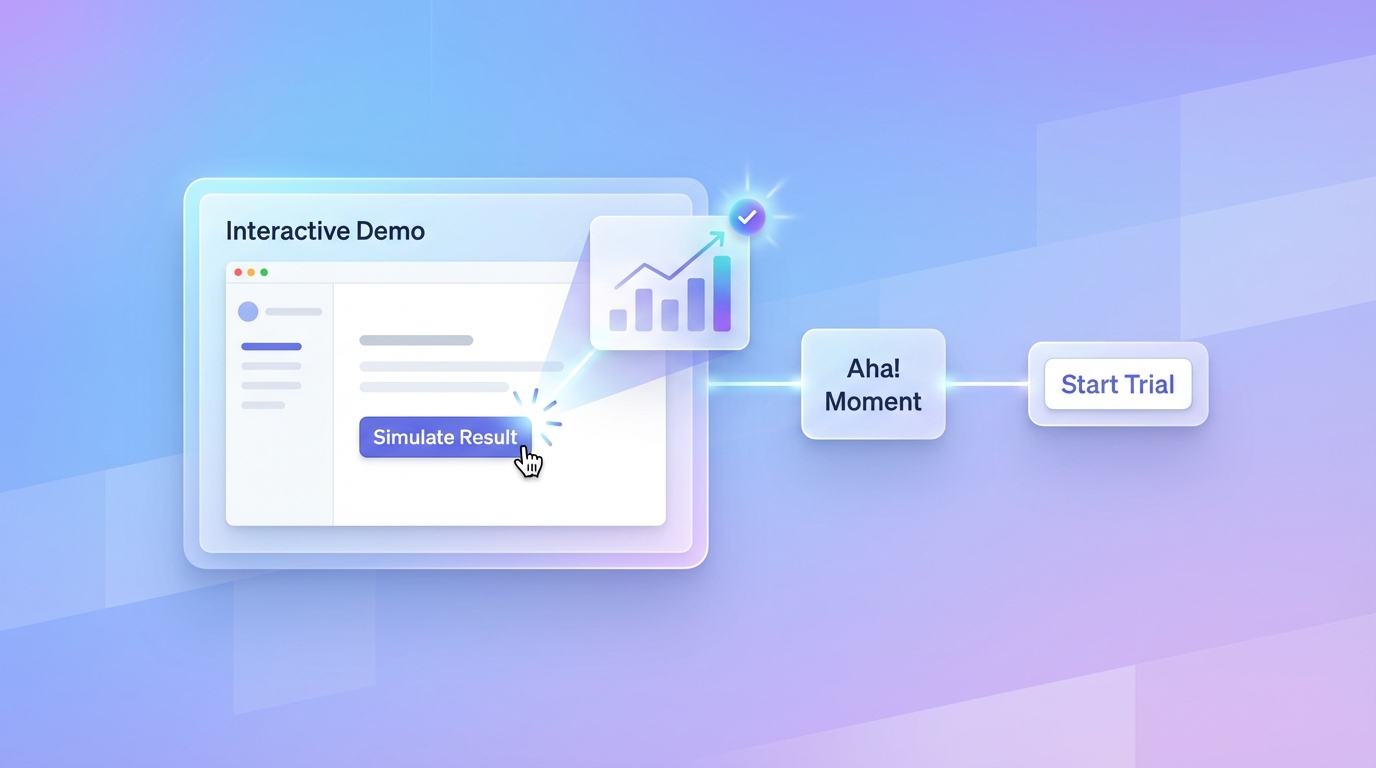
The product aha moment is the specific turning point when a potential customer finally understands how a product solves their problem. Moving this realization from after the sign-up wall to the pre-conversion content phase can significantly streamline the path to utility for new visitors.
This shift reduces the time it takes for a reader to see real value, making them more likely to commit to a trial or subscription. Keep reading to learn how to simulate the full product experience through strategic content.
Understanding the Aha Moment and the Pre-Signup Gap
Successful digital products rely on a moment of clarity where the user recognizes the solution's true utility for their unique situation. When this moment happens early, the path to long-term adoption becomes much smoother for the average user. Modern consumers expect to see what a tool can do before they provide their personal information or credit card details.
Defining the Product’s Core Value Realization
An aha moment represents the specific point of insight when a user feels the emotional impact of a product's value. For Airbnb, the aha moment is making a first booking, while for Facebook, it's the moment a user connects with several friends. For Google, the moment happens when a user finds the answer to something complex, and for Zoom, it often involves signing up and holding the first video conference.
This moment differs from activation, which is the actual completion of a key task or milestone within the software interface. Because activation is a strong predictor of long-term retention, users who experience this realization early are far more likely to remain active. Providing this insight before the signup process begins ensures that new users enter the product with a clear goal already in mind.
The Problem with Gated Value and the Friction Barrier
Many companies hide their best features and capabilities behind a sign-up wall, creating a significant barrier for new visitors. More than 67% of site visitors will completely abandon a sign-up process if they encounter any complications or excessive friction. This abandonment often happens because the user hasn't seen enough value to justify the effort of creating an account.
Up to 75% of users churn within their first week if the initial onboarding experience feels poor or confusing to navigate. Improving the trial activation rate by just 10% can lead to a 7.3% improvement in paid conversions, highlighting why eliminating user hesitation is helpful for growth. When the core value is gated, the time-to-value is delayed, making it harder for the product to prove its worth to a skeptical prospect.
Designing for the Pre-Signup Psychology
Crafting effective pre-signup content requires a deep understanding of how potential users perceive progress, commitment, and effort. Designing for the human brain's natural tendencies can turn a passive reader into a motivated and ready-to-use trial user. It's about shifting the focus from product features to the immediate cognitive rewards of finding a solution.
The Endowed Progress Effect: Showing a Head Start
The Endowed Progress Effect suggests that people are more likely to finish a task if they feel they've already made some progress toward the goal. A study showed that 34% of people redeemed a reward when given a head start, compared to only 19% who started from zero. Content can use this phenomenon by making the transition from reading to using feel like a continuation rather than a start.
Marketing content can apply this by showing a pre-configured solution or a demo that auto-completes the first few setup steps for the user. When a user feels they're already halfway to a goal, the perceived effort of signing up to finish the task feels much smaller. This feeling of momentum encourages the user to create an account just to see the project through to its completion.
Personalization and Contextual Relevance
Modern consumers have high expectations for tailored experiences, with 71% expecting personalization when interacting with a brand online. Many visitors feel frustrated when they encounter generic content that doesn't address their specific industry, role, or pain points. If the content feels like it was written for someone else, the moment of realization will likely never come.
Personalized onboarding experiences can cut churn rates by up to 25% by aligning the product's value with the user's specific goals from the very start. If a prospect clicks an ad for small team management, the content they see should focus exclusively on that use case. This hyper-relevance ensures the simulated experience feels personal, immediate, and worth the time spent.
Delivering tailored demos or walkthroughs makes the product's utility feel undeniable to the specific persona being targeted. When the content speaks directly to a user's problem, the simulated aha moment becomes much more impactful and conversion-driving.
Minimizing Commitment vs. Maximizing Perceived Value
The goal of pre-signup content is to maximize the perceived value of the product while keeping the initial commitment as low as possible. By proving the core value with zero friction, brands can build trust and authority before asking for any personal information or data. This strategy focuses on giving first and asking later, which aligns with modern buyer preferences.
Once the user has experienced the product's benefits through a demo or guide, the call to action should feel like a natural next step. Framing the sign-up as a way to save progress or unlock more features makes the commitment feel like a gain rather than a cost. It shifts the perception of sign-up from a chore to a logical way to retain the value they've already found.
Mapping Search Intent to the Aha Moment
Effective PLG content marketing requires a deep understanding of why a user landed on your page in the first place. Mapping user intent to product features ensures you're not just driving traffic but the right kind of engagement. Different search queries require different paths to the product realization moment.
Aligning Information Retrieval with Product Utility
Users searching for how-to queries are usually looking for a specific method to solve a problem right now. If your content provides a static answer without showing how your tool simplifies that process, you've missed an opportunity. You should use an article brief creator to ensure your content addresses the specific intent behind long-tail keywords.
A user looking for the best category software is in a comparison mindset and wants to see the product interface and workflow immediately. In these cases, your content should move quickly to the visual or interactive elements that define your unique value proposition. Aligning the depth of your content with the user's current intent is a fundamental part of a successful SaaS content strategy for product-led growth.
SaaS Content Strategy for Product-Led Growth
Self-serve user acquisition depends on content that acts as an advocate for the product's ease of use and immediate utility. Your strategy should prioritize topics that allow for natural product integration without sounding like a forced sales pitch. This approach bridges informational interest and the desire to start a trial.
By focusing on self-serve user acquisition, you can create a content library that continuously educates and converts visitors. Each article serves as a standalone entry point that provides a micro-win, making the eventual sign-up feel like a small hurdle. This focus on value-first education is what separates high-growth SaaS brands from those struggling with high customer acquisition costs.
The Strategic Shift: Content as the New Onboarding
Content can act as a bridge that delivers product value before a user ever creates an official account. By treating marketing assets as the first stage of the onboarding journey, brands can demonstrate their worth without requiring immediate data sharing. This transition turns passive reading into active learning and product discovery.
Interactive Demos: The Hands-On, Zero-Commitment Experience
Interactive demos allow visitors to click through a product's interface and navigate specific features without leaving a blog post or landing page. Visitors who experience these demos are nearly four times more likely to convert than those who don't interact with the software at all. These tools remove the mystery of the product by letting the user drive the experience at their own pace.
These demos simulate the actual user journey, providing a high-fidelity experience that closely mirrors the real product environment. While standard B2B SaaS demo close rates range from 20% to 50%, embedding these tools directly into content helps capture that interest much earlier. It's a way to provide a trial-like experience without the friction of a traditional trial setup.
Top-performing interactive product walkthroughs often achieve completion rates of around 35%, with some reaching 50% for well-designed walkthroughs. This high level of engagement shows that prospects are willing to explore a product's mechanics without having to provide an email address first. When users finish a demo, they've already experienced a small win, which builds confidence in the solution.
The Spectrum of Visual Education: From Static Screenshots to Narrative Walkthroughs
When full interactivity isn't an option for a specific article, high-quality visual content can serve as a powerful alternative to demonstrate value. Currently, 86% of businesses use video as a marketing tool to bridge the gap between curiosity and product understanding. Visuals can convey the ease of a workflow much more quickly than several paragraphs of technical description.
Roughly 94% of marketers say video content has directly helped increase users' understanding of their specific products or services. Using short, annotated GIFs or videos to showcase a single high-value feature can illustrate a solution in seconds. These assets help the reader see the product in action, demystifying complex processes and accelerating time-to-value.
These visual assets should focus on the specific steps required to achieve the result, essentially serving as a mini-tutorial within the content. They provide a show-don't-tell approach that allows the reader to visualize themselves using the tool successfully in their own work. Clearly annotating these visuals ensures the reader knows exactly what they're looking at and why it matters to their workflow.
Short-term vs. Long-term Time to Value (TTV)
Time to value is a critical metric that measures how quickly a user realizes a product's value. Content can artificially shorten the TTV by providing immediate micro-wins before the user even enters the product dashboard. This is achieved by solving a small part of their problem directly within the article they're reading.
While long-term TTV focuses on the total ROI of a software platform, short-term TTV is about that first spark of understanding. Content targeting short-term TTV often includes templates, checklists, or calculators that users can use right away. By providing value instantly, you establish a baseline of trust that makes the user more willing to invest time in the full product experience.
The Technical Framework for Ungated Experiences
Building a successful pre-signup aha moment requires close collaboration between marketing and product teams. The technical framework must support the transition from a guest visitor to a registered user without losing any of the momentum built. This involves creating a seamless environment where the product's value is accessible with zero barriers.
Sandbox Environments and State-Persistent Demos
A sandbox environment allows users to play with live product data or configurations without creating a formal account. This ungated experience lets them experience the full power of the software in a controlled, safe setting. It's a high-intent tactic that effectively demonstrates technical capabilities to a sophisticated audience.
State-persistent demos take this a step further by carrying a user's progress from a blog post demo directly into their new account. If a user spends ten minutes configuring a dashboard in a demo, they shouldn't have to start over after signing up. This technical integration makes the sign-up process feel like a way to save their hard work rather than an interruption.
Streamlining the Path to Utility Through Collaboration
Marketing and product teams must align on which features are most likely to trigger an aha moment for specific personas. This collaboration ensures that the content highlights the right workflows and that the product is ready to deliver on those promises. Without this alignment, you risk creating content that over-promises and a product experience that under-delivers.
SaaS onboarding content best practices suggest that the first five minutes of the user experience are the most critical. By moving the best parts of that experience into the content, you're essentially front-loading the value. This strategy requires a shared vision of the user journey that spans from the first search result to the final subscription renewal.
Leveraging Social Proof as a Secondary Aha Moment
Sometimes a user cannot experience the product directly due to technical or time constraints, so they need to see a peer doing it instead. Social proof can serve as a vicarious realization moment that validates the product's value through another user's lens. This is particularly effective for complex B2B solutions where the aha moment involves large-scale organizational change.
Narrative Walkthroughs as Vicarious Realization
A narrative walkthrough goes beyond a standard case study by detailing the exact steps a customer took to find success. It focuses on the specific moment when the customer realized the tool was indispensable to their workflow. By sharing this story, you allow the reader to project themselves into that same situation and feel the potential impact.
These stories should be structured as narrative walkthroughs that guide the reader through the problem, the discovery, and the ultimate resolution. They provide a psychological blueprint for success that readers can follow in their own minds. When a peer's success feels attainable, the reader is much more likely to take the next step toward a trial.
Social Proof for Product Activation
Social proof for product activation focuses on demonstrating how other users have successfully navigated the tool's initial stages. Seeing that thousands of others have reached their goals using your software reduces the perceived risk of starting a new project. This builds a sense of community and shared success that is very difficult for competitors to replicate.
Using real-world examples of activation helps demystify the product and makes the value proposition feel more concrete. It's about showing that the aha moment isn't just a marketing claim but a consistent reality for your customers.
The Role of Interactive Calculators and Tools
Beyond interactive demos, tools like ROI calculators or diagnostic audits can provide an immediate realization of a product's value. These assets give the user a personalized data point that highlights the cost of their current problem or the potential gain from your solution. This personalized insight is one of the most powerful ways to trigger a pre-signup aha moment.
Triggering Insights Through ROI Assessment
An ROI calculator helps a user quantify the value they stand to gain by implementing your software in their specific workflow. By inputting their own numbers, they get a personalized report that makes the solution feel tailored to their business needs. This immediate feedback often acts as the definitive moment of clarity that drives a conversion.
These tools are a core part of a strategy to reduce CAC through product-led content, as they attract high-intent leads who are already evaluating solutions. They provide a helpful service that builds trust while simultaneously qualifying the lead for your sales or product teams. It's a win-win scenario that moves the prospect closer to the product without any forced sales pressure.
Low-Friction Signup Flow Design
Once the realization moment has happened, the transition to the product must be as smooth as possible. A low-friction signup flow design ensures that you don't lose the momentum generated by your high-value content. Every additional field in a signup form is a potential point of abandonment that could undo your hard work.
Consider offering social sign-on options or allowing users to sign in with just an email address before asking for more details. The goal is to get them into the product environment while the aha moment is still fresh in their mind.
Measuring Success: Metrics for Pre-Aha Content
Determining whether pre-signup content is actually moving the needle requires tracking specific engagement and conversion metrics over time. These data points provide a roadmap for optimizing content to better serve the audience's needs and drive more sign-ups. You need to know not just how many people are reading, but how many are experiencing a genuine insight.
Tracking Content Engagement and Conversion
Marketers should monitor metrics such as scroll depth on walkthrough articles and the time spent interacting with embedded product demos. High tutorial completion rates usually indicate that the content is successfully guiding readers toward a moment of insight. If people are spending significant time in a demo, they're likely finding the value they were looking for initially.
Tracking the click-through rate from the content's primary call to action to the registration page is another clear indicator of its effectiveness. This data allows teams to iterate on the content structure, ensuring it effectively bridges the gap between initial interest and account creation. Understanding where users drop off helps pinpoint where the value proposition isn't resonating with your target audience.
Correlating Pre-Signup Engagement with Activation
Advanced strategies involve linking the behavior of anonymous visitors to their subsequent actions after signing up for an account. If users who view a specific interactive demo have higher activation rates than those who don't, that content is likely triggering the right realization. This correlation helps teams prioritize the types of content that produce the most successful long-term users.
True success is reflected in reduced time-to-value for new users who engaged with high-value content before converting. When pre-signup education is effective, users arrive in the product ready to complete their first task immediately. This seamless transition from content to product use is the ultimate goal of a pre-signup aha moment strategy.
Technical Analysis Tools for Product-Led Content
To gain a deep understanding of user behavior, use technical analysis tools such as Google Analytics 4 (GA4) and heat-mapping software like Hotjar. GA4 lets you track custom events, such as demo interactions or calculator completions, to see exactly how users engage with your tools. These insights help you refine your content to better trigger those essential realization moments.
Heatmaps provide a visual representation of where users are clicking and how far they scroll on your pages. This helps you identify whether your most important visual assets are getting the attention they deserve or are buried too deep in the text. By constantly monitoring these technical metrics, you can ensure your content remains a powerful engine for product-led growth.
Transforming Your SaaS Growth Strategy With Product-Led Content
Triggering a product's realization moment before a user signs up is a powerful way to streamline the path to utility and accelerate the customer journey. By demonstrating value through interactive and visual content, brands can improve conversion rates, lower churn, and build stronger relationships with their audience. This strategic shift ensures visitors understand the solution's value before they provide their personal information.
We understand that creating these detailed and engaging content assets requires consistent effort and strategic expertise to execute correctly. Brand Voice delivers ready-to-publish SEO content that captures attention and drives meaningful results for your SaaS business. We handle the heavy lifting of content creation so you can focus on building your product and growing your brand.
Reach out to us to book a demo today and learn how we can help you build content that turns readers into loyal customers.