
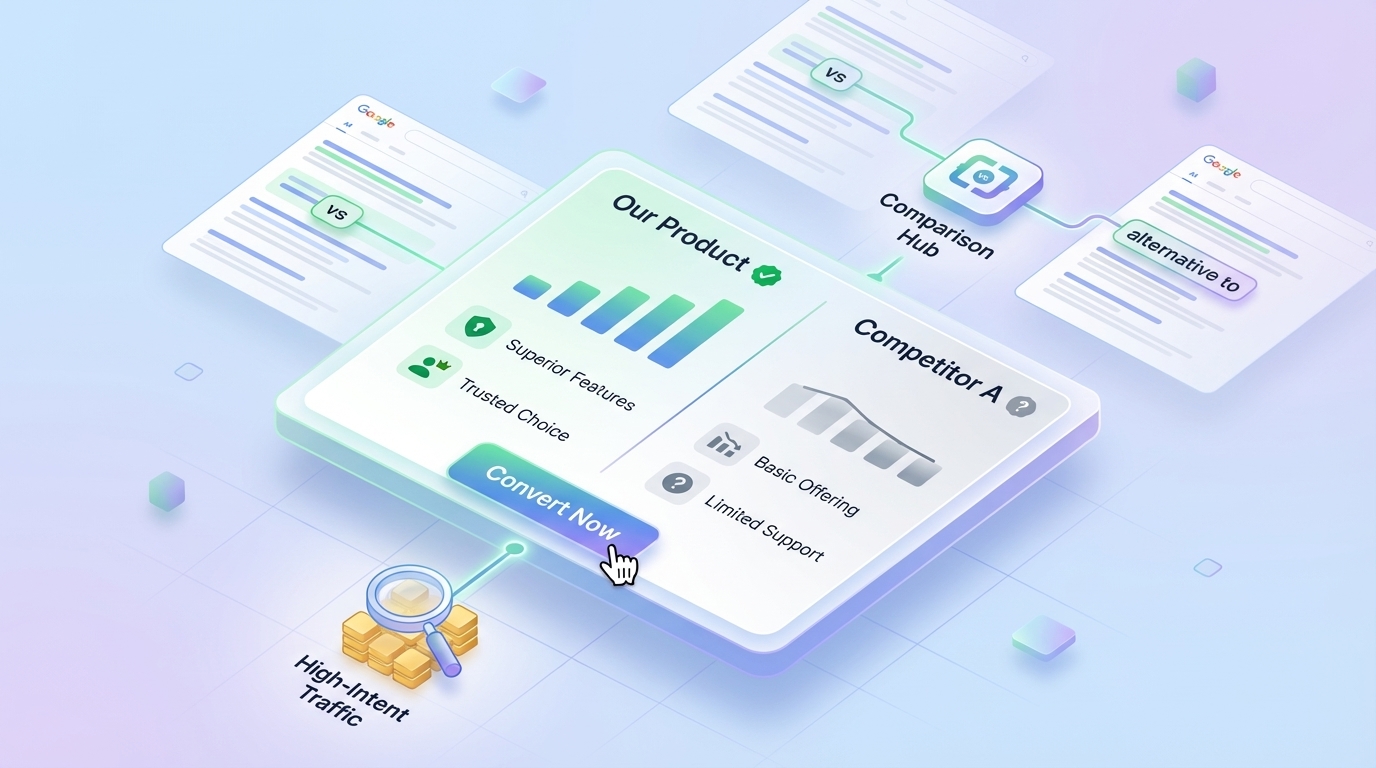
- Proprietary comparison pages capture high-intent traffic and typically convert at two to five times the rate of standard blog content by targeting buyers in the final decision-making stage.
- Owning "vs" and "alternative to" keywords allows brands to reclaim their voice from third-party affiliates and position their unique value propositions directly to autonomous B2B buyers.
- Effective product comparison pages build trust through balanced side-by-side charts, qualitative data, and the integration of social proof like unbiased third-party reviews.
- Implementing Product and Review schema markup alongside a centralized Comparison Hub silo structure improves search engine visibility and helps brands outrank high-authority review aggregators.
- Scaling a comparison strategy requires a data-driven approach to identify high-volume rival queries and a regular audit schedule to ensure all pricing and feature information remains accurate and verifiable.
Search engine results pages often look like a battlefield where third-party affiliates and review aggregators dominate the most valuable real estate. These external sites frequently control the narrative for vs-keyword and alternative-to-[brand] search queries. This dynamic forces brands to rely on others' subjective opinions rather than their own factual data and unique value propositions.
Relinquishing control over these search terms represents a significant loss of potential revenue and brand authority in the modern digital landscape. Transitioning to a strategy focused on proprietary comparison hubs allows your organization to reclaim its voice and guide the buyer through the final stages of the journey. Understanding the mechanics of these high-intent assets is the first step toward capturing more revenue and outperforming competitors in the SERPs.
Why Brands Must Own Their "VS" and "Alternative To" Keywords
Capturing bottom-of-funnel content directly on your own website is a strategic necessity for any brand looking to maximize its digital footprint. High-intent users who are actively searching for comparisons are in the final decision-making stage and have already identified their pain points. Owning these keywords ensures that your brand remains the primary source of truth for its own capabilities and market positioning.
The financial impact of this ownership is significant because comparison and review pages typically convert at two to five times the rate of general blog content. These readers aren't looking for educational definitions or broad overviews of an industry. They're looking for a reason to choose one solution over another, making them the most qualified leads in your entire marketing funnel. By retaining this traffic, you prevent potential customers from being distracted by affiliate links or alternative recommendations that don't serve your business goals.
One B2B SaaS company demonstrated the power of this approach by building approximately 50 competitor comparison pages to target specific competitors in the market. These pages now drive between 1,000 and 2,000 organic visits every month with conversion rates ranging from 5% to 10%. This performance highlights the massive ROI available when you dedicate resources to high-intent traffic rather than just top-of-funnel awareness. Most organizations neglect this area, as research shows only 14% of marketers actively create bottom-of-funnel content.
Proprietary comparison pages establish brand authority by providing the data buyers need to validate their choices. Comparison pages reach individuals who intend to shop or buy and want to complete their research independently. When a user finds a transparent and comprehensive comparison on your site, it naturally shortens the sales cycle. Providing these answers upfront builds immediate trust and positions your brand as a helpful partner rather than just a vendor.
The Role of Cognitive Bias in Comparison Shopping
Users process information during a side-by-side evaluation, influenced by various cognitive biases that shape their perception of value. One of the most powerful tools a brand can use is framing, which involves presenting data in a way that highlights specific strengths. For example, if your product has a higher price point but includes more features, you frame it as a complete solution rather than an expensive option. This ensures the user feels they're making a logical choice based on the data you've provided.
Brands must use framing carefully to maintain credibility while still advocating for their own product. The goal is to present a side-by-side comparison that makes your product the logical choice for the user's specific needs. If the framing is too aggressive or obviously skewed, the user's skepticism will increase, and the page will lose its effectiveness. Providing a balanced view that acknowledges a competitor's basic features while highlighting your unique specialized tools creates a sense of objectivity.
Cognitive ease is another factor that dictates how well a comparison page performs. When you simplify complex data into readable charts, you reduce the mental effort required to make a decision. A buyer who feels overwhelmed by information is likely to postpone their purchase or choose the most familiar brand. Your design should guide the eye toward the most important differentiators without requiring the user to hunt for the facts.
Understanding the High-Intent Searcher: The Psychology of Comparison
Designing an effective comparison page requires a deep understanding of the mindset of a user weighing two specific options. These users are rarely looking for brand discovery or general category education. Instead, they're searching for confirmation of their existing research to feel confident in their final purchase decision. This psychological state is fragile, and the user will quickly abandon a page that feels like an unhelpful sales pitch or a biased advertisement.
The Shift from Discovery to Decision
The psychological transition a buyer makes when moving from broad category searches to specific brand-on-brand comparisons is profound. Early in the journey, a user might search for "best project management software" to understand the general landscape and available features. By the time they search for a specific comparison, they've narrowed their options and are looking for a tie-breaker to justify their choice. They've moved from the discovery phase into the high-stakes decision phase where the details matter most.
These users require highly specific information, such as pricing transparency, granular feature differences, and use-case suitability. They are looking for the nuances that distinguish one platform from another in a real-world working environment. Vague marketing claims about being SOC 2 Type II compliant or having an API-first architecture are ignored in favor of hard data and technical specifications. B2B buyers consume an average of 11 pieces of content before they ever contact a sales representative.
Comparison pages are often the very last piece of content a lead reads before they convert into a customer. Because this is the final touchpoint, the clarity and accuracy of the information provided are paramount. If the page answers their final lingering questions about integration capabilities or data security, the barrier to purchase is removed. Providing this clarity on your terms ensures that the buyer feels empowered to move forward without further hesitation.
The Rise of the Autonomous B2B Buyer
The modern B2B buyer is more autonomous than ever before. Research indicates that 75% of B2B buyers prefer not to engage with a sales team at all during their evaluation process. They rely heavily on digital content to guide their decisions and validate their choices. If your website doesn't provide the granular data they need, they'll find it on a third-party site that may not have your best interests in mind.
This autonomy means your SEO articles must do the heavy lifting that a sales representative would. Every comparison page should address common objections and highlight the specific benefits of your solution. By providing a self-service research tool, you respect the buyer's preference for independence. This approach builds a foundation of trust before the first human interaction even occurs.
Strategic Planning: Identifying the Right Competitors to Challenge
A data-driven approach is necessary when choosing which competitor comparison pages to build first for your website. You cannot challenge every player in the market simultaneously, so prioritization is key to efficient resource management. You must evaluate which competitors your sales team most frequently mentions and which appear most often in search queries. This ensures that your content team spends time on pages that will have the greatest immediate impact on revenue.
Analyzing Search Volume for "[Brand] vs [Competitor]"
Keyword research tools are the primary way to identify high-volume comparison queries that are already happening in your industry. You should start by comparing your brand name with your primary rivals to see how often users try to differentiate you from them. This data shows which competitors are currently top of mind for your potential customers. If YourBrand vs CompetitorX has significant volume, that page should be your highest priority.
It's also beneficial to look at competitor-versus-competitor queries where your brand isn't currently mentioned. These queries represent an opportunity to disrupt the conversation and insert your product as a superior alternative. By ranking for 'Competitor A' vs 'Competitor B', you can capture users who are unhappy with both options and are looking for a better way. This allows you to intercept traffic that was originally intended for your rivals and redirect it to your own solution.
Don't ignore keywords with lower search volumes during your research process. Even keywords with fewer than 20 monthly searches can collectively drive 149 or more organic signups with conversion rates between 2% and 4.5%. These long-tail comparison queries often represent the most specialized and determined buyers in the market. When you aggregate these small volumes across dozens of pages, the total impact on your bottom line is substantial.
Leveraging "Alternative to [Competitor]" Search Queries
The alternative to keyword trend is a powerful way to reach users who are frustrated with a market leader or a direct rival. These users are actively looking for a reason to switch providers because of price hikes, poor customer service, or missing features. Positioning your brand as the logical next step for these individuals requires a deep understanding of why they are leaving their current solution. Your content must speak directly to those frustrations and offer a clear path forward.
When creating these pages, you should focus on the specific gaps in the competitor's offering that your product fills. Tracking 'alternative to [brand]' search queries in Search Console allows teams to identify which rivals are most frequently associated with their product in the audience's mind. If a market leader is known for being overly complex, position your product as the streamlined alternative with a documented sub-five-minute onboarding flow. This targeting ensures that you're not just getting traffic but the right kind of traffic.
You can also target long-tail, high-intent keywords such as 'best CRM alternative for mid-market teams' to capture specific audience segments. These phrases bring users closer to a purchasing decision than generic 'brand vs. brand' queries. By addressing the specific needs of a niche group, you increase your page's relevance. This specificity often leads to higher conversion rates and better lead quality.
Building a Comparison Silo Structure
Internal link siloing is critical for ranking competitor comparison pages against high-authority review sites. You should create a parent Comparison Hub page that links out to every individual versus page on your site. This centralizes your authority and makes it easier for search engines to crawl your high-intent content. A well-organized hub signals to Google that you are a comprehensive resource for market evaluation.
From each comparison page, you should link back to the hub and other related versus pages. This distribution of link equity helps your newer pages rank faster by leveraging the strength of your established content. Leveraging topic clusters in this manner ensures that search engines recognize the semantic relationships among your various product evaluations. It transforms a collection of isolated pages into a powerful topical authority engine.
Effective siloing also improves the user experience by providing a clear path for further research. If a user is comparing you to one competitor, they might also be interested in how you stack up against another rival. Providing these links keeps the user on your domain and prevents them from returning to the SERPs. The longer a user stays engaged with your content, the higher the likelihood of a conversion.
Designing for Trust: The Anatomy of an Effective Comparison Page
The visual layout of a comparison page is just as important as the copy written on it. A page that resembles a traditional sales pitch, with massive Buy Now buttons and hyperbolic claims, will immediately lose credibility. These users are looking for a tool to help them make a decision, not a brochure that tries to force one on them. The design must feel organized, professional, and objective to keep the reader engaged.
The Power of the Side-by-Side Product Comparison Charts
Designing effective product comparison charts requires a balance between simplicity and depth. A standard grid with features on the left and brands across the top is the most recognizable format for users. It allows for quick scanning and immediate identification of where one product excels over the other. Well-structured product comparison charts highlight product differentiation by providing a clear visual contrast between solutions.
Using clear Check and X marks is helpful for high-level comparisons, but these marks alone are often insufficient for technical buyers. You should include qualitative data within those cells to provide real context for the comparison. For example, instead of a simple checkmark for Support, you might specify 24/7 live chat versus Email only. This level of detail provides the evidence a user needs to validate the comparison as authentic and researched.
The visual clarity of your chart should guide the user toward your product's unique strengths without being deceptive. You can use subtle design cues, such as a slightly highlighted column for your own product, to draw the eye. However, you must ensure that the competitor's features are accurately represented to maintain the trust you've built. A chart that clearly shows your product has more features is more convincing than a chart that hides the competitor's strengths.
Going Beyond Features: Use Case Narratives
A simple feature list isn't enough to convert a high-intent buyer who is looking for a solution to a specific problem. You must create narratives tailored to specific industries or user roles to demonstrate why your product is the superior choice. For instance, a feature like bulk data export is more compelling when explained as a way for Financial Analysts to save five hours a week. This narrative approach helps the user visualize themselves successfully using the product.
Showcasing why your product is the better choice for a specific customer type allows you to segment your audience effectively. You might explain that while a competitor is great for small startups, your platform is built for the security requirements of global enterprises. This honesty helps filter out the wrong leads and increases the satisfaction of the customers who do sign up. It also builds authority by showing that you understand the different needs within your market.
Use case narratives should be supported by concrete examples and data points. If you claim your product is better for creative agencies, explain exactly which tools in your suite benefit that specific workflow. This prevents the content from feeling like generic marketing fluff and provides the granular information buyers crave. By connecting features to outcomes, you make the researcher's decision much easier.
Incorporating Social Proof and Unbiased Product Reviews
Integrating third-party reviews and ratings directly into your competitor comparison pages is one of the most effective ways to increase perceived objectivity. Displaying G2 or Trustpilot badges or star ratings shows that you're not just making claims in a vacuum. When a user sees that other people have already made the switch and are happy, their social proof bias is triggered. This reduces the perceived risk of choosing your product over a more established rival.
Showing what real users say about both products can further enhance the page's credibility. Including unbiased product reviews that mention a competitor's strength actually makes your own claims about your product's strengths more believable. It signals to the reader that you're confident enough in your value to acknowledge the competition. This 'honest broker' approach is far more effective at converting sophisticated buyers than a page that pretends the competition has no merits.
You should curate these reviews to highlight specific transitions from a competitor to your product. A testimonial that says "We switched from CompetitorX because of the better API-first architecture" is incredibly powerful. It provides the social validation a researcher needs to justify their own desire to switch. By focusing on the results of the transition, you make the path to your brand feel safe and proven.
The Ethics of Objectivity: Balancing Bias and Advocacy
The challenge of being honest yet biased is central to the success of any comparison page strategy. To be effective, you must acknowledge a competitor's strengths while still positioning your product as the better overall fit. If you claim your competitor is terrible at everything, the reader will immediately recognize the bias and discount your information. Admitting that a competitor has a good mobile app while your desktop experience is superior for heavy-duty work creates a sense of balance.
When to Concede a Feature
Admitting that a competitor offers a better feature for a specific use case can actually increase the conversion rate for your target audience. It positions your brand as an expert advisor rather than a biased seller who is willing to say anything for a click. If your product is built for enterprise security, you can safely concede that a rival is better for hobbyists or individual freelancers. This builds immense trust with the high-value buyers who actually belong on your platform.
When you concede a feature, you should immediately follow up by explaining why your product prioritizes something else. For example, you might say a competitor offers more visual themes, but your product focuses on a documented sub-five-minute onboarding flow. This reframes the comparison as a matter of philosophical difference rather than a technical failure. It helps the buyer choose the tool that aligns with their own values and operational goals.
The long-term SEO and brand benefits of being an honest broker of information are substantial. Google's algorithms are increasingly sophisticated at identifying content that provides genuine value versus content that is purely promotional. Pages that provide balanced, factual, and helpful comparisons are more likely to maintain high rankings over time. Furthermore, customers who join your brand based on an honest comparison are less likely to churn because they have accurate expectations.
Technical SEO Best Practices for Comparison Pages
The technical side of these pages is what ensures they actually reach the users who are searching for vs keywords. Comparison pages have unique requirements because they need to rank for both brand names involved in the query. This means your on-page optimization must be precise enough to signal relevance to search engines without making it look like you're trying to hijack traffic. A well-optimized technical foundation is what allows you to compete with established review sites.
Implementing Product and Review Schema
Schema.org markup is a critical technical component for any high-performing comparison page. You should use Product and Review snippets to provide search engines with structured data about the items being compared. This markup allows Google to display rich results, such as star ratings and price ranges, directly in the search results. Schema markup provides technical context for search engine crawlers to understand the page's intent.
When you implement schema correctly, you're essentially speaking the search engine's language. It helps the algorithm understand that your page is a side-by-side evaluation rather than just a blog post. By achieving rich results in the SERPs, you can often outshine affiliate sites that may lack the technical resources to implement complex schema. This gives your brand-owned page a professional edge that attracts more high-intent clicks.
Rich snippets also provide an immediate sense of authority to the user before they even click on your site. Seeing a high star rating or a clear price comparison in the search results validates the page's utility. This is especially important for competitor comparison pages where you are trying to win trust from the very first interaction. Technical SEO, in this context, is not just about rankings; it's about the user's first impression of your brand's transparency.
URL Structure and On-Page Optimization for "VS" Keywords
Tactical elements of SEO, such as URL structure and H1 tags, play a massive role in how these pages are indexed. Your URL slug should be clean and descriptive, typically following a format like /vs/competitor-name or /alternatives/competitor-name. This clear structure tells both the user and the search engine exactly what to expect on the page. It also makes it easier for you to organize many comparison pages in a dedicated hub on your site.
Your H1 tag should directly address the "versus" intent by prominently including both brand names. For example, an H1 like "YourBrand vs. CompetitorX: Which Is Better for [Use Case]?" is highly effective. This matches the user's search query while also adding a helpful qualifier that hints at the content's depth. Avoiding overly clever or cryptic titles ensures that you don't miss out on the specific vs keywords traffic you're targeting.
Meta descriptions should be optimized to capture the researcher's specific intent for comparison. You want to summarize the key differences mentioned on the page and provide a reason for the user to click. A description that says "Compare features, pricing, and user reviews for YourBrand and CompetitorX" is much better than a generic company bio. The meta description is your elevator pitch in the search results, so it must be clear and direct.
Conversion Rate Optimization (CRO) for Comparison Pages
Turning high-intent traffic into actual leads or customers is the ultimate goal of these pages. Because these users are already in the decision phase, your conversion rate optimization (CRO) should be focused on removing the final barriers to action. Research shows that comparison content attracts users who are 3-4 times more likely to convert than readers of informational content.
The placement of call-to-action buttons, such as Start Free Trial or Request a Demo, is vital to guiding the user. You should place these buttons near the top of the comparison chart, where user interest is highest. It's also helpful to include a secondary CTA at the bottom of the page once the user has finished reading the breakdown. Providing multiple opportunities to convert ensures that you capture the user as soon as they feel they've seen enough information.
Using sticky navigation bars that keep the CTA visible as the user scrolls down the page is a highly effective tactic. Comparison pages can often be long and data-heavy, and you don't want the user to have to scroll all the way back to the top. A persistent button keeps the next step in their peripheral vision at all times. This reduces the friction of the conversion process and reminds the user why they are on the page.
Exit-intent pop-ups can be a final way to capture users who are still on the fence. These pop-ups should be specifically tailored to the comparison they were reading. For example, if they were comparing your product to a more expensive rival, the pop-up could offer a Cost Savings Calculator. This provides value even if they aren't ready to buy today, allowing you to capture their email address for content marketing for SaaS nurturing.
Overcoming Legal and Compliance Challenges in Competitor Marketing
Mentioning competitors by name on your own website comes with specific legal and compliance challenges that must be managed carefully. You must ensure that all the data you provide is factual, verifiable, and not misleading. Using false information to make a competitor look bad is not only unethical but can also lead to legal disputes or trademark infringement claims. Your goal is to win on merit, not on deception.
To stay within the bounds of fair use and trademark laws, you should always include disclaimers about the data on the page. Mention when the information was last updated and provide links to the sources of your data whenever possible. This transparency shows that you've made a good-faith effort to be accurate. It also protects you if a competitor changes their pricing or features after your page has been published.
Maintaining a factual tone is the best way to avoid compliance issues. Instead of saying "CompetitorX is slow," you should say "CompetitorX has a reported average latency of 200ms." This shift from opinion to data-backed statement makes your content much harder to challenge. It also makes your brand look more professional and authoritative to the user. Always have your legal or compliance team review your comparison templates before you scale the strategy.
Scaling Your Comparison Page Strategy
Moving from one or two comparison pages to a full-scale Comparison Hub is how you truly dominate your industry's high-intent search results. A hub is a centralized section of your website that hosts all your "vs" and "alternative to" content in an organized way. This structure makes it easy for users to find the specific comparison they need and helps search engines understand the breadth of your knowledge. It turns your site into a one-stop shop for anyone evaluating the category.
Comparison Page Audit Checklist
Maintaining high-converting comparison pages requires a commitment to data accuracy and technical performance. You should establish a regular audit schedule to ensure your competitor data remains up to date. Outdated pricing or feature lists can damage your credibility and lead to high bounce rates. A systematic approach to auditing ensures that your comparison hub remains a reliable source of truth.
- Verify competitors' pricing monthly to ensure accuracy.
- Check for new feature releases every six weeks to maintain topical relevance.
- Validate that all CTA links use UTM parameters for precise conversion tracking.
- Ensure review ratings from G2 or Trustpilot are updated quarterly.
Regularly reviewing your differentiating content allows you to stay ahead of market shifts. If a competitor pivots their strategy or changes their focus, your comparison page should reflect that update. This agility is what allows challenger brands to outpace stagnant incumbents. A well-maintained library of comparison pages is one of the most profitable activities your marketing team can perform.
Defensive SEO: Protecting Your Brand from Negative Ads
Owning your comparison pages serves a vital defensive purpose by preventing competitors from bidding on your brand name with negative ads. When you rank highly for "Alternative to YourBrand," you provide a counter-narrative you control. This ensures that a prospect searching for your rivals finds your objective comparison before they find a biased competitor landing page. Defensive SEO is about securing your brand's reputation in the high-stakes evaluation phase.
By capturing this real estate, you force competitors to pay more for less effective ad placements. If your organic result is comprehensive and trustworthy, users are less likely to click on a paid ad that feels like a biased sales pitch. This strategy protects your customer acquisition costs by reducing the effectiveness of aggressive rival marketing. It is a proactive way to maintain your share of voice in a competitive market.
Defensive strategies also involve monitoring the SERPs for new comparison pages created by third-party affiliates. You should reach out to these sites to provide accurate data about your product and its latest features. While you cannot control what they write, you can ensure they have the facts they need to be fair. Combining proprietary content with third-party outreach creates a robust shield for your brand's digital presence.
Accelerate Your Market Share Acquisition with Brand Voice
Owning the comparison narrative is a powerful way to capture users at the point of purchase and build long-term brand authority. By creating proprietary pages for "vs" keywords and "alternative to [brand]" search queries, you take control of your reputation. You ensure that potential customers see the most accurate version of your value proposition during their final decision phase. The Brand Voice platform automates high-intent article production to help you scale this strategy without the manual burden of research and design.
Achieving this level of comprehensive comparison content often requires significant internal resources for research, design, and SEO optimization. We understand the challenges of manually constructing these complex pages while ensuring every fact is verifiable and aligned with your brand voice. Creating a Comparison Hub is an investment in your brand's future that pays dividends through higher conversion rates and shorter sales cycles. Our SaaS platform is designed to eliminate the guesswork so that you can publish high-quality, high-intent SEO content at scale.
Our expertise allows you to create ready-to-publish content that outranks competitors and affiliate sites alike. Whether you need five comparison pages or fifty, we provide the technical accuracy and engaging writing needed to drive real business results. Schedule a demo today to see how Brand Voice can deliver the high-intent content you need to dominate your market.
