
- Authority retention measures how effectively a backlink maintains its search engine optimization impact over time as content moves from high-visibility areas into deeper layers of a site's architecture.
- Data on link rot indicates that nearly 44% of backlinks are lost after seven years, highlighting the need for ongoing monitoring to combat the natural erosion of a brand’s organic search authority.
- Technical audits are necessary to identify ghost links and link equity decay, ensuring that aged digital PR placements still return a 200 OK status and remain indexed by search engines.
- Effective link reclamation strategies, such as the Broken Resource Replacement method, allow brands to restore lost ranking power by providing editors with updated and relevant content to replace dead links.
- Future-proofing a digital PR strategy requires prioritizing publishers with stable site architectures and creating evergreen content that maintains its topical relevance and E-E-A-T signals long after the initial launch.
Most digital PR campaigns follow a predictable lifecycle, with the primary focus on the initial launch and the immediate influx of referral traffic. Brands often celebrate the surge in visibility but quickly move on to the next project without considering the long-term health of their acquired assets. This narrow focus ignores the reality that a placement is not a permanent fixture once it's published on a reputable site.
Authority retention describes how well a backlink maintains its search engine optimization impact over time. Understanding that a link on a domain with significant topical authority and a high volume of referring domains isn't a static asset is the first step toward a more mature search strategy. The value of these connections fluctuates based on publisher activity, site changes, and search engine algorithms. Understanding the mechanics of link decay is the first step toward protecting your brand's long-term organic search authority.
The Evolution of Link Value in Digital PR
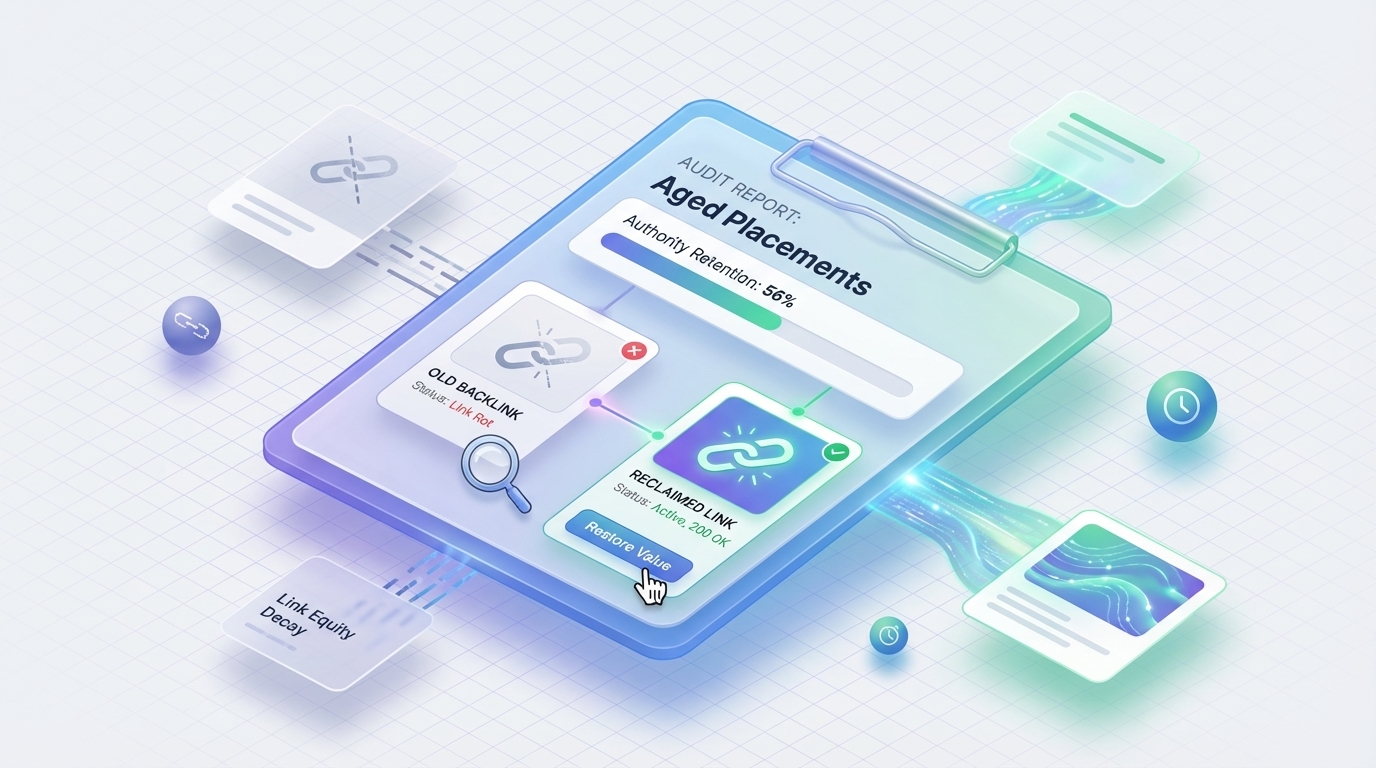
The value of a link changes significantly as it moves from a fresh news story to archival content. Initially, a placement often benefits from being featured on a publisher's homepage or in a prominent category section. These high-visibility areas provide strong internal link equity and high crawl frequency from search engines. As time passes, the article moves further away from the homepage and into the deeper layers of the site's architecture.
Data on link rot suggests that nearly 44% of backlinks are lost after 7 years. This statistic highlights the precarious nature of historical placements and the need for ongoing monitoring. Since early 2013, studies indicate that approximately 66.5% of links pointing to a massive sample of websites have rotted away. These figures demonstrate that the initial victory of a digital PR hit is only the beginning of its lifecycle.
A placement usually has its greatest impact during the newsworthy phase, when internal links are most numerous. Once the article is archived, it must rely on its own deep page authority and the host site's remaining internal structure. While the link may still exist, its ability to pass meaningful ranking signals can diminish if the page becomes isolated. Regular audits help you understand which of these older links are still contributing to your organic search performance.
The Mechanisms of Link Equity Decay
The term link equity decay refers to the gradual loss of a backlink's power as the hosting page loses its prominence on a publisher's site. Technical and structural shifts are often the primary drivers of this decline in strength. When a publisher adds thousands of new articles over several years, your original placement naturally sinks deeper into the site hierarchy. This increase in click depth means the page receives fewer internal links and a smaller share of the domain's overall authority.
The timeline for this decay can be surprisingly fast for some industries and publication types. About 8.03% of all links break within the first three months of being published on the web. By the seven-year mark, that number jumps to 44% as pages are deleted or sites undergo major structural overhauls. This consistent erosion means your historical backlink profile is constantly shrinking unless you're actively monitoring for link equity decay.
Psychological and editorial reasons also contribute to the loss of link value over time. Editors may perform content pruning to remove outdated information or improve site speed. During these updates, your link might be removed or changed to a different format that passes less authority. Being proactive allows you to catch these changes before they negatively impact your overall domain rating growth.
The Phenomenon of Ghost Links
Ghost links occur when a backlink appears active in your monitoring tools but provides no actual SEO value. This happens when a page is technically present but becomes hidden from search engines or users. A publisher might decide to put older content behind a paywall, which can limit search bots' ability to crawl the link effectively. In other cases, a site might change its editorial policy and apply a no-follow attribute to all articles over a certain age.
A link not being found is actually the most common reason for link loss in the digital PR world. Studies show that someone on the editorial or technical team eventually removes 50.9% of links. Sometimes these removals are intentional housecleaning, while other times they're the result of content pruning strategies aimed at improving site speed. When a link is deleted, it may still leave a link echo or a ghosting effect where some ranking power remains briefly.
A ghost link is the residual ranking power a backlink retains even after it's been deleted. This phenomenon can mislead marketing teams into thinking their old PR wins are still working when they're actually losing ground. Relying on these echoes is a poor long-term strategy because search engines eventually refresh their index to reflect the current state of the web. Identifying these ghosts allows you to stop counting on dead weight and focus on reclaiming lost value.
The Role of Nofollow and Sponsored Attributes in Aged Placements
Publishers often update their outbound linking policies to align with evolving search engine guidelines. Some major media outlets bulk-change older outbound links to no-follow as a safety measure against penalties. This loss of silent authority can occur without notice, effectively neutralizing the link's impact. Monitoring these attribute changes is necessary to maintain link relevance for your historical profile.
The shift from follow to no-follow attributes can occur during site-wide migrations or platform updates. While no-follow links still provide referral traffic, they do not pass as much link equity as standard links. Search engines use these attributes to understand the nature of the relationship between the two domains. Identifying these shifts helps you assess whether a placement still aligns with your technical SEO goals.
Maintaining a healthy mix of link attributes is important for a natural backlink profile. However, you should prioritize retaining follow links on placements on domains with a DR of 70 or higher. If a high-value placement suddenly switches to a sponsored attribute, it may signal a change in the publisher's monetization strategy. Tracking these nuances ensures that your authority retention remains high across your entire portfolio.
Developing a Comprehensive Audit Framework for Historical Placements
A systematic approach to auditing aged digital PR placements allows you to move from a reactive state to a proactive strategy. You shouldn't wait for your rankings to drop before checking on the health of your historical backlink profile. The goal of this framework is to identify where value has been lost and where reclamation opportunities exist. By using data to guide your decisions, you can refine your future campaign strategies to favor publishers who offer better authority retention.
Inventory Management and Source Validation
The first phase of a successful audit involves compiling a master list of every historical digital PR placement you've earned. You should pull data from multiple sources, including backlink monitoring tools and your own internal campaign records. This initial list acts as the foundation for all subsequent technical checks and value assessments. Success in long-term search performance depends on auditing historical backlinks at least once per quarter to ensure your site's foundation remains stable.
Verifying that the linking page still exists is a fundamental part of the audit process. You must confirm that the URL is live and that the specific link to your site remains in the content body. Publishers often update old articles to remove outbound links that they no longer find useful or relevant. If the page is still there but your link is gone, you've identified a clear loss of authority that needs to be addressed.
Editorial teams may also alter a page's context during a routine content update. A link that was once part of a supportive paragraph might now be buried in a list of related resources or moved to a different section. These changes can affect how search engines assess a link's relevance to your target keywords. Keeping an accurate inventory allows you to track these subtle shifts in how your brand is represented on external sites.
Technical Status Analysis and Redirect Identification
Technical checks are necessary to ensure that your links are not being caught in a series of redirects that dilute their strength. You should check the HTTP status code for every linking page in your inventory to see how the publisher handles it. A 301 redirect on the publisher's side is preferable to a broken page, but it still results in a small loss of equity. You want to see a clean 200 OK status for your most important placements.
301 redirects preserve approximately 90 percent of link equity in many scenarios. However, excessive redirect chains can slow down crawlers and eventually lead to a total loss of authority. A soft 404 is a specific technical issue in which a page appears to load normally, but search engines treat it as a dead end. Identifying these soft 404s is a high priority during your technical audit phase because they waste crawl budget.
You must also check the health of your own internal pages that these historical links point to. If you've deleted a page on your own site that was once a popular PR target, those links are now hitting 404 errors. This completely severs the link's value and wastes the authority the publisher is trying to pass on. Implementing proper 301 redirects on your end can immediately restore the flow of equity from these aged placements.
Measuring Deep Page Authority and Indexation Status
Evaluating the current strength of a linking page requires looking at metrics like deep page authority rather than just the overall Domain Rating. While a site might have a high domain score, a specific article could have very low authority if it's isolated. Page Authority is a metric developed by Moz that predicts how well a specific web page is likely to rank in search engine results. Using this metric helps you prioritize which links are worth the effort of a reclamation campaign.
Indexation status is another critical data point that you must verify manually for your top-tier placements. A page that isn't in Google's index cannot pass any ranking signals to your website. You can use the site: search operator followed by the specific URL to see if Google still recognizes the page. If the page doesn't appear in the search results, it has likely been de-indexed due to quality issues or structural changes.
Googlebot assigns crawl priority based on internal link depth within the publisher's site. Understanding the difference between a high-authority domain and a high-authority page is key to maintaining link relevance. A link from a major news site's archive folder may be less valuable than a link from a smaller niche site's active blog. Your audit should identify which pages have maintained their standing and which have faded into obscurity.
Phase 3: Quantitative Performance Mapping
Determining whether a historical link is still pulling its weight requires considering several performance indicators beyond its mere existence. Referral traffic trends over time are often the most direct way to measure a placement's current health. If a link that used to drive hundreds of visitors a month now drives zero, the page has likely lost its visibility. This drop in traffic often precedes a drop in the link's SEO value as well.
The number of internal links pointing to the placement on the publisher's site is another indicator of its archival status. You can use SEO tools to see how many other pages on the publisher's domain are still linking to your PR piece. If that number has dropped to zero, the page is effectively orphaned within the site's architecture. Orphaned pages are rarely crawled and offer very little in terms of authority retention.
You should also monitor the keyword rankings of the linking page itself to see if it still holds any topical weight. If the page used to rank for several high-volume terms but has now fallen out of the top 100, its authority has diminished. A page that search engines no longer trust to rank well will not pass significant equity to your site. Reviving decaying content can sometimes help, but you must first identify which external sources are failing to support your profile.
Step-by-Step Technical Workflow for a Digital PR Audit
A structured workflow ensures that your audit is both efficient and thorough. Start by exporting your entire backlink profile from a tool like Ahrefs or Semrush. This list should include the referring URL, the anchor text, and the date the link was first seen. This raw data serves as the baseline for your technical status checks.
Next, use a tool like Screaming Frog to perform a bulk status code check on every referring URL. This identifies which pages return 404 errors, 301 redirects, or 200 OK responses. You can also configure the crawler to look for the presence of your link within the HTML code of each page. This automated step quickly filters out the broken or removed links that need immediate attention.
Finally, cross-reference your findings with Google Analytics 4 to identify which aged PR placements are still sending engaged sessions. Links that still drive traffic are the highest priority for retention and reclamation. This data-driven approach ensures you spend your time on the placements that provide the most tangible value. Integrating this SEO content strategy into your regular maintenance routine protects your long-term growth.
The Publisher Retention Score
Not all publishers are equal when it comes to maintaining the long-term health of their content. You can grade publishers based on their historical retention rates and the stability of their site architecture. A publisher with a stable architecture that keeps old news stories well-indexed is a much better target for future campaigns. This score helps you allocate your budget to publishers that offer the best value in archival content.
Crawl budget only matters for sites with 10,000 pages or more, which includes almost all major digital PR targets. For these massive sites, Google must decide which pages are worth visiting regularly. Publishers who prioritize their archives and maintain strong internal linking provide better long-term value for your backlinks. If a site frequently moves content to low-crawl subdomains, its retention score should be lower.
You should also consider the frequency of site migrations when evaluating a publisher's retention score. A major media outlet that migrates its platform every two years often loses a high percentage of its historical link equity. Sites that maintain consistent URL structures and implement 1:1 redirects during updates are more reliable partners. This grading system ensures your digital PR articles continue to support your domain authority for years to come.
Strategic Reclamation: How to Restore Lost Authority from Old Wins
Link reclamation is the process of identifying removed or broken links and working to have them restored or updated. Once your audit reveals where value has been lost, you can begin reaching out to editors. This outreach should be polite and focused on providing value to the publisher's audience by fixing a broken user experience. Many editors are willing to update a link if it means their old content stays accurate and functional.
The Broken Resource Replacement method is a highly effective framework for these outreach efforts. Instead of simply asking for a link back, suggest an updated and more relevant replacement for a dead or outdated resource. This provides immediate value to the editor by improving the quality of their archival page. It also increases the chances that your link will be moved to a more prominent position within the article.
You can also prop up the value of an old placement by using internal linking on your own site. If you have an outdated link pointing to a specific page, make sure that page is well integrated into your current site structure. This internal equity flow can signal to search engines that the target page remains important and worth crawling. It also helps preserve the authority being passed from the external publisher.
Some lost links are not worth the effort of reclamation because the publisher's policies are too rigid. Many large media organizations have automated archival systems that editors cannot easily override for individual requests. Reclaiming a link from a site that Google no longer trusts will not provide a meaningful boost to your rankings. An audit helps you identify these dead sites so you don't waste time chasing authority that no longer exists.
Contractual Link Retention and E-E-A-T
To combat immediate link rot, some high-end agencies now include link uptime or minimum live duration clauses in their agreements. These contracts provide a layer of security by ensuring that a placement remains active for at least 12 to 24 months. This practice is particularly common for sponsored content or major partnership agreements where the investment is significant. Contractual retention protects your brand from the sudden loss of equity shortly after a campaign concludes.
Establishing links on a domain with significant topical authority improves your site's E-E-A-T signals. Search engines look for mentions and links from recognized experts within your specific industry. When these links are maintained over a long period, they provide a consistent signal of your brand's expertise and trustworthiness. This long-term association is a powerful factor in maintaining rankings during major core algorithm updates.
Google's frequent Helpful Content Updates can sometimes lead to the de-indexation of older news stories that lack helpful signals. Maintaining the relevance of your target pages ensures these older placements remain valuable in the algorithm's eyes. By providing high-quality resources that serve as long-term references, you increase the likelihood that your link will survive these technical shifts. This stability is the result of consistent output and strategic maintenance.
Future-Proofing Your Digital PR Strategy for Long-Term Retention
Building longevity into your digital PR campaigns from the beginning reduces the need for extensive reclamation work later. Choosing publishers with stable site architectures and clear archival policies is a smart way to ensure your links last. You should look for sites that have a history of keeping their old content accessible and well-indexed. Avoid sites that frequently delete old articles or move them to obscure subdomains after a few months.
Creating evergreen content is another way to reduce the likelihood that publishers will archive or delete your placements. If your content remains useful for years, editors have a strong incentive to keep it live and prominent. News-heavy pieces are often the first to be moved to the deep archives once the initial buzz dies down. Developing high-quality resources that serve as long-term references will lead to better authority retention and higher archival content value.
Updating the target page on your own site can signal freshness to search engines and trigger a re-crawl of older linking pages. When Googlebot notices a significant update to a page it has already indexed, it often follows outbound and inbound links to verify the new context. This can lead to a refresh of the authority signals coming from your aged digital PR placements. Using your archival content value as a springboard for new stories is a great way to keep old links relevant.
Follow this checklist to future-proof your new placements for the next decade:
- Prioritize domains with high topical relevance and stable URL structures.
- Ensure the publisher has a history of keeping archives indexed in search results.
- Target evergreen topics that provide value beyond the current news cycle.
- Include link retention clauses in any paid or sponsored agreements.
- Verify the presence of descriptive anchor text that includes target entities.
- Check that the publisher does not move older content to no-indexed subdomains.
- Monitor the site's migration history to assess the risk of future redirect loss.
- Create high-quality visual assets that are likely to be cited by others.
- Build relationships with editors to facilitate future link updates.
- Ensure your target pages are technically sound with proper internal links.
Maximize Your SEO ROI with Brand Voice
The true value of digital PR lies in the long-term retention of authority rather than just the initial traffic surge. While the first wave of visibility is exciting, the sustainable growth of your brand depends on how well these placements age.
Regular audits are the only way to ensure that your historical investments continue to pay dividends in your search rankings. By identifying link equity decay and ghost links early, you can take action to protect your site's authority and maintain your competitive edge.
Our team at Brand Voice understands that high-quality, evergreen content is the cornerstone of authority retention. We specialize in creating ready-to-publish, SEO-optimized articles that are designed to stand the test of time and support your long-term organic growth. Our expertise ensures that your backlink profile remains strong and that every piece of content contributes to your bottom line. Schedule a demo today to see how we can help you navigate the complexities of digital PR and build a lasting presence in search results.
